translate

Site update

Since I have been really terrible at updating the blog (but pretty good at keeping up with the facebook blog posts) I've added the widget below so that facebook cross posts to the blog.

You shouldn't need to join facebook but can just click on the links in the widget to access the articles. If you have any problems or comments please mail me at arandjel 'AT' eva.mpg.de.

Thursday, July 30, 2009

Alarming Rise in Elephant and Rhino Poaching

Symbolic ivory burning in 1989
From baraza.wildlifedirect.org
Date: Jul 20 2009 | By: Maina

On Tuesday last week, Kenyan authorities seized a 300kg haul of elephant tusks and rhino horn hidden in coffins at the Jomo Kenyatta International Airport (JKIA). This large haul, valued at approximately $ 1-million, is thought to have either come from Tanzania or South Africa and was headed for Laos. Officials of the Kenya Wildlife Service (KWS) however speculate that the load’s final destination was indeed China, but through Laos, the de-facto ‘gateway to China’.

The KWS has been complaining about increasing ivory poaching since the Convention on International Trade in Endangered Species (CITES) allowed a one-off sale of ivory from southern Africa to China and Japan. The entry of China into the world trade in ivory was in itself a cause for alarm amongst many conservationists on account of what is viewed as China’s laissez-faire attitude towards wildlife - except the giant panda. There have been reports from the KWS and other organizations in Kenya and elsewhere in Africa indicating that there is definitely a rise in poaching for ivory and rhino horn.

According to the KWS, the rise in ivory poaching is partly caused by the CITES declaration to allow minimal trade from southern Africa. They say that this declaration created the illusion that it was OK to trade in ivory. If the number of seizures of ivory being witnessed today is anything to go by, then the KWS are right: the CITES declaration is indeed responsible for this mess.

It’s not just elephant poaching that is a problem. Just the previous week, a report was made public that indicates that rhino poaching has reached a 15 year high. The International Union for the Conservation of Nature, IUCN, and the global conservation organization WWF, and their affiliated wildlife trade monitoring network, TRAFFIC, told a CITES committee in a recent meeting that poachers in Africa and Asia are killing as many as two to three animals a week in some areas to meet a growing demand for the horns. What is more worrying is that this poaching is no longer a subsistence activity but it has now evolved into organized crime similar to cocaine and small arms rackets.

Elephants and rhinos are in a very dire situation as this new wave of wanton decimation of the majestic creatures picks up pace. We are witnessing the inevitable extinction of - in the case of the rhino - an evolutionary relic that generations upon generations of humans have marveled at; and the total loss of - in the case of the elephant - the gentle intelligent giant that has been the centre of almost all mythology.

Sentimental values aside, these are ‘keystone’ species that shape the environment that they occur in. Keeping a balance in the ecology of their habitat, and therefore determining the biological diversity of these habitats. The looming departure of these two could permanently alter ecosystems - in the most part - for the worst.

Poaching can do that, and this is going to happen in our lifetime.

A solution has to be found. We first have to stop lying to ourselves that there can be any sustainable trade in elephant ivory and rhino horn. We have seen this with our own eyes. It’s never going to happen. Having realized that, governments should tighten the noose on illegal traffic routes, cut down the poachers on sight, and increase punishment for poaching offenders. China and it’s Asian friends will need to be re-educated.

Dr Richard Leakey, while he was the head of KWS, led an elephant anti-poaching campaign back in the mid-1980s which brought down a large number of poaching rings. It has been 20 years since the symbolic burning of 12 tonnes of ivory - then worth about $3 million and from approximately 2000 dead elephants - at the height of the campaign. Today, elephant population that had dropped from 167, 000 in 1973 to a paltry 16,000 in 1989, now stand at 32,ooo. These numbers could easily start falling if nothing is done about the recent upsurge in poaching. Current wildlife officials could learn from this and step up the fight against poachers on the local level, while all conservationists push for the total ban on trade in ivory and rhino horn.

Again, China and the Asian world that still believes that rhino horn has medicinal value, and carvings from elephant ivory are ‘cute’, needs re-education.

Tuesday, July 28, 2009

Human Pollution & Wildlife Cancer

From newsweek.com
The Wild’s Creeping Killer
The great outdoors is a dangerous place for animals, who often die from hunger, predator attacks, or infections. But cancer can also be a culprit, and human pollution may be making it worse.
By Daniel Heimpel | Newsweek Web Exclusive
Jul 27, 2009

In 1999, wildlife disease specialist Thierry Work looked over the bow of his small whaler as it cut through a lagoon on the south side of Molokai, an island in Hawaii. On an emergent rock he saw a listless sea turtle, waiting to die.

"This guy was so weak that he just let us pick him up," says Work, who runs the National Wildlife Health Center’s Honolulu field station. "He was so emaciated that his ventral was completely disked in. You could fill him up with water and use him as a bowl." Like more than quarter of the green turtles Work has plucked from the water or found stranded on Hawaii's beaches, this one was covered with tumors on its eyes and mouth, dying from a poorly understood form of cancer.

Work's turtle is one of a wide array of species afflicted by a range of cancers, according to a paper published in the July edition of Nature Reviews Cancer. "Wildlife Cancer: a conservation perspective," summarizes mounting evidence of human's contribution to carcinogenesis in wild-animal populations across the globe, thanks to man-made toxins dumped into wildlife's natural habitats.

"I am concerned that we as humans continue to impact the environment quite significantly," says Denise McAloose, the report's lead author and chief pathologist for the Wildlife Conservations Society's (WCS) Global Health Program. "As the human population continues to grow and utilize resources and damage the environment, I do believe that we will continue to see the emergence of disease, including cancer in wildlife."

On San Francisco's touristy Pier 39, the incessant barking of male sea lions and their harems of smaller females fills the air. Periodically Frances Gulland, the director of veterinary science at the Marine Mammal Center in neighboring Sausalito, receives calls from the pier reporting a sea lion crippled by tumors. Despite huge swelling on and around their hind flippers and anus, Gulland says the animals "mask their pain" in a last ditch effort to elude opportunistic predators. "You see that they have been struggling and struggling."

According to Gulland, 17 percent of the sea lions brought to the center die of renal failure or paralysis, caused when tumors linked to Otarine herpesvirus-1 travel up the genital tact and push against the kidney and spine. According to the Nature Reviews Cancer article, sea lions that died of genital carcinoma had an 85 percent higher concentration of toxic polychlorinated biphenyls (PCBs) in their system than other sea lions. (PCBs are toxic compounds used in coolants and electrical transformers.) Gulland points out that blubber samples of sea lions who died of cancer also show high concentrations of the pesticide dichlorodiphenyltrichloroethane (DDT), in part because many are born near the Channel Islands where 1,700 tons of the toxin were dumped prior to its ban in 1972.

"The more we contaminate the environment, the more we will see problems," Gulland says. "If you dump a pollutant, it doesn't just go away."

In the icy waters of Canada's St. Lawrence Estuary, where researchers have been studying the local population of Beluga whales for decades, the connection between contamination and cancer is stark. The Saguenay River, which flows into the St. Lawrence Estuary, is lined with the smoking stacks of aluminum smelters, heavy producers of polycyclic aromatic hydrocarbons (PAHs). PAHs are toxic compounds formed by the incomplete burning of anything carbon based, and are long-proven carcinogens in both man and beast. Not surprisingly, the humans working the smelters along the river have shown high rates of lung cancer, while those in the vicinity who drank from taps supplied with surface water developed stomach and intestinal cancer.

Out in the estuary, researchers note a similar trend among the dead Belugas found beached or drifting out to sea. Research published in a 2002 edition of Environmental Health Perspectives found that the second leading cause of death (in 18 percent of the Beluga carcasses) was cancer, largely of the gut. That fits with the animal's feeding patterns. Belugas run their wide mouths along the sandy estuary floor, eating invertebrates like the blue mussel. The concentration of the PAH benzo[a]pyrene was 200 times higher in blue mussels in the Sanguenay River portion of the Beluga habitat than in adjacent areas.

The Belugas of Quebec are considered an endangered species, brought down by environmental pollution. The devils of Tasmania are similarly at risk, but for much different reasons.

A contagious cancer and the Tasmanian devil's penchant for fighting may be the species' death knell. In the 1990s the devil population was estimated at 150,000; by 1996 the population had been halved. The killer: devil facial tumor disease (DFTD), which affects 65 percent of the remaining population and has an unflinching mortality rate of 100 percent.

Devils, the largest marsupial carnivore, are notoriously territorial and temperamental. During their riotous, squeal-infused battles, they bite and scratch each other's faces, which dislodge microscopic bits of cancerous tissue in infected animals. Those bits are thought to seed the skin of the uninfected devils through a rare process called allograft transmission. The result is a fast-metastasizing cancer that attacks the face and neck and quickly spreads into the lymph nodes and lungs.

"Animals with large tumors can be severely disfigured, with complete erosion of the jaw and eye sockets," says Hamish McCallum, head of the Griffith School of Environment in Australia and a lead researcher of DFTD. "The tumors are an angry red color."

Researchers attribute the cancer partly to a loss of genetic diversity, thanks to the animals limited, island habitat. In the "multi-hit theory" of carcinogenesis such a lack of diversity could be one of many reasons for the cancer's aberrant and uncontrollable cell reproduction, along with other factors like viruses and, yes, the presence of man-made contaminants. The only recourse is drastic mitigation: culling the infected, isolating the healthy and hoping for a vaccine.

The good news for animals suffering from pollution-induced cancer is that when contaminants are taken out of the environment, some species have shown marked drops in carcinogenesis. For example, catfish living in Ohio's Black River had cancer rates ranging from 22 percent to 39 percent in the early 1980s. The disease killed virtually all fish before they reached five years of age. After a steel plant's coking facility closed in 1983, PAH levels dropped significantly; cancer rates dropped 75 percent and the amount of fish living past five years has tripled.

Despite these spectacular and telling cases, animal cancer is still largely a mystery.

A key reason for the dearth of scrutiny is biologists' difficulty in performing animal autopsies before the jackals, crows and maggots destroy the carcasses. "When animals die they simply disappear," says William Karesh, director of WCS's Global Health Program. When specimens are found, cancer ranks much lower in mortality rates than the trauma, predation or infectious diseases so rife in the wild.

McAloose, like many wildlife pathologists, sees the study of the intersection between the environment and cancer in wild animals as a clear way to better understanding how cancer affects humans. "Now we need collaboration and cooperation across conservation organizations, public-health communities, as well as governments to make changes that have positive outcomes for animals and the planet," she says. "Because that will have positive impacts on the human population."

For the turtles of Hawaii, which like California's sea lions suffer from tumors linked to a herpes-associated virus, such collaboration may someday mean relief.

In Molokai, Thierry Work had little choice. "With such heavily tumored animals, surgery would be like butchering the turtles alive," Work says. Instead he euthanized the turtle, and like he has done with hundreds of turtles since, he conducted a necropsy, hopefully bringing scientists one step closer to figuring out the riddle of cancer—animal and human.

Find this article at http://www.newsweek.com/id/208917

Friday, May 29, 2009

Six things science has revealed about the female orgasm

From the New Scientist
17:35 28 May 2009 by Michael Marshall

This week we report on the continuing debate about female ejaculation: is it real, and if so why does it happen?
See Everything you always wanted to know about female ejaculation (but were afraid to ask)
Ejaculation is just one of the aspects of female sexuality that are being demystified by research. In particular, the female orgasm, the subject of so many myths and folk beliefs, is gradually being understood.
Following some intense field research, here are some of the key facts about the female orgasm, as revealed by modern science.

1) The G spot is real
The G spot is a small region in the vagina that, if stimulated, can produce wildly intense orgasms – or so the popular claim goes. However, for decades, strong evidence for the region's existence was harder to find than the spot itself.
However, in 2008, an Italian research team found anatomical differences between women who could have G-spot orgasms and women who couldn't; apparently solving the mystery. The researchers have since begun teaching women with G spots how to put them to use.
See Ultrasound nails location of the elusive G spot

2) The brain switches off
It's folk wisdom that people can't think straight when they have sex on their minds, but when women have an orgasm most of their brains switch off.
A brain scanning study showed that many areas of women's brains were deactivated during orgasm, including those involved in emotion. The effect was less striking in men, but that may be because male orgasms are so short they are hard to detect in a brain scan.
See Orgasms: A real turn-off for women

3)Many women can't have orgasms

According to a 1999 survey, around 43 per cent of women in the US have some sort of problem with their sex lives (Journal of the American Medical Association, vol 281, page 537).
Female sexual dysfunction (FSD) is so common that the very idea that it is a medical disorder has come under attack. If nearly half the female population has a problem, say critics, does that mean it is our society that is dysfunctional?
Even so, efforts to develop drugs to treat it are underway. The impotence drug Viagra has had mixed results in women, but there are many other avenues being explored.
See What women want

4) Genes affect orgasm frequency
According to the first genetic study of the female orgasm, up to 45 per cent of the variation in women's ability to have them could be down to genes.
Many women never have orgasms during intercourse, and some also cannot have them through masturbation. Some of this may be down to external factors like upbringing, but the study showed the genetic factor is significant.
See Genes blamed for fickle female orgasm

5)Technology can help
Perhaps the most extreme solution is the so-called "orgasmatron"; an implant inserted into the spinal cord, which stimulates the user when switched on via a remote control.
Despite an initial struggle to find subjects for clinical testing, the device is now in development.
See Push my button

6) Some mystery remains
The female orgasm is a puzzle for evolutionary biologists. It is unclear why women should have orgasms at all, and it is particularly baffling that so many women should be unable to have orgasms during penetrative sex, but able to have them by masturbation.
According to researcher Elisabeth Lloyd, that implies that female orgasms are an evolutionary accident. Like male nipples, they persist simply because there is no good reason to get rid of them.
See The case of the female orgasm

Saturday, May 23, 2009

Op-Ed: Gorillas and Now Leatherbacks


Editorial from the New York Times
Gorillas and Now Leatherbacks
Published: May 21, 2009

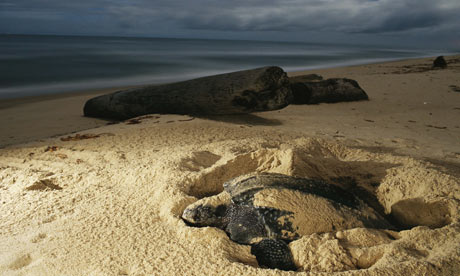
Last year, scientists were surprised to discover a large population of western lowland gorillas, a species close to extinction, in northern Congo Republic. Now there is news of another extraordinary find. In a multi-year survey of nesting sites along the coast of Gabon, scientists have found a startling number of leatherback turtles, possibly as many as 40,000, enough perhaps to remove leatherbacks from the list of globally endangered species. This is very good news, especially coupled with the fact that most of the nesting sites were discovered within protected areas.

In both cases, these new populations were located by conducting surveys in regions that had not been thoroughly combed before. Beyond relief, they remind us of what scientists felt in much earlier times, when explorers routinely chronicled the biological largess this world had to offer. Wonder was the predominant note in their chronicles, but there was also a keen eye for economic potential. Behind it all was the feeling of plenitude, that the biological riches of this planet were essentially inexhaustible, no matter what human beings did. That was clearly and tragically wrong.

Which brings us back to sea turtles and gorillas. We've grown accustomed to very different kinds of surveys, like the recent one showing that chimpanzee populations had dropped by 90 percent in Ivory Coast, which was supposed to be a stronghold for the species. In a very real sense, we are still exploring the planet, gradually obtaining a more realistic census of what life looks like in the early 21st century. Now and then there will be good surprises, like the fact that as many as 40,000 leatherbacks are nesting in Gabon. But the question those good surprises ultimately raise is a simple one: for how long?

An original article on the discovery of 40,000 leatherback turtles can be found at the guardian online