translate

Site update

Since I have been really terrible at updating the blog (but pretty good at keeping up with the facebook blog posts) I've added the widget below so that facebook cross posts to the blog.

You shouldn't need to join facebook but can just click on the links in the widget to access the articles. If you have any problems or comments please mail me at arandjel 'AT' eva.mpg.de.
Showing posts with label oil. Show all posts

Monday, November 29, 2010

Impact of seismic oil exploration on chimps, gorillas, elephants and other primates (Loango, Gabon)


The previous post on the oil exploration in the Virungas made me realize I never posted about Luisa Rabanal's (and colleagues) amazing paper on the impact of oil exploration in Loango National Park -MA

The impact of seismic oil exploration on rainforest wildlife
From Conservation Maven.com
by ROB GOLDSTEIN

A new study looks at the impact of seismic oil exploration on wildlife in Gabon's Loango National Park. Luisa Rabanal and fellow researchers found evidence that the loud noises generated by oil exploration activities can cause elephants to move large distances to escape the disturbance. The study findings also indicate that seismic activities can cause smaller scale disturbances for gorillas.

In threatened species like African forest elephants that have few offspring and mature slowly, disturbances that cause large scale shifts in spatial distribution may negatively affect the health of populations. According to the authors, this is the first study they know of to quantitatively assess the impact of noise from seismic activities on rainforest mammals.

Oil development activities in rainforests have raised a number of deep concerns about social and ecological impacts. During seismic oil exploration, dynamiting and other human activities can generate extremely loud noises - up to 210 decibels next to the explosion site or 10,000 times louder than a jet aircraft flying by at 300 m altitude.

The researchers surveyed elephants, gorillas, chimpanzees, duikers, and monkeys in Loango National Park over a 6-week period of dynamiting in 2007. They used modeling to detect impacts to wildlife distribution at large, intermediate, and small scales.

The researchers hypothesized that large wildlife like elephants, gorillas, and chimpanzees with expansive home ranges would experience large-scale disturbance. They also hypothesized that smaller wildlife like monkeys with limited ability to disperse large distances would experience small scale disturbance - i.e. dynamiting would just cause them to move short distances during the period of the activity.

While the study found large-scale impacts in elephants, they only found medium and small-scale effects in gorillas. The weaker than expected impacts on species distribution may have been due to the fact that the oil exploration activities were actually much less invasive then they could have been.

Environmental organizations commissioned by the Gabon government audited the activities to enforce certain agreed upon best practices to minimize disturbance to wildlife - for example, no chainsaws were permitted and dynamite had to be placed at least 6 meters deep. So seismic activities in other cases without rigorous environmental standards might cause much worse impacts.

The researchers also warn that seismic activity may cause other negative impacts to species unrelated to habitat use. They write,

"Our results may also suggest that the apes were even more disturbed by the explosions if they were unable to move larger distances and hence we stress the need for other methods of examining the seismic impact such as hormone and physiological measures. This also applies to certain species whose movements are restricted by their ranging patterns (e.g. duikers) where stronger responses may be exhibited through physiological mechanisms such as increased stress levels and/or reduced reproductive output"
---
Reference:
Rabanal L, Kuehl H, Mundry R, Robbins M, Boesch C (2010) Oil prospecting and its impact on large rainforest mammals in Loango National Park, Gabon Biological Conservation 143(4): 1017-1024 DOI: 10.1016/j.biocon.2010.01.017

Abstract
Resource extraction is increasingly affecting protected areas worldwide. However, aside from studies on logging, limited information is available about the effect this has on wildlife, which may be of great consequence, especially when endangered species could be affected. Specifically, the effect of intense human-induced noise during oil exploration on wildlife is poorly understood. We explore the effect of seismic oil exploration on large mammal distribution in an 80 km2 area of Loango National Park, Gabon. Following the ecological theory of habitat disturbance, we predicted that changes in habitat use in response to noise disturbance would scale with the body/home range size of each species examined. Our study was conducted over six months before, during and after low-impact seismic operations. We recorded counts along transects of indirect signs of elephants (Loxondota africana cyclotis), chimpanzees (Pan troglodytes troglodytes), gorillas (Gorilla gorilla gorilla), duikers (Cephalophus spp.), and the vocalizations of five monkey species (Cercocebus torquatus, Cercopithecus cephus, C. nictitans, C. pogonias and Lophocebus albigena) and modeled seismic impact over different spatial scales (small, intermediate and large). We found that elephants avoided seismic activity on all three spatial scales, apes avoided on the intermediate and small scales, and there was no effect for duikers and monkeys. We conclude that low-impact seismic operations can cause considerable temporary habitat loss for species with large ranges and suggest that the impact on those endangered species can be minimized by adequately spacing seismic lines and activity in space and time to enable species to move away from the progressive noise disruption.

Oil extraction may happen in/around Virungas

Oil extraction does not have to be a horribly invasive and destructive force if done properly. If managed properly (and if one wants to be as optimistic as possible) oil income could really boost up the standard of living around the park and within the country. On the more skeptical side, one must realize that it will probably happen no matter what, and that there are smart ways to extract oil and protect the park and its inhabitants (horizontal drilling comes to mind). The seismic surveys are already a bad sign that things are not being done as well as they could be (boo)...In any case, it will be interesting to see how it plays out, since its one of the only places where long-term conservation revenue might trump oil revenue...Thanks to Chrissie E for the link! -MA


UN urges Congo to ban oil drilling in gorilla park
From International Business Times

The United Nations' cultural arm UNESCO has appealed to Congolese President Joseph Kabila to guarantee there will be no oil exploration in the forest home of rare gorillas where two UK-listed firms hold drilling rights.

SOCO International and Dominion Petroleum were awarded a presidential decree to Block 5 of east Congo's Albertine Graben in June. Plans for a seismic survey include exploding dynamite, despite the fact that the rebel-heavy area overlaps with the protected Virunga National Park.

In a letter seen by Reuters, UNESCO chief Irina Bokova warned Kabila of "extremely damaging repercussions" of oil activity and asked him to ensure no exploration took place in the park, which is also home to chimpanzees, lions, elephants, and migratory birds so rare it has special wetland status.

"I call on you to guarantee that no oil exploration or production will be committed at the heart of the Virunga national park," she said in the letter dated August 6, which noted past commitments by Congo to protect the World Heritage site.

Local environmentalists argue that any exploration would be contrary to Congo's own laws.

"Congolese legislation does not authorise mineral and petrol production in national parks," said a November 15 letter seen by Reuters to Environment Minister Jose Endundo from the Congolese Institute for the Conservation of Nature (ICCN).

It noted SOCO's environmental impact assessment, required by law, made no reference to the park's status as a protected zone.

DONORS TO EXPRESS CONCERN
Separately, a World Bank official said it and other donors were planning to express concern to the government and question how oil development was compatible with Congo's commitments.

Calls to Kabila's office for comment went unanswered on Friday. However, Endundo played down the concerns.

"We'll do everything to preserve the park but the Congolese people also have to benefit from the riches under the soil," he told Reuters by telephone.

Endundo noted that if oil activities were excluded from the park, he might seek compensation along the lines of a pact signed by Ecuador in August, under which the Andean nation expects payments from rich nations in return for not drilling for oil in a wildlife reserve in the Yasuni National Park.

Operator SOCO, which has 38.25 percent of the block, and Dominion, with 46.75 percent, told Reuters in July they would start seismic exploration this year with a view to production after three years. Congo has the remaining share.

Company maps seen by Reuters indicate drilling will take place throughout the park and the companies have sent in teams.

"I don't see any problem if it's done correctly," Roger Cagle, deputy CEO and chief financial officer for SOCO told Reuters by telephone, adding its partner Dominion was already working in Uganda's Queen Elizabeth National Park.

"We've paid for the opportunity to explore a previously unexplored block; we're not expecting it to be a moving feast because it hasn't been sold to us as that," said Cagle, adding the company's presence could increase security of the park.

Thursday, July 22, 2010

unFUCK the Gulf

...Not sure if i buy the message (a bit of misinfo...) but LOVE the delivery-MA

Oil Spill Charity "F-Bomb-A-Thon" from UnF--kTheGulf.com on Vimeo.

For more info go to the Huffington Post or unf--kthegulf.com

Thanks to Olaf T for the link!

double post: dolphins mysteriously not being killed by oil but turtles are being hit hard on several fronts

from WWLTV
by KATIE MOORE


To the surprise of some of the Gulf's best marine scientists, marine mammals, like dolphins, appear to have been spared the effects of the oil.

In fact, no dolphins have been cleaned or rehabilitated in Louisiana, Mississippi or Alabama since the oil spill began. It's one of the scientific mysteries of the spill.

Sea turtles are needing rehabilitation in much greater numbers.

“Mississippi had no oil for a long period of time, and these animals were coming in and coming closer to the coast line,” said Executive Director of the Institute of Marine Mammal Research Moby Solangi.

Solangi's Gulfport facility has cleaned hundreds of turtles and is rehabbing even more that were indirectly impacted by the spill.

“These big guys came from the Chandeleur Islands. That's where they're dredging. There are net boats in front of the hopper dredges and they're creating the sand berms,” he said about two turtles weighing hundreds of pounds.

The Audubon Research Institute in Louisiana has cared for 143 turtles so far.

But what you don't see much of, in either place, are dolphins.

“We expected to have debilitated animals showing up on the shoreline, or being seen out having trouble in the water. We haven't really seen that,” said Audubon’s Lead Veterinarian, Dr. Robert MacLean.

So far, in Mississippi and Alabama, Solagi has only dealt with 16 dead dolphins, a number just slightly above normal.

“We had predicted earlier that there would be larger numbers, but we have not seen it,” he said.

Solangi also said animal autopsies, called necropsies, performed here haven't shown any deaths directly related to the oil. So far, only two dead dolphins have washed ashore in Louisiana.

“It's difficult to know whether they floated through it after they died, or if the oil affected them directly. We're still waiting on necropsy results,” MacLean said.

But they know the dolphins are out swimming in it. In fact, WWL-TV caught these on tape in Barataria Bay (See video above).

“Are the susceptible? Can crude oil harm them? Yes. I'm positive it can,” MacLean said.

But the experts also said the dolphins swimming in the crude don't appear to be in distress. However, they don't know two things: what the long-term impact will be for dolphins breathing the crude fumes and eating oil-exposed fish, and they don't know whether more are washing up undetected in Louisiana's marshes.

“Louisiana, it's difficult to know because we don't have a lot of shoreline. We have a lot of marsh. It's possible, not unlikely, that we're having more mortality than we can document,” MacLean said.

“We don't know how many people are looking for them either,” Solangi said.

So for now, it will remain a marine mystery.


---
From The Latin American Tribune

Dozens of Turtles Found Dead on Guatemala’s Southern Coast

GUATEMALA CITY – Guatemala’s National Council of Protected Areas, or CONAP, said Wednesday it found more than 30 dead sea turtles washed up on the country’s southern coast.

“This week alone, 30 dead turtles have been found mutilated and with signs of asphyxia on the beaches of Monterrico and Sipacate,” CONAP said in a statement.

The animals, which are dying because of fishermen’s incorrect use of Turtle Excluder Devices, become trapped in nets and suffocate, the organization said, adding that it also suspects that fishermen are using fish hooks in prohibited areas.

By law, fishing nets must be equipped with TEDs so that turtles who become ensnared are able to escape, the statement said.

CONAP’s wildlife director, Kurt Duchez, said his group has called a meeting to give fishermen and representatives of state institutions that enforce fishing laws training on the use of TEDs.

The appearance of dead turtles “is worrying” because the nesting season has just begun and efforts to protect sea turtles are already under threat, according to Jose Martinez, head of CONAP’s hydro-biological resources department.

According to CONAP, six sea turtle species nest in Guatemala and all are in danger of extinction due to poaching, over-harvesting of their eggs and pollution.

Tuesday, July 13, 2010

***updated with debunking links*** kiss your as goodbye: gulf oil spill may cause end of days

update (July 14th 2010):
Louwttjie dT sent me 2 great debunking links today so we can rest easy now, our precious lives will be saved and just the wildlife in the gulf will be eradicated - phewf! http://io9.com/5585294/methane-bubble-doomsday-story-debunked
This 2nd article though sorta reads as a coverup considering the greenpeace report below http://cgi.stanford.edu/group/wais/cgi-bin/?p=49815 so it makes me more nervous. I mean, greenpeace doesnt have much to gain my lying, the government on the other hand has much to lose...
Anyway, am happy the world probably won't be ocming to an end, just a pretty big portion of it-MA

original post:
The only good news is: "Most experts in the know, however, agree that if the world-changing event does occur it will happen suddenly and within the next 6 months." So if we make it to new year's 2011 we should be in the clear - if anyone has any more insight into this please post, would love for this to be some crock and unfounded in science [hopeful fear grimace]....The video below is from the Greenpeace Intl facebook page, who posted today " Greenpeace International Professional photographers and film teams are kept away from the shores..metal detectors are being used to make sure no photos are taken with cell phones...animal corpses are secretly taken away in the early morning...sick workers/volunteers need respirators. Riki Ott, Marine Toxicologist reports on the massive cover-ups to hide the Gulf disaster."-MA


Doomsday: How BP Gulf disaster may have triggered a 'world-killing' event
by TERRENCE AYM
from Helium.com

Ominous reports are leaking past the BP Gulf salvage operation news blackout that the disaster unfolding in the Gulf of Mexico may be about to reach biblical proportions. 251 million years ago a mammoth undersea methane bubble caused massive explosions, poisoned the atmosphere and destroyed more than 96 percent of all life on Earth. [1] Experts agree that what is known as the Permian extinction event was the greatest mass extinction event in the history of the world. [2] 55 million years later another methane bubble ruptured causing more mass extinctions during the Late Paleocene Thermal Maximum (LPTM). The LPTM lasted 100,000 years. [3] Those subterranean seas of methane virtually reshaped the planet when they explosively blew from deep beneath the waters of what is today called the Gulf of Mexico.

Now, worried scientists are increasingly concerned the same series of catastrophic events that led to worldwide death back then may be happening again-and no known technology can stop it. The bottom line: BP’s Deepwater Horizon drilling operation may have triggered an irreversible, cascading geological Apocalypse that will culminate with the first mass extinction of life on Earth in many millions of years. The oil giant drilled down miles into a geologically unstable region and may have set the stage for the eventual premature release of a methane mega-bubble.

Ryskin’s methane extinction theory
Northwestern University's Gregory Ryskin, a bio-chemical engineer, has a theory: The oceans periodically produce massive eruptions of explosive methane gas. He has documented the scientific evidence that such an event was directly responsible for the mass extinctions that occurred 55 million years ago. [4]

Many geologists concur: "The consequences of a methane-driven oceanic eruption for marine and terrestrial life are likely to be catastrophic. Figuratively speaking, the erupting region "boils over," ejecting a large amount of methane and other gases (e.g., CO2, H2S) into the atmosphere, and flooding large areas of land. Whereas pure methane is lighter than air, methane loaded with water droplets is much heavier, and thus spreads over the land, mixing with air in the process (and losing water as rain). The air-methane mixture is explosive at methane concentrations between 5% and 15%; as such mixtures form in different locations near the ground and are ignited by lightning, explosions and conflagrations destroy most of the terrestrial life, and also produce great amounts of smoke and of carbon dioxide..." [5]

The warning signs of an impending planetary catastrophe—of such great magnitude that the human mind has difficulty grasping it-would be the appearance of large fissures or rifts splitting open the ocean floor, a rise in the elevation of the seabed, and the massive venting of methane and other gases into the surrounding water. Such occurrences can lead to the rupture of the methane bubble containment—it can then permit the methane to breach the subterranean depths and undergo an explosive decompression as it catapults into the Gulf waters. [6] All three warning signs are documented to be occurring in the Gulf.

Ground zero: The Gulf Coast
The people and property located on the greater expanse of the Gulf Coast are sitting at Ground Zero. They will be the first exposed to poisonous, cancer causing chemical gases. They will be the ones that initially experience the full fury of a methane bubble exploding from the ruptured seabed.

The media has been kept away from the emergency salvage measures being taken to forestall the biggest catastrophe in human history. The federal government has warned them away from the epicenter of operations with the threat of a $40,000 fine for each infraction and the possibility of felony arrests. Why is the press being kept away? Word is that the disaster is escalating.

Cracks and bulges
Methane is now streaming through the porous, rocky seabed at an accelerated rate and gushing from the borehole of the first relief well. The EPA is on record that Rig #1 is releasing methane, benzene, hydrogen sulfide and other toxic gases. Workers there now wear advanced protection including state-of-the-art, military-issued gas masks. Reports, filtering through from oceanologists and salvage workers in the region, state that the upper level strata of the ocean floor is succumbing to greater and greater pressure. That pressure is causing a huge expanse of the seabed-estimated by some as spreading over thousands of square miles surrounding the BP wellhead-to bulge. Some claim the seabed in the region has risen an astounding 30 feet. The fractured BP wellhead, site of the former Deepwater Horizon, has become the epicenter of frenetic attempts to quell the monstrous flow of methane.

The subterranean methane is pressurized at 100,000 pounds psi. According to Matt Simmons, an oil industry expert, the methane pressure at the wellhead has now skyrocketed to a terrifying 40,000 pounds psi. Another well-respected expert, Dr. John Kessler of Texas A&M University has calculated that the ruptured well is spewing 60 percent oil and 40 percent methane. The normal methane amount that escapes from a compromised well is about 5 percent.

More evidence? A huge gash on the ocean floor—like a ragged wound hundreds of feet long—has been reported by the NOAA research ship, Thomas Jefferson. Before the curtain of the government enforced news blackout again descended abruptly, scientists aboard the ship voiced their concerns that the widening rift may go down miles into the earth. That gash too is hemorrhaging oil and methane. It’s 10 miles away from the BP epicenter. Other, new fissures, have been spotted as far as 30 miles distant.

Measurements of the multiple oil plumes now appearing miles from the wellhead indicate that as much as a total of 124,000 barrels of oil are erupting into the Gulf waters daily-that’s about 5,208,000 gallons of oil per day.

Most disturbing of all: Methane levels in the water are now calculated as being almost one million times higher than normal. [7]

Mass death on the water

If the methane bubble—a bubble that could be as big as 20 miles wide—erupts with titanic force from the seabed into the Gulf, every ship, drilling rig and structure within the region of the bubble will immediately sink. All the workers, engineers, Coast Guard personnel and marine biologists participating in the salvage operation will die instantly.

Next, the ocean bottom will collapse, instantaneously displacing up to a trillion cubic feet of water or more and creating a towering supersonic tsunami annihilating everything along the coast and well inland. Like a thermonuclear blast, a high pressure atmospheric wave could precede the tidal wave flattening everything in its path before the water arrives.

When the roaring tsunami does arrive it will scrub away all that is left.

A chemical cocktail of poisons
Some environmentalist experts are calling what’s pouring into the land, sea and air from the seabed breach ’a chemical cocktail of poisons.’ Areas of dead zones devoid of oxygen are driving species of fish into foreign waters, killing plankton and other tiny sea life that are the foundation for the entire food chain, and polluting the air with cancer-causing chemicals and poisonous rainfalls.

A report from one observer in South Carolina documents oily residue left behind after a recent thunderstorm. And before the news blackout fully descended the EPA released data that benzene levels in New Orleans had rocketed to 3,000 parts per billion. Benzene is extremely toxic and even short term exposure can cause agonizing death from cancerous lesions years later. The people of Louisiana have been exposed for more than two months—and the benzene levels may be much higher now. The EPA measurement was taken in early May. [8]

Doomsday
While some say it can’t happen because the bulk of the methane is frozen into crystalline form, others point out that the underground methane sea is gradually melting from the nearby surging oil that’s estimated to be as hot as 500 degrees Fahrenheit.

Most experts in the know, however, agree that if the world-changing event does occur it will happen suddenly and within the next 6 months.

So, if events go against Mankind and the bubble bursts in the coming months, Gregory Ryskin may become one of the most famous people in the world. Of course, he won't have long to enjoy his new found fame because very shortly after the methane eruption civilization will collapse.

Perhaps if humanity is very, very lucky, some may find a way to avoid the mass extinction that follows and carry on the human race.

Perhaps.
…………

Sources

Links

Thanks to Carol R for the link!

Monday, July 12, 2010

How to help with the oil spill from home.

From NOW Magazine
I’m at a loss as to how to help with the BP oil spill when I live nowhere near it. What are we supposed to do?

Q: I’m at a loss as to how to help with the BP oil spill when I live nowhere near it. What are we supposed to do?

A: Twelve weeks into watching the Gulf of Mexico drown in oil, millions of North Americans have started flipping the channel. Why? Disaster fatigue.

Most people are at a loss as to how to get involved and be part of the solution (outside of packing bags and heading to the Gulf). After all, if the most powerful government in the world and a multi-billion-dollar corporation can’t figure out how to fix things, how are we supposed to?

Think outside the well.

Turns out you can help wash the sticky stuff off struggling birds without physically going there.

Adopt your own pelican or heron through the International Bird Rescue Research Center, which has rescued birds at more than 150 oil spills and whose executive director has been named one of Oceana’s Ocean Heroes of the Year. You’ll get an adoption certificate with the band number of your bird and the place and date of its release (ibrrc.org/adopt_a_bird.html). Up your donation by giving adopted birds as b-day gifts.

Of course, every org involved in the cleanup welcomes a generous donation. But instead of simply sending $20, consider organizing a creative fundraiser at work/summer school/your local community centre – anything from an organic bake sale to a dance-athon to an inventive pledge drive. (One York student just emailed me wanting to start a living-plastic-free pledge.) Just make sure you’re sending collected money to a reputable org, since disasters trigger a tsunami of scammers.

You could also ask guests coming to your backyard BBQ/family reunion/wedding to bring a donated item from the wish list of a wildlife org. In the case of Suncoast Seabird Sanctuary, for instance, that could be laundry detergent, dish soap, heating pads with auto shut-off, bath towels, stainless steel scrubbing pads or rain ponchos. The National Wildlife Federation wants old digital cameras, clipboards, pens, bug repellent, gas gift cards, even GPS units – all for their wildlife surveillance teams.

Collecting your beard trimmings and mailing them off to be made into booms might not do all that much for the cause, but convincing your hair salon to join the collection drive will certainly boost volume.

True, hair booms were rejected by Unified Area Command for the Deepwater Horizon/BP response for being considerably less effective than sorbent booms, but hair mats (laced with mushroom spores) are still super-useful at sopping up oil that hits the coast (matteroftrust.org/programs/hairmatsinfo.html).

Try being an armchair lobbyist. Honestly, the National Audubon Society isn’t just asking for physical volunteers; it’s calling on the public to call and email officials about freezing expansion of offshore drilling on the American east coast.

Why stop at the border?

WWF Canada says Canada’s regulatory framework is even weaker than the U.S.’s, making a spill here “almost inevitable.” The org adds that extreme conditions in the Beaufort Sea would limit the ability of emergency responders to tackle a spill in ice-covered waters. Send a letter to the PM, the federal Natural Resources minister and the head of the National Energy Board calling for tougher safeguards for drilling in the Arctic (wwf.ca/conservation/oceans/oil_spill_petition.cfm).

And tell them to wake up to the risks of letting Chevron drill the deepest offshore oil well Canada has ever seen off Newfoundland without first establishing safeguards to prevent a BP sequel. They should stop upselling the tar sands as a greener option than offshore drilling, too. We want real clean energy.

Finally, skim off some oiliness from your everyday life. Obvious enough when it comes to choosing cycling and subways over gas-powered transport, but can you get through the rest of your week without buying a single item of plastic (from electronics cases to dental floss)? Can you steer clear of petrochemicals altogether? That means no synthetic fabrics, no synthetic fragrances, no foods grown with synthetic fertilizers, no synthetic shampoos.

Try it for a day and you’ll see how intricately linked our daily lives are with BP, Exxon Mobil and every other oil driller on the planet.

Their by-products are impossible to entirely avoid unless you’re a Quaker, but reaching for plastic- and petrol-free options is an honest start.

Sunday, June 27, 2010

AT LEAST 783 birds, 355 sea turtles and 41 mammals dead due to oil spill so far. Others displaying odd behaviours...

Sometimes I fell so powerless against issues like this oil spill in the gulf that I can't really read too much about it which is why I haven't been posting all that much on the subject. It's just such a tragedy. Even if you aren't an "animal lover" or "tree hugger" you have to find the fact that these animals are behaving so oddly tragic and heartbreaking. -MA

From examiner.com via the SeaTurtle.org facebook page

Dolphins and other aquatic life are coming to shorelines to escape spill
by TAMMY ROSE

Dolphins and sharks are appearing in large numbers in the shallow waters of Florida beaches. Crabs Stingrays, and fish have shown up by the thousands along the Alabama Pier. Marine scientists believe this strange behavior is caused by the aquatic life seeking refuge from the danger of the BP oil spill.

Marine scientists studying the effects of the BP disaster are seeing some strange phenomena.

Scientists believe the wildlife is fleeing oil infested water and searching out cleaner waters along the coast. Their gathering in shallow shore waters is proof that their natural habitat is polluted. However their congregating in shallow water could result in mass deaths as they run out of oxygen.

Marine life is just beginning to display odd behavior as they struggle against a nemesis that they cannot understand or defeat. As each day passes scientists are finding dead birds, sea turtles and other marine life in heartbreaking numbers. The latest numbers are: 783 birds, 355 sea turtles and 41 mammals. However, because of the size of the spill they are only finding a small portion of the dead animals out there. For instance many birds are taking refuge deep in the Louisiana marshes seeking shelter from the spill and die there.

As for the fish, researchers are still trying to determine where exactly they are migrating to understand the full scope of the disaster, and no scientific consensus has emerged about the trend. It is difficult to tally up the fish deaths as often they are eaten by larger predators.

Fish are gathering along shores in massive groups because their natural waters are tainted with oil and being depleted of oxygen. Sadly their instincts for survival could prove to be deadly as more oil washes ashore and overwhelms the fish. By moving to the shoreline they have literally trapped themselves. As more life comes to the shorelines the more competition for oxygen. Sadly in the end their instinct to survive may bring about their deaths.

Thursday, June 24, 2010

When boycotts work and when they don't at all. The best article I've read about the BP oil spill.


This is the greatest article I have read on the oil spill. Boycotting BP is useless, all big oil is bad for our environment, but worse still is all our independent dependencies on oil. Big oil is supplying to our demand. Let's first turn to ourselves (and acknowledge that when we fly across the world for conferences, workshops, etc, that we too are also contributing to the problem, never mind what we do in our daily lives) and then turn to our governments to mandate that the environment and our future existence should be prioritized. Until then, blaming specific oil companies is an exercise in hypocrisy. -MA

From Newsweek.com via the Newsweek facebook page
Boycott BP!

Because it’s much better to give your money to Exxon.

Go ahead, boycott BP. Not only do you get to send a message to the company that has proved incapable of stopping the undersea gusher unleashed on April 20, but (unless you live in a one-gas-station town) you can do it without much pain to yourself.

Drive right on by the BP station and pull up to the pumps from Exxon, the company responsible for the Exxon Valdez oil spill of 1989 and, more recently, one of the biggest corporate funders of the movement to tar the science of climate change. Exxon also managed to reduce the $5 billion in punitive damages awarded by an Anchorage jury for the Valdez disaster to $507.5 million; the Valdez fishermen and other victims have still not been made whole. (Fun fact: to protect itself in case the original judgment was affirmed, Exxon got a line of credit from JP Morgan, which the bank then parlayed into the first credit default swap, as recounted in the 2009 book Fool’s Gold by Gillian Tett. These are the exotic financial instruments that helped trigger the Great Recession of 2008–09.)

Or roll into the Texaco or Chevron station (Chevron bought Texaco in 2001). Texaco is being sued by people in Ecuador for contaminating their groundwater, causing hundreds of residents to develop fatal cancers and causing other environmental damage near the Lago Agrio oilfield, where Texaco dumped oil-production waste (18.5 billion gallons into open, unlined pits) for almost 20 years. (For those of you moved by First Amendment issues, Chevron has also gone to court to force filmmaker Joe Berlinger to turn over more than 600 hours of outtake footage he shot for his documentary on the case, titled Crude.) Chevron counters that dumping sludge was standard operating procedure at the time.

Or roll up to the Citgo pumps. Citgo is a wholly owned subsidiary of the state oil company of Venezuela, which is ruled by the always-entertaining (except to political opponents he has silenced) Hugo Chávez. A 2009 fire at Citgo’s refinery in Corpus Christi, Texas, sent toxic fumes into nearby neighborhoods for two days.

Uncomfortable giving your money to a petrodictator? There’s a Shell station up ahead. Too bad Shell has been accused of human-rights violations in Nigeria, through its collaboration with the country’s former military rulers who executed activist Ken Saro-Wiwa and eight others in 1995, committed crimes against humanity, and tortured opponents. (Shell settled the case for $15.5 million last year.) Shell has also been accused of despoiling the Niger Delta through its oil operations there: a ruptured oil pipeline that killed 100 people in 2008; polluted drinking wells; fields and farmland poisoned by leaked oil.

In other words, pick which malefactor or criminal—environmental or human—you’d like to support when you gas up. And the list above doesn’t even include the fact that what the oil companies sell is one of the major contributors to catastrophic climate change. So unless your boycott of BP extends to all oil companies—oh, and throw in coal companies and natural-gas utilities—you get points for symbolism and self-righteousness but not much else.

It’s understandable that consumers are furious and frustrated by the gulf catastrophe and want to punish those responsible. Protesters have shown up at BP stations in Europe and the United States, and Facebook’s Boycott BP group has 431,000 fans as of this morning. Demonstrators wield banners proclaiming, “We won’t pay for BP’s mess. Take it from your bonus chest.” But to find the ultimate culprits, look in the mirror.

BP and the 32 other operators of deepwater wells in the gulf are there not because they find it technologically interesting to see how deep they can drill, or because their roustabouts like the view from the rigs. They’re drilling because of America’s—and the world’s—insatiable lust for oil. The U.S. consumes 800 million gallons of petroleum per week, according to the Energy Information Agency. The only way to make this the last oil spill in the gulf is to make oil obsolete. Shall we all hop on our bicycles, charge our plug-in hybrids with wind-generated electricity, swap out the heating oil or natural gas warming our homes for geothermal wells and passive solar?

Didn’t think so.

Just as buying green products is better for our eco-esteem than it is an effective way to save the planet, so consumer boycotts of the latest oil company to run afoul of public opinion are emotionally satisfying but ultimately futile. To be sure, there have been some great, and effective, consumer boycotts in the past, and you don’t even have to go back to the American colonists’ refusal to buy British goods as a protest against taxation without representation to find examples. The 1955 Montgomery, Ala., bus boycott ignited the modern civil-rights movement. The 1965–70 consumer boycott of California grapes to show solidarity with Cesar Chavez’s farmworkers brought the growers to their knees, forcing them to recognize Chavez’s union and sign a contract with it guaranteeing workers’ rights. The consumer boycott of canned tuna in the 1980s led the industry to adopt dolphin-safe fishing.

For a boycott to achieve its aims, there has to be a clear issue. “Don’t kill dolphins when you catch what I need for my tuna sandwich” is specific and clear; “don’t despoil the environment when you get what I need to drive” isn’t. (See Ecuador and Nigeria examples above.) A boycott must also give consumers alternatives; you can eat strawberries instead of grapes, but trading in your gasoline-powered car for a Tesla or Volt or other electric isn’t nearly so simple. And a boycott must be organized so that violations are visible. Co-workers could see if you brought grapes for lunch, and anyone in Montgomery could see if you were riding the bus. Unless someone figures out how to make gasoline bought from BP produce exhaust that forms a big “BP” when it spews out your tailpipe, no one knows where you gassed up.

All of the above likely explains why BP station owners—for it is they, not the corporation, who own stations—say the boycott has had no noticeable effect.

It’s out of fashion to point out that the solution to the problem of oil harming the environment has to come from the government. Yes, the Minerals Management Service did not exactly cover itself with glory in requiring oil companies to have workable plans in case of an accident in the gulf. The culture of corruption at the MMS—letting oil companies write their own environmental-impact statements, accepting expensive gifts, sleeping with company officials—didn’t help. But just because government did not prevent the Deepwater Horizon disaster does not mean we can give up on government policies to avert future ones. Only by weaning ourselves off oil and other fossil fuels do we have a prayer of preventing future oil spills and all the other environmental calamities of petroleum production and use.

President Obama has seized on that argument to call for Senate passage of the energy and climate bill introduced by Sens. John Kerry and Joe Lieberman. Like the climate bill passed by the House last year, this version would put a price on the greenhouse-gas pollution from oil and other fossil fuels, which would more accurately reflect their true costs and spur people to adopt alternatives. The bills also provide support for developing cleaner alternatives, including nuclear. In an ironic sop to Republicans more concerned about the country’s dependence on foreign oil than about climate change, the Senate bill still calls for more offshore oil-and-gas drilling. Which shows just how hard it is to wean ourselves off, let alone boycott, the stuff that powers society.

Monday, June 21, 2010

Using doggie poop to light park lamps

This is fabulous - I have had this big moral dilemma recently about picking up my dog's poop when he poops somewhere where there is no risk of anyone stepping in it: like in the bushes on the side of a street. It smells so i should pick it up, right? but even if i use biodegradable bags, I generally throw these in the trash at the first garbage can i see, so really im just filling landfills with dog poop that is totally biodegradable. This seems like a GREAT solution to me! Only problem i see is how to make people not throw other stuff in there or just poop directly into it, cuz folks can be nutty like that- MA

from TreeHugger.com via the Tree Hugger facebook page
New Design Turns Dog Poop into Gold- Well, Methane.
by ALEX DAVIES

Scenario A: You're in the park walking your dog. He sniffs around, finds the perfect spot, squats and poops. You, being the responsible owner, break out the biodegradable plastic bag you brought and pick it up, then throw the bag in the nearest trash can.

Scenario B: You're in the park walking your dog. He sniffs around, finds the perfect spot, squats and poops. You, being the responsible owner, break out the biodegradable plastic bag you brought and pick it up, and throw it the Park Spark Methane Digester. The methane in Fido's poop is then piped to another location, where it is burned for energy to light the lamps in the very park your dog just pooped in.

The Park Spark is the brainchild of Matthew Mazzotta, the creator of the TreeHugger approved Buscyle. The idea of the human and animal waste digester is hardly new, but Mazzotta's design takes it to an interesting new place, seeking to make it part of our everyday lives, not just a love of Ed Begley Jr.'s. Digesters work using the natural process of anaerobic decomposition. Organic matter sealed in an air-tight container produces methane, which can then be separated from the rest of the matter and used as fuel.

The goal of the Park Spark is to make people rethink the idea of waste- epitomized by bags of dog poop- by turning it into something useful. Mazzotta imagines that upon installation, the methane produced by the Park Spark will burn as a sort of "eternal flame" for everyone to see. The idea is that once everyone sees the energy that comes from dog waste, someone will be bound to propose a more practical use for it.

It's an idea that's a bit of a long shot to catch on nationally or internationally, but that's not saying we're pessimistic. Even one Park Spark will go a long way towards changing common perceptions of waste and energy, which is a great start.

Monday, June 14, 2010

The majority of rehabilitated oiled birds survive. 1% survival rate debunked.

From the International Bird Rescue Research Center via the Association of Zoos and Aquariums facebook page
by JAY HOLCOMB, IBRRC's Executive Director:

Hi everyone. We are very busy here in Louisiana at the gulf oil spill, but doing well. We are washing the very oiled pelicans and other birds that you have seen on TV and most of them are doing very well. More on that aspect of our work later. I want to address a few issues that have come up in the media recently. First of all, let me say that this is the time during an oil spill that the skeptics come out. These “experts” are quoted and their opinions, no matter how ill researched or biased they are, become controversial and newsworthy. I spent much time during the Exxon Valdez oil spill, 21 years ago, and in every other oil spill since then addressing them and I now just consider this a part of the politics of an oil spill.

For those who are concerned about the survival rates of oiled birds, based on recent news coverage (or the outdated studies they cite), I’d like to address the topic head-on. I am writing from personal experience, as a veteran of more than 200 oil spills, and as a representative of one of the foremost oiled bird rescue and research organizations in the world. IBRRC and Tri-State Bird Rescue--who is leading the Gulf response effort--host a bi-annual conference on the Effects of Oil on Wildlife, and, as such, are well versed in the latest science. The “experts” that I am referring to rarely, if ever, attend this global forum for oiled wildlife professionals, nor do they attempt to learn about advancements and successes in oiled wildlife rehabilitation.

How well do birds survive in the wild when they have been oiled and rehabilitated?

Recent studies (a few of which are listed below) indicate that birds can be successfully rehabilitated and returned to the wild, where many survive for years and breed.

The papers cited by opponents of oiled bird rehabilitation—like Oregon’s biologist Brian Sharp’s infamous 1996 report "Post Release Survival of Oiled, Cleaned Seabirds in North America" Ibis. Vol. 138:222-228—tend to rely on anecdotal band returns (meaning there is no daily tracking method for individuals released and no control groups observed.) These surveys are misleading because they fail to consider some important variables: the protocols used to care for the birds in question, the experience of the organization caring for the oiled birds and basic things like how the bird’s health and water proofing were assessed prior to release.

Simply put, one would not lump together the survival rates of human patients receiving emergency trauma care between two hospitals like Mogadishu's Madina Hospital and New York's Bellevue Hospital. Yet surveys like Sharp's do just that, they lump together released birds treated at various centers, under different conditions, with different resources and experience levels.

Studies support oiled, properly treated sea birds

A growing number of studies using radio telemetry, satellite tracking and long-term breeding colony observations are more accurately illustrating the post oiling survival of sea birds:

Wolfaardt, A.C. and D.C. Nel. 2003, Breeding Productivity and Annual cycle of Rehabilitated African Penguin Following Oiling. Rehabilitation of oiled African Penguins: A Conservation Success Story.

Newman, S.H., Golightly, R.T., H.R. Carter, E.N. Craig, and J.K. Mazet 2001, Post-Release Survival of Common Murres (Uria aalge) Following the Stuyvesant Oil Spill.

Golightly. R.T., S.H. Newman, E.N. Craig, H.R. Carter and J.K. Mazet. 2002, Survival and Behavior of Western Gulls Following Exposure to Oil and Rehabilitation.

Anderson, D.W., F. Gress, and D.M. Fry 1996, Survival and dispersal of oiled Brown Pelicans after rehabilitation and release.

These studies indicate that many seabirds do survive the oiling and rehabilitation process successfully returning to their wild condition. And in some cases (when birds are located and observed in breeding colonies) have been shown to breed successfully for many years following their oiling, rehabilitation and release. These studies show that a bird’s survival is often based on how a specific species can cope with the stress of the entire process from oiling to rehabilitation, and that their overall survivorship across species is far greater than Sharp’s assertions. As survivorship may be correlated to individual species it is irresponsible to draw conclusions of survivability from one species to another, rather, in depth studies must be conducted for each species considered if we are to begin to answer this question with any measure of reliability.

Pelicans handle stress better than most birds

In regards to pelicans specifically, IBRRC works year-round with brown pelicans at our two rescue centers in California, treating, on average, 500 injured, sick and oiled pelicans every year. Our release rate on these animals is 80% or higher for general rehabilitation. Pelicans, like penguins, can tolerate the stress of rehabilitation much better than birds like loons and murres for example. All of our birds (including pelicans) are federally tagged upon release. Sightings and band recoveries indicate that a high percentage of them survive. One recent example was a brown pelican, oiled and rehabilitated, during the American Trader spill in 1990 in Southern California. This bird was sighted still alive in Newport Beach earlier this year, 20 years on, and is considered one of the oldest brown pelicans ever recorded.

While this is just one bird it is a good example of the type of band returns we see from oiled and non-oiled pelicans. Of course it’s important to also remember that it is these individual birds that make up populations. At the ‘New Carissa’ oil spill in Oregon in 1999, the snowy plover population in Coos Bay was 30-45 birds. We captured 31 and rehabilitated all of them. They are an intensely studied bird and each one is considered valuable to the species. Studies of the birds showed that there was no difference in the mortality of these previously oiled birds to those never oiled.

What gives IBRRC, and Tri-State Bird Rescue, the best chance to make a difference to threatened species during oil spills is the year-round dedication to saving individual lives that has been at the heart of our mission for nearly 40 years. This approach has helped us to develop teams of trained animal care and oiled wildlife professionals that understand the intricacies of this specific field of rehabilitation and continually strive to improve our techniques as well as build a more comprehensive scientific picture of our work over time.

Saturday, June 12, 2010

Space Solar Power


From disinfo.com
Buzz Aldrin’s Answer To The Louisiana Oil Spill
HOWARD BLOOM, one of the stars of the Disinformation TV Series, sent us this press release:

Buzz Aldrin, the second man to set foot on the moon, has proposed an answer to the Louisiana oil spill. It’s solar energy harvested in space, known in the space community as Space Solar Power.

“The timing of the oil catastrophe,” says Aldrin, “is a great opportunity for re-evaluating solar energy from space.”

We’ve been harvesting solar power in space and sending it to Earth since 1962, when the first commercial satellite, Telstar, was launched and began transmitting energy harvested by the solar panels studded all over its beach-ball-like surface. Today, the space solar power harvesting business is a quarter of a trillion dollar industry. We call it “the commercial satellite industry.” That industry uses space solar power transmitted to earth for everything from satellite radio and television to direction finding via GPS.

The Japanese space agency, JAXA, has committed $27 million to space solar power and has plans for a satellite capable of powering 300,000 homes. JAXA says it has the backing of 15 other nations in its effort. And Russia, China, and India are all working on space solar power development.

Says Howard Bloom, head of The Space Development Steering Committee, “Space solar power means no more Louisiana oil spills. No more carbon in the atmosphere. No more nuclear waste. No more energy wars. No more nations hogging resources and driving up prices. And no more villages in the hinterlands of Africa and Asia kept in poverty by the cost of running landlines hundreds of miles to reach them.”

There are currently four American commercial companies seeking capital to make space solar a reality: Solaren, the Space Island Group, Space Energy Inc, and Managed Energy Technologies LLC. One of those firms, Solaren, has a power purchase agreement with the California’s Pacific Gas and Electric and anticipates being able to begin delivery of solar power from space by 2016.

Take the load off the earth. Drill up not down. Space Solar Power.

Thanks to Jen F for the link!

Saturday, May 22, 2010

Seriously disturbing - Live camera of Gulf oil "spill"


You are watching a live video feed of the BP Oil Spill from the Gulf of Mexico floor, 5000 feet below the surface of the water from WKRG.com

Sunday, May 16, 2010

Visiting Africa’s Eden By Nicholas D. Kristof


Below is Nicholas D. Kristof's latest op-ed piece while he is visting the Gamba Complex in Gabon (which includes Loango National Park).
“The parks are for foreigners, or for rich Gabonese,” she said. “They’re not for ordinary people like me.”
- village chief, Evelyne Kinga
I wonder more and more if eco-tourism is the answer. I can't see how it would change this attitude (which I also heard echoed in Cote d'Ivoire) and is bringing these wild animals into contact with humans (and human development) across their entire range, in all national parks, what we really want for our last untouched spaces? In this sense, carbon credits make so much more sense to me, especially in light of the fact that
"Gabon set aside the parks partly in hopes of diversifying its economy ...and becoming an African version of Costa Rica, bringing in revenue from tourism. But so far the economic bet isn’t paying off."
Nevertheless, the Gabonese government , along with Mike Fay and Lee White, have my utmost respect for their commitment to protected areas, for setting up the amazing National Park system across Gabon and for protecting our wild spaces even though harvesting them could bring them short term economic gains - MA

From the NYTimes.com
Visiting Africa’s Eden
By NICHOLAS D. KRISTOF
GAMBA, Gabon

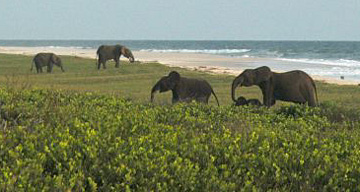
The moment I fell in love with Gabon was when my companions and I walked along the beach at sunset: an endless strip of white sand with no one in sight as far as the eye could see in any direction. Then we spotted movement, and we realized we were sharing the beach after all.

With three elephants.

The elephants had an animated conversation among themselves, presumably about the rare sighting of human beings, then ambled off into the rain forest to tell their friends.

This is my annual win-a-trip journey, in which I take a university student with me on a reporting trip to Africa. The winner this year is Mitch Smith, a University of Nebraska student who had never been outside the United States before. (He is writing about his trip on my blog, nytimes.com/ontheground).

Readers have sometimes complained that my win-a-trip journeys focus on the wretchedness of the developing world — warlords, malnourished children, maternal mortality. Frankly, I’ve always thought these critics had a point. So Mitch and I are starting this trip by covering an African triumph: Gabon’s bold steps to preserve its natural heritage.

Gabon has plenty of problems, including corruption and misspent oil revenues, but it is also covered by dense, uninhabited forest teeming with wildlife. In 2002, the government set aside more than one-tenth of the country for national parks — in one step, making Gabon a leader in wildlife conservation.

“Gabon is definitely a special place,” said Sebastiaan Verhage, an official here with the World Wildlife Fund, which is helping Gabon preserve its parks. “Where else do you see elephants roaming on the beach, buffalo on the beach, hippos in the surf, humpback whales mating just off the coast, the most important leatherback turtle nesting site in the world, one of the few last refuges for lowland gorillas? Its name of ‘the last Eden,’ ‘the last paradise on earth’ — that’s not too far-fetched.”

The head of the national parks is Lee White, a conservation specialist of Scottish origin. And the technical director is an American, Michael Fay, who famously walked across Gabon in 2000.

President Ali Ben Bongo, who took over last year from his late father, seems enthusiastic about developing a “Green Gabon.” He told me he would like to deepen the environmental protections and build up infrastructure so that Gabon can become an eco-tourism destination.

For now, that’s a problem. Gabon set aside the parks partly in hopes of diversifying its economy (it is dependent on oil, which is slowly running out) and becoming an African version of Costa Rica, bringing in revenue from tourism. But so far the economic bet isn’t paying off.

Very few foreign tourists are coming, because of the distance and the lack of modern hotels. Mitch and I ate lunch at one of the restaurants aiming for tourists, and afterward saw the staff cleaning our plates in the lagoon.

What’s more, thick forest isn’t great terrain to spot wildlife. On one walk along an elephant trail, Mitch and I smelled elephants all around us but never actually spotted them. (Elephants here normally are curious but shy — unless they’ve been nibbling on a root prized among local humans for its hallucinogenic properties, in which case be sure to accord them right of way).

Still, following elephant footprints through an untouched forest is magical. Here in the rain forest, humans seem less the masters of the ecosystem than components of it, along with others. Like gorillas.

I ran into Chloe Cipolletta, a gorilla expert I had met in the Central African Republic in 2006 on my first win-a-trip journey. Ms. Cipolletta was advising on a plan to bring tourists to visit gorillas in Gabon, and she mentioned offhand that some primates self-medicate herbally.

Development experts have been raving in recent years about the health benefits of deworming people in poor countries — but gorillas are way ahead of us. There is a furry forest plant that gorillas occasionally eat, despite evident distaste, making faces and spitting bits of it out. So why do they eat it? Ms. Cipolletta said the plant turns out to be a natural medication that kills intestinal parasites, and the gorillas are deworming themselves.

One sobering truth is that the people who gush about gorillas or elephants usually are Americans and Europeans. For local people, many of them very poor despite the country’s oil wealth, conservation can be an inconvenience. While visiting Loango, we encountered an outspoken young village chief, Evelyne Kinga, who protested that she’d rather elephants were dead than eating her cassava plants.

“The parks are for foreigners, or for rich Gabonese,” she said. “They’re not for ordinary people like me.”

That’s a real tension, and I don’t know whether Gabon can pull this off and monetize its spectacular forest the way it could monetize timber. But for the world’s sake, I’m hoping that it will.
