from news.com.au
AN Indonesian civil servant who declared himself an atheist on Facebook was arrested and is now facing jail for blasphemy after being attacked by an angry mob, police said today.
Alexander An, 30, who wrote "God doesn't exist" on his Facebook page, was beaten by a mob of dozens on Wednesday in his hometown in Pulau Punjung, West Sumatra province.
"He is suspected of having blasphemed against Islam," local police chief Chairul Aziz told AFP.
"The man told police investigators that if God really exists and has absolute power, why didn't he prevent bad things from happening in this world."
An said on his Facebook page that he was brought up as a Muslim, like the vast majority in Indonesia, where blasphemy is a punishable crime carrying a maximum five-year prison term.
Dozens of locals stormed into his office after a heated debate with them on Facebook over religion, police said.
An was also an administrator of a Facebook group promoting atheism with 1243 followers. His postings no longer appeared online following his arrest.
Showing posts with label asia. Show all posts
Showing posts with label asia. Show all posts
Friday, March 16, 2012
Wednesday, January 11, 2012
Camera Traps FTW: first photographs of the recently discovered Myanmar snub-nosed monkey.
 Myanmar snub-nosed monkey with infants. Credit: FFI/BANCA/PRCF
From PhysOrg
Announced today in Yangon, Myanmar, a joint team from Fauna & Flora International (FFI), Biodiversity And Nature Conservation Association (BANCA) and People Resourhttp://www.blogger.com/img/blank.gifces and Conservation Foundation (PRCF), caught pictures of the monkey on camera traps placed in the high, forested mountains of Kachin state, bordering China.
“The Myanmar snub-nosed monkey was described scientifically in 2010 from a dead specimen collected from a local hunter,” said Frank Momberg of FFI, who organised the initial expeditions that led to the monkey’s discovery. “As yet, no scientist has seen a live individual,” he added.
“These images are the first record of the animal in its natural habitat,” said Ngwe Lwin, the Burmese national who first recognized the monkey as a possible new species. “It is great to finally have photographs because they show us something about how and where it actually lives,” he added.
Heavy snows in January and constant rain in April made expeditions to set the camera traps difficult. “We were dealing with very tough conditions in a remote and rugged area that contained perhaps fewer than 200 monkeys,” said Jeremy Holden, who led the camera trapping team. “We didn’t know exactly where they lived, and I didn’t hold out much hope of short term success with this work.” But in May a small group of snub-nosed monkeys walked past one of the cameras and into history. “We were very surprised to get these pictures,” said Saw Soe Aung, a field biologist who set the cameras. “It was exciting to see that some of the females were carrying babies – a new generation of our rarest primate.”
As with most of Asia’s rare mammals, the snub-nosed monkey is threatened by habitat loss and hunting. The team is now working together with the Ministry of Environmental Conservation and Forest (MOECAF), local authorities and communities to help safeguard the future of the species. In February this year, FFI and MOECAF will hold an international workshop in Yangon aiming to create a conservation action plan for the Myanmar snub-nosed monkey.
In addition to the world’s first images of the snub-nosed monkey, the camera trapping also caught photos of other globally threatened species including red panda, takin, marbled cat, Malayan sun bear and rare pheasants such as Temminick’s tragopan, documenting the importance of this area for biodiversity conservation.http://www.blogger.com/img/blank.gif
more info: http://www.fauna-flora.org/species/myanmar-snub-nosed-monkey/
Thursday, November 3, 2011
691orangutans killed for meat in Kalimantan

Orangutans killed for meat in Kalimantan
from the Jakarta Post via GRASP UNEP facebook page
A report says 691 Borneo orangutans were slaughtered in Kalimantan – most of whom were eaten by residents.
The great apes were killed for several reasons, Suci Utami Atmoko, a field coordinator for report co-author The Nature Conservancy (TNC), said on Tuesday.
“Some [residents] were desperate and had no other choice after spending three days hunting for food,”
she said.
Local residents also killed the orangutans for safety reasons, Suci said, harvesting orangutan meat to make traditional medicine and selling any surviving orangutan babies.
The Nature Conservancy led the survey, which was conducted between April 2008 and September 2009 and involved 6,972 respondents in 698 villages across Kalimantan.
Nineteen NGOs joined the survey, including the World Wildlife Fund (WWF), the People’s Resource and Conservation Foundation Indonesia (PRCFI) and the Borneo Orangutan Survival Foundation (BOSF).
TNC program manager Neil Makinuddin said 70 percent of the respondents knew that orangutans were a protected and endangered species when they hunted the animals.
Decisions to open land in Kalimantan to development have not considered orangutans, leading to the destruction of their habitat, Neil said.
“We must soon open conservation areas for orangutans or their population will become extinct,” he said, adding that the government should punish orangutan killers.
Erik Meijaard, forest director of People and Nature Consulting International, said Kalimantan’s orangutans would become extinct if 1 percent of female orangutans were killed in a year. “Uncontrolled killing will soon diminish their population.”
Forestry Ministry species conservation chief Agus SB Sutito said the ministry had yet to receive reports about the rapid killing of orangutans in Kalimantan.
“We gladly welcome the results of the survey,” he said. “The ministry will work harder to enforce the law.”
There were currently 40,000 to 65,000 orangutans in Kalimantan, although the number was rapidly decreasing due to habitat loss, according to the WWF.
The government previously set a target of raising the populations of 14 endangered species, including orangutans, by up to 3 percent by 2020.
Orangutan Culture Develops Like Human Culture

Thanks to Geraldine F and Zoran A for the link
from WIRED.com
By Olivia Solon
A team of anthropologists have shown that orangutans may have the ability to learn socially and pass these lessons down through generations — evidence that culture in humans and great apes has the same evolutionary roots.
In humans, certain behavioral innovations tend to be passed down from generation to generation through social learning. Many consider the existence of culture in humans to be one of the key factors that differentiates us from other animals.
Around a decade ago, biologists observing great apes noticed geographical variations in behavior that suggested that they were passing certain innovations down through generations, just as humans do. To this day, there is much debate about whether geographical variations in behavior is driven culturally or through genetic and environmental factors.
Researchers from the University of Zurich have now studied whether the geographic variation of behavioral patterns in nine orangutan populations in Sumatra and Borneo can be explained by cultural transmission. They have concluded that it can.
The team analyzed more than 100,000 hours of behavioral data and created genetic profiles of more than 150 wild orangutans. They measured the ecological differences between the habitats of the different populations using satellite imagery and remote sensing techniques.
Co-author of the study, published in Current Biology, Carel van Schaik said: “The novelty of our study is that, thanks to the unprecedented size of our dataset, we were the first to gauge the influence genetics and environmental factors have on the different behavioral patterns among the orangutan populations.”
Environmental influences and, to a lesser degree, genetic factors did play an important role in defining differences in social structure and behavioral ecology between the populations. However, these factors did not explain the behavioral patterns.
Michael Krützen, the first author of the study, said: “The cultural interpretation of the behavioral diversity also holds for orangutans — and in exactly the same way as we would expect for human culture. It looks as if the ability to act culturally is dictated by the long life expectancy of apes and the necessity to be able to adapt to changing environmental conditions.”
Wednesday, October 12, 2011
More pachyderms being targeted by deadly jaw bomb
via TRAFFIC - the wildlife trade monitoring network
From Lakimba News
Patas! More pachyderms being targeted by deadly jaw bomb
By Saliya Kumara Gunasekera
Wildlife and Conservation Department officials in the Wayamba, North and North Central Provinces state that over 300 elephants in total die annually in the above areas.
These officials said that the elephants are being killed by the use of a primitive explosive device known as hakka patas.
Hakka patas are explosives made to resemble loaves of bread and laced with dry fish curry. When an elephant attempts to swallow one, the device explodes, injuring its jaws and sometimes even causing death. Department of Wildlife and Conservation sources told LAKBIMAnEWS that at least ten elephants have been injured by hakka patas in the Wayamba Province alone.
Poachers thriving
Environmentalists claimed that Wildlife Department officials have even dispensed with night patrols due to a lack of vehicular facilities. A Department official told LAKBIMAnEWS, on condition of anonymity, “We do not have the necessary vehicles to transport injured animals, nor to bring back to our office suspected poachers.”
Spike in use
When contacted, Director General of the Department of Wildlife and Conservation H.D. Ratnayake commented: “Hakka patas has come into use only relatively recently and its use has increased this year. Not only is it difficult to treat elephants injured by hakka patas, but it is also difficult to track down those using the devices.” He added that they will also be attempting to enlighten villagers on the dangers of using hakka patas.
From Lakimba News
Patas! More pachyderms being targeted by deadly jaw bomb
By Saliya Kumara Gunasekera
Wildlife and Conservation Department officials in the Wayamba, North and North Central Provinces state that over 300 elephants in total die annually in the above areas.
These officials said that the elephants are being killed by the use of a primitive explosive device known as hakka patas.
Hakka patas are explosives made to resemble loaves of bread and laced with dry fish curry. When an elephant attempts to swallow one, the device explodes, injuring its jaws and sometimes even causing death. Department of Wildlife and Conservation sources told LAKBIMAnEWS that at least ten elephants have been injured by hakka patas in the Wayamba Province alone.
Poachers thriving
According to Wildlife Department officials, poachers use this method to obtain elephant tusks. And with the Department’s raids not having measured up, such ruthless poachers continue to thrive. The officials added elephants have suffered at the hands of these poachers in a wide range of areas including Thuruvila, Rambewa Vavuniya, Padaviya,Kahatagasdigiliya, Galgamuwa and Kala weva.
Environmentalists claimed that Wildlife Department officials have even dispensed with night patrols due to a lack of vehicular facilities. A Department official told LAKBIMAnEWS, on condition of anonymity, “We do not have the necessary vehicles to transport injured animals, nor to bring back to our office suspected poachers.”
Spike in use
When contacted, Director General of the Department of Wildlife and Conservation H.D. Ratnayake commented: “Hakka patas has come into use only relatively recently and its use has increased this year. Not only is it difficult to treat elephants injured by hakka patas, but it is also difficult to track down those using the devices.” He added that they will also be attempting to enlighten villagers on the dangers of using hakka patas.
Wednesday, September 21, 2011
How water bottles create cheap lighting in Philippines
From BBC - CLICK HERE
to watch the reportA simple initiative in the Philippines is bringing a bit of brightness into the lives of the country's poorest people.The project is called "Litre of Light", and the technology involved is just a plastic bottle filled with water.It's an environmentally-friendly alternative to an electric light bulb, and it's virtually free
Wednesday, August 17, 2011

Wednesday, June 1, 2011
India tiger adopts orphaned cubs
 India male tiger plays doting dad to orphaned cubs
By Geeta Pandey
From BBC
Thanks to Geraldine F for the link!
Forest officials in northern India say a male tiger appears to be caring for two orphaned cubs in an extremely rare display of paternal feeling.
The cubs lost their mother in February in the Ranthambore tiger reserve. Officials there say they believe the male tiger, named T25, is their father.
Wildlife experts say cubs are usually raised by their mothers and male tigers often kill cubs they come across.
Officials believe there is no recorded evidence of males behaving like this.
Photographs taken by hidden cameras in the forest reserve in India's northern Rajasthan state have documented the tiger's behaviour. The most recent images show the male tiger walking just a metre behind one of the cubs, Ranthambore field director Rajesh Gupta told the BBC.
The cubs, who are believed to be about eight months old now, were first seen on 29 January with their mother T5, a forest official in Ranthambore told the BBC.
He said after the tigress died on 9 February, the cubs were being reared in the wild by forest department staff.
The cubs are too young to make a kill on their own and are being provided with bait by forest staff.
"During my visit to the park on Monday 30 May, I was standing on the top of a cliff and I saw one of the cubs down below eating the kill," Mr Gupta says.
"It is seen in good health," he said. It appears as if the male tiger is allowing the cubs to eat their kill and not taking it for himself."
Cubs as food
"It's very unusual," UM Sahai, Rajasthan's Chief Wildlife Warden, told the BBC from the state capital, Jaipur.
"Normally the tigress keeps an eye on the cubs while the father is a visitor, who is seen off and on, especially when he comes to mate with the tigress," he said.
Wildlife experts say that it is common for male tigers to never even set eyes upon the cubs they father - especially when the mother is not present and many male tigers will simply see cubs as food.
Ranthambore, one of India's best known tiger parks, has about 40 tigers, including about a dozen cubs.
According to the latest tiger census figures released in March, India has 1,706 of the big cats.
The country had 100,000 tigers at the turn of the last century but there has been a serious decline in numbers since then.
Experts say that 97% of tigers have been lost to poaching and shrinking habitats.
Fareed Zakaria: How to beat bribery
Sorry for the back log everyone - but I successfully defended my PhD and will be back to regular postings now. Again, its so much easier to update the DNApes facebook page so everything is put there as it happens.
Cheers,
MA.
From CNN blogs
by Fareed Zakaria
One out of every four people on this planet paid a bribe last year. Bribery has been said to cost the world $1 trillion a year. The United Nations says bribes accounted for one fourth of Afghanistan's annual GDP.
Cheers,
MA.
From CNN blogs
by Fareed Zakaria
One out of every four people on this planet paid a bribe last year. Bribery has been said to cost the world $1 trillion a year. The United Nations says bribes accounted for one fourth of Afghanistan's annual GDP.
So I was intrigued to hear about an innovative idea to deal with corruption from one of the places most plagued by it - India.
India's Chief Economic Adviser, the economist Kaushik Basu, posted a paper on his personal website in which he made a case for legalizing certain types of bribes.
Corruption is a huge and growing problem in India. More than half of all Indians say they had to pay a bribe last year. Many of those are what Basu calls "harassment bribes" - illegal payments to get basic services, like an extra 100 rupees to get a driver's license or a routine permission.
These are the kinds of bribes Basu wants to change the law on. Under current Indian law, both the bribe giver and the bribe taker are guilty. If they're caught, both are fined an equal amount, say 100 rupees. So the state gets 200 rupees total.
Basu has a radical proposal. Fine the bribe taker, the government official, 200 rupees, he says. Let the bribe giver go scot-free. So the government collects the same amount in fines, but the person who had to pay the bribe is not fined. Instead, he gets his bribe money back.
So how does this reduce corruption? Well, Basu's game theory simulation suggests that bribery in general will decrease because people who are asked for bribes can pay the money and they can still go and complain without worrying that they will be prosecuted. And the corrupt official who takes the bribe will know that if they take the money they face twice the penalty.
It's a fascinating idea. It has come in for lots of criticism in India, but the critics are missing the point. India needs creative thinking to cure the cancer of corruption that is actually getting much worse, and not just in India.
Take a look at this map.

It's a corruption index, put together by Transparency International. The redder a country is, the more corrupt its bureaucrats. The yellow spots are less corrupt. You notice here in the U.S. we're not doing too badly.
So what's the least corrupt country in the world? Singapore.
About five decades ago, that tiny country was newly independent, and for all of the rapid growth, it had the usual third world baksheesh culture. That changed under Lee Kuan Yew. He decided to pay government officials at par with those in the private sector. That killed the incentive for officials to be corrupt.
The Singapore solution is expensive, especially for large countries with large bureaucracies, but it would probably still be a bargain considering how much corruption costs most economies.
Another innovative idea came out of Africa. The Sudanese-born billionaire Mo Ibrahim often wondered why his continent had the richest resources, the richest natural resources, and yet the poorest people.
Identifying corrupt leaders is the problem. Ibrahim tried to change those leaders' incentives. He instituted the annual Ibrahim Prize. It awards $5 million to an African leader who is not corrupt and leads office peacefully. The winner then goes on to get an additional $200,000 annually for life.
A great incentive, right? The problem is they couldn't find a winner for 2009 or 2010. The jury simply refused to make the award to someone who was not truly deserving.
But the point of this story isn't to despair. Corruption or bribery are not innate cultural qualities. Singapore shows that cultures can change. Studies show that these crimes are due to inertia. If everyone's doing it, then there's incentive to take and offer bribes as well. But how do you get to a critical mass where people stop doing it? Well, smart government policies and good leadership from the private and public sector help.
It is possible. This is the year of change, after all. And remember, much of the popular anger against governments in the Arab world this year was fueled by the sense that they were out of touch, repressive and corrupt. So let's try more ideas like the one from Mr. Basu in India.
0
comments

 Labels:
africa,
asia,
economics,
homo,
mo ibrahim foundation,
politics,
poverty,
society,
success
Labels:
africa,
asia,
economics,
homo,
mo ibrahim foundation,
politics,
poverty,
society,
success
Labels:
africa,
asia,
economics,
homo,
mo ibrahim foundation,
politics,
poverty,
society,
success
Tuesday, February 15, 2011
a little (late) valentine's day romance: A glimpse of Cambodia’s elephants mating for the camera
From Fauna and Flora International
A glimpse of Cambodia’s elephants mating for the camera
Warning: Explicit Footage
Matt Maltby, Projects Officer at Fauna & Flora International’s Cambodia Programme talks about elephants, mating and the challenges of day-to-day conservation in Cambodia.
A glimpse of Cambodia’s elephants mating for the camera
Warning: Explicit Footage
Matt Maltby, Projects Officer at Fauna & Flora International’s Cambodia Programme talks about elephants, mating and the challenges of day-to-day conservation in Cambodia.
After spending the last few years surveying and tracking elephants in Cambodia, I never thought getting a photograph of one would be so difficult. The range and distribution of the Asian elephant in the country is relatively well known in terms of the general areas that the animals inhabit.
They live largely in the eastern plains of Mondulkiri province and the rugged and remote Cardamom Mountains in the country’s Southwest. And yet, despite many surveys over the past decade, there are still large swathes of forest that remain uncharted by biologists, where elephants have not yet given up their secrets.
The elusive elephant
Being such elusive beasts with a penchant for damaging crops and property, heading out into the forest armed with a camera and tripod was never a good idea in terms of personal safety or getting results on film.
Deploying motion-triggered camera traps were our only viable alternative, so in 2010 the Fauna & Flora International (FFI) Cambodia elephant team set out to try and capture images and data on a group of elephants that was only rumoured to exist, high on a forested plateau called Dalai.
Last year: into the jungle
Last year in March we travelled for one day by four wheel drive westwards from Phnom Penh to the huge Phnom Samkos Wildlife Sanctuary, which is over 300 000 hectares in area-we started our first ascent of Dalai on foot.
We were horribly sweaty and dehydrated after a seven-hour hike, six hours of which was spent scrambling up steep overgrown jungle trails. But the hard exercise was worth it.
As we neared the summit we found fresh elephant tracks less than a day old, with fresh gaur prints inside them. To the left of the trail I saw a tree with fresh bear scratches and to top it all off a flock of wreathed hornbills flew overhead as we were scratching our heads trying to estimate the size of the bear that climbed the tree.
Finding this many animal signs in such a short space of time is very rare these days and we immediately realized this mountain and surrounding plateau might be one of the last uninhabited and un-hunted areas in the Cardamoms.
We made camp just off the trail in a clearing next to the only known water source on the mountain – a small freshwater spring forming the head of a stream with a small saltlick nearby. The thought then occurred to me that camping here might not be such a good idea after all if there were going to be any thirsty night-time visitors…
We woke at 5.30am the next morning to a deafening dawn chorus of birds and cicadas and after a hasty breakfast of dried noodles and coffee, found fresh elephant tracks less than 100m from our hammocks!
The next two days were spent carefully selecting the best locations to set up our cameras. Tempting as it is to put cameras all around the tracks we found, some wise words from FFI photographer and camera trapping expert Jeremy Holden reminded me that the cameras needed to be in places where elephants would come to, not necessarily where they had already been.
Several litres of sweat and inordinate amounts of rehydration salts later our cameras were set at a watering hole, a saltlick and across numerous trails crisscrossing the mountain top. All we could do then was to wait.
The first pictures of mating
Now, many trips to Dalai later, we are extremely pleased with the results. Although it took months to get our first shot of elephants – a pair of females – we now have concrete evidence that the population is actively mating.
Through an outstanding bit of luck rather than skill, we were able to capture moments of the courtship and mating process on camera, including the frankly very graphic copulation shots! Had the camera been placed a couple of metres either side of where it was we would not have been so fortunate.
We also captured pictures of a male “tusker”, the first photographic evidence of a male with tusks in the Cardamom Mountains – confirming our belief that poachers had not yet accessed the area and that FFI’s support to the management and protection of the Phnom Samkos Wildlife Sanctuary remains vital.
The study also turned up some other surprises: a breeding herd of gaur; evidence of sambar deer at over 1000m elevation – which are an important tiger prey species; a muntjac deer; the first ever photo of the coral-billed ground cuckoo in Cambodia; the Asiatic black bear; pileated gibbons; crab-eating mongooses; large Indian civets; long-tailed macaques as well as wild pigs and leopard cats.
We plan to continue camera trapping for a further three months until we have a year of data. It is still unknown where the elephants go between visits to the mountain, and how many more of them there may be. Hopefully the forest and its elephants might give up a few more of their secrets….
Monday, January 24, 2011
Chinese citizen caught smuggling ivory from the Republic of Congo
 Ivory pieces confiscated by Republic of Congo authorities in Saturday's bust.
Photo by: Naftali Honig (PALF).
by JEREMY HANCE
A Chinese national was caught attempting to smuggle 22 pounds (10 kilos) of ivory out of the Republic of Congo on Saturday, according to the AFP. Officials confiscated five elephant tusks, 80 ivory chopsticks, 3 ivory carvings, and a number of smaller ivory-made items.
The suspect was taken into custody at the Maya-Maya airport in the Republic of Congo's capital, Brazzaville.
"We vowed to help the government of Congo send a zero tolerance message to ivory traffickers, and as you can see this message is in action," Naftali Honig, head of the Project to Apply the Law on Fauna (PALF), told the AFP. A Brazzaville-based NGO, PALF is working to build the capacity of Congolese authorities to enforce wildlife laws, which have long gone ignored in the central African nation.
PALF has been involved in a number of seizures, including catching illegal wildlife traders dealing in leopard skins, ivory, and living chimpanzees and gorillas for the illegal pet trade. The chimpanzee dealer became the first individual sentenced for wildlife trafficking in the Republic of Congo. He was sentenced to a year in prison.
"We work with investigators and local authorities to catch criminals in the act and then follow the legal proceedings to ensure that they don't use a phone call, a bribe, or anything of that nature to illegitimately get themselves off the hook," Honig explained to mongabay.com in an interview last February.
In its first year, PALF conducted 17 investigations resulting in the arrests of 19 alleged traffickers. The program was developed by the Aspinall Foundation and Wildlife Conservation Society.
Friday, January 7, 2011
Mitochondrial Genome Sequences Effectively Reveal the Phylogeny of Hylobates Gibbons
Chan Y-C, Roos C, Inoue-Murayama M, Inoue E, Shih C-C, et al. (2010) Mitochondrial Genome Sequences Effectively Reveal the Phylogeny of Hylobates Gibbons. PLoS ONE 5(12): e14419. doi:10.1371/journal.pone.0014419
Abstract
Background
Uniquely among hominoids, gibbons exist as multiple geographically contiguous taxa exhibiting distinctive behavioral, morphological, and karyotypic characteristics. However, our understanding of the evolutionary relationships of the various gibbons, especially among Hylobates species, is still limited because previous studies used limited taxon sampling or short mitochondrial DNA (mtDNA) sequences. Here we use mtDNA genome sequences to reconstruct gibbon phylogenetic relationships and reveal the pattern and timing of divergence events in gibbon evolutionary history.
Methodology/Principal Findings
We sequenced the mitochondrial genomes of 51 individuals representing 11 species belonging to three genera (Hylobates, Nomascus and Symphalangus) using the high-throughput 454 sequencing system with the parallel tagged sequencing approach. Three phylogenetic analyses (maximum likelihood, Bayesian analysis and neighbor-joining) depicted the gibbon phylogenetic relationships congruently and with strong support values. Most notably, we recover a well-supported phylogeny of the Hylobates gibbons. The estimation of divergence times using Bayesian analysis with relaxed clock model suggests a much more rapid speciation process in Hylobates than in Nomascus.
Conclusions/Significance
Use of more than 15 kb sequences of the mitochondrial genome provided more informative and robust data than previous studies of short mitochondrial segments (e.g., control region or cytochrome b) as shown by the reliable reconstruction of divergence patterns among Hylobates gibbons. Moreover, molecular dating of the mitogenomic divergence times implied that biogeographic change during the last five million years may be a factor promoting the speciation of Sundaland animals, including Hylobates species.
Monday, November 22, 2010
CITES joins forces with Interpol, the World Bank & the UN
Illegal wildlife trade: World's police 'must learn from environmental groups'
Chief enforcer of global efforts to halt decline in endangered species says tactics and priorities must change
by JOHNATHAN WATTS
Police forces across the globe need to learn from environmental NGOs in investigating and exposing poachers and smugglers, according to the chief enforcer of global efforts to halt the illegal wildlife trade.
John Sellar, a former Aberdonian police chief who now works for the Convention on the International Trade in Endangered Species (Cites), said priorities and tactics needed to change if the alarming decline in tigers and other threatened animals was to be reversed.
Speaking before the the launch of a new international consortium to fight wildlife smuggling, he expressed admiration for international NGOs who work undercover to identify individuals and crime organisations that profit from the contraband sales driving much of the kill-off.
Though he did not mention any of the groups by name, Traffic, the Environment Investigation Agency and Global Witness are among the groups that have produced a series of hard-hitting studies in recent years.
"If an NGO had come to me with these kinds of reports while I was a police officer in Scotland, I would have called my staff into the office for a long shouting match and asked why they are doing what we should be doing in terms of policing," said Sellar. "If we brought to bear the investigative skills that we bear on other criminals, we'd be infiltrating these networks and markets and taking action against them."
Cites has joined forces with Interpol, the World Bank, the UN Office on Drugs and Crime and the World Customs Organisation to co-ordinate and promote legal action against smugglers.
The International Consortium on Combating Wildlife Crime will be signed tomorrow at the International Tiger Forum in St Petersburg where delegates have vowed to reverse a dramatic decline that has seen the predators' number fall by 97% in the past century.
"We should agree to eradicate the illegal traffic," said Keshav Varma, director of the Global Tiger Initiative at the World Bank. "This is the cruellest thing. It has to bloody well stop. We have to come down very heavily."
The new group aims to help national police and customs officers to launch undercover investigations, extradite suspects and follow the money trail of profits generated by smuggling.
"There is an opportunity for law-enforcement authorities to make major inroads," said Sellar, who has worked with Cites for 13 years. "In my experience, when dealing with criminals there are only two ways to hurt them, either lock them up or hit them in the pocket."
Currently, he said, the wildlife trade was a source of easy money for organised crime groups because the profits were lucrative and the risk of detection was low. Even if caught, prosecutions were often difficult and penalties minimal.
"Every country could do more," said Sellar. "There is not a single country in the world that has the response to wildlife crime right."
Part of the problem is that police resources are often tied up with other crimes. This was particularly true after the attack on the World Trade Center in 2001, when Sellar said priorities shifted noticeably away from wildlife smuggling and are only now starting to return.
Environment groups said enforcement efforts were just as important close to the ground as at international level. "Without that, all other strategies would fail," said Joseph Walston of the Wildlife Conservation Society, which is pushing for at least $35m per year to strengthen anti-poaching efforts.
Thanks to Dieter L for the link!
Chief enforcer of global efforts to halt decline in endangered species says tactics and priorities must change
by JOHNATHAN WATTS
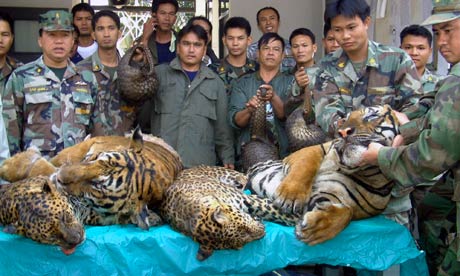
Thai navy officers and forestry officials display dead tigers and leopards seized after a
raid on an illegal wildlife trade in northeastern Thailand. Photograph: AP
raid on an illegal wildlife trade in northeastern Thailand. Photograph: AP
Police forces across the globe need to learn from environmental NGOs in investigating and exposing poachers and smugglers, according to the chief enforcer of global efforts to halt the illegal wildlife trade.
John Sellar, a former Aberdonian police chief who now works for the Convention on the International Trade in Endangered Species (Cites), said priorities and tactics needed to change if the alarming decline in tigers and other threatened animals was to be reversed.
Speaking before the the launch of a new international consortium to fight wildlife smuggling, he expressed admiration for international NGOs who work undercover to identify individuals and crime organisations that profit from the contraband sales driving much of the kill-off.
Though he did not mention any of the groups by name, Traffic, the Environment Investigation Agency and Global Witness are among the groups that have produced a series of hard-hitting studies in recent years.
"If an NGO had come to me with these kinds of reports while I was a police officer in Scotland, I would have called my staff into the office for a long shouting match and asked why they are doing what we should be doing in terms of policing," said Sellar. "If we brought to bear the investigative skills that we bear on other criminals, we'd be infiltrating these networks and markets and taking action against them."
Cites has joined forces with Interpol, the World Bank, the UN Office on Drugs and Crime and the World Customs Organisation to co-ordinate and promote legal action against smugglers.
The International Consortium on Combating Wildlife Crime will be signed tomorrow at the International Tiger Forum in St Petersburg where delegates have vowed to reverse a dramatic decline that has seen the predators' number fall by 97% in the past century.
"We should agree to eradicate the illegal traffic," said Keshav Varma, director of the Global Tiger Initiative at the World Bank. "This is the cruellest thing. It has to bloody well stop. We have to come down very heavily."
The new group aims to help national police and customs officers to launch undercover investigations, extradite suspects and follow the money trail of profits generated by smuggling.
"There is an opportunity for law-enforcement authorities to make major inroads," said Sellar, who has worked with Cites for 13 years. "In my experience, when dealing with criminals there are only two ways to hurt them, either lock them up or hit them in the pocket."
Currently, he said, the wildlife trade was a source of easy money for organised crime groups because the profits were lucrative and the risk of detection was low. Even if caught, prosecutions were often difficult and penalties minimal.
"Every country could do more," said Sellar. "There is not a single country in the world that has the response to wildlife crime right."
Part of the problem is that police resources are often tied up with other crimes. This was particularly true after the attack on the World Trade Center in 2001, when Sellar said priorities shifted noticeably away from wildlife smuggling and are only now starting to return.
Environment groups said enforcement efforts were just as important close to the ground as at international level. "Without that, all other strategies would fail," said Joseph Walston of the Wildlife Conservation Society, which is pushing for at least $35m per year to strengthen anti-poaching efforts.
Thanks to Dieter L for the link!
Sunday, November 21, 2010
Movie trailer: Born to be Wild
If I put aside my reservations about re-introduction and its role in conservation and the issues of zoonotic disease transmission, then this movie looks lovely. (Thanks to Tracy K for the link!) -MA
0
comments
Labels:
africa,
asia,
disease,
elephants,
Movies,
orangutans,
reintroduction,
sanctuary,
video
Labels:
africa,
asia,
disease,
elephants,
Movies,
orangutans,
reintroduction,
sanctuary,
video
Friday, November 19, 2010
Friendship Among Macaques
 From the NYTimes.com
Hanging Out, Grooming, Fighting Foes: Friendship Among Macaques
By SINDYA N. BHANOO
The human tendency to form close bonds with people other than kin may have primal roots. Researchers from Germany report in the journal Current Biology that male macaques exhibit a social bonding behavior similar to human friendship.
Macaque monkeys live in groups of 50 to 60, but “every male in the group has a few other males he interacts with more than others,” said Oliver Schülke, the study’s lead author and an evolutionary biologist at the University of Göttingen.
Dr. Schülke and his colleagues studied male Assamese macaques in Thailand over a period of five years and monitored their behavior. Macaques that spent a lot of time within 1.5 meters of each other were considered friends, since it is easy to attack another macaque at this distance. Males that groomed each other’s bodies frequently and for excessive periods of time were also considered friends. Often, they groomed areas that an individual could groom himself. “The grooming seems to work to foster these bonds,” Dr. Schülke said. “The hygiene aspect was only one part of it.” The bonds can lead to the forming of coalitions, where a group of males might fight another male to improve rank and social status, the researchers found. “The interesting thing is that these coalitions can help pull up low-ranking individuals and help high-ranking males stay where they are,” Dr. Schülke said. “Both things are going on at the same time.”
It appears that, just as in humans, some friendships were long lasting whereas others broke up after a short time. Why this happens is still unclear.
It was previously known that female macaques form strong social bonds, but these bonds tend to be with kin. Females prefer to form close relationships with their mothers, sisters and daughters.
---
Reference:
Schülke O, Bhagavatula J, Vigilant L, Ostner J (2010)Social Bonds Enhance Reproductive Success in Male Macaques. Current Biology. doi: 10.1016/j.cub.2010.10.058
Highlights
- Males act politically when manipulating their own and others' rank
- High- and low-ranking coalition partners benefit by maintaining and enhancing status
- The strength, rather than the number, of social ties affects males' siring success
For animals living in mixed-sex social groups, females who form strong social bonds with other females live longer and have higher offspring survival [1,2,3]. These bonds are highly nepotistic, but sometimes strong bonds may also occur between unrelated females if kin are rare [2,3] and even among postdispersal unrelated females in chimpanzees and horses [4,5]. Because of fundamental differences between the resources that limit reproductive success in females (food and safety) and males (fertilizations), it has been predicted that bonding among males should be rare and found only for kin and among philopatric males [6] like chimpanzees [7,8,9]. We studied social bonds among dispersing male Assamese macaques (Macaca assamensis) to see whether males in multimale groups form differentiated social bonds and whether and how males derive fitness benefits from close bonds. We found that strong bonds were linked to coalition formation, which in turn predicted future social dominance, which influenced paternity success. The strength of males' social bonds was directly linked to the number of offspring they sired. Our results show that differentiated social relationships exert an important influence on the breeding success of both sexes that transcends contrasts in relatedness.
Thursday, November 18, 2010
*updated* Saving Rhinos website and facebook page
*updated*: Louwtjie sent me this update on the rhino situation in S. Africa, like i said, its bad news "Rhino dump found on govt park - Limpopo officials have discovered a rhino cemetery containing 17 rhino carcasses at the Letaba Ranch, on the western border of the Kruger National Park." -MA
original post:
Maybe you have noticed I haven't been posting too much bad/sad conservation news lately, and there is a lot of it happening right now, I simply cannot keep up. The rhino poaching situation in South Africa is out of control it seems...consider 'liking" the saving rhinos facebook page or visiting their website at savingrhinos.org to keep up to date with the arrests, releases and poaching situation. -MA
original post:
Maybe you have noticed I haven't been posting too much bad/sad conservation news lately, and there is a lot of it happening right now, I simply cannot keep up. The rhino poaching situation in South Africa is out of control it seems...consider 'liking" the saving rhinos facebook page or visiting their website at savingrhinos.org to keep up to date with the arrests, releases and poaching situation. -MA
0
comments
Labels:
asia,
hunting,
ivory,
medicine,
misc mammals,
poaching,
South Africa,
southern Africa
Labels:
asia,
hunting,
ivory,
medicine,
misc mammals,
poaching,
South Africa,
southern Africa
Wednesday, October 27, 2010
*updated* New monkey with a hairdo discovered in Myanmar
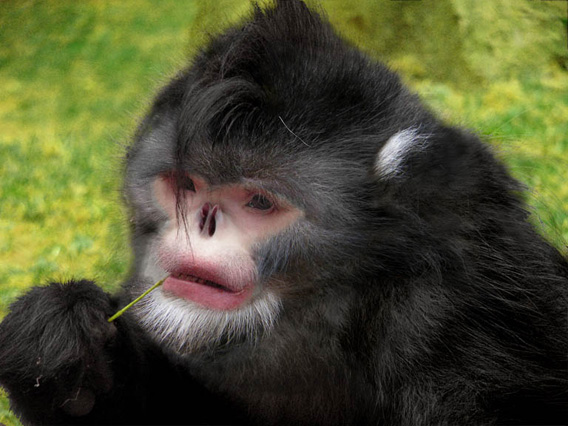
With no photos yet of a living Myanmar snub-nosed monkey, this image was reconstructed using Photoshop, based on a Yunnan snub-nosed monkey and the carcass of the newly discovered species, the Myanmar snub-nosed monkey. Image by: Dr. Thomas Geissmann.
From Mongabay.com
new monkey discovered in Myanmar
by JEREMY HANCE
Described in the American Journal of Primatology, the new monkey, dubbed the Myanmar snub-nosed monkey (Rhinopithecus strykeri), was only discovered after researchers heard reports from hunters of a strange monkey with upturned nostrils and prominent lips. It is known locally as mey nwoah,or 'monkey with an upturned face'.
Locals have an easy time finding the species, since, according to them, it sneezes whenever it rains. Rainwater collects on the monkey's upturned noses causing them to sneeze. To combat this, the monkeys spend their rainy days with heads tucked between legs.
The new primate is especially notable for being the only snub-nosed monkey known in Myanmar. The other four snub-nosed monkey species are found in parts of China and Vietnam.
Frank Momberg, FFI’s Regional Program Development Coordinator in the Asia Pacific and co-author of the paper, told mongabay.com that this new species proves "snub-nosed monkeys must have had a much largest distribution in China and adjacent areas in the past," adding that "[the new species] is most closely related to the Yunnan snub-nosed monkey. However, the two species are morphologically very distinct and are now separated by two major species barriers, the Salween and the Mekong River."
Researchers believe only 260-330 individuals survive of the new species, which would rank it as Critically Endangered according to IUCN Red List standards. Unfortunately, the new species faces a large variety of threats.
"Snub-nosed monkey get frequently trapped in traps laid out for bears. Local hunters also use shotguns. Until 8 years ago hunting was primarily for subsistence use only. Since Chinese logging roads are moving closer, hunting is now increasingly supplying bushmeat for local logging and dam construction camps, as well as feeding into the wildlife trade to China," Momberg says.
But overexploitation of the species isn't the only concern.
"By next year Chinese logging companies will have moved into the Myanmar snub-nosed monkey range, which will cause serious degradation of their habitat and increase hunting pressure," Momberg says.
Saving the Myanmar snub-nosed monkey will require quick work on many different issues, according to Momberg. First, the Chinese government must "crackdown on illegal Chinese logging in the area" and "step-up law enforcement of CITES regulations by Chinese customs officers to reduce trans-border illegal wildlife trade."
A protected area should be established in the Myanmar snub-nosed monkey's range, a recommendation already given by the China Power Investment Corporation, which is building a dam in Myanmar.
In addition, conservationists must work quickly with local people to minimize hunting and trapping, as well as provide income.
Momberg recommends that conservationists "develop a community-based conservation program for the Myanmar snub-nosed monkey range, involving all surrounding villagers in the conservation initiative. Employ local hunters as species guardians and provide alternative livelihoods for forest dependent communities."
The discovery of a new monkey in Myanmar proves just how little we know about the country's wildlife according to Momberg.
"There is plenty of more species to be discovered [in Myanmar], even mammal species. Myanmar is a priority country for biodiversity conservation with currently the second highest deforestation rate in Asia after Indonesia."
REFERENCE: Geissmann. T, Lwin. G, Aung. S, Naing Aung. T, Aung. Z M, Hla. T, Grindley. M, Momberg. F, “A new species of Snub-nosed monkey, Genus Rhinopithecus Milne-Edwards, 1872 (Primates, Colobianae), From Northern Kachin State, Northeastern Myanmar”, American Journal of Primatology, Wiley-Blackwell, October 2010, DOI: 10.1002/ajp.20894
--
*update*
here is an actual picture of the new species moments before it was eaten, from National Geographic

Tuesday, October 12, 2010
Remote camera traps tiger then illegal bulldozer then another tiger
From WWF
Jakarta, Indonesia — A video camera trap installed by WWF and partners has captured footage linking the destruction of a crucial Sumatran tiger forest to the expansion of palm oil plantations in Indonesia’s Riau Province.
Videos and photos captured in May and June 2010 – released to the public for the first time today – caught a male Sumatran tiger walking straight to a camera and sniffing it.
A week later, the heat-activated-video camera trap documented a bulldozer clearing trees for an illegal palm oil plantation in the same exact location. The next day, the camera recorded a Sumatran tiger walking through the devastated landscape.
Bukit Batabuh, where the film was taken, was classified as a protected area by Riau Province in 1994, and categorized as a limited production forest based on Indonesia’s 1986 Land Use Consensus, meaning no company can legally exploit the forest.
Clearing forest most likely illegal
“Because of its status, both as a protected area and limited production forest, the area cannot be developed as a palm oil plantation, therefore any forest clearence —including bulldozing activities to clear the path — strongly indicates this excavation was illegal,” said Ian Kosasih, WWF-Indonesia’s Director of Forest and Species Program. “The law should be enforced in this matter.”
“And to stop illegal activities such as this, the palm oil industry should not source its material from farmers or producers who develop their plantations illegally.”
Since mid-2009, WWF has installed video camera traps in Bukit Batabuh to study Sumatran tiger distribution, habits, and threats they are facing. The wildlife corridor connects Rimbang Baling Wildlife Reserve and Bukit Tigapuluh National Park, making it a crucial area for tiger conservation.
This area is an important habitat for Sumatran tigers
“These video camera traps show that Bukit Batabuh area is an important habitat for the Sumatran tiger in Riau, functioning as a wildlife corridor between Bukit Tigapuluh and Rimbang Baling Tiger Priority Landscape, hence it becomes a priority area for tiger conservation,” explained M. Awriya Ibrahim M.Sc Director of Investigation and Forest Protection, Ministry of Forestry.
“Forest clearance in this area threatens this endangered species because it reduces natural habitat and consequently increases human-tiger conflicts, an unfortunate consequence for both sides. Therefore, we encourage all stakeholders—namely provincial and district level government, business sectors, and communities—to support protection for this landscape. The Ministry of Forestry is investigating this matter and will take strong measure in law enforcement, if this activity is proven violating the law.”
Previous footage documents tigress and cubs only 200 metres from this location
The location where the tiger and bulldozer were documented by video in May 2010 is only 200 meters away from a video camera trap which captured a tigress and her cubs passing by in October 2009. ( Watch video)
Indonesia has adopted protection for critical tiger habitats as part of its commitment to the Conservation Strategy and Action Plan for Sumatran Tiger 2007, and the National Tiger Recovery Plan, delivered at the Pre-Tiger Summit Partners’ Dialogue Meeting in Bali, in July 2010.
During the Bali meeting, which was attended by government delegates from all13 tiger range countries, a strategic plan to achieve an overarching goal of doubling wild tiger populations by 2022 was discussed. The plan is expected to be ratified by heads of government at the Tiger Summit in St. Petersburg, Russia, scheduled for 21-24 Nov. 2010.
“The Indonesian government’s commitment to improve protection for its biodiversity—including an ecosystem-based land-use planning delivered in international fora like the Pre-Tiger Summit Partners’ Dialogue Meeting in Bali last July, and upcoming Conference of Parties to the Convention on Biological Diversity in October —should be supported by stakeholders in provincial or district levels especially on the issue of overlapping land-use planning,” explained Chairul Saleh, General Secretary of the Sumatra Land Use Forum (ForTRUST).
Saleh said sufficient prey and protection for the remaining wild Sumatran tiger populations will allow the species to procreate and provide it with an intact home range and habitat that will minimize incidents of human-tiger conflict.
“Bearing this in mind, a revision of Riau’s Provincial Land Use Planning—based on sustainable development principles adhering to ecosystem preservation and accomodating the tiger’s habitat—is crucial.”
Land clearing practices for palm oil plantations in the area have been going on for some time, pushing the tiger to have close contact with humans. Workers have testified that they frequently find tiger tracks in palm oil plantations.
The deforestation rate in Riau pushed WWF to intensify tiger population surveys in the province. Aside from vast deforestation, the population declines are exacerbated by illegal poaching. In March, WWF’s Tiger Patrol Unit and Riau’s Nature Conservation Agency confiscated more than 110 tiger snares in Bukit Betabuh.
Tigers everywhere are losing habitat
There are as few as 400 Sumatran tigers left in Indonesia, or about 12 percent of the estimated global tiger population of 3,200 tigers. With its significant percentage of the global tiger population, Indonesia has a prominent role in tiger conservation efforts. The tiger population is threatened by loss and fragmented habitat, decreasing prey populations, illegal poaching and trading of the tiger and its body parts, as well as human-tiger conflicts.
Take action now and sign the Tiger Pledge on the WWF Action Centre.
For more information please contact:
M. Awriya Ibrahim M.Sc of Directorate-General Forest Protection and Nature Conservation, Ministry of Forestry of Indonesia +62 21 5730138
Karmila Parakkasi, WWF-Indonesia’s Sumatran tiger research team leader, m + 62 8117510735
Desmarita Murni, WWF-Indonesia’s Communications Manager, m +62 811793458, dmurni@wwf.or.id
The video of Sumatran tiger and forest clearing activities in Sumatra’s Bukit Batabuh (referenced in the above text) can be downloaded from http://gvn.panda.org/?r=356&k=11fca67902
- The link includes copyright information, a shot list, and a description.
Jakarta, Indonesia — A video camera trap installed by WWF and partners has captured footage linking the destruction of a crucial Sumatran tiger forest to the expansion of palm oil plantations in Indonesia’s Riau Province.
Videos and photos captured in May and June 2010 – released to the public for the first time today – caught a male Sumatran tiger walking straight to a camera and sniffing it.
A week later, the heat-activated-video camera trap documented a bulldozer clearing trees for an illegal palm oil plantation in the same exact location. The next day, the camera recorded a Sumatran tiger walking through the devastated landscape.
Bukit Batabuh, where the film was taken, was classified as a protected area by Riau Province in 1994, and categorized as a limited production forest based on Indonesia’s 1986 Land Use Consensus, meaning no company can legally exploit the forest.
Clearing forest most likely illegal
“Because of its status, both as a protected area and limited production forest, the area cannot be developed as a palm oil plantation, therefore any forest clearence —including bulldozing activities to clear the path — strongly indicates this excavation was illegal,” said Ian Kosasih, WWF-Indonesia’s Director of Forest and Species Program. “The law should be enforced in this matter.”
“And to stop illegal activities such as this, the palm oil industry should not source its material from farmers or producers who develop their plantations illegally.”
Since mid-2009, WWF has installed video camera traps in Bukit Batabuh to study Sumatran tiger distribution, habits, and threats they are facing. The wildlife corridor connects Rimbang Baling Wildlife Reserve and Bukit Tigapuluh National Park, making it a crucial area for tiger conservation.
This area is an important habitat for Sumatran tigers
“These video camera traps show that Bukit Batabuh area is an important habitat for the Sumatran tiger in Riau, functioning as a wildlife corridor between Bukit Tigapuluh and Rimbang Baling Tiger Priority Landscape, hence it becomes a priority area for tiger conservation,” explained M. Awriya Ibrahim M.Sc Director of Investigation and Forest Protection, Ministry of Forestry.
“Forest clearance in this area threatens this endangered species because it reduces natural habitat and consequently increases human-tiger conflicts, an unfortunate consequence for both sides. Therefore, we encourage all stakeholders—namely provincial and district level government, business sectors, and communities—to support protection for this landscape. The Ministry of Forestry is investigating this matter and will take strong measure in law enforcement, if this activity is proven violating the law.”
Previous footage documents tigress and cubs only 200 metres from this location
The location where the tiger and bulldozer were documented by video in May 2010 is only 200 meters away from a video camera trap which captured a tigress and her cubs passing by in October 2009. ( Watch video)
Indonesia has adopted protection for critical tiger habitats as part of its commitment to the Conservation Strategy and Action Plan for Sumatran Tiger 2007, and the National Tiger Recovery Plan, delivered at the Pre-Tiger Summit Partners’ Dialogue Meeting in Bali, in July 2010.
During the Bali meeting, which was attended by government delegates from all13 tiger range countries, a strategic plan to achieve an overarching goal of doubling wild tiger populations by 2022 was discussed. The plan is expected to be ratified by heads of government at the Tiger Summit in St. Petersburg, Russia, scheduled for 21-24 Nov. 2010.
“The Indonesian government’s commitment to improve protection for its biodiversity—including an ecosystem-based land-use planning delivered in international fora like the Pre-Tiger Summit Partners’ Dialogue Meeting in Bali last July, and upcoming Conference of Parties to the Convention on Biological Diversity in October —should be supported by stakeholders in provincial or district levels especially on the issue of overlapping land-use planning,” explained Chairul Saleh, General Secretary of the Sumatra Land Use Forum (ForTRUST).
Saleh said sufficient prey and protection for the remaining wild Sumatran tiger populations will allow the species to procreate and provide it with an intact home range and habitat that will minimize incidents of human-tiger conflict.
“Bearing this in mind, a revision of Riau’s Provincial Land Use Planning—based on sustainable development principles adhering to ecosystem preservation and accomodating the tiger’s habitat—is crucial.”
Land clearing practices for palm oil plantations in the area have been going on for some time, pushing the tiger to have close contact with humans. Workers have testified that they frequently find tiger tracks in palm oil plantations.
The deforestation rate in Riau pushed WWF to intensify tiger population surveys in the province. Aside from vast deforestation, the population declines are exacerbated by illegal poaching. In March, WWF’s Tiger Patrol Unit and Riau’s Nature Conservation Agency confiscated more than 110 tiger snares in Bukit Betabuh.
Tigers everywhere are losing habitat
There are as few as 400 Sumatran tigers left in Indonesia, or about 12 percent of the estimated global tiger population of 3,200 tigers. With its significant percentage of the global tiger population, Indonesia has a prominent role in tiger conservation efforts. The tiger population is threatened by loss and fragmented habitat, decreasing prey populations, illegal poaching and trading of the tiger and its body parts, as well as human-tiger conflicts.
Take action now and sign the Tiger Pledge on the WWF Action Centre.
For more information please contact:
M. Awriya Ibrahim M.Sc of Directorate-General Forest Protection and Nature Conservation, Ministry of Forestry of Indonesia +62 21 5730138
Karmila Parakkasi, WWF-Indonesia’s Sumatran tiger research team leader, m + 62 8117510735
Desmarita Murni, WWF-Indonesia’s Communications Manager, m +62 811793458, dmurni@wwf.or.id
The video of Sumatran tiger and forest clearing activities in Sumatra’s Bukit Batabuh (referenced in the above text) can be downloaded from http://gvn.panda.org/?r=356&k=11fca67902
- The link includes copyright information, a shot list, and a description.
Monday, October 11, 2010
Talking Elephant in South Korea?
From the Huffington Post:
In this video from CBS, an elephant named Kosik is attracting visitors and scientists alike with his unique ability to vocalize various Korean words...
...Dr. Daniel Mietchen, a biological scientist from the University of Jena in Germany, has come to South Korea with other researchers from the university to study the exceptional elephant. They believe Kosik may reveal that elephants are capable of learning language, though they doubt that he actually grasps the meaning of the words he speaks.
Mietchen says Kosik is the only living elephant capable of this feat that they know of, though other elephants have exhibited the ability to mimic the sounds of trucks and other elephants.
Monday, September 20, 2010
New "population" of high altitude tigers found in Bhutan

There is a cool video at the BBC.co.uk of the camera trap footage of these newly discovered high altitude tigers.
from the website:
Television footage shot by the BBC's Natural History Unit has provided the first evidence that tigers can live and breed at extremely high altitudes. The team filmed the animals, normally found in jungle habitats, more than 4,000 metres high in the Himalayas.Experts say the discovery could make it easier to create a conservation corridor, linking populations of the endangered felines across Asia.
Lost Land of the Tiger will be broadcast on BBC One at 21.00BST on Tuesday 21st, Wednesday 22nd and Thursday 23rd September.
Subscribe to:
Posts (Atom)



 Posts
Posts


