translate

Site update

Since I have been really terrible at updating the blog (but pretty good at keeping up with the facebook blog posts) I've added the widget below so that facebook cross posts to the blog.

You shouldn't need to join facebook but can just click on the links in the widget to access the articles. If you have any problems or comments please mail me at arandjel 'AT' eva.mpg.de.
Showing posts with label law. Show all posts

Tuesday, January 10, 2012

Lack of conservation effort rapidly increases African great ape extinction risk


Sandra Tranquilli, Michael Abedi-Lartey, Fidele Amsini, Luis Arranz, Augustus Asamoah, Ogunjemite Babafemi, Nsengiyunva Barakabuye, Genevieve Campbell, Rebecca Chancellor, Tim R.B. Davenport, Andrew Dunn, Jef Dupain, Christina Ellis, Gilles Etoga, Takeshi Furuichi,Sylvain Gatti, Andrea Ghiurghi, Elisabeth Greengrass, Chie Hashimoto, John Hart, Ilka Herbinger, Thurston C. Hicks, Lars H. Holbech, Bas Huijbregts, Inaoyom Imong, Noelle Kumpel, Fiona Maisels, Phil Marshall, Stuart Nixon, Emmanuelle Normand, Leonidas Nziguyimpa, Zacharie Nzooh-Dogmo, David Tiku Okon, Andrew Plumptre, Aaron Rundus, Jacqueline Sunderland-Groves, Angelique Todd, Ymke Warren, http://www.blogger.com/img/blank.gifRoger Mundry, Christophe Boesch & Hjalmar Kuehl (2011) Lack of conservation effort rapidly increases African great ape extinction risk Conservation Letters doi: 10.1111/j.1755-263X.2011.00211.x

Abstract
A network of resource management areas (RMAs) exists across tropical Africa to protect natural resources. However, many are poorly managed and weakly protected. We evaluated how the lack of conservation effort influences the extinction risk of African great apes. We compiled information on presence/absence of primary (law enforcement guards) and secondary (tourism,research) conservation activities and nongovernmental conservation organizations (NGOs) support for 109 RMAs over the last 20 years. Along with these data, we collected environmental and anthropogenic variables, including recent records of ape presence/absence for all RMAs. As expected, law enforcement as a primary activity was the best predictor of ape survival rather than tourism or research as secondary activities. Furthermore, long-term NGO support had a significant positive influence on ape persistence. Our study demonstrates the feasibility of evaluating the relative importance of different conservation activities, an important step towards more evidence-based approaches in ape conservation.

Thursday, June 30, 2011

Rhino DNA kits added to South Africa's Arsenal


From Rhino Conservation.org

South Africa’s embattled rhinos now have a new weapon on their side: 1,000 DNA kits have been provided to South African National Parks (SANParks) by the faculty of Veterinary Services of the University of Pretoria.

The kits are expected yield a higher conviction rate for rhino crimes, according to Dr. Cindy Harper, Head of Veterinary Genetics Laboratory (VGL) at the Faculty of Veterinary Science.

"The ability to obtain a full DNA profile from rhino horn allows us to match recovered horns to specific poaching incidents."

SANParks CEO, Dr David Mabunda, noted that DNA profiling would allow prosecutors to be tougher on rhino crimes.

"This will certainly go a long way in changing the trend of suspects found in possession of rhino horn only being charged with possession as the horns will be linked to a carcass lying somewhere in a national park or game reserve."

Read the entire release at SANParks receives kits to fight rhino poaching .

DNA analysis at work
Indeed, it was DNA evidence that led to at least three successful convictions over the past 13 months.

For example, in June 2010, a Vietnamese rhino horn smuggler was sentenced to 10 years in prison after the rhino horns in his possession were found to be a DNA match to rhinos that were killed a few days earlier.

So far this year, DNA analysis has been instrumental in two cases which put a total of four rhino killers in jail.

In April 2011, DNA evidence helped put two killers behind bars for a combined total of 19 years.

Earlier this month, DNA analysis of the rhino and horns helped secure the convictions of two Mozambican nationals, who were sentenced to a combined total of 16 years in prison.

Killing continues
SANParks announced that the year’s rhino death toll had already reached 173 as of June 6th.

Since that time, a female rhino was killed on a private game farm in Hoedspruit. The assailants also shot and wounded her four-month-old calf.

However, the number could be as high as 186, according to sources outside the media.

Thursday, April 28, 2011

Virunga Forests Going to Pot


Marijuana Trade Threatens African Gorilla Refuge
Pot-growing rebels in Virunga National Park clashing with rangers.
by STEFAN LOVGREN
from National Geographic News

The battle over the war-ravaged Virunga National Park, home to some of the world's last wild mountain gorillas, is heating up.

In early April a ranger in the park, in the eastern part of the Democratic Republic of the Congo, was shot to death by militias—the eighth ranger to have been killed in the past three months.

And rebels who have been fueling the illegal charcoal business, which destroys critical gorilla habitat, now appear to have turned to an additional criminal activity: growing marijuana.

"The same people are involved," said Innocent Mburanumwe, the warden in charge of the southern sector of Virunga, where the mountain gorillas live.

A crackdown on the charcoal and marijuana businesses in 2009 was very successful. But the Rwandan militia living in the park, known as FDLR, seems to have reorganized and stepped up its activities, Mburanumwe said.

"The most recent attack is by far the most worrying, as it appears the rebels may be changing their tactics, and are currently getting the better of the wildlife authority," Rob Muir, of the Frankfurt Zoological Society's office in Goma, DRC, said via email.

Virunga Forests Going to Pot
The latest trouble has been occurring in the volcanic Nyamulagira region of the park, away from the gorilla sector, which has so far remained calm.

With the Congolese government absent in much of eastern Congo, the rangers have been left to fight the ragtag militias, poachers, and bandits who have turned Virunga—Africa's oldest national park—into a battleground for decades.

Charcoal is illegally produced in the park by cutting down wood, then slowly burning it for six days inside a kiln made of wood and covered with dirt, according to the park's website. People then sell the charcoal in Goma, or trade it for guns and bullets. In 2007, people involved with the charcoal trade killed seven gorillas. (See a National Geographic interactive time line of the turmoil in Virunga.)

The FDLR rebels, remnants of the 1994 Rwandan genocide, are based in the forest and provide "security" for traders, who transport the illegal charcoal from forest kilns to the main road to be sold.

Villagers provide the FDLR with money, food, cell phone airtime, and medicine in exchange for being allowed into the forest to make the charcoal, the rangers say.

When the charcoal has been removed, the area may be cleared and seeded with marijuana, usually by the FDLR. Rebels will come back to harvest, dry, and sell or exchange the pot, often for uniforms, bullets, and guns, according to the rangers.

"The charcoal trade is destroying the forest, and the marijuana comes in after it," said LuAnne Cadd, a spokesperson for the park service.

In March two people were caught with marijuana plants that had been grown in the forest.

Rangers Need to Rethink Security
Patrols are aimed at eradicating the charcoal business, not going after the marijuana traders. But in the most recent incident, rangers patrolling the Kibumba area in Nyamulagira found not only a charcoal kiln but also a lot of marijuana plants.

A team of 15 rangers began a patrol in Kibumba, specifically looking for charcoal kilns, when they came under fire by an unknown number of men believed to have been FDLR rebels. Ranger Magayane Bazirushaka was killed in the attack.

"It seems likely that the rebels established a charcoal fire to draw the rangers into an area where they could be easily ambushed, and then sat and waited," the Frankfurt Zoological Society's Muir said.

"If this is indeed the case, the rangers will need to rethink their current law enforcement strategy, increase their intelligence and surveillance networks, and diversify their operations on the ground," he said.

"The bottom line is that the park is now under greater pressure than it has been for many years, and this is directly linked to the efforts to uphold and enforce the law."

Gorilla Population Up Despite Strife
Despite the turmoil, the mountain gorilla population in the Virunga region—which straddles the borders of the DRC, Rwanda, and Uganda—has increased by 26 percent in the last seven years and now totals 480.

Emmanuel de Merode, Virunga's director, said rangers are now planning to launch new operations to stop illegal marijuana trade.

"Perhaps the most remarkable outcome of this terrible war," de Merode said, "is the unwavering determination of our rangers on the ground not to give up on the efforts to bring stability and the rule of law back to Virunga."

Tuesday, April 26, 2011

Congolese ecoguards prosecuted for ivory trafficking


From the Africa Geographic facebook page

Congo’s courts slam 13 wildlife criminals in push against corruption and ivory trafficking

On Monday, 18 April 2011 in Ouesso, northern Republic of Congo, thirteen wildlife traffickers were prosecuted for various wildlife crimes, hit with tough jail sentences ranging from 12 to 24 months in prison. The highest profile cases include two international ivory dealers, a notorious large-scale elephant poacher and four Ecoguards revealed to have committed the same crimes they were supposed to prevent, and arrested in the act of facilitating ivory traffic.

Other notable cases included other elephant hunters and ivory traffickers, two gorilla hunters, and a truck driver for the logging company working in the region, CIB (Congolaise Industrielle des Bois), who was involved in ivory traffic as well.

The Ecoguards admitted to corruption, having turned their noble task into an organized trafficking operation. They were sentenced to two years in prison each. Other sentences ranged between 12 and 18 months in jail, the two year sentences representing a crackdown on corruption.

The Republic of Congo started a push for the application of its wildlife laws by launching PALF (Project for the Application of Law for Fauna) - a partnership between two NGOs and the Ministry of Sustainable Development, Forest Economy and the Environment. The purpose is to support the ministry in investigations of wildlife crime, operations, follow up on court cases; and to fight corruption which often blocks the full application of the law. “While Congo has advanced in wildlife law enforcement, the North of the country remains an area of great concern, with ivory traffickers and poachers being freed from jail often before ever seeing the inside of a courtroom.

With the support of PALF and serious treatment of illegal trafficking networks by the Ministry of Justice, the way wildlife crimes are treated in Congo is beginning to change. No one is above the law.” says PALF Coordinator Naftali Honig.

The cases exposed international trafficking routes, highlighting the need for international collaboration in the fight. Congo joined Cameroon in an alliance, now including Gabon and CAR as well, coordinated by LAGA (Last Great Ape Organization) to intensify the crackdown regionally. LAGA Coordinator Ofir Drori says, “Corruption
remains our number one obstacle in the struggle to protect Africa’s forests. Not just corruption in government offices but in NGO projects. Congo’s prosecutions serve as a lesson to all those ignoring corruption that it can be fought and won over.”

WCS (Wildlife Conservation Society), who supports Ecoguards in a number of protected areas in Congo, is intent upon rooting out the corruption amongst the park rangers. “Corruption in conservation is unacceptable” says Director of WCS-Congo, Paul Telfer. “This case demonstrates that it exists and that we can fight it. We will root it out wherever it exists to make sure that conservation efforts serve to protect wildlife and do not become victim to individual greed.”

The difficulties are numerous in putting wildlife legislation into practice. Arms suppliers are often authorities. Traffic may be facilitated by the presence of logging companies and even park rangers. Bribery attempts are commonplace from the moment a trafficker is taken into custody through the carrying out of a prison sentence.

“The battle is uphill,” says Honig, “but these sentences are a major success for Congo. More sentences like these could really change the way people weigh out the risks of illegally trafficking wildlife and we hope this will echo from cities all the way to the forests and work in the favor of protected species.”

***

PALF website – www.palf-enforcement.org

Monday, January 24, 2011

Chinese citizen caught smuggling ivory from the Republic of Congo

Ivory pieces confiscated by Republic of Congo authorities in Saturday's bust.
Photo by: Naftali Honig (PALF).

From mongabay.com
by JEREMY HANCE

A Chinese national was caught attempting to smuggle 22 pounds (10 kilos) of ivory out of the Republic of Congo on Saturday, according to the AFP. Officials confiscated five elephant tusks, 80 ivory chopsticks, 3 ivory carvings, and a number of smaller ivory-made items.

The suspect was taken into custody at the Maya-Maya airport in the Republic of Congo's capital, Brazzaville.

"We vowed to help the government of Congo send a zero tolerance message to ivory traffickers, and as you can see this message is in action," Naftali Honig, head of the Project to Apply the Law on Fauna (PALF), told the AFP. A Brazzaville-based NGO, PALF is working to build the capacity of Congolese authorities to enforce wildlife laws, which have long gone ignored in the central African nation.

PALF has been involved in a number of seizures, including catching illegal wildlife traders dealing in leopard skins, ivory, and living chimpanzees and gorillas for the illegal pet trade. The chimpanzee dealer became the first individual sentenced for wildlife trafficking in the Republic of Congo. He was sentenced to a year in prison.

"We work with investigators and local authorities to catch criminals in the act and then follow the legal proceedings to ensure that they don't use a phone call, a bribe, or anything of that nature to illegitimately get themselves off the hook," Honig explained to mongabay.com in an interview last February.

In its first year, PALF conducted 17 investigations resulting in the arrests of 19 alleged traffickers. The program was developed by the Aspinall Foundation and Wildlife Conservation Society.

Monday, November 22, 2010

CITES joins forces with Interpol, the World Bank & the UN

Illegal wildlife trade: World's police 'must learn from environmental groups'
Chief enforcer of global efforts to halt decline in endangered species says tactics and priorities must change
by JOHNATHAN WATTS

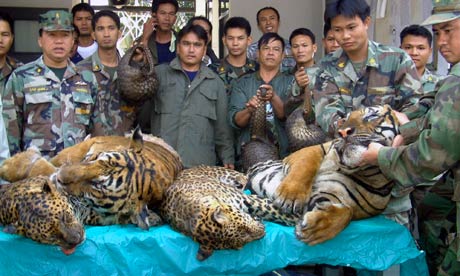
Thai navy officers and forestry officials display dead tigers and leopards seized after a
raid on an illegal wildlife trade in northeastern Thailand. Photograph: AP


Police forces across the globe need to learn from environmental NGOs in investigating and exposing poachers and smugglers, according to the chief enforcer of global efforts to halt the illegal wildlife trade.

John Sellar, a former Aberdonian police chief who now works for the Convention on the International Trade in Endangered Species (Cites), said priorities and tactics needed to change if the alarming decline in tigers and other threatened animals was to be reversed.

Speaking before the the launch of a new international consortium to fight wildlife smuggling, he expressed admiration for international NGOs who work undercover to identify individuals and crime organisations that profit from the contraband sales driving much of the kill-off.

Though he did not mention any of the groups by name, Traffic, the Environment Investigation Agency and Global Witness are among the groups that have produced a series of hard-hitting studies in recent years.

"If an NGO had come to me with these kinds of reports while I was a police officer in Scotland, I would have called my staff into the office for a long shouting match and asked why they are doing what we should be doing in terms of policing," said Sellar. "If we brought to bear the investigative skills that we bear on other criminals, we'd be infiltrating these networks and markets and taking action against them."

Cites has joined forces with Interpol, the World Bank, the UN Office on Drugs and Crime and the World Customs Organisation to co-ordinate and promote legal action against smugglers.

The International Consortium on Combating Wildlife Crime will be signed tomorrow at the International Tiger Forum in St Petersburg where delegates have vowed to reverse a dramatic decline that has seen the predators' number fall by 97% in the past century.

"We should agree to eradicate the illegal traffic," said Keshav Varma, director of the Global Tiger Initiative at the World Bank. "This is the cruellest thing. It has to bloody well stop. We have to come down very heavily."

The new group aims to help national police and customs officers to launch undercover investigations, extradite suspects and follow the money trail of profits generated by smuggling.

"There is an opportunity for law-enforcement authorities to make major inroads," said Sellar, who has worked with Cites for 13 years. "In my experience, when dealing with criminals there are only two ways to hurt them, either lock them up or hit them in the pocket."

Currently, he said, the wildlife trade was a source of easy money for organised crime groups because the profits were lucrative and the risk of detection was low. Even if caught, prosecutions were often difficult and penalties minimal.

"Every country could do more," said Sellar. "There is not a single country in the world that has the response to wildlife crime right."

Part of the problem is that police resources are often tied up with other crimes. This was particularly true after the attack on the World Trade Center in 2001, when Sellar said priorities shifted noticeably away from wildlife smuggling and are only now starting to return.

Environment groups said enforcement efforts were just as important close to the ground as at international level. "Without that, all other strategies would fail," said Joseph Walston of the Wildlife Conservation Society, which is pushing for at least $35m per year to strengthen anti-poaching efforts.

Thanks to Dieter L for the link!