Since I have been really terrible at updating the blog (but pretty good at keeping up with the facebook blog posts) I've added the widget below so that facebook cross posts to the blog.
You shouldn't need to join facebook but can just click on the links in the widget to access the articles. If you have any problems or comments please mail me at arandjel 'AT' eva.mpg.de.
Read this amazing Reddit thread of how one man's tragic attack at a Kenyan orphange lead to major funds being raised for the children under his care.
it all started with this plea:
Meet Omari. Two days ago he returned from the hospital after being hacked in the face by a machete defending an orphanage of 35 children by himself. Think we could raise the $2,000 needed for the remainder of the cement/barbed wire wall to keep both him and the children safe?
As of now, the best way to donate is through www.longonoteducation.org. We will assume that any donation made between now and next week was meant for the Faraja Orphanage in Ngong, Kenya. Also, remember her? The construction date is scheduled for February 15th! Edit: In the process of uploading more pictures of the orphanage, but my modem is being very slow. I would also like to add that this orphanage is unlike any I have seen before. The mother of Omari, the sole caretaker of the children (with the help of volunteers), has made multiple efforts to keep the orphanage sustainable. There are dozens of chickens and a small garden which helps feed the 35 children between the ages of 2 and 17. As you can imagine, these efforts are great but not enough to support 35 children everyday. Edit 2: The wooden fence next to the concrete section of the wall. The goal is to construct a wall the same height as the existing structure, with three feet of barbed wire (three coiled stacked on top of each other) on top. Edit 3: Omari explained to me that many of the kids are very scared to re-enter the home; scared that the attackers are still inside "waiting with knives". So it was nice to see them playing (and eating oranges) outside in the yard. Edit 4: I figure the story is worth sharing: After two previous invasions during the week, Omari was relatively certain another would occur. He woke up to the sound of footsteps outside his door, he figured it was his mother taking a few of the boys outside to go to the bathroom. He quickly realized that the footsteps were heavy, and that of more than one person; he then saw a flashlight shine beneath the crack of his door. Being the third time this happened that week, he had already stashed a hammer beside his bed. He grabbed it, and threw it at the first person who entered his room. He hit the person square in the head, and chased the rest out. The following night, the three thugs returned, presumably to avenge their friend. Omari put up a fight but was outnumbered. The last thing he remembers was being struck in the face by the machete. He has been in and out of the hospital since, yet remains positive and confident that the suspects will one day see justice. Until then, I only hope that is courage and strength is felt by all of you. Speaking with him was a very humbling and special experience that I will never forget. I told him I would try my best to help, so this is my effort: Reddit, already donations are pouring in, and I can't thank you enough. Edit 5: Another picture of a few kids playing with one of their favorite toys. Reddit, twice now, you have nearly brought me to tears. I have never felt so encouraged in my life. Donations are coming in too fast to keep track, so I will update as soon as they seem to slow down. If the donations reach over $2,000, the rest will go towards food and supplies for the children. I will ABSOLUTELY keep all of you updated with the progress. Edit 6: Many people are asking for proof, the mods have contacted me and I'm working on it. It's 5:03am right now, I haven't slept all night (nor do I plan to), I've been messaging my friends on facebook left and right trying to get the word out, but I never, NEVER, could have imagined the night ending this way. In just a few short hours I will return to the orphanage with by far the BEST news I could ever tell anyone. There will be pictures! Edit 7: I've sent the mod a picture of myself, reddit name, date, PSU id, and the expired Kenyan residency card I received in 2010 when I first studied abroad. I am literally waiting for the sun to come up so I can run to the orphanage and tell them the INCREDIBLE news. I will take a picture with everyone (Omari will absolutely be present) and return as soon as I can. Edit 8: Over $9,000 and I'm in a state of shock. I...... Just.....................Thank you. Edit 9: Over $11,000. It's 6am. In 45 minutes I will RUN to the orphanage. I should be back with pictures in just a few hours. This is the best news I have ever had to privilege to tell anyone, and you are all to thank for it. Also, I am too overwhelmed at the moment, but I will do my best to reply to as many comments/messages/questions as I can. Edit 10: $44,000!!!!!!!!! REDDIT!!!!! I can hardly breathe. I refreshed the page at least twice to make sure it was real. I cannot believe this. I just came back from the orphanage..... Let's just say many tears were shed, and many hugs were shared. The children were all leaving to school as I arrived, but I will return around 6pm to take a group picture. I am about to upload the picture and video of Omari's thanks. He's been reading all of your comments, he said he'll read every one if it takes him all day. $44,000. Reddit, thank you. Edit 11: $48,000! This is surreal. Thank you Weebly.com for the $10,000 donation in addition to upgrading our website to Weebly Pro for two free years. Of course, thank you all so much. I must sleep for a bit, but I'll be back! Edit 12: Who am I kidding I couldn't sleep if I tried. We hit the $50,000 mark! I know by now I sound like a broken record, but thank you Reddit, sincerely.
How we see Africa now Polling of 2,000 UK adults reveals a huge need to open our eyes to Africa
Recent polling of 2,049 UK adults reveals misconceptions and negative attitudes towards Africa – highlighting the key areas that the See Africa Differentlycampaign needs to focus on.
The polling – conducted by research company ComResin Autumn 2011 – uncovers some shocking misconceptions.
1 in 5 people mis-identify Africa as a country. This rises to more than 1 in 3 people aged 18 – 35. It is, of course, the world’s second largest continent - containing 54 countries.
Hardly anyone (just 2%) knew that 7 of the world’s 10 fastest-growing economies are in Africa. Most people (32%) responded that they didn’t know and over a quarter (28%) of participants thought it was a meagre ‘1 to 2’ African economies.
Only 3% of people associate Africa with technological innovations. Yet Wired magazine reported this year that: “From mobile payments to telemedicine...there’s a common pulse of innovation (in) the new Africa” - in a fantastic article showcasing the impressive amount of techno-firsts Africa boasts.
And just 5% equate Africa with gender equality. But 16 African countries have more female MPs than we have here in the UK – and Rwanda has the highest proportion in the world.
The polling highlighted the sort of negative attitudes we’re keen to change.
We asked respondents what words come to mind when they think of Africa: 84% said ‘poverty’ ; 62% said ‘corruption;’ 52% said ‘a long-term charity case.’ http://www.blogger.com/img/blank.gif Despite the negative images associated with the continent, the good news is people aren’t writing it off – a majority (61%) disagreed with the statement that ‘Africa is a lost cause.’
We’ll keep you updated on how we’ll use these stats to inform our strategy, spread the under-reported good news and campaign to shift perceptions and overturn misconceptions.
Abstract A network of resource management areas (RMAs) exists across tropical Africa to protect natural resources. However, many are poorly managed and weakly protected. We evaluated how the lack of conservation effort influences the extinction risk of African great apes. We compiled information on presence/absence of primary (law enforcement guards) and secondary (tourism,research) conservation activities and nongovernmental conservation organizations (NGOs) support for 109 RMAs over the last 20 years. Along with these data, we collected environmental and anthropogenic variables, including recent records of ape presence/absence for all RMAs. As expected, law enforcement as a primary activity was the best predictor of ape survival rather than tourism or research as secondary activities. Furthermore, long-term NGO support had a significant positive influence on ape persistence. Our study demonstrates the feasibility of evaluating the relative importance of different conservation activities, an important step towards more evidence-based approaches in ape conservation.
From the BBC Western black rhino declared extinct By Daniel Boettcher
No wild black rhinos remain in West Africa, according to the latest global assessment of threatened species.
The Red List, drawn up by the International Union for Conservation of Nature (IUCN), has declared the subspecies extinct.
A subspecies of white rhino in central Africa is also listed as possibly extinct, the organisation says.
The annual update of the Red List now records more threatened species than ever before.
The IUCN reports that despite conservation efforts, 25% of the world's mammals are at risk of extinction. As part of its latest work it has reassessed several rhinoceros groups.
Poaching vulnerability As well as declaring the western black rhino (Diceros bicornis longipes) extinct, it records the northern white rhino (Ceratotherium simum cottoni), a subspecies in central Africa, as being on the brink of extinction.
The last Javan rhino (Rhinoceros sondaicus) outside Java is also believed to have disappeared.
Overall numbers of black and white rhinos have been rising, but some subspecies have been particularly vulnerable to poaching by criminal gangs who want to trade the animals' valuable horns.
Simon Stuart, chair of the IUCN Species Survival Commission, told BBC News: "They had the misfortune of occurring in places where we simply weren't able to get the necessary security in place.
"You've got to imagine an animal walking around with a gold horn; that's what you're looking at, that's the value and that's why you need incredibly high security."
Another focus for this year's list is Madagascar and its reptiles. The report found that 40% of terrestrial reptiles are threatened. But it also says that new areas have been designated for conservation.
Among the success stories identified in the latest annual update is the reintroduction of the Przewalski's horse (Equus ferus). Listed extinct in the wild in 1996, it was brought back after a captive breeding programme and the wild population is now thought to exceed 300.
Among the partner organisations involved in compiling the research for the list is the Zoological Society of London (ZSL).
ZSL's Dr Monika Boehm said: "This Red List update very much shows us a mixed picture of what's happening to the world's species. There's some good news and some bad news.
"Unfortunately, the overall trend is still a decline in biodiversity. We still haven't achieved our conservation potential."
Do chimpanzees have traditions? As wild populations dwindle, researchers are racing to find out.
Thump! Thump! Thump! As the hollow sound echoes through the Liberian rainforest, Vera Leinert and her fellow researchers freeze. Silently, Leinert directs the guide to investigate. Jefferson 'Bola' Skinnah, a ranger with the Liberian Forestry Development Authority, stalks ahead, using the thumping to mask the sound of his movement.
In a sunlit opening in the forest, Skinnah spots a large adult chimpanzee hammering something with a big stone. The chimpanzee puts a broken nut into its mouth then continues pounding. When Skinnah tries to move closer, the chimp disappears into the trees. By the time Leinert and her crew get to the clearing, the animal is long gone.
For the past year, Leinert has been trekking through Sapo National Park, Liberia's first and only protected reserve, to study its chimpanzee population. A student volunteer at the Max Planck Institute for Evolutionary Anthropology (EVA) in Leipzig, Germany, Leinert has never seen her elusive subjects in the flesh but she knows some of them well. There's an energetic young male with a big belly who hammers nuts so vigorously he has to grab a sapling for support. There are the stronger adults who can split a nut with three blows. And there are the mothers who parade through the site with their babies. They've all been caught by video cameras placed strategically throughout Sapo.
Chimpanzees in the wild are notoriously difficult to study because they flee from humans — with good reason. Bushmeat hunting and human respiratory diseases have decimated chimpanzee populations1, while logging and mining have wiped out their habitat. Population numbers have plunged — although no one knows by exactly how much because in most countries with great apes, the animals have never been properly surveyed.
The Pan Africa Great Ape Program, the first Africa-wide great-ape census to be mounted, could change that. In addition to surveying chimpanzee numbers (see 'How many chimpanzees are left?'), project scientists plan to set up automated video and audio recording devices at 40 research sites in 15 countries with chimp populations. Led by Christophe Boesch, director of the primatology department at the EVA, and Hjalmar Kühl, also at the EVA, the programme aims to get a picture of how chimpanzee behaviour — from nut cracking to vocal calls — varies across Africa. Ultimately, the hope is to learn about the origins and extent of what, in humans, would be called culture.
Until recently, scientists regarded culture — defined as socially transmitted behaviours — as exclusive to humans, but there is growing recognition that many animals exhibit some sort of culture. Chimpanzees, which share 98% of their genes with humans, have the most varied set of behaviours documented in the animal world. The difference between humans and animals is growing less distinct, say some researchers. "It is not black and white," says Kühl, who is Leinert's supervisor at the EVA.
In the old scenario, "only humans have culture", says Jason Kamilar, a biogeographer in the department of anthropology at Yale University in New Haven, Connecticut. "Then, culture would be the defining feature of humanity, which evolved some time after the split between the human and chimp lineages," he says. But "if chimps have culture, then presumably the last common ancestor of chimps and humans had culture".
Mapping Behaviour Some chimps dance slowly at the beginning of rain showers, others don't; some use long sticks to dig up army ants; others use short sticks. In West Africa, some chimp groups hammer nuts with a stone or a piece of wood to open them. But east of the river Nzo-Sassandra, which cuts across Côte d'Ivoire, only one group has been seen cracking nuts.
So far, researchers have observed these variations over years spent studying groups of chimpanzee that have been carefully habituated to the presence of humans. There are just 12 such colonies in Africa (see 'Chimpanzee census'), the most famous of which is in Gombe Stream National Park in Tanzania, where primatologist Jane Goodall worked.
In 1999, evolutionary psychologist Andrew Whiten of the University of St Andrews, UK, and his colleagues compiled a list of behaviours seen in seven of those groups and showed that chimpanzees have unique traditions depending on where they live2. They identified at least 39 behaviours from a list of 65 that varied between groups for no obvious reason.
In humans, culture is passed on from one person to another, and in laboratory studies chimpanzees have shown the capacity to pass on learned customs. In one experiment, Whiten and his colleagues taught two chimps a complex series of steps for getting food from a box. Soon after the chimps were reunited with their groups, all the animals were using this method to get their food3. But whether such social learning happens in the wild is less clear. Gorillas and bonobos can also learn to use tools in the lab, but rarely use them in their natural habitat4.
Deciphering culture in the wild is difficult because researchers must ensure that behavioural differences between groups do not have other causes, such as variation in genetics or environmental conditions. "Why is it all chimps don't do everything? One solution is that there are hidden ecological differences between populations," says primatologist Richard Wrangham at Harvard University in Cambridge, Massachusetts. A behaviour could be linked to any number of variables such as amount of rainfall, the types of tree available, or the kinds of predator in the area, he says.
These influences can be subtle, as researchers found while studying how chimps use sticks to harvest army ants. Chimpanzees in Guinea sometimes use short sticks and sometimes use sticks up to twice as long. No reason for this was obvious until Tatyana Humle, an anthropologist at the University of Kent, UK, found that some ants are more aggressive, with longer legs and larger mandibles; they run up sticks quicker and bite harder5. This might explain why chimps elsewhere in Africa also choose tools of varying lengths to get at ants.
But researchers have not been able to find obvious explanations for other variations related to ant harvesting. Chimpanzees in Cote d'Ivoire sweep the ants off their sticks and into their palms before eating; in Guinea, only about 320 kilometres away, the animals stick the ant-laden sticks directly into their mouths. The same type of ant is present in both places.
Ruling out genetic influences is equally complicated. This year, molecular ecologist Kevin Langergraber at the EVA and his colleagues compared genetic and behavioural data for nine groups of chimpanzee. They found that communities with greater overlap in their mitochondrial DNA showed more similarities in their behaviour6. "What we are saying is, you haven't really ruled out the genetic explanation," says Langergraber.
There may be a few hundred thousand chimpanzees in Africa, but researchers have studied just 700–1,000 chimpanzees at the dozen sites with well habituated colonies, says Whiten. The available information from those groups is too little to determine how genes and the environment influence behavioural variations. Kühl compares the situation to using a handful of villages scattered around the world to draw basic conclusions about all the rituals that define human culture.
Whiten and his colleagues are now carrying out more detailed comparisons of the behaviour and ecology of chimps at all the habituated sites. But it has taken 50 years to capture the data they are using, most of which were recorded by painstaking observational studies.
The way forward may be the use of cameras hidden in strategic sites, like those Leinert and her team are setting up in Liberia. Such techniques have already proved their worth. Two years ago in Gabon, Boesch and his team were puzzled by random pits they observed in the ground. They set up camera traps and obtained video recordings of chimps digging to extract honey from underground bees' nests — something that had never been seen before7. "Camera traps are proving to be an exciting way to reveal new and often complex behavioural techniques in wild chimpanzee communities," says Whiten.
Caught in the act
At the site in Sapo, Leinert pulls on gloves to measure the rock used by the chimp to crack open nuts of the Guinea plum, Parinari excelsa. The rock is sizeable, weighing in at 880 grams. She collects nuts for later analysis, as well as hair and dung samples for genetic studies.
Leinert may later put up a video camera at the location to collect more data on the nut-cracking behaviour. The cameras are mounted in boxes on tree trunks at the height of a chimp's shoulder, and powered by rechargeable batteries. An infrared motion detector activates the camera for one minute when anything moves in its range.
Near the nut-cracking site, a solar-powered audio device is already continuously recording the forest sounds. Chimpanzees emit a range of calls, including short, high-pitched 'pant hoots' that are unique to each individual, and researchers can use them to identify individuals and to tally the size of a community. These calls may be a form of vocal culture, somewhat like human dialects8.
Over the next five years, the Pan Africa Great Ape Program will establish similar recording stations at locations across Africa. "So potentially we might have, in a few years, behavioural differences from 40 different populations, which is, as you know, four times more than what we have now," says Boesch.
Kühl proposes that these data could help in designing computer models to test how genes, ecology and social transmission influence the distribution and spread of behaviours such as nut cracking. One idea is that when female chimpanzees reach sexual maturity and move to new communities, they pass along their learned behaviours. Another possibility is that each group invents its own behaviours, some of which catch on and become a culture. Individual practices can die out in particular groups but thrive in others. Or, it might be that some chimp groups refuse to take up new ways of doing things from incoming individuals. This could explain why some populations show similar behaviours and others do not.
Before Kühl and his colleagues can conduct the modelling work, they need to devise a faster way to go through the recordings made by the camera and audio traps, which are accumulating at a rate of hundreds of hours each month. Students are currently carrying out the analysis but it can take 10 hours to go through an hour of video, according to Kühl. So engineers at the Fraunhofer Institute for Digital Media Technology, based in Ilmenau, Germany, have developed a computer algorithm to recognize individual chimpanzees from their facial patterns and distinctive features, such as the wrinkles under their eyes. In tests of zoo animals, the software can correctly identify individual chimpanzees 83% of the time, and it processes recordings ten times faster than a person can.
Nevertheless, the cameras cannot reveal how an adult chimp patrols its range, or other actions that play out over a wide area. The full portfolio of traditions in the community will remain a mystery. And automated recordings will never capture the subtle ecological information — such as the mandible size and leg length of army ants — that may eventually explain particular behaviours. These require boots on the ground, and long-term behavioural studies are needed to see how chimpanzees pass traditions on to each other as a driver of culture.
But already, the 30 cameras that Leinert has set up in Sapo Park have delivered some tantalizing clues. She is most interested in the lively young male she calls 'Janosch', whom she likes for "his big belly and the way he strikes out to crack the nuts". Besides being entertaining, he sometimes carries his pounding rock away with him, something Leinert hasn't seen with most other chimpanzees in Sapo. The practice may yet catch on with others there. If so, Leinert could be seeing the beginnings of a cultural variation, captured by the cameras she set up in the forest.
Jacob the chimp, now two years old, spends most of his day in a wooden box not much bigger than himself. Born in Sapo National Park in Liberia, he was rescued by a forest ranger, who found Jacob and his dead mother in the arms of a poacher.
Such tales are common in Africa. Bushmeat is a vital source of protein and a dead chimpanzee can fetch US$200 in Nigeria. No one knows exactly how many chimps there are in the wild: in 2003, the International Union for Conservation of Nature made a very rough estimate of 172,700–299,700. But the population is declining rapidly, and many communities are likely to disappear in the next few decades. A study in 2008 found that the population in Côte d'Ivoire had decreased by 90% in 17 years.
In 2010, the dearth of data prompted the Max Planck Institute for Evolutionary Anthropology (EVA) in Leipzig, Germany, to team up with the Wild Chimpanzee Foundation, headquartered at the EVA, and Conservation International, based in Arlington, Virginia, to launch the Pan Africa Great Ape Program. They aim to conduct nationwide surveys in 15 countries to estimate how many chimps are left in Africa. The scientists involved would not disclose the project's budget, but acknowledged that the surveys will be expensive and that they do not yet have all the necessary funding.
As part of the survey, graduate student Jessica Junker of the EVA and her Liberian team of graduate students and rangers from the Forest Development Authority are walking some 400 kilometres to survey 68 squares laid out on a grid across the country. They trek through uncut bush and overgrown farms, across rivers, and into deep muddy valleys to look for chimpanzee nests. Each chimp usually builds a new nest every day, and the researchers can estimate the age of a nest from its state of decomposition. They can then extrapolate to get an idea of the number of animals in an area. Their findings so far suggest that Liberia holds at least 3,300 chimpanzees.
Using similar methods in Sierra Leone, the 2008–10 Tacugama National Chimpanzee Census estimated that more than 5,500 chimpanzees live in that country. This is much higher than a 1981 estimate of 2,500, probably because the earlier survey used less systematic survey methods.
Christophe Boesch of the EVA, who co-heads the Pan Africa Great Ape Program, says that it will guide conservation efforts to where they can do the most good. But getting precise numbers on the great apes in each country is expensive because of the labour involved, and some conservationists would rather see the money spent on enforcing laws against poaching.
“We don't need a nationwide survey to tell us we are losing the battle,” says David Greer, who coordinates the African Great Apes Program for the conservation group WWF. “We need to be more assertive, more aggressive with intervention measures, trying to stop the decline.”
Sorry for the back log everyone - but I successfully defended my PhD and will be back to regular postings now. Again, its so much easier to update the DNApes facebook page so everything is put there as it happens. Cheers, MA.
One out of every four people on this planet paid a bribe last year. Bribery has been said to cost the world $1 trillion a year. The United Nations says bribes accounted for one fourth of Afghanistan's annual GDP.
So I was intrigued to hear about an innovative idea to deal with corruption from one of the places most plagued by it - India.
India's Chief Economic Adviser, the economist Kaushik Basu, posted a paper on his personal website in which he made a case for legalizing certain types of bribes.
Corruption is a huge and growing problem in India. More than half of all Indians say they had to pay a bribe last year. Many of those are what Basu calls "harassment bribes" - illegal payments to get basic services, like an extra 100 rupees to get a driver's license or a routine permission.
These are the kinds of bribes Basu wants to change the law on. Under current Indian law, both the bribe giver and the bribe taker are guilty. If they're caught, both are fined an equal amount, say 100 rupees. So the state gets 200 rupees total.
Basu has a radical proposal. Fine the bribe taker, the government official, 200 rupees, he says. Let the bribe giver go scot-free. So the government collects the same amount in fines, but the person who had to pay the bribe is not fined. Instead, he gets his bribe money back.
So how does this reduce corruption? Well, Basu's game theory simulation suggests that bribery in general will decrease because people who are asked for bribes can pay the money and they can still go and complain without worrying that they will be prosecuted. And the corrupt official who takes the bribe will know that if they take the money they face twice the penalty.
It's a fascinating idea. It has come in for lots of criticism in India, but the critics are missing the point. India needs creative thinking to cure the cancer of corruption that is actually getting much worse, and not just in India.
Take a look at this map.
It's a corruption index, put together by Transparency International. The redder a country is, the more corrupt its bureaucrats. The yellow spots are less corrupt. You notice here in the U.S. we're not doing too badly.
So what's the least corrupt country in the world? Singapore.
About five decades ago, that tiny country was newly independent, and for all of the rapid growth, it had the usual third world baksheesh culture. That changed under Lee Kuan Yew. He decided to pay government officials at par with those in the private sector. That killed the incentive for officials to be corrupt.
The Singapore solution is expensive, especially for large countries with large bureaucracies, but it would probably still be a bargain considering how much corruption costs most economies.
Another innovative idea came out of Africa. The Sudanese-born billionaire Mo Ibrahim often wondered why his continent had the richest resources, the richest natural resources, and yet the poorest people.
Identifying corrupt leaders is the problem. Ibrahim tried to change those leaders' incentives. He instituted the annual Ibrahim Prize. It awards $5 million to an African leader who is not corrupt and leads office peacefully. The winner then goes on to get an additional $200,000 annually for life.
A great incentive, right? The problem is they couldn't find a winner for 2009 or 2010. The jury simply refused to make the award to someone who was not truly deserving.
But the point of this story isn't to despair. Corruption or bribery are not innate cultural qualities. Singapore shows that cultures can change. Studies show that these crimes are due to inertia. If everyone's doing it, then there's incentive to take and offer bribes as well. But how do you get to a critical mass where people stop doing it? Well, smart government policies and good leadership from the private and public sector help.
It is possible. This is the year of change, after all. And remember, much of the popular anger against governments in the Arab world this year was fueled by the sense that they were out of touch, repressive and corrupt. So let's try more ideas like the one from Mr. Basu in India.
From Science Entering a Wild Frontier: Testing Vaccines in Apes for Apes by JON COHEN
Tomorrow, chimpanzees will take part in a vaccine experiment that, for the first time, aims to help chimpanzees. Researchers at the New Iberia Research Center, a branch of the University of Louisiana, Lafayette, plan to inoculate six chimpanzees with a vaccine against Ebola, which is decimating wild ape populations. The experiment will not test whether the vaccine works, which would require injecting the animals with a "challenge" dose of the deadly Ebola virus. Rather, it will simply assess the safety of the vaccine and its ability to trigger an immune response.
Primatologist Peter Walsh, the driving force behind the experiment, ultimately wants to vaccinate wild chimpanzees and gorillas against Ebola, and he hopes this test will help him clear a few remaining hurdles. "The objective is to show the conservation community that the vaccine won't kill chimpanzees or gorillas," says Walsh, an ecologist who worked until recently at the Max Planck Institute for Evolutionary Anthropology in Leipzig, Germany. A study led by Walsh and published in the 8 December 2006 issue of Science documented that Ebola had killed about 5000 gorillas in the area his group studied in Gabon and the Republic of Congo. "Ebola has killed one-third of the gorillas in the world," estimates Walsh.
Walsh has pushed for vaccinating wild apes for several years and says he has met some steep resistance. "Vaccination is scary both in international conservation circles and to many people in Africa," says Walsh. But Max Planck primatologist and great ape conservationist Christophe Boesch, who has worked with Walsh in the past, supports his efforts. "Vaccination of wild apes is certainly a new and somehow contentious notion," says Boesch. "However, pristine nature is becoming rarer and rarer in Africa, and if we want apes to survive in Ebola-infected areas, vaccination is one of the few realistic solutions. Peter has the stamina to bring this very challenging project to completion, and I am happy to see the concrete steps starting soon."
The vaccine the chimpanzees will receive presents little risk. Developed by Integrated BioTherapeutics Inc. in Gaithersburg, Maryland, which hopes to develop a product to protect humans against biowarfare, the vaccine contains Ebola virus proteins in what's known as a viruslike particle that cannot copy itself or cause disease. In a monkey experiment published in the 15 November 2007 Journal of Infectious Diseases, investigators from the company and the U.S. Army showed that the vaccine completely protected five monkeys against a lethal challenge dose of Ebola virus. But monkeys are not great apes, and captive chimpanzees were the next logical rung in the testing process, especially given Walsh's desire to conduct vaccination of their relatives in the wild.
New Iberia plans to immunize the chimpanzees tomorrow and then 28 days later. The researchers will collect blood samples from the animals, which will require anesthetizing them. "There's a minimal risk there," acknowledges Thomas Rowell, who heads the New Iberia facility. But he stresses that the potential benefit to chimpanzees and other great apes offsets the risks. The tests will also look for Ebola antibodies triggered by the vaccine in chimp stools, which will mirror what Walsh hopes to do in the wild.
Walsh, who has consulted many experts about how best to immunize wild apes, for safety reasons does not want to anesthetize wild apes. Instead, he plans to use darts that contain the vaccine; similar darting has been used to treat wild gorillas with antibiotics. Collection of subsequent fecal samples should allow Walsh and his team to hunt for vaccine antibodies and to pluck out DNA to identify individuals.
The New Iberia experiment is taking place against a backdrop of increasing opposition to the use of chimpanzees in biomedical research. Researchers for many decades have turned to our closest relatives to test vaccines against a wide range of diseases, including polio, hepatitis B and C, respiratory syncytial virus, and AIDS. But this "animal model" largely has fallen out of favor, primarily because the ethical landscape has changed and costs have escalated. Several countries have banned all invasive biomedical research experiments with this endangered species, and the United States and Gabon remain the only two that house captive chimps for research and allow it.
The debate about chimpanzees in research went to a full boil in the United States last year. First, Congress began considering a bill, the Great Ape Protection Act, that would altogether ban this type of biomedical research. Proponents of the bill—including the Humane Society of the United States and primatologist Jane Goodall—teamed with then-New Mexico Governor Bill Richardson and launched a high-powered campaign over the fate of a colony of 186 "research" chimpanzees that live in Alamogordo, New Mexico, and are owned by the U.S. National Institutes of Health (NIH). Scientists have not conducted studies with these chimpanzees for several years, and when NIH announced that it intended to move them to a facility in Texas that again may use them in research, a furor broke out. At the behest of three U.S. senators, the National Academy of Sciences agreed in December to analyze the current and future need for chimpanzees in biomedical research, and NIH put plans for the Alamogordo chimps on hold. New Iberia's Rowell says the analysis will likely look at the impact such a ban would have on chimpanzee health by slowing development of products like an Ebola vaccine that could help both humans and apes.
If all goes well, Walsh expects to begin tests of the Ebola vaccine in Gabon later this year.
Among African Apes Stories and Photos from the Field Edited by Martha M. Robbins, and Christophe Boesch
Description: These compelling stories and photographs take us to places like Bwindi Impenetrable National Park in Uganda, Ivindo National Park in Gabon, and the Taï National Park in Côte d’Ivoire for an intimate and revealing look at the lives of African wild apes—and at the lives of the humans who study them. In tales of adventure, research, and conservation, veteran field researchers and conservationists describe exciting discoveries made over the past few decades about chimpanzees, bonobos, and gorillas. The book features vivid descriptions of interactions among these highly intelligent creatures as they hunt, socialize, and play. More difficult themes emerge as well, including the threats apes face from poaching, disease, and deforestation. In stories that are often moving and highly personal, this book takes measure of how special the great apes are and discusses positive conservation efforts, including ecotourism, that can help bring these magnificent animals back from the brink of extinction. Contents: 1. Discovering Apes - Martha M. Robbins 2. Life and Death in the Forest - Christophe Boesch 3. Encounters with Bili Chimpanzees in the Undisturbed Gangu Forest - Cleve Hicks 4. Is Blood Thicker Than Water? - Gottfried Hohmann and Barbara Fruth 5. Our Cousins in the Forest—or Bushmeat? - Christophe Boesch 6. Discovering Chimpanzee Traditions - Crickette Sanz and David Morgan 7. Keeping it in the Family: Tribal Warfare between Chimpanzee Communities - Josephine Head 8. Winona’s Search for the Right Silverback: Insights into Female Strategies at a Natural Rain Forest Clearing in Northern Congo - Thomas Breuer 9. The Long Road to Habituation: A Window into the Lives of Gorillas - Chloé Cipolletta 10. Among Silverbacks - Martha M. Robbins 11. The Diversity of the Apes: What Is the Future? - Christophe Boesch
"Some of the most devoted primatologists offer a wonderful collection of first-hand accounts and splendid photographs that make us feel like we're beside them watching our relatives in the forest."
-Frans de Waal, author of Our Inner Ape and Chimpanzee Politics
If I put aside my reservations about re-introduction and its role in conservation and the issues of zoonotic disease transmission, then this movie looks lovely. (Thanks to Tracy K for the link!) -MA
If you cruise the Web you can find long-lost friends, high school sweethearts and ... far-traveling humpback whales.
With the help of Flickr, a photo-sharing site, Peter Stevick, a biologist at the College of the Atlantic, in Bar Harbor, Me., and colleagues have identified a whale that made an unprecedented journey, an epic 6,000 miles from Brazil to Madagascar, about 10 years ago. The whale’s adventure is described in Biology Letters.
Gale McCullough, a research assistant in Dr. Stevick's lab, often checks Flickr for whale photos because humpbacks can be identified by their tails, which are as individual as fingerprints. An amateur photographer had taken a photo on a film camera in 2001 and only recently posted it. That photo matched one taken by researchers of a whale off the coast of Brazil in 1999.
There is no way to know what the humpback’s exact journey was, but the shortest route it could have taken would have been across the south Atlantic Ocean and around Africa to arrive in Madagascar, in the Indian Ocean, said Dr. Stevick, the study’s lead author.
During the course of a year, humpback whales spend their summers in cooler climates and focus their efforts on getting as much nourishment as possible. In the winter, they travel to warm tropical areas where they mate and give birth to their calves. It is not uncommon for the whales to travel close to 4,000 miles in a single year.
But this female’s journey was unprecedented. “It traveled between two different breeding habitats, which is something that is virtually unseen,” Dr. Stevick said. Just why this particular whale made the unusual journey is unclear. It is possible that it was in search of a better habitat, or that it simply got lost, he said.
ABSTRACT Fidelity of individual animals to breeding sites is a primary determinant of population structure. The degree and scale of philopatry in a population reflect the fitness effects of social facilitation, ecological adaptation and optimal inbreeding. Patterns of breeding-site movement and fidelity are functions of social structure and are frequently sex biased. We report on a female humpback whale (Megaptera novaeangliae) first identified by natural markings off Brazil that subsequently was photographed off Madagascar. The minimum travel distance between these locations is greater than 9800 km, approximately 4000 km longer than any previously reported movement between breeding grounds, more than twice the species' typical seasonal migratory distance and the longest documented movement by a mammal. It is unexpected to find this exceptional long-distance movement between breeding groups by a female, as models of philopatry suggest that male mammals move more frequently or over longer distances in search of mating opportunities. While such movement may be advantageous, especially in changeable or unpredictable circumstances, it is not possible to unambiguously ascribe causality to this rare observation. This finding illustrates the behavioural flexibility in movement patterns that may be demonstrated within a typically philopatric species.
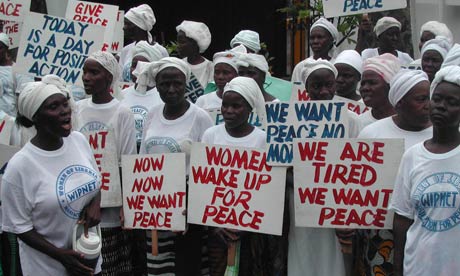
I remember reading this article in Newsweek way back when and have been searching for it since, and today while doing my background reading for the previous post, i finally found it. A good companion piece is Nicholas D Kristof's op-ed on why we need to get money into African women's hands. Also Pray the Devil Back to Hell trailer (about how Liberia's women rose up against tyranny) at the bottom. Enjoy! -MA From http://www.msnbc.msn.com/id/12014185/site/newsweek/ Newsweek, April 3, 2006 issue Healing Powers African women are starting to take charge—making new laws, changing old attitudes, inspiring others to follow their lead. Who will help them mend a broken continent? by JOSHUA HAMMER with Alexandra Polier in Kigali
The national legislature on Monrovia's Capitol Hill is a forlorn wreck of a place, its façade peppered with bullet holes from the country's civil wars, its interior crumbling after two decades of looting and neglect. Legislators wander through darkened hallways that haven't had lights for years; the ceilings are so torn up they look as if they've been hit by mortar rounds. But on a recent Monday, red, white and blue bunting festooned the Joint Chamber and a volunteer band played jauntily on the balcony. Liberian tribal chieftains, Western ambassadors and other dignitaries filed in, buzzing with expectation. Ellen Johnson-Sirleaf, the first elected female leader in Africa's history, was coming to call.
Sweeping in with her entourage at 5 o'clock sharp, Johnson-Sirleaf, who looked both regal and grandmotherly, cast barely a glance over the rogues' gallery that packed the dim hall. There in the front row sat Sen. Adolphus Dolo, formerly known as General Peanut Butter, who stands accused of committing gross abuses as a wartime commander in rural Nimba County. Just behind him, smirking beneath a flaming red cap, was Sen. Prince Johnson, the leader of a breakaway rebel faction that hacked the ears off President Samuel Doe, then killed him, in 1990.
Glowering beside Johnson-Sirleaf on the podium was the new Speaker of the House, Edwin Snowe, accused by opposition leaders and human-rights groups of looting millions of dollars from the Liberian Petroleum Refinery Corporation. (Snowe denies the charge.) Front and center sat Sen. Jewel Howard Taylor, ex-wife of and First Lady to former warlord and president Charles Taylor. Hanging over everything was the specter of Taylor himself, who fled the country in 2003 and has since been accused of stirring up violence from afar.
Yet if Johnson-Sirleaf felt intimidated by the predators who surrounded her, she didn't show it. Instead, she displayed a genteel defiance toward those who wish her harm, and gave hope to those who regard her as a political savior. (A stunning 470,000 voters, or 60 percent, chose her in the November 2005 election.) Standing upright at the podium, she vowed to root out theft from the public coffers and announced a plan to establish a "code of honor" for all civil employees. "Mr. Speaker," she proclaimed, staring directly at Snowe, "we will fight this cancer of corruption."
Nobody doubts her sincerity. But look at what she's up against. For decades, men driven by a lust for power and self-enrichment have ruled the country and stripped it bare. Between 1990 and 2003, ragtag militiamen murdered, raped and plundered with abandon, leaving 150,000 dead and displacing half of the country's 3 million people. Monrovia hasn't had electricity since 1991. Unemployment stands at 80 percent, most schools have been shut down and the infant-mortality rate, at 129 per 1,000 births, is among the worst in the world. Annual per capita income, about $100, is the lowest anywhere.
Can this 67-year-old grandmother, this Harvard-trained economist who has never held a gun and, according to all who know her, never embezzled a dime, really rebuild her ruined country? She has the support of powerful allies—including George W. Bush, whom she met in Washington last week, and U.N. Secretary-General Kofi Annan. But how will she be able to work with the thugs who dominate the legislature? "We believe in redemption," Johnson-Sirleaf told NEWSWEEK. The war criminals in the government, she said, "were elected by the people in a free and fair process, and we accept the decision of the people, who have forgiven them. Unless they revert to their own former practices, we'll give them the benefit of the doubt."
Johnson-Sirleaf's ascendance is the most dramatic development in a quiet revolution transforming Africa. Across the continent, women's empowerment initiatives, disgust with male-dominated politics-as-usual and the inspiring examples of a few female leaders are propelling women to positions of clout in record numbers. Women in at least a dozen African countries are breaking the male stranglehold on national legislatures, cabinets, courts and other government institutions. They're making laws, changing attitudes, inspiring other women to follow them.
The women's revolution has come about partly by necessity. In Rwanda, the genocide led by the Hutu Army and militias nearly wiped out the male Tutsi population. When the killing ended in July 1994, women outnumbered men by seven to three. The government recognized that it faced a crippling shortage of men, and set aside nearly a third of parliamentary seats for female representatives. Now women make up half of Parliament—the largest percentage anywhere in the world.
But Africa's transformation also reflects a growing recognition that the corruption, civil war and decay that have plagued the continent for generations have been largely the work of men. In the past few years, grass-roots women's groups have been sounding a distinctly feminist message, arguing that the qualities displayed by women at the family level—fiscal integrity, maternal nurturing—may be what Africa needs to lift itself off its knees. Give an African woman a loan, they argue, and she'll spend it on her children's school fees and food for the family. Give it to a man, and he'll just as likely fritter it away.
Women certainly have different problems and priorities than men. Across Africa, they're often deprived of education, job opportunities, even the choice of marital partners. Rape is seldom punished. Polygamy is widespread, which has led to spiraling HIV-infection rates. Most African women have no right to own property. Yet the new female politicians are confronting these and other issues that their male counterparts haven't been willing to touch.
Johnson-Sirleaf, who suffered a rape attempt while in jail 20 years ago, worked with a group of female lawyers last year to push Liberia's transitional government to prescribe far tougher sentences for rapists. New laws guaranteeing a woman a sizable share of her late husband's estate just went on the books in Rwanda and Liberia. And microfinancing schemes aimed at freeing women from dependence on men are flourishing. As more women enter legislatures and raise awareness, issues such as inheritance rights, genital mutilation and wife abuse are all coming to the fore. Just as significant, a few African women have proved that they can match or exceed the abilities of men in areas that used to be off bounds—such as law enforcement and security.
Travel now to Lagos, the fetid commercial capital of Nigeria, long regarded as one of the most corrupt, dangerous countries on earth. In the hulking Federal Secretariat building on Lagos Island, Dora Akunyili stands ankle deep in the charred remains of her former office, eying burned air conditioners and dangling wires that still smell of smoke. This is the first time that Akun-yili has been back since March 2004, when arsonists doused four floors of the building with gasoline and set them alight. It was part of an effort by gangs to intimidate her and the law-enforcement agency she runs: the National Agency for Food and Drug Administration and Control, or NAFDAC. "It's depressing being back here," says Akunyili, a 50-year-old mother of three who has become one of the first women to run a police agency in Africa. "But it tells you just how desperate these people are."
Born in southeastern Nigeria to an educated family, Akunyili was a midlevel civil servant with a degree in pharmacology when she inadvertently drew the attention of powerful men in government. While working for the Petroleum Trust Fund, supervising the distribution of oil dividends in villages in southeast Nigeria, she was diagnosed with a potentially fatal pancreatic disorder. Given an $18,000 grant from the PTF, she flew to London for emergency surgery. The diagnosis proved wrong, and Akunyili did the unthinkable: she returned the money. Nigeria had just thrown off years of military rule and established a democracy, and the new president, Olusegun Obasanjo, was looking for a few good men—and women—to clean up the country's tainted agencies. He summoned Akunyili to Abuja, and offered her a job leading the fight against counterfeit drugs.
When Akunyili took over NAFDAC in February 2001, the organization was understaffed and demoralized. Counterfeit drug cartels operated with impunity, protected by corrupt judges, Customs agents and police. In league with manufacturers in India and China, the cartels flooded pharmacies and markets with phony antimalarial pills, antibiotics, blood thinners and dozens of other drugs. According to one study at the time, 80 percent of the pharmaceuticals in Nigeria were fakes. "People were dying in hospitals because of this," says Akunyili, who lost her own sister to an injection of fake insulin. "It was a disgrace."
Weeks after taking over NAFDAC, Akunyili targeted the leader of the most powerful cartel, Marcel Nnakwe, a multimillionaire with an army of bodyguards and protectors high in the government. She pressured wholesalers to reveal Nnakwe's secret warehouses, and acquired product samples for testing. When results proved his drugs were fakes, Akunyili demanded—and got—a confession and a public letter of contrition.
The gesture was meaningless. Fetishes turned up in Akunyili's office as a warning: chicken feathers dipped in blood, a dried tortoise, cowrie shells, beads. Her aides and staff were terrified. Akunyili put a permanent guard at the door, but also stationed agents at ports and seized container loads of phony pharmaceuticals destined for Nnakwe. She raided more warehouses, and NAFDAC destroyed piles of seized drugs in huge bonfires in Lagos.
In December 2003, assassins came for Akunyili. They pulled alongside her Peugeot sedan as she was being driven to work, and opened fire with AK-47s. A bullet grazed her scalp; another killed a bus driver. After the attempt on her life, Akunyili sent her three children—ages 18, 25 and 27—out of the country. But she refused to flee. "If I left after the shooting, I'd look like a coward," she told NEWSWEEK. "I told my family, 'Let me strive to complete my five years'."
Last year Nnakwe and his son were charged in an Abuja court with organizing the attempted hit. But six months into their trial, the judge abruptly announced he had no jurisdiction and freed the defendants. They have gone into hiding. "I suspect it was not just a bribe but a threat [that caused the judge's ruling]," Akunyili says. Despite the setback, Akunyili's crackdown on the cartels has been a huge success. A 2004 study conducted by Britain's Department for International Development said that fake drugs in circulation in Nigeria had declined by 80 percent since she took over. Trust has largely been restored to the pharmaceutical industry. And though Nnakwe remains at large, his drug empire has been broken.
Some countries will be harder to repair than others. In the hallways of Rwanda's National Parliament on the verdant outskirts of Kigali, the chatter and laughter of dozens of women resound through the corridors. It's a dramatic counterpoint to the mortar rounds and machine-gun fire that echoed here a dozen years ago, when Rwandan Patriotic Front guerrillas fought a fierce battle for Parliament with the genocidal Hutu regime. During the war and genocide, hundreds of thousands of Tutsi women and girls were raped, and tens of thousands contracted AIDS. Now, partly in response to that crime, many female legislators have joined forces to rewrite the law—and change the way Rwandan men regard women.
The unprecedented campaign began early last year. Female lawmakers drove through 22 districts, gathering anecdotal evidence from women about their experiences. The progressive sexual-rights bill they drafted establishes a sentence of 15 years for rape, makes spousal abuse a crime, guarantees women an equal split of assets in the event of a divorce, allows them to gain custody of their children and requires that the government set up shelters for victims of wife beating. The bill has received backing from President Paul Kagame, and stands an excellent chance of becoming law this year. "The world is looking to us as role models for gender-based violence," says Rep. Judith Kanakuze, who cosponsored the bill.
Few other African nations have been as progressive. Women in Kenya still have no rights to own property, rape is seldom punished and gender violence appears to be on the rise. Even in countries where tough new laws exist on paper, enforcing them will be difficult. Some 90 percent of Liberian women are illiterate, which makes it hard for them to claim their rights under new property and rape laws passed in 2003 and 2005. But they couldn't ask for a better advocate than Ellen Johnson-Sirleaf.
The new president knows the painful contours of their lives. Although a person of privilege—who had ample opportunities to remain in the West and live a comfortable life—she repeatedly returned home in the face of danger. She says she was raised that way. Her indigenous parents—both adopted as children by Americo-Liberians, the descendants of freed slaves who founded Liberia in 1847—were role models. Her father was the first native Liberian to win election to the country's Congress, but his career was cut short by a crippling stroke when he was in his 40s. Martha Johnson, Ellen's mother, was the family breadwinner, an itinerant Methodist minister who cared for her invalid husband and four kids. Mom traveled from church to church by canoe, often taking the children along. "The things we did as kids instilled hard work and honesty," says the president. "We did chores before and after school, we said prayers every morning. We understood the sanctity of 'do not steal'."
Ellen could have been killed on any number of occasions. She was Finance minister in 1980 when soldiers led by Sgt. Samuel Doe murdered President William Tolbert and seized power. Days later the rebels rounded up 13 top officials, tied them to stakes on a Monrovia beach and shot them dead before a cheering crowd. Johnson-Sirleaf was one of a handful of regime insiders who weren't executed. Five years later, after rival officers attempted another coup, Johnson-Sirleaf again was high on Doe's enemies list. Locked inside a Monrovia prison with 15 men, she cowered in terror as soldiers led her cellmates into a courtyard and executed them. Later that night, one of the killers came back to rape her; she was rescued by a sympathetic guard. "Doe had the opportunity to kill me, but whether because of my international contacts, or my positions, he never gave the instructions to do it," Johnson-Sirleaf says. She spent six months in prison, then was acquitted. She fled to the United States shortly after that.
She knows what it means to grab for a thin reed of hope, only to have it break. In the late 1980s, when Charles Taylor was assembling a ragtag rebel force in Côte d'Ivoire, Johnson-Sirleaf gave him aid and encouragement. "So many people supported him in the early days," Johnson-Sirleaf recalls. "But he betrayed everybody. He was hungry for power." Taylor and his rivals fought a vicious civil war for seven years. When it subsided, Johnson-Sirleaf returned to Liberia and challenged Taylor in elections. But the country was volatile, and most feared that if Taylor lost, he'd return to the bush and restart the war. He won with 75 percent of the vote.
Now that she's finally in control, Johnson-Sirleaf needs all the support she can get. Yet expectations are so high, say analysts and diplomats, that Liberians face an inevitable letdown. Already, female activist groups have complained that she didn't appoint enough women to her cabinet, and foes in Congress reprimanded her for making a state visit to Gabon without their permission. She was forced to dial back on a campaign pledge to restore electricity across Liberia in 150 days; she says now that she'll turn some lights on in Monrovia within six months.
Other pressures are growing on Johnson-Sirleaf from outside the country. During an interview with NEWSWEEK at the end of January, she blasted the European Union for threatening to withhold aid until she leans on Nigeria to extradite Charles Taylor to face trial for war crimes. "I just think they're passing the buck on to me," she said, eyes flashing with annoyance. "They should have taken care of this issue before I came to office. It's hanging over my head."
Two weeks ago, she bowed to pressure and publicly called for Taylor's extradition to the war-crimes tribunal in Sierra Leone —risking a backlash by Taylor loyalists. Nigeria later agreed to turn him over to Liberian custody. "I believe that Ellen's personal survival is at risk," says Minister of Gender and Development Varba Gayflor. "I told the U.S. Embassy, 'Guard the life of Ellen Sirleaf, whatever else you do'."
Fifteen thousand U.N. peacekeepers have kept Liberia quiet since 2003. And the U.S. government has committed $1 billion through 2006 to support the peacekeepers, rebuild Liberia's infrastructure and provide demobilized soldiers with education and jobs. Johnson-Sirleaf can't afford to dwell on the dangers. "I've invested my time, my life, my safety in this country, and the Liberians have always defended me," she told NEWSWEEK. "Now I need to stand by them."
She downplays her role as an African pioneer. "I always start from the note that I'm a technocrat who happens to be a woman," she says. "We're not running a women's government." Still, she says she'll keep pushing for women's rights, making sure that rapists get prosecuted, perhaps even setting government hiring quotas. As a result of her success and the achievements of other women on the continent, Johnson-Sirleaf says, "Women know not only that they can compete, but also that they can excel. They can be mothers and also professionals. They know that we don't have to be stuck in the backyard." It's a shining model for Africa, and even the world. But it's far from complete. If Johnson-Sirleaf fails—if her friends and allies allow her to fail—this model will end up like so many others on the continent, a model of despair.
A REALLY great article on the pros and cons of REDD (Reducing Emissions from Deforestation and forest Degradation) aka Carbon Credits. But by far the best part is this quote from Dan Nepstad:
"We need to approach REDD as a skinny pack donkey upon which we are loading concerns for food security, biodiversity (in savannas and grasslands), land rights, and other issues. The risk is that we will overload the beast and keep it from making any progress or, worse, killing," he said. "REDD must be viewed not as the latest "silver bullet" for protecting tropical forests. Rather, REDD is the first component of a new rural development paradigm that is focused on the maintenance of forests, but that must eventually culminate in even greater biodiversity protection, increased agricultural output, and stronger control over forests and lands by their traditional and indigenous inhabitants."
Scientists convening in Bali expressed a range of concerns over a proposed mechanism for mitigating climate change through forest conservation, but some remained hopeful the idea could deliver long-term protection to forests, ease the transition to a low-carbon economy, and generate benefits to forest-dependent people.
Presenting at the annual Association for Tropical Biology and Conservation, scientists and policy experts warned that the Reducing Emissions from Deforestation and forest Degradation (REDD) program outlined in international climate talks could fail to achieve the desired outcome of protecting forests, while having detrimental impacts on biodiversity and local livelihoods, if it isn't properly designed or excludes critical safeguards. Some researchers argued that the economics of REDD may fall short of competing with returns from other forms of land use, including logging and plantation development, while others said that a successful REDD program could undermine wildlife-friendly farming approaches, promote conversion of low carbon landscapes for industrial tree-planting projects, and shift conservation priorities toward carbon-dense ecosystems.
"REDD is a potentially excellent mechanism by which to address GHG emissions while incidentally contributing to biodiversity conservation and the maintenance of ecosystem services," said Jaboury Ghazoul, an ecologist at ETH Zurich, who discussed potential unrealized costs of REDD. "There are, however, challenges to overcome, ranging from the administrative and technical implementation of REDD, to the wider knock-on effects on downstream livelihoods and regional development. As scientists keen to see the successful implementation of REDD we must also recognize and grapple with its wider challenges."
Several presenters used the host country of Indonesia, which recently signed a one billion dollar deal with Norway to reduce emissions from deforestation and forest degradation, to provide context of the types of problems that could befall a poorly designed and implemented REDD mechanism. Financial fraud Christopher Barr, a former CIFOR researcher, pointed to financial mismanagement and outright fraud in Indonesia's Reforestation Fund as an example. He noted that during former Indonesian President Soeharto's reign the country’s Reforestation Fund suffered losses of more than $5.2 billion – much of it to corruption and fraud. Although the current administration has taken steps to improve financial controls, hHundreds of millions more have been misappropriated or wasted on poorly managed projects in recent years.
According to Barr, “Indonesia’s experience with the Reforestation Fund provides important insights into the government’s capacity to manage and allocate a large stream of funds in the country’s forestry sector. It demonstrates that existing administrative structures are ill-equipped to handle the influx of REDD+ funds and will need to be strengthened. Just as mechanisms are being developed to measure and verify changes in forest carbon emissions, effective systems are urgently needed for financial verification as well.”
Roger James of Conservation International echoed these concerns in a presentation on the REDD readiness of Papua New Guinea, a country that on the international stage has led the push for the payments for forest conservation mechanism, but done little at home to support the scheme at home. James highlighted examples of fraud revolving around the PNG forest carbon sector as well as the rise of a REDD "cargo cult", whereby the expectations for "sky money" have risen so high they can never be met. He mentioned that the fundamentals of REDD were poorly understood in many parts of the country, with some villagers talking of getting carbon money for their forests and then selling the trees to loggers. James said that given the uncertainty around REDD and lack of capacity within PNG, conservationists working in country should focus on making biodiversity conservation effective rather than waiting for carbon finance.
Knock-on effects Jaboury Ghazoul said that policymakers supporting REDD may be greatly undervaluing the opportunity costs of forgoing logging and conversion of primary forests. Looking at Indonesia, he highlighted potential job losses, shifts in overseas development aid regimes linked to forestry, and impacts on downstream industries as examples. Ghazoul also said that by increasing the opportunity cost of land use, REDD could put pressure on "wildlife-friendly" farming approaches like organic agriculture.
"Two important challenges facing human society is reduction of greenhouse gas emissions and the need to meet food demands for a growing population. REDD is a mechanism that can substantially contribute to the first challenge, but by doing so might constrain our ability to manage the second."
"An expanding population will need more food, which is likely to require more agricultural land at the expense of forests, something that would conflict with REDD. Resolving this conflict requires us to produce more food from less land - in other words the intensification of land use. While this may allow us to reconcile one conflict, it opens us up to another - that of maintaining diverse agricultural landscapes that support biodiversity. So, while promoting REDD to preserve forests we might inadvertently be driving agricultural intensification and the loss of biodiversity in human dominated landscape mosaics. REDD++, which accounts for carbon values of agricultural as well as forest landscapes, offers exciting possibilities to circumvent this second challenge." Carbon conservation not necessarily aligned with biodiversity conservation Stuart Pimm, a Duke University scientist, added that biodiversity hotspots not always aligned with the most carbon-dense regions of the world, leading to risk that REDD focus could shift priorities away from species conservation, a sentiment shared by Elizabeth Losos, president of the Organization for Tropical Studies Environmental Sciences & Policy.
Francis "Jack" Putz, an ecologist from the University of Florida, urged caution on what he termed the "arborealization" of conservation agendas. Putz fears that new emphasis on REDD will trigger afforestation of low-carbon ecosystems like savannas, jeopardizing biodiversity.
"We need to be careful not to undervalue low carbon landscapes," he said.
Still hope for REDD Not all the news was negative however. Greg Asner discussed breakthroughs in remote monitoring of forests, including high resolution, 3-D mapping of forest cover using airplane-based LiDAR sensors and advanced processing of satellite imagery. The image processing technology, which is currently being used in the Amazon to detect both deforestation and small-scale forest disturbance caused by selective logging, will soon be available online for Southeast Asia and Africa. Asner said LiDAR is now allowing researchers to conduct biological inventories of tree species from thousands of feet above the canopy at a rate of more than 10,000 hectares per day.
Dan Nepstad, a researcher at the Woods Hole Research Center, was upbeat about the prospects of carbon finance for protecting rainforests. Nepstad detailed the sharp drop in deforestation in the Brazilian Amazon in recent years and said that REDD could play a key part to consolidating gains in the region, perhaps bringing an end to deforestation within a generation, while helping the world transition to a low carbon economy. He cautioned that REDD could be "messy" from the get-go, but the potential benefits are immense.
"We need to approach REDD as a skinny pack donkey upon which we are loading concerns for food security, biodiversity (in savannas and grasslands), land rights, and other issues. The risk is that we will overload the beast and keep it from making any progress or, worse, killing," he said. "REDD must be viewed not as the latest "silver bullet" for protecting tropical forests. Rather, REDD is the first component of a new rural development paradigm that is focused on the maintenance of forests, but that must eventually culminate in even greater biodiversity protection, increased agricultural output, and stronger control over forests and lands by their traditional and indigenous inhabitants."
Claudia Stickler, also a Woods Hole Research Center scientist, added that carbon finance could be a path to reconcile seemingly conflicting national targets for Brazil: a 30 increase in agricultural production by 2019 and a 70 percent reduction in deforestation by 2020. She said REDD payments could provide a key incentive covert the largest drivers of deforestation in the Amazon — ranchers and farmers — into forest protectors.
“It’s important to understand the true potential of REDD+. If done properly, it could represent a sea-change in the prevailing conservation and economic/social development paradigms, which have largely separated these two agendas and/or relegated their conception and execution to relatively small-scale projects and initiatives," she told mongabay.com.
"Clearly, there are a number of critical issues to deal with—not the least of which is the depth and breadth of social engagement that is necessary to make policies associated with REDD implementation stick—but the opportunity to achieve forest governance on a broad scale should not be jettisoned for fear that these obstacles will prove insurmountable.”
Making logging a part of the solution Several ATBC presenters emphasized the importance of "sustainable forest management" or low-impact logging and reforestation under the REDD+ mechanism. Bronson Griscom of The Nature Conservancy, said that reduced impact logging would increase returns from carbon conservation, improving its economic performance and reducing the risk that landowners would abandon forest conservation commitments. Griscom argued that careful logging could help mitigate the issue of international leakage, since forests would continue to supply timber to meet global demand. Lex Hovani, also of The Nature Conservancy, added that low-impact logging could generate income for communities and forest managers once REDD payments are phased out sometime after 2030.
"We need to think not only about how REDD is going to start, but how REDD is going to end," he said.
Putz said that reduced impact logging (RIL) techniques can significantly reduce emissions relative to conventional logging. He estimated that RIL could cut global emissions in legal logging concessions alone by 160-360 million tons per year. Several other researchers reported that selectively logged forest retains 80-90 percent of the species found in primary forests, but cautioned that single-species plantations — like acacia, rubber, and oil palm plantations are biological deserts.
"Plantations aren't forests," said Putz.
The ATBC meeting wraps up tomorrow. A declaration on the billion dollar Norway-Indonesia forest partnership is expected at the conclusion of the conference.
The World Bank released two studies Sunday linking cash payments to Malawian and Tanzanian youths with "significantly lower" rates of HIV and other sexually transmitted infections.
In the first study, a two-year program rewarded young girls in Malawi, rife with poverty and high HIV infection rates, with cash payments for regular school attendance. In Tanzania, the Bank paid young adults in cash to avoid unsafe sex.
The studies "show the potential for using cash payments to prevent people, especially women and girls, from engaging in unsafe sex while also ensuring that they stay in school and get the full benefit of an education," said David Wilson, who heads the Bank's global HIV/AIDS program.
In the education study in Malawi's Zomba district, which has both high HIV rates and school dropout rates among young girls, the World Bank found cash payments for at least 75 percent school attendance each month reduced infection rates by 60 percent, compared to an unpaid control group.
"Girls who received payments not only had less sex, but when they did, they tended to choose younger, safer partners," the World Bank said in a statement on the studies, which were released on the first day of the 18th International AIDS Conference in Vienna.
Cash transfers, the institution said, enabled a significant drop in what is called "transactional sex" among girls and young women who trade intercourse for assistance, gifts or money.
Schoolgirls who received payment appeared to avoid older, wealthier men who are much more likely to be HIV positive than schoolboys, according to the study.
"Programs like these could become an important missing part of effective HIV-prevention strategies," said Berk Ozler, a senior economist with the World Bank's Development Research Group, who conducted the study with researchers from George Washington University and the University of California.
Ozler said the findings suggest that "empowering girls financially can lead to reduced risk -- not just by reducing their sexual activity or practicing safer sex, but also by enabling them to choose partners who are less likely to be infected with HIV in the first place."
In Tanzania, meanwhile, a 12-month cash payment scheme for both young men and women to avoid unsafe sex and prevent a multitude of curable sexually transmitted infections (STIs) found a 25 percent drop compared to a control group.
"Existing prevention strategies have had limited success, so we have to look for creative new approaches to help people change their behavior and finally stop and then reverse the HIV/AIDS epidemic," said senior World Bank economist Damien de Walque, who carried out the study with researchers from the University of California and the Ifakara Health Institute in Tanzania.
To date, the World Bank has provided 4.5 billion dollars for HIV prevention, treatment, care and support programs in developing countries.
Peter Gostelow is cycling across Africa (from north to south) to raise money and awareness for anti-malaria mosquito nets. He has a great blog at http://www.thebigafricacycle.com/ and you can follow him on facebook and twitter as well and then go here to support him on his donation page. Nets are 5$ (USD) each or you can just donate whatever amount you like and you can pay by almost every method possible, its very easy and for a great cause! -MA From his facebook page:
On August 16th 2009 I began a solo and unsupported expedition, by bicycle, from the UK-CapeTown. My route will take me through France, Spain and Portugal, before continuing to west, central and southern Africa - over 25 countries and 20,000km. This is my second major bicycle expedition, having cycled 50,000km from Japan-UK(www.gostelow.crazyguyonabike.com)
As Malaria kills more people in Africa than any other disease, I'm raising money along the way to buy mosquito nets.This is the cheapest and most effective way of preventing the disease. 100% of the money raised will go on nets and a donation of just £3 guarantees that someone receives a net. It is me, with the help of the Against Malaria Foundation charity, who will be distributing the nets. My target is to raise £1 for every kilometre cycled. Help keep me motivated on the road by pledging a donation to The Big Africa Cycle. www.againstmalaria.com/petergostelow
A plea for microfinance in subsaharan Africa: Although its uncomfortable to admit, this is happening in some of the poorest parts of Africa, parents (predominantly fathers) prioritize booze/cigs/petits nanas over their children's education. A really great NYtime OpEd report by Nicholas D Kristof.




 Posts
Posts


