Since I have been really terrible at updating the blog (but pretty good at keeping up with the facebook blog posts) I've added the widget below so that facebook cross posts to the blog.
You shouldn't need to join facebook but can just click on the links in the widget to access the articles. If you have any problems or comments please mail me at arandjel 'AT' eva.mpg.de.
Read this amazing Reddit thread of how one man's tragic attack at a Kenyan orphange lead to major funds being raised for the children under his care.
it all started with this plea:
Meet Omari. Two days ago he returned from the hospital after being hacked in the face by a machete defending an orphanage of 35 children by himself. Think we could raise the $2,000 needed for the remainder of the cement/barbed wire wall to keep both him and the children safe?
As of now, the best way to donate is through www.longonoteducation.org. We will assume that any donation made between now and next week was meant for the Faraja Orphanage in Ngong, Kenya. Also, remember her? The construction date is scheduled for February 15th! Edit: In the process of uploading more pictures of the orphanage, but my modem is being very slow. I would also like to add that this orphanage is unlike any I have seen before. The mother of Omari, the sole caretaker of the children (with the help of volunteers), has made multiple efforts to keep the orphanage sustainable. There are dozens of chickens and a small garden which helps feed the 35 children between the ages of 2 and 17. As you can imagine, these efforts are great but not enough to support 35 children everyday. Edit 2: The wooden fence next to the concrete section of the wall. The goal is to construct a wall the same height as the existing structure, with three feet of barbed wire (three coiled stacked on top of each other) on top. Edit 3: Omari explained to me that many of the kids are very scared to re-enter the home; scared that the attackers are still inside "waiting with knives". So it was nice to see them playing (and eating oranges) outside in the yard. Edit 4: I figure the story is worth sharing: After two previous invasions during the week, Omari was relatively certain another would occur. He woke up to the sound of footsteps outside his door, he figured it was his mother taking a few of the boys outside to go to the bathroom. He quickly realized that the footsteps were heavy, and that of more than one person; he then saw a flashlight shine beneath the crack of his door. Being the third time this happened that week, he had already stashed a hammer beside his bed. He grabbed it, and threw it at the first person who entered his room. He hit the person square in the head, and chased the rest out. The following night, the three thugs returned, presumably to avenge their friend. Omari put up a fight but was outnumbered. The last thing he remembers was being struck in the face by the machete. He has been in and out of the hospital since, yet remains positive and confident that the suspects will one day see justice. Until then, I only hope that is courage and strength is felt by all of you. Speaking with him was a very humbling and special experience that I will never forget. I told him I would try my best to help, so this is my effort: Reddit, already donations are pouring in, and I can't thank you enough. Edit 5: Another picture of a few kids playing with one of their favorite toys. Reddit, twice now, you have nearly brought me to tears. I have never felt so encouraged in my life. Donations are coming in too fast to keep track, so I will update as soon as they seem to slow down. If the donations reach over $2,000, the rest will go towards food and supplies for the children. I will ABSOLUTELY keep all of you updated with the progress. Edit 6: Many people are asking for proof, the mods have contacted me and I'm working on it. It's 5:03am right now, I haven't slept all night (nor do I plan to), I've been messaging my friends on facebook left and right trying to get the word out, but I never, NEVER, could have imagined the night ending this way. In just a few short hours I will return to the orphanage with by far the BEST news I could ever tell anyone. There will be pictures! Edit 7: I've sent the mod a picture of myself, reddit name, date, PSU id, and the expired Kenyan residency card I received in 2010 when I first studied abroad. I am literally waiting for the sun to come up so I can run to the orphanage and tell them the INCREDIBLE news. I will take a picture with everyone (Omari will absolutely be present) and return as soon as I can. Edit 8: Over $9,000 and I'm in a state of shock. I...... Just.....................Thank you. Edit 9: Over $11,000. It's 6am. In 45 minutes I will RUN to the orphanage. I should be back with pictures in just a few hours. This is the best news I have ever had to privilege to tell anyone, and you are all to thank for it. Also, I am too overwhelmed at the moment, but I will do my best to reply to as many comments/messages/questions as I can. Edit 10: $44,000!!!!!!!!! REDDIT!!!!! I can hardly breathe. I refreshed the page at least twice to make sure it was real. I cannot believe this. I just came back from the orphanage..... Let's just say many tears were shed, and many hugs were shared. The children were all leaving to school as I arrived, but I will return around 6pm to take a group picture. I am about to upload the picture and video of Omari's thanks. He's been reading all of your comments, he said he'll read every one if it takes him all day. $44,000. Reddit, thank you. Edit 11: $48,000! This is surreal. Thank you Weebly.com for the $10,000 donation in addition to upgrading our website to Weebly Pro for two free years. Of course, thank you all so much. I must sleep for a bit, but I'll be back! Edit 12: Who am I kidding I couldn't sleep if I tried. We hit the $50,000 mark! I know by now I sound like a broken record, but thank you Reddit, sincerely.
From Save the Serengeti.org Alert! The Serengeti – Why We’re Not Celebrating Those who believe that we’ve stopped the Serengeti highway and achieved a great victory need to step back and look again.
Whose Victory? Unfortunately, some in the media have claimed a great victory for conservation, believing that plans for a road across the Serengeti have been stopped. Some conservation organizations have diplomatically praised President Kikwete for his wisdom.
But we do not share this view, knowing that those who have pushed for a commercial route through the Serengeti can claim their victory as well.
If their plans continue,
* They will get their road across the Serengeti. * They get improved connecting roads on either side of the park. * They get a bonus southern route around the Serengeti. * The way will be paved for more development.
The current Tanzanian government has been refused funds for the Serengeti highway by every major donor, government, and lending institution in the world.
Those who want a true commercial highway clearly cannot achieve it now. But they can make inroads and later connect the dots. A New Road Across the Serengeti is Likely In its recent letter to the World Heritage Committee, the government of Tanzania stated that the road through the Serengeti will not be paved, but will “remain gravel road.”
The truth, however, is more complicated. No gravel road exists across this 53 km stretch. Much of this area is designated as a Wilderness Zone, with no public access.
The 10-year Serengeti management plan, painstakingly developed in 2005 by scientists, Park officials, and conservation organizations clearly indicates that the area in the northwestern part of the Park is particularly sensitive.
As shown on the map below, from the 10-year management plan, the area of the proposed road cuts through areas designated as “Low Use” and “Wilderness” zones.
The Low Use Zone “will have a lower number and density of visitors” and “more limited road network and lower bed capacity.” The Wilderness Zone in green “is subject to minimal disturbance. As a result, visitor access will be restricted to walking safaris, with game viewing by vehicle prohibited. The only infrastructure permitted will be a limited number of access roads that can be used by Park management and support vehicles for walking safari operations.”
These areas were not designated lightly. They are critical to the migration of two million animals as they make their way between Kenya and Tanzania. Of special concern to scientists is the fragmentation of this ecosystem. Fool Me Once… The media has been fooled before. Over the past year, the government spin publicly “gives in” and downgrades the road to gravel, saying it won’t be paved with tarmac after all.
In reality, the road was initially announced as gravel.
In November, 2009, the Tanzanian delegation to the UNESCO World Heritage Centre announced the road through the northern Serengeti. Representing their government, they stated a “53 km stretch within the Serengeti would be a gravel and not a tarmac road.”
Yet in September of 2010, appearing to give into pressure, President Kikwete said that, okay they’ve decided not to pave the road. Again on February 9, speaking to the World Bank, he repeated, “we will not build a tarmac road.” And at this year’s World Heritage Committee meeting in Paris, the mantra was repeated: no tarmac road.
In fact, the initial road surface has never been the real issue. Tanzania’s original statement of a gravel road prompted the WHC to warn of dire consequences to the ecosystem.
“The World Heritage Centre and IUCN consider that, if built, the North Road could critically impact the property’s Outstanding Universal Value and justify its inscription on the List of World Heritage in Danger.”
What is different now? The government curiously says that the current road across the same 53 km stretch across wilderness zone will “remain” gravel, though no such road exists. They do not exclude commercial use, stating that it will be “mainly for tourism and administrative purposes as it is currently.” And clearly, it will be the only connection between upgraded roads being planned on either side of the Serengeti. Whatever route is now there, which is not much, will have to be upgraded to make this connection happen.
One good piece of news – the road will remain under the management of the Park. This will mean gates and restrictions. But for how long? Just the Beginning
When the road was announced, conservation organizations and scientists immediately sounded the alarm. Though initially announced as gravel, no one, in fact, ever believed that the road would remain unpaved.
Tony Sinclair, one of the world’s leading experts on the Serengeti, wrote:
“The soils are largely of silt and cannot take heavy vehicle traffic. Although the road may be initially of murrum (a clay soil) or gravel, the increasing flow of vehicles will inevitably lead to a tarmac road. This will result in road kills when as many as one million wildebeest will be settled, not just crossing, along this road… Essentially the Serengeti as we know it will no longer exist. History has shown that once we start this process of road development, there is no turning back on the sequence.”
Last year, Serengeti Watch conducted a survey of 302 world scientists. 71% of them believed that if the road was built, the collapse of the migration would be very or extremely likely, or inevitable. See the petition and survey
Even the government’s own Environmental Impact Statement assumed that the road would not be paved, yet predicted it would carry hundreds of thousands of vehicles a year. Those estimates will certainly be reduced, as yet another impact study is prepared. The expected volume of traffic should go down, and this is good.
But after the government’s latest announcement, a leading infrastructure expert wrote us saying, the road from Mugumu to Loliondo (those sections on the margins of the park) not being paved is “clearly progress against the previous statement that only the road through Serengeti section will not be tarmac.” But he adds,
“That is however only 20% (of the entire route) and likely not a great deterrent against large scale through traffic. The fundamental question remains: what would be the purpose of this road?”” Motives Recently, information has come to light about other motives behind the highway. In fact, if some have their way, the highway will actually be a railway.
In 2010, the Uganda and Tanzanian governments signed a Memorandum of Understanding for the development of a new transportation route between Uganda and the Indian Ocean port of Tanga in Tanzania. The route would extend from Lake Victoria through the Serengeti, on to Arusha, and then to the Indian Ocean.
Tanzania’s Transport Minister, Omar Nundu, spoke earlier this year about the plans for this new route. He stated the project would involve the construction of a new port at Mwambani harbor, near Tanga. It would also include a Tanga-Arusha-Musoma Railway. (Musoma is on Lake Victoria.)
This would give Uganda an alternate means of exporting oil and minerals, in addition to the railway through Kenya. It would also provide the Chinese with another route for minerals from the African interior, particularly coltan, a mineral used in cell phones. Along this route lies Lake Natron, virtually the only breeding ground for East Africa’s lesser flamingos. President Kikwete has recently vowed to mine Lake Natron for soda ash, regardless of what any environmental impact study says.
And the terminus of this route, Mwambani Harbor, where the Coelocanth Marine Reserve would be sacrificed.
The Future So with the recent statement on the Serengeti road, have these big plans now changed? One June 23, one day after the letter to the World Heritage Centre was released, The Guardian newspaper interviewed Deputy Minister for Transport, Athuman Mfutakamba. The article says
“that apart from improving Tanga port, they would also construct a new port in Mwambani area. He noted that the new port would mainly serve as a gateway for consignments transported to the northern part of the country, Uganda, Rwanda, Burundi and Southern Sudan after completing the Arusha-Musoma railway.”
The Serengeti highway has been proposed three times in the past. Inevitably, as population and trade grows, the Uganda-Tanga commercial route will be more and more compelling. Road traffic will grow, settlements will expand, and with it, what experts have feared (and predicted) all along, demands that the road be paved and fenced. Hope There is always hope. Not hope that traffic will be kept to a minimum, but that the Serengeti road won’t be build at all, that the area will be kept intact for the migration.
Hope that the world will see through what one world authority on wildebeests has termed “smoke and mirrors” and understand the struggle is far from over. Hope that authorities will understand the economic asset that the Serengeti represents.
And hope that people living around the park, and throughout Tanzania, will see real benefits and protect the Serengeti for future generations.
With a growing population and expanding human needs, increased pressure is inevitable. This is a critical time. To make the Serengeti ecosystem viable, we must make sure that the Serengeti provides for the needs of the people whose heritage it is.
We cannot afford to lose the Serengeti, because once gone, it will be gone forever.
Possible Solutions: Build support for a rational solution that benefits the Tanzanian people. What's Being Done: Continued pressure to abandon the road altogether.
WHAT AN AMAZING WAY TO END THE WEEK!!! Great news today - a major victory for East Africa and its wildlife, and a great victory for the power of social media. Today hope wins. -MA
In what is a victory for environmentalists, scientists, tourism, and the largest land migration on Earth, the Tanzanian government has cancelled a commercial road that would have cut through the northern portion of the Serengeti National Park. According to scientists the road would have severed the migration route of 1.5 million wildebeest and a half million other antelope and zebra, in turn impacting the entire ecosystem of the Serengeti plains.
"The State Party confirms that the proposed road will not dissect the Serengeti National Park and therefore will not affect the migration and conservation values of the Property," reads a statement from the Tanzanian Ministry of Natural Resources and Tourism. A paved road, however, will be constructed close to the park boundaries: ending at Mugumu on the western side (12 kilometers from the park's border) and Loliondo on the eastern side (57.6 kilometers from the border), allowing a slim buffer of habitat around the park. It is uncertain whether a gravel road will be constructed through the park, but if it is it will remain under the park authority TANAPA and will be used for tourists and administration according to the statement.
According to a recent scientific study direct impacts from the road would have cut the wildebeest herd down by over one-third (over half a million animals) with indirect impacts, such as poaching and new development, exacerbating the situation.
"[The road's cancellation] is a wise and insightful decision by the Tanzanian Government," Andrew Dobson, who was one of the authors on the study, told mongabay.com. "It will ensure the long-term persistence of the Serengeti ecosystem and it's world famous wildebeest migration, while also providing infrastructure to the people who live to the East of the Serengeti. It allows Tanzania to show great leadership to other African nations, by illustrating that the way to economic success in the 21st Century is to balance natural resource conservation with economic development."
A leaked government environmental impact study largely agreed with Dobson's study, finding that the road would 'limit' the Serengeti migration and hurt predator populations (lions, hyenas, cheetahs, leopards, crocodiles, etc.) due to a declining prey base.
By 2015, the government report predicted that 800 vehicles per day would cross the proposed 30 mile (50 kilometer) stretch of the park. By 2035, the number of vehicles per day is expected to rise to 3,000, or well over a million a year. Conservationists and researchers in the area told mongabay.com that these were conservative figures.
For over a years conservationists warned that the road would eventually kill the iconic migration, crippling Tanzania's tourism industry and ending one of the last great wildlife spectacles on the planet. Wildlife NGOs fought fiercely against the road, including crafting images of wildebeest being mowed down by semi-trucks.
But concern regarding the road came from more than just environmentalists. The US and German governments, as well as the UN, voiced opposition to the road plans. The World Bank offered to pay for an alternative route circumventing the park, while the German government offered to pay for local roads for cut-off people in the northern Serengeti region. Connecting far-flung local populations was the Tanzanian government's line on the need for the road, however many suspected that the road was being aggressively pushed as part of an industrial corridor to bring raw materials from the African interior quickly and cheaply to the coast. In the statement on the road cancellation, Tanzania says it is considering the alternative southern route.
"A battle has been won, but the struggle to save the Serengeti goes on. Roads will still be constructed up to the edges of the park. The pressures on the Serengeti, including a commercial corridor to Uganda, still exist. The highway across the Serengeti has been proposed three times now, and can be raised again. But yes, let's congratulate ourselves on the work we've done," reads a statement from the NGO Serengeti Watch.
Environmentalists have been increasingly concerned by government plans in Tanzania. While the Serengeti road has received the most coverage, Tanzania has also recently announced plans to mine soda ash in the world's most important lesser flamingo breeding ground, Lake Natron. The plans were abandoned in 2008 due to concerns that it would disrupt the flamingo's breeding, but were recently resurrected and put on the fast-track. Over half of the world's lesser flamingos (65-75%) breed on the single lake.
However, Dr. Dobson says now is the time to credit the Tanzanian government for safe-guarding the Serengeti ecosystem.
"President Kikwete and Minister for Natural Resources and Tourism, Ezekial Maige, deserve the nation's and the world's praise for making a wise and forward looking decision at a time when they were under pressure from multiple national and international sources to make a very difficult decision," Dobson said. "They have shown great leadership that points the way to the future for all African nations." "A battle has been won, but the struggle to save the Serengeti goes on. Roads will still be constructed up to the edges of the park. The pressures on the Serengeti, including a commercial corridor to Uganda, still exist. The highway across the Serengeti has been proposed three times now, and can be raised again. But yes, let's congratulate ourselves on the work we've done," reads a statement from the NGO Serengeti Watch.
Environmentalists have been increasingly concerned by government plans in Tanzania. While the Serengeti road has received the most coverage, Tanzania has also recently announced plans to mine soda ash in the world's most important lesser flamingo breeding ground, Lake Natron. The plans were abandoned in 2008 due to concerns that it would disrupt the flamingo's breeding, but were recently resurrected and put on the fast-track. Over half of the world's lesser flamingos (65-75%) breed on the single lake.
However, Dr. Dobson says now is the time to credit the Tanzanian government for safe-guarding the Serengeti ecosystem.
"President Kikwete and Minister for Natural Resources and Tourism, Ezekial Maige, deserve the nation's and the world's praise for making a wise and forward looking decision at a time when they were under pressure from multiple national and international sources to make a very difficult decision," Dobson said. "They have shown great leadership that points the way to the future for all African nations."
"A battle has been won, but the struggle to save the Serengeti goes on. Roads will still be constructed up to the edges of the park. The pressures on the Serengeti, including a commercial corridor to Uganda, still exist. The highway across the Serengeti has been proposed three times now, and can be raised again. But yes, let's congratulate ourselves on the work we've done," reads a statement from the NGO Serengeti Watch.
Environmentalists have been increasingly concerned by government plans in Tanzania. While the Serengeti road has received the most coverage, Tanzania has also recently announced plans to mine soda ash in the world's most important lesser flamingo breeding ground, Lake Natron. The plans were abandoned in 2008 due to concerns that it would disrupt the flamingo's breeding, but were recently resurrected and put on the fast-track. Over half of the world's lesser flamingos (65-75%) breed on the single lake.
However, Dr. Dobson says now is the time to credit the Tanzanian government for safe-guarding the Serengeti ecosystem.
"President Kikwete and Minister for Natural Resources and Tourism, Ezekial Maige, deserve the nation's and the world's praise for making a wise and forward looking decision at a time when they were under pressure from multiple national and international sources to make a very difficult decision," Dobson said. "They have shown great leadership that points the way to the future for all African nations."
"Last real preserve of nature, of our collective humanity" says award winning foreign correspondent Richard Engel in a two part segment done by NBC NIGHTLY NEWS. Below are the links to both shows:
We believe this might be the first ever recorded rescue of a baby zebra and wildebeest by the same hippo on the Mara River close to Lemala Mara camp. Both were rescued within space of 10 minutes as they crossed over from the Lamai side. The photos and videos were captured by Michael Yule and other guests as they were watching a major wildebeest crossing at the time.
The hippo was watching as the wildebeest herd swam past. As soon as the calf jumped in, the hippo swam up to it and pushed it along all the way across until it had reached safety on the other side. It then went back and did the same for a zebra foal just minutes later.
The wildebeest and zebra are now moving down in large numbers from the Masai Mara across the Lamai plains and crossing the Mara River. Guests of Lemala Camp are witnessing crossings every day. Some of the herds have arrived north of Lobo.
From the 15th of November, Lemala Ndutu will be newly appointed with the larger styled tents. As this camp moves to the banks of the Mara River in the Northern Serengeti, the Mara Camp as from 1st of June 2011 will also have the new tents.
We still have space available at Lemala Mara and your guests might just witness the miracle rescues again. It appears the crossings will continue until end of October and possibly longer if there are showers and the wildebeest return to the Lamai and Kogatende areas.
Football fans who watch the televised English Premier League match between Stoke City and West Ham United on Saturday may get an urge to visit Tanzania. Adverts in Stoke's Britannia Stadium will tout the country's attractions, including the Serengeti National Park.
Home to an iconic wildebeest migration, the Serengeti is one of the most valuable ecosystems on the planet. So why does President Jakaya Kikwete of Tanzania want to build a road through it?
In an Opinion piece on page 272 [see below-MA], 27 conservation experts warn that the proposed road could drive the entire Serengeti ecosystem to collapse by interrupting or diverting migration routes. No more wildebeest migration. No more tourists. The consequences seem dire.
Plans for a road across the Serengeti have been rejected on environmental grounds before. The World Bank refused funds in the 1980s, and impact assessments by external consultants in the 1990s found that the probable damage was too high a price for transport convenience.
Yet, in late July, Kikwete confirmed that his government would send bulldozers to the Serengeti in 2012, repeating a campaign pledge that he made in 2005. Markers along parts of the proposed route are already in place.
The president's desire to push the road through the Serengeti is especially puzzling given that an alternative route, farther south and outside the boundaries of the park, would bring many of the same economic benefits from increased trade and avoid the most serious effects.
As the New York Times noted last month, Kikwete's government is not keen for anyone to pursue its reasoning — especially Tanzanians.
Conservation and politics are tightly bound, and in this case the politics are opaque indeed. Ahead of coming elections in the country, there are rumours of favours to be repaid to the communities in the north and east of the Serengeti that would benefit the most from the road.
Some observers claim that the Chinese government is set to fund the US$480 million project, to help extract raw materials such as minerals from its existing investments in east Africa. There has been no official explanation of the reasons for the decision or of where funds will come from. It is difficult for anyone outside the Tanzanian government to know anything for sure.
Against this uncertain background, those pushing for the Serengeti road to be abandoned should proceed with caution to avoid exacerbating the situation. Thousands of people across the world have backed protest websites, and some in the US tourist industry mutter about a possible boycott of Tanzania — leading Kikwete to hit out at what he characterizes as pressure from ill-informed foreigners.
A swell of well meaning but poorly targeted international criticism could strengthen the president's position and allow him to promote the road as a way for Tanzania to stand up to meddling outsiders.
Critics should also be careful not to overstate the case. The government has so far promised only a gravel road; predictions of the most serious ecological damage are based on an upgraded tarmac highway protected with fences, which would probably follow.
The next step should be a comprehensive and independent assessment of the two routes and their respective merits. If the southern route proves as superior as its supporters promise, then those both outside and inside the Kikwete government will be able to present it as the wise environmental and political choice. That is the best way to stop the road taking this damaging and unnecessary route.
Plans for building a two-lane road through 50 kilometres of the Serengeti National Park in Tanzania must be halted. The road will cause an environmental disaster by curtailing the migration of wildebeest. Evidence from other ecosystems demonstrates that migratory species are likely to decline precipitously, causing the Serengeti ecosystem to collapse, and even flip from being a carbon sink into a major source of atmospheric carbon dioxide.
A road linking Tanzania's coast to Lake Victoria and Uganda, Rwanda, Burundi and the Democratic Republic of the Congo has been under discussion for the past 20 years. Pressure to start digging is mounting in the run-up to Tanzania's election next month, in part because of increasing foreign economic interest in the mineral wealth of Central Africa.
There is an alternative to driving the road through the World Heritage Sites of the Serengeti National Park, where humans took their first recorded steps1 and which harbour one of the last great animal migrations2. Building a road to the south of the Ngorongoro Conservation Area would minimize environmental and economic damage and maximize benefits to human development and infrastructure. Domino effect
The Serengeti is a rare and iconic example of an ecosystem driven by a large mammal migration3. Classic, long-term studies there have made fundamental contributions to knowledge of how natural ecosystems function4, 5. Rain falling on rich volcanic soils creates phenomenal nutrient-rich plant life that wildebeest, zebra and gazelle consume during their breeding seasons. When the rains end, these herds migrate to southern Kenya, hundreds of kilometres north, to access water and pastures nourished by dry-season rainfall. The nearly 2 million herbivores are an essential resource for a large predator community that includes globally important populations of threatened carnivores such as lions, cheetahs and wild dogs.
Wildebeest — 1.3 million of them — are the keystone species in the Serengeti ecosystem. They determine the abundance and diversity of all other species. Each year about 500,000 calves are born in February, on plains where they consume about 50% of the rapidly growing grasses. Each day the herd produces 500 truckloads of dung and 125 road tankers of urine, recycling vast quantities of nutrients throughout the system. Their grass consumption removes fuel that would otherwise cause fires to destroy trees. They also maintain grasslands by trampling and thrashing seedlings and saplings. Disrupting their annual migration cycle would dramatically alter this ecosystem.
Each year, about 1.5 million wildebeest and zebras cross the path of the proposed road as they head north, and then again on their return south. In drier years, or those with erratic rainfall, they cross many times, responding to local rainfall. This would be a significant hazard for traffic, and would probably result in human and animal casualties. The proposed road (see graphic) would also bisect newly re-established wild dog and rhinoceros populations, reducing the probability of the emergence of spatially distinct, interbreeding populations of these endangered species. Figure 1
Once the public road is built, the area within 50 metres on either side would no longer be under the jurisdiction of the national parks (as in Mikumi National Park in eastern Tanzania). Traffic could travel at night and at speed — restrictions and calming methods are difficult to implement in rural Tanzania6. Increasingly hazardous road-traffic collisions would probably necessitate fencing, as happened in Banff National Park in Canada7, 8. Fences, roads and habitat fragmentation have caused the recent collapse of at least 6 of the last 24 terrestrial migratory species left in the world2. Although speed bumps in Mikumi and overpasses in Banff have reduced the number of wildlife collisions, these have cost several million dollars and speed bumps scarcely slow traffic or prevent collisions. In Banff, overpasses carry populations of several hundred elk and deer and increasingly rare carnivores. No overpass could be wide enough, or long enough, for 1.5 million wildebeest and zebras. In all other areas where fences and roads have hampered large-mammal migrations, notably Banff, Etosha National Park in Namibia and Kgalagadi Transfrontier Park in Botswana, the ecosystem has collapsed to a less diverse and less productive state9, 10.
Simulations11 suggest that if wildebeest access to the Mara river in Kenya is blocked, the population will fall to less than 300,000. This would lead to more grass fires, which would further diminish the quality of grazing by volatizing minerals, and the ecosystem could flip into being a source of atmospheric CO2. The trees and soil there are a significant carbon sink. The system would return to the impoverished state that developed when wildebeest numbers plummeted during the rinderpest pandemic in the last decade of the nineteenth century12. There would be far fewer game, fewer predators and more than 80% of the park would burn every year.
The public road would carry goods and supplies, including seeds of potentially invasive and non-native species, chemical pesticides, herbicides and livestock pathogens transmissible to wildlife. It would also disrupt local patterns of water drainage, increasing erosion and changing local vegetation. The road would become a source of chemical pollutants, particularly lead and other heavy metals; these would accumulate in the dry season and then flow into streams and rivers at high concentrations during the rains13, 14. Roads also allow easy access for poachers, and create a ribbon of communities on either side, increasing human–animal conflict.
Construction of the road by the Tanzanian government is planned for 2012; marker flags have already been placed in some sections of the park. An evaluation, 15 years ago, of a route between the coast and Musoma considered a route through Ngorongoro and the Serengeti — it was discarded because of their environmental sensitivity. At the time, the Tanzania National Parks authority was not supportive of the road through the park. After the last election (2005), promises by President Jakaya Kikwete for a road linking Lake Victoria to the coast led to two more evaluations: both concluded that a road would ruin the Serengeti's status as a major tourist destination and as a World Heritage Site. A better way
There is a clear alternative to the Serengeti route. A road going around the southern end of the park, and never crossing park boundaries (see graphic), would also connect Lake Victoria to Arusha and then to the coastal ports. It would provide valuable access to agricultural markets for around 2.3 million people as opposed to 431,000 on the northern route. The southern road could use an existing gravel road network and would require an additional 155 kilometres of new road, as opposed to 120 kilometres. The total southern road from the coast would be about 50 kilometres longer than the northern route, but could cost less, in not having to climb the 500-metre cliff face of the Rift Valley. Above all, it would allow crucial development in rural Tanzania to proceed with minimal damage to tourism, which contributed US$824 million to the nation in 2005 — 23% of the total foreign revenue and 6.3% of all Tanzanian jobs.
Tanzania is a developing country, with an average gross national income of $350 per year; more than 95% of its people live on less than $2 per day. These people need improved infrastructure to facilitate development, distribute goods and reach agricultural markets. However, wildlife tourism is a cornerstone of Tanzania's economy, and the Serengeti, along with Mount Kilimanjaro, is central to the success of this industry. Moreover, ecotourism is supported by pastoralist land use in conservation areas, such as Loliondo and Ngorongoro (see graphic), that surround the park. Livestock production accounts for well over half of all household income across these buffer-zone districts15 and drives regional, national and international livestock trade. The proposed road would severely affect these economic and ecological synergies.
In sum, the proposed road could lead to the collapse of the largest remaining migratory system on Earth — a system that drives Tanzania's tourism trade and supports thousands of people. Such a collapse would be exceedingly regrettable for a country that has consistently been a world leader in conservation. We therefore urge the government of Tanzania and all stakeholders to consider carefully the full ecological and economic benefits of building the route to the south. This road would open up transport to the interior, but explicitly acknowledge and conserve the global benefits of preserving the Serengeti National Park, one of the world's natural wonders and one of Africa's last surviving pristine ecosystems.
Update: today, Cynthia Moss posted the final picture of Winston on her facebook. She writes: "I hate to have to post this photo but I think it's necessary. This is Winston."
To end on a slightly more hopeful note though, Sean Whyte posted the following on his facebook today:
"If you think you're too small to be effective, you have never been in a bedroom with a mosquito.-Anon"
One of Amboseli's up-and-coming prime bulls was killed by poachers the day before yesterday. Winston had just turned 30 in January of this year and was regularly coming into musth. It should have been just the beginning of a successful breeding life but he was cut down for his ivory tusks.
I felt particularly close to Winston because he was one of 14 calves I chose for a special study in 1980. I carried out research on mother-calf bonds and calf development on these calves and so I spent hours with them in the first year of their lives.
Here's a photo of Winston. He was easy to recognize because he had a huge chunk out of his left ear. His mother was Willa of the WA family and he was born in January 1980. At 30 years old he was only just entering his prime. I fear we are going to lose all of Amboseli's older bulls.
I haven't been posting too much on the Serengeti highway because there are many great resources out there to keep updated about the project, including the great facebook page "stop the serengeti highway" and its affiliated website. It seems like recently all was lost, the president had OKed the project, made his declarations and all the protests in the world were not going to stop him. But, it seems like now opposition to the highway is gaining steam and the New York Times even reported on it today. Please visit savetheserengeti.org for more information. -MA
Wildebeest Roadblock? Highway Planned in Serengeti From the NYTimes
Tanzania's Serengeti is a vast plain dotted with acacia trees and watering holes, where wildebeest and zebra gather in huge herds for annual migrations.
But conservationists warned Wednesday that one of the world's natural wonders will be scarred and the ancient migratory patterns destroyed if Tanzania's government carries through with a plan to build a highway through the park.
The Wildlife Conservation Society and the Zoological Society of London called on Tanzania to reconsider the plan.
''The Serengeti is the site of one of the last great ungulate (hoofed) migrations left on Earth, the pre-eminent symbol of wild nature for millions of visitors and TV viewers, and a hugely important source of income for the people of Tanzania through ecotourism,'' said James Deutsch, executive director of the WCS's Africa Program.
''To threaten this natural marvel with a road would be a tragedy,'' Deutsch said.
Tanzania plans to build a 420-kilometer (260-mile) road between Arusha, near Mount Kilimanjaro, and Musoma, on Lake Victoria, in 2012. The route would bisect the northern Serengeti, potentially jeopardizing the 2 million wildebeests and zebra who migrate in search for water from the southern Serengeti north into Kenya's adjacent Masai Mara reserve.
Tanzania's government says the road is needed to connect the country's west with commercial activity on the eastern coast. The president has vowed to move forward with its construction.
A spokesman for Tanzania National Parks, Pascal Shelutete, said the road won't be built until feasibility studies have been done.
''All the precautions will be taken care of. The government is aware of the importance of this portion of the road,'' Shelutete said. ''The project won't take off until all the kinds of studies are carried out to see what will be the positive and negative impact of it.''
But Tanzanian media have previously quoted officials as saying such feasibility studies have already been completed and that the road project is on track.
Critics say a new highway could just as easily be built through the southern parts of the park and not harm the migratory route.
The northern road could provide easier access for poachers, and conservationists predict a ''catastrophic decrease'' in wildebeests and zebras, both from a stunted migration and animals being hit by vehicles.
''Once that starts to happen officials are going to want to put a fence up, and once you have a fence you stop the migration completely,'' said Sarah Christie, a conservationist at the Zoological Society of London.
The Frankfurt Zoological Society sounded an alarm against the road earlier this year, saying its construction would have ''disastrous effects'' on the region's ecosystem.
A Kenya Wildlife Service spokeswoman, Kentice Tikilo, said the road would negatively affect Kenya's Masai Mara, which sits directly above the Serengeti. Animals move back and forth over the border between the two parks. If the road is built and the animal populations dwindle, Masai Mara stands to lose animals and consequently fewer tourists will want to visit.
''At the end of the day we want to be sure conservation wins, whether it's on the Tanzania side or the Kenya side,'' Tikilo said. ''We are all conservationists and we want to be sure we preserve our heritage.''
How do we even start to convince people that ivory and rhino horn are bad, when they are trading their own species??? -MA
Albino children in a school for the blind in Tanzania
From BBC.co.uk Kenyan jailed for trying to sell albino In Tanzania, albino body parts are believed to bring wealth or health
A court in Tanzania has sentenced a Kenyan accused of trying to sell an albino to 17 years in jail and a fine of more than $50,000 (£41,200). The court sentenced Nathan Mutei after he pleaded guilty to human trafficking. Police said they arrested Mutei in a sting operation as he tried to sell an albino fellow Kenyan for the equivalent of more than $250,000. Albino body parts are prized in parts of Africa, with witch-doctors claiming they have special powers.
The albino, Robinson Mkwama, is being escorted home to Kenya with a police guard, the BBC's Eric Nampesya reports from Tanzania. Mutei, 28, was arrested just outside the town of Mwanza. In the sting operation, which was announced on Tuesday, police pretended to be businessmen buying albino body parts.
The regional police commander, Simon Siro, told the BBC that Mr Mutei had tricked Mr Mkwama, 20, into believing he would secure a job in Tanzania as a lorry driver's assistant.
In Tanzania, the body parts of people living with albinism are used by witch-doctors for potions which they tell clients will help make them rich or healthy. Dozens of albinos have been killed, and the killings have spread to neighbouring Burundi. Tanzanian authorities have promised to crack down on albino traffickers, and several people have been sentenced to death in connection with killings.
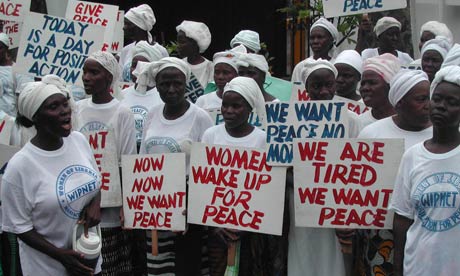
I remember reading this article in Newsweek way back when and have been searching for it since, and today while doing my background reading for the previous post, i finally found it. A good companion piece is Nicholas D Kristof's op-ed on why we need to get money into African women's hands. Also Pray the Devil Back to Hell trailer (about how Liberia's women rose up against tyranny) at the bottom. Enjoy! -MA From http://www.msnbc.msn.com/id/12014185/site/newsweek/ Newsweek, April 3, 2006 issue Healing Powers African women are starting to take charge—making new laws, changing old attitudes, inspiring others to follow their lead. Who will help them mend a broken continent? by JOSHUA HAMMER with Alexandra Polier in Kigali
The national legislature on Monrovia's Capitol Hill is a forlorn wreck of a place, its façade peppered with bullet holes from the country's civil wars, its interior crumbling after two decades of looting and neglect. Legislators wander through darkened hallways that haven't had lights for years; the ceilings are so torn up they look as if they've been hit by mortar rounds. But on a recent Monday, red, white and blue bunting festooned the Joint Chamber and a volunteer band played jauntily on the balcony. Liberian tribal chieftains, Western ambassadors and other dignitaries filed in, buzzing with expectation. Ellen Johnson-Sirleaf, the first elected female leader in Africa's history, was coming to call.
Sweeping in with her entourage at 5 o'clock sharp, Johnson-Sirleaf, who looked both regal and grandmotherly, cast barely a glance over the rogues' gallery that packed the dim hall. There in the front row sat Sen. Adolphus Dolo, formerly known as General Peanut Butter, who stands accused of committing gross abuses as a wartime commander in rural Nimba County. Just behind him, smirking beneath a flaming red cap, was Sen. Prince Johnson, the leader of a breakaway rebel faction that hacked the ears off President Samuel Doe, then killed him, in 1990.
Glowering beside Johnson-Sirleaf on the podium was the new Speaker of the House, Edwin Snowe, accused by opposition leaders and human-rights groups of looting millions of dollars from the Liberian Petroleum Refinery Corporation. (Snowe denies the charge.) Front and center sat Sen. Jewel Howard Taylor, ex-wife of and First Lady to former warlord and president Charles Taylor. Hanging over everything was the specter of Taylor himself, who fled the country in 2003 and has since been accused of stirring up violence from afar.
Yet if Johnson-Sirleaf felt intimidated by the predators who surrounded her, she didn't show it. Instead, she displayed a genteel defiance toward those who wish her harm, and gave hope to those who regard her as a political savior. (A stunning 470,000 voters, or 60 percent, chose her in the November 2005 election.) Standing upright at the podium, she vowed to root out theft from the public coffers and announced a plan to establish a "code of honor" for all civil employees. "Mr. Speaker," she proclaimed, staring directly at Snowe, "we will fight this cancer of corruption."
Nobody doubts her sincerity. But look at what she's up against. For decades, men driven by a lust for power and self-enrichment have ruled the country and stripped it bare. Between 1990 and 2003, ragtag militiamen murdered, raped and plundered with abandon, leaving 150,000 dead and displacing half of the country's 3 million people. Monrovia hasn't had electricity since 1991. Unemployment stands at 80 percent, most schools have been shut down and the infant-mortality rate, at 129 per 1,000 births, is among the worst in the world. Annual per capita income, about $100, is the lowest anywhere.
Can this 67-year-old grandmother, this Harvard-trained economist who has never held a gun and, according to all who know her, never embezzled a dime, really rebuild her ruined country? She has the support of powerful allies—including George W. Bush, whom she met in Washington last week, and U.N. Secretary-General Kofi Annan. But how will she be able to work with the thugs who dominate the legislature? "We believe in redemption," Johnson-Sirleaf told NEWSWEEK. The war criminals in the government, she said, "were elected by the people in a free and fair process, and we accept the decision of the people, who have forgiven them. Unless they revert to their own former practices, we'll give them the benefit of the doubt."
Johnson-Sirleaf's ascendance is the most dramatic development in a quiet revolution transforming Africa. Across the continent, women's empowerment initiatives, disgust with male-dominated politics-as-usual and the inspiring examples of a few female leaders are propelling women to positions of clout in record numbers. Women in at least a dozen African countries are breaking the male stranglehold on national legislatures, cabinets, courts and other government institutions. They're making laws, changing attitudes, inspiring other women to follow them.
The women's revolution has come about partly by necessity. In Rwanda, the genocide led by the Hutu Army and militias nearly wiped out the male Tutsi population. When the killing ended in July 1994, women outnumbered men by seven to three. The government recognized that it faced a crippling shortage of men, and set aside nearly a third of parliamentary seats for female representatives. Now women make up half of Parliament—the largest percentage anywhere in the world.
But Africa's transformation also reflects a growing recognition that the corruption, civil war and decay that have plagued the continent for generations have been largely the work of men. In the past few years, grass-roots women's groups have been sounding a distinctly feminist message, arguing that the qualities displayed by women at the family level—fiscal integrity, maternal nurturing—may be what Africa needs to lift itself off its knees. Give an African woman a loan, they argue, and she'll spend it on her children's school fees and food for the family. Give it to a man, and he'll just as likely fritter it away.
Women certainly have different problems and priorities than men. Across Africa, they're often deprived of education, job opportunities, even the choice of marital partners. Rape is seldom punished. Polygamy is widespread, which has led to spiraling HIV-infection rates. Most African women have no right to own property. Yet the new female politicians are confronting these and other issues that their male counterparts haven't been willing to touch.
Johnson-Sirleaf, who suffered a rape attempt while in jail 20 years ago, worked with a group of female lawyers last year to push Liberia's transitional government to prescribe far tougher sentences for rapists. New laws guaranteeing a woman a sizable share of her late husband's estate just went on the books in Rwanda and Liberia. And microfinancing schemes aimed at freeing women from dependence on men are flourishing. As more women enter legislatures and raise awareness, issues such as inheritance rights, genital mutilation and wife abuse are all coming to the fore. Just as significant, a few African women have proved that they can match or exceed the abilities of men in areas that used to be off bounds—such as law enforcement and security.
Travel now to Lagos, the fetid commercial capital of Nigeria, long regarded as one of the most corrupt, dangerous countries on earth. In the hulking Federal Secretariat building on Lagos Island, Dora Akunyili stands ankle deep in the charred remains of her former office, eying burned air conditioners and dangling wires that still smell of smoke. This is the first time that Akun-yili has been back since March 2004, when arsonists doused four floors of the building with gasoline and set them alight. It was part of an effort by gangs to intimidate her and the law-enforcement agency she runs: the National Agency for Food and Drug Administration and Control, or NAFDAC. "It's depressing being back here," says Akunyili, a 50-year-old mother of three who has become one of the first women to run a police agency in Africa. "But it tells you just how desperate these people are."
Born in southeastern Nigeria to an educated family, Akunyili was a midlevel civil servant with a degree in pharmacology when she inadvertently drew the attention of powerful men in government. While working for the Petroleum Trust Fund, supervising the distribution of oil dividends in villages in southeast Nigeria, she was diagnosed with a potentially fatal pancreatic disorder. Given an $18,000 grant from the PTF, she flew to London for emergency surgery. The diagnosis proved wrong, and Akunyili did the unthinkable: she returned the money. Nigeria had just thrown off years of military rule and established a democracy, and the new president, Olusegun Obasanjo, was looking for a few good men—and women—to clean up the country's tainted agencies. He summoned Akunyili to Abuja, and offered her a job leading the fight against counterfeit drugs.
When Akunyili took over NAFDAC in February 2001, the organization was understaffed and demoralized. Counterfeit drug cartels operated with impunity, protected by corrupt judges, Customs agents and police. In league with manufacturers in India and China, the cartels flooded pharmacies and markets with phony antimalarial pills, antibiotics, blood thinners and dozens of other drugs. According to one study at the time, 80 percent of the pharmaceuticals in Nigeria were fakes. "People were dying in hospitals because of this," says Akunyili, who lost her own sister to an injection of fake insulin. "It was a disgrace."
Weeks after taking over NAFDAC, Akunyili targeted the leader of the most powerful cartel, Marcel Nnakwe, a multimillionaire with an army of bodyguards and protectors high in the government. She pressured wholesalers to reveal Nnakwe's secret warehouses, and acquired product samples for testing. When results proved his drugs were fakes, Akunyili demanded—and got—a confession and a public letter of contrition.
The gesture was meaningless. Fetishes turned up in Akunyili's office as a warning: chicken feathers dipped in blood, a dried tortoise, cowrie shells, beads. Her aides and staff were terrified. Akunyili put a permanent guard at the door, but also stationed agents at ports and seized container loads of phony pharmaceuticals destined for Nnakwe. She raided more warehouses, and NAFDAC destroyed piles of seized drugs in huge bonfires in Lagos.
In December 2003, assassins came for Akunyili. They pulled alongside her Peugeot sedan as she was being driven to work, and opened fire with AK-47s. A bullet grazed her scalp; another killed a bus driver. After the attempt on her life, Akunyili sent her three children—ages 18, 25 and 27—out of the country. But she refused to flee. "If I left after the shooting, I'd look like a coward," she told NEWSWEEK. "I told my family, 'Let me strive to complete my five years'."
Last year Nnakwe and his son were charged in an Abuja court with organizing the attempted hit. But six months into their trial, the judge abruptly announced he had no jurisdiction and freed the defendants. They have gone into hiding. "I suspect it was not just a bribe but a threat [that caused the judge's ruling]," Akunyili says. Despite the setback, Akunyili's crackdown on the cartels has been a huge success. A 2004 study conducted by Britain's Department for International Development said that fake drugs in circulation in Nigeria had declined by 80 percent since she took over. Trust has largely been restored to the pharmaceutical industry. And though Nnakwe remains at large, his drug empire has been broken.
Some countries will be harder to repair than others. In the hallways of Rwanda's National Parliament on the verdant outskirts of Kigali, the chatter and laughter of dozens of women resound through the corridors. It's a dramatic counterpoint to the mortar rounds and machine-gun fire that echoed here a dozen years ago, when Rwandan Patriotic Front guerrillas fought a fierce battle for Parliament with the genocidal Hutu regime. During the war and genocide, hundreds of thousands of Tutsi women and girls were raped, and tens of thousands contracted AIDS. Now, partly in response to that crime, many female legislators have joined forces to rewrite the law—and change the way Rwandan men regard women.
The unprecedented campaign began early last year. Female lawmakers drove through 22 districts, gathering anecdotal evidence from women about their experiences. The progressive sexual-rights bill they drafted establishes a sentence of 15 years for rape, makes spousal abuse a crime, guarantees women an equal split of assets in the event of a divorce, allows them to gain custody of their children and requires that the government set up shelters for victims of wife beating. The bill has received backing from President Paul Kagame, and stands an excellent chance of becoming law this year. "The world is looking to us as role models for gender-based violence," says Rep. Judith Kanakuze, who cosponsored the bill.
Few other African nations have been as progressive. Women in Kenya still have no rights to own property, rape is seldom punished and gender violence appears to be on the rise. Even in countries where tough new laws exist on paper, enforcing them will be difficult. Some 90 percent of Liberian women are illiterate, which makes it hard for them to claim their rights under new property and rape laws passed in 2003 and 2005. But they couldn't ask for a better advocate than Ellen Johnson-Sirleaf.
The new president knows the painful contours of their lives. Although a person of privilege—who had ample opportunities to remain in the West and live a comfortable life—she repeatedly returned home in the face of danger. She says she was raised that way. Her indigenous parents—both adopted as children by Americo-Liberians, the descendants of freed slaves who founded Liberia in 1847—were role models. Her father was the first native Liberian to win election to the country's Congress, but his career was cut short by a crippling stroke when he was in his 40s. Martha Johnson, Ellen's mother, was the family breadwinner, an itinerant Methodist minister who cared for her invalid husband and four kids. Mom traveled from church to church by canoe, often taking the children along. "The things we did as kids instilled hard work and honesty," says the president. "We did chores before and after school, we said prayers every morning. We understood the sanctity of 'do not steal'."
Ellen could have been killed on any number of occasions. She was Finance minister in 1980 when soldiers led by Sgt. Samuel Doe murdered President William Tolbert and seized power. Days later the rebels rounded up 13 top officials, tied them to stakes on a Monrovia beach and shot them dead before a cheering crowd. Johnson-Sirleaf was one of a handful of regime insiders who weren't executed. Five years later, after rival officers attempted another coup, Johnson-Sirleaf again was high on Doe's enemies list. Locked inside a Monrovia prison with 15 men, she cowered in terror as soldiers led her cellmates into a courtyard and executed them. Later that night, one of the killers came back to rape her; she was rescued by a sympathetic guard. "Doe had the opportunity to kill me, but whether because of my international contacts, or my positions, he never gave the instructions to do it," Johnson-Sirleaf says. She spent six months in prison, then was acquitted. She fled to the United States shortly after that.
She knows what it means to grab for a thin reed of hope, only to have it break. In the late 1980s, when Charles Taylor was assembling a ragtag rebel force in Côte d'Ivoire, Johnson-Sirleaf gave him aid and encouragement. "So many people supported him in the early days," Johnson-Sirleaf recalls. "But he betrayed everybody. He was hungry for power." Taylor and his rivals fought a vicious civil war for seven years. When it subsided, Johnson-Sirleaf returned to Liberia and challenged Taylor in elections. But the country was volatile, and most feared that if Taylor lost, he'd return to the bush and restart the war. He won with 75 percent of the vote.
Now that she's finally in control, Johnson-Sirleaf needs all the support she can get. Yet expectations are so high, say analysts and diplomats, that Liberians face an inevitable letdown. Already, female activist groups have complained that she didn't appoint enough women to her cabinet, and foes in Congress reprimanded her for making a state visit to Gabon without their permission. She was forced to dial back on a campaign pledge to restore electricity across Liberia in 150 days; she says now that she'll turn some lights on in Monrovia within six months.
Other pressures are growing on Johnson-Sirleaf from outside the country. During an interview with NEWSWEEK at the end of January, she blasted the European Union for threatening to withhold aid until she leans on Nigeria to extradite Charles Taylor to face trial for war crimes. "I just think they're passing the buck on to me," she said, eyes flashing with annoyance. "They should have taken care of this issue before I came to office. It's hanging over my head."
Two weeks ago, she bowed to pressure and publicly called for Taylor's extradition to the war-crimes tribunal in Sierra Leone —risking a backlash by Taylor loyalists. Nigeria later agreed to turn him over to Liberian custody. "I believe that Ellen's personal survival is at risk," says Minister of Gender and Development Varba Gayflor. "I told the U.S. Embassy, 'Guard the life of Ellen Sirleaf, whatever else you do'."
Fifteen thousand U.N. peacekeepers have kept Liberia quiet since 2003. And the U.S. government has committed $1 billion through 2006 to support the peacekeepers, rebuild Liberia's infrastructure and provide demobilized soldiers with education and jobs. Johnson-Sirleaf can't afford to dwell on the dangers. "I've invested my time, my life, my safety in this country, and the Liberians have always defended me," she told NEWSWEEK. "Now I need to stand by them."
She downplays her role as an African pioneer. "I always start from the note that I'm a technocrat who happens to be a woman," she says. "We're not running a women's government." Still, she says she'll keep pushing for women's rights, making sure that rapists get prosecuted, perhaps even setting government hiring quotas. As a result of her success and the achievements of other women on the continent, Johnson-Sirleaf says, "Women know not only that they can compete, but also that they can excel. They can be mothers and also professionals. They know that we don't have to be stuck in the backyard." It's a shining model for Africa, and even the world. But it's far from complete. If Johnson-Sirleaf fails—if her friends and allies allow her to fail—this model will end up like so many others on the continent, a model of despair.
Information received from Arusha indicates that the government has at last made a decision as to the exact route of the new proposed road from Arusha to Musoma, bringing bad news to conservation activists, who tried to prevent the new highway to cut right through the traditional migration routes in the Serengeti National Park.
For those acquainted with the geography of Tanzania, the new road link, much in demand, by the way, from the business community and local communities, the new road will start at Mto Wa Mbu – located on the foot of the Manyara escarpment, and then move through along Engaruka, pass Lake Natron, Loliondo, and the Serengeti, before reaching Musoma.
Proponents of the road reportedly considered the impact of the main highway leading through Queen Elizabeth National Park in Uganda, where a tarmac road runs through the park towards Kasese, but migration there is limited to smaller numbers of animals crossing the road, while the new highway cutting through the Serengeti will, at certain times of the year, see the big herds march across the area by the tens of thousands, while a traditional elephant migration route is also being divided by the new highway.
Construction is due to start in early 2012 after a full feasibility study has been completed by the end of this year and further anticipated impacts have been dealt with. It could not be established from TANAPA what made them accept the routing they fought against for so long, and if political instructions came down on them like the proverbial ton of bricks, but the unusual silence of regular sources within and close to TANAPA speaks volumes for itself.
---- from Coastweek.com by KASMANI SHAZAAD Tanzania Request Alternative Route For Highway Through Serengeti National Park
We are all sensitized to the human wildlife impact and its challenges being faced everyday in our country. Every year we loose hundreds of our precious wildlife to drought, disease, economic growth and effects of climate change. As Kenyans, we have at least recognized the importance of our wildlife heritage and are now beginning to do something about it. The rejection of opening up trade in Ivory stockpiles, restoration of the Mau and the likes of Nairobi Green Line tree planting initiative to conserve our Nairobi National Park is a perfect example of what we accomplished this year.
But what if you found out that our Great Migration of the Masai Mara will end in 2012?
Yes! In just two short years, not twenty or fifty, only two!
How is this possible you ask?
Because of a highway.
A highway cutting right through the Serengeti National Park which will edge towards our borders next to the Masai Mara. Tanzania is at this very moment preparing a feasibility study to be completed in December this year for the construction of the new Arusha-Musoma highway by 2012. The proposed new road will start at Mto Wa Mbu which is at the base of the Manyara Escarpment, continuing along Engaruka, further passing Lake Natron , following into the Loliondo Sanctuary, and directly through the Serengeti literally splitting the park apart before reaching Musoma.
This road is smack in the middle of the great migration path which comes into Masai Mara.
Although this highway will be of considerable economic importance to Tanzania and it will improve their human migration, the opportunity cost however to wildlife and to us in Kenya will be ruinous. The effect on our tourism would be colossal if the migration was slightly tainted or even destroyed. Kenya ’s tourism within the Mara and beyond will be seriously affected as inflows of tourism dollars will be diverted towards other international destinations that have parks or beaches. Local investment and thousands of jobs in the hospitality, tourism and corresponding industries will be lost.
The Masai Mara and Serengeti are unquestionably the most profiled parks on this continent and only because of the largest animal migration on our planet. Thousands of Wildebeest, Zebras and other herbivores cross over from Tanzania into Kenya and return back, as they search for fresher greener pastures, to breed and to deliver new offspring. This routine which is driven by instinct and has been followed for centuries will now have a highway directly in its trail. Our Mara predators such as Lions, Cheetahs and Hyenas who have carefully timed the birth of their young to coincide with this migration and are desperately awaiting the arrival of the herbivores after a prolonged period of hunger, may be wiped out by starvation.
The new highway could support hundreds of coaches, large trucks and other vehicles traversing each day.
Imagine thousands of Wildebeest lined up on the side of this highway, all disoriented, scared and unable to cross the large tarmac into the Mara. Consequently forcing them to return into Tanzania . Imagine the wildlife massacres and human losses from the road accidents, the air pollution, noise pollution and increased levels of poaching.
As a wildlife photographer, I am appalled, and the same sentiments are being expressed by our local safari guides and operators who also predict that this mass migration will now stay confined; into just a Tanzanian wildlife spectacle.
There is already an inter-national outcry from environ-mentalists about the ecological impact and petitions are already flying all over the internet.
Are we as Kenyans going to sit back? or are we also going to voice our concerns?
I’m already trying to do my part.
We and our government have a duty to reason with our COMESA neighbours.
Tanzania , can you seek an alternative route which is outside the national park. If not, we should possibly bid farewell to the migration and say kwaheri to a world heritage site… the Masai Mara will die.
From Interpol.int llegal ivory and rhino horn trade target of INTERPOL co-ordinated operation across southern Africa
A transnational operation co-ordinated by INTERPOL targeting wildlife crime across southern Africa has resulted in the location and closure of an illegal ivory factory, the seizure of nearly 400 kilos of ivory and rhino horn with a market value of more than one million dollars, as well as the arrest of 41 people.
The two-day operation (13-14 May), codenamed Mogatle, involved nearly 200 officers from police, national wildlife, customs and national intelligence agencies across six countries – Botswana, Namibia, South Africa, Swaziland, Zambia and Zimbabwe – who carried out inspections and raids on markets and shops.
Checks were also made on suspect vehicles at border crossing points where for the first time in a wildlife crime operation, sniffer dogs provided by South African and Swaziland police were used at check points at the Mozambique/Swaziland border.
“The success of Operation Mogatle is not only in relation to the seizures and arrests which have been made, but is a demonstration of the commitment of national and international law enforcement and other involved agencies to working together to combat wildlife crime,” said Peter Younger, manager of INTERPOL’s OASIS (Operational Assistance, Services and Infrastructure Support) Africa wildlife crime programme.
“Taking these illegal items off the market is just the first step,” added Mr Younger. “Information gathered as part of this operation will also enable law enforcement, both in Africa and abroad, to identify smuggling routes and eventually to further arrests of other individuals involved in these crimes.
“The impact of wildlife crime is wide-ranging. People are threatened with violence, law enforcement officers have been killed while carrying out their duties, and there is the wider economic impact on a country and therefore the livelihoods of ordinary people.”
Supported by INTERPOL’s National Central Bureaus and INTERPOL’s Regional Bureau in Harare, Operation Mogatle was co-ordinated by INTERPOL’s OASIS Africa initiative, which is funded by the German Federal Government. Additional support and funding was also provided for the operation by the Humane Society of Canada and the Born Free Foundation.
INTERPOL’s OASIS programme helps countries in Africa develop a global and integrated approach to fighting 21st century crime by building operational capacities for policing in the region and enhancing the ability of INTERPOL member countries to tackle crime threats nationally, regionally and globally.
Operation Mogatle - named in honour of the late Professor Keitirangi Mogatle, assistant director of the Botswana Department of Wildlife and National Parks and principle motivator behind effective wildlife law enforcement in Botswana – was the third multi-agency wildlife operation co-ordinated by INTERPOL.
The first, Operation Baba (November 2008) resulted in the arrests of nearly 60 people and the seizure of one ton of illegal elephant ivory following co-ordinated actions in Congo, Ghana, Kenya, Uganda and Zambia.
The second, Operation Costa (November 2009) across Burundi, Ethiopia, Kenya, Rwanda, Tanzania and Uganda, led to the arrest of more than100 people and the recovery of 1.5 tons of ivory and hundreds of other illegal wildlife items.
Eight lions have been poisoned to death in a month in Kenya, according to conservation organization WildlifeDirect. Locals, frustrated by lions killing their livestock, have taken to poisoning the great cats using a common pesticide in Kenya called carbofuran, known commercially as Furadan.
Last month in Amboseli National Park an entire pride of lions—five in total—died after eating bait that had been laced with carbofuran. A hyena was poisoned as well in what is believed to be a revenge-killing. Later in April three additional lions were poisoned to death in the Masai Mara Park. In this case, the perpetrator was caught and arrested. But he has since been released.
The Kenyan Wildlife Service (KWS) estimated that 1,970 lions survive in Kenya while stating that "poisoning is perhaps the greatest threat to predators and scavenging birds." Scavenger birds also succumb to the poison when farmers or herders lace a livestock corpse with it. It is believed that birds may have died by the millions from the pesticide, because farmers spread it over their fields which birds subsequently feed off. Farmers have even been known to use it to kill birds they consider pests, some will eat the birds or sell them for food.
The toxicity of carbofuran was brought home tragically to the Kenyan public last year when a three-year-old boy consumed the poison and died. Her father, a primary school teacher, had bought the pesticide for his garden.
"The future of tourism in Kenya is at risk if dangerous pesticides like carbofuran (sold locally as Furadan) remain on the market. Time and again, we've seen these substances used to slaughter our national heritage and destroy one of our greatest economic assets. Yet the authorities continually fail to follow up cases of abuse and prosecute the culprits. The Kenyan government must show that it is serious and take swift action to ban deadly pesticides like Furadan and enforce the law," said chairman of Wildlife Direct and renowned conservationist, Dr. Richard Leakey. "If we fail to put a stop to poisonings, our lions could go extinct in a matter of years; a catastrophic loss for anyone who cares about our national heritage, but also a devastating blow to the tourism industry that currently brings in hundreds of millions of dollars to our economy."
WildlifeDirect has long been campaigning against carbofuran in Kenya. The Kenyan government is currently considering a ban, alhough WildlifeDirect warns it may be years before it is approved.
While all forms of carbofuran have been banned in the US and the EU, the pesticide is manufactured in Philadelphia, Pennsylvania by Farm Machinery and Chemicals (FMC).
Although beloved animals to many, lion populations have been falling precipitously over the last century, down from over 100,000 lions at the beginning of the century to approximately 39,000 in 2002. Poisoning, spearing, habitat loss, decline in prey, and even climate change are thought to be behind the species' decline. The lion is currently listed as Vulnerable by the IUCN Red List.
Last year the KWS warned that 'the king of the jungle' could vanish entirely from Kenya in 20 years, if action isn't taken to better protect the cat.
from BBC Nature Kenyan authorities have arrested a gang suspected of killing a white rhino and cutting off and selling its horns.
Julius Kipng'etich of the Kenya Wildlife Service said the suspects were caught with two rhino horns and 647,000 shillings ($8,500; £5,300) in cash.It is thought some of the 12 suspects were buyers of the horns and had used the money to pay the poachers.Kenya had many thousands of rhinos in the 1970s but only hundreds remain after decades of poaching.The hunters supply an illegal trade in rhino horns, which are widely used in traditional medicines in Asia.
Week-long manhunt
Lobby groups warned last month that rhino poaching around the world was on the rise despite efforts to protect the animals.A report funded by WWF International suggested that a decline in law enforcement is the main reason for the rise in poaching in Africa.The report found that 95% of rhino poaching in the continent since 2006 had occurred in Zimbabwe and South Africa.
Mr Kipng'etich said Kenya had the world's third-largest rhino population with 610 black rhinos and 240 white ones.But he said 2009 had been a bad year, with poachers killing 12 black rhinos and six white ones.
The gang of 12 men was arrested near a private ranch in Laikipia West in the Rift Valley Province after a man-hunt lasting several days.
The ranch's 10-year-old female white rhino was found dead on 28 December.




 Posts
Posts


