from congo-site.com
Ouvrant la séance, le Président de la République a réitéré les priorités de cette année 2012 : la santé, l’électricité, l’assainissement de nos villes, l’agriculture ou encore la consolidation de notre politique visant à doter le pays des infrastructures de base. Il a, de la sorte, appelé le gouvernement à traduire dans les faits ces orientations. Pour ce qui concerne la tenue des jeux africains au Congo, en 2015, le Président de la République a rappelé la nécessité de commencer notre préparation et de procéder à des inscriptions budgétaires pour que cette manifestation ait lieu dans les conditions les meilleures.
Il a , enfin, tenu à ce que le gouvernement s’assure de l’effectivité des mesures prises portant gratuité d’un certain nombre de services administratifs.
Huit affaires ont été inscrites à l’ordre du jour de ce Conseil des Ministres, concernant des projets de décrets pris à l’initiative de cinq départements ministériels.
En premier lieu, le Ministre de l’Economie forestière et de l’environnement, Monsieur Henri DJOMBO, a soumis à l’attention du Conseil des Ministres deux projets de décrets :
• Un projet de décret portant création, attributions et organisation de ‘’l’autorité nationale désignée’’ du mécanisme pour un développement propre ;
• Un deuxième, modifiant et complétant certaines dispositions du décret n°93-727 du 31 décembre 1993 portant création du parc national de Nouabalé-Ndoki dans les départements de la Likouala et de la Sangha.
S’agissant du premier projet de décret, il convient de rappeler que le Congo a ratifié le protocole de Kyoto par la loi n°24-2006 du 12 septembre 2006, relative à la convention-cadre des Nations Unies sur les changements climatiques.
Le protocole de Kyoto prévoit un Mécanisme dit de ‘‘développement propre’’, qui est en fait un mécanisme de financement pour le soutien à des projets relevant de la réduction des gaz à effet de serre. Dans ce cadre là, le Secrétariat de la Convention-cadre des Nations Unies sur le changement climatique recommande aux Etats membres de mettre en place une « Autorité Nationale Désignée » dont les missions visent à travailler sur la réduction des émissions de gaz à effet de serre, dans les conditions définies par l’article 3 du titre I dudit projet de décret. Selon les termes de ce décret, l’Autorité Nationale Désignée comprendra :
Un coordonnateur, et cinq experts nationaux chargés des questions techniques et promotionnelles.
• Aux termes du deuxième projet de décret, qui modifie et complète certaines dispositions antérieures concernant le parc national de Nouabalé-Ndoki situé entre les districts de Dongou dans la Likouala, et de Mokéko dans la Sangha, le site de Goualougo qui compte une population de chimpanzés supérieure à 120 unités, présente une opportunité unique dans le territoire, pour étudier leur comportement. C’est ainsi qu’en intégrant le site de Goualougo au parc national de Nouabalé-Ndoki, celui-ci passera d’une superficie de 386 592 hectares, à une superficie de 423 870 hectares.
Les deux projets de décrets ont obtenu l’approbation du Conseil des Ministres.
Poursuivant l’examen des affaires inscrites à l’ordre du jour, le Conseil des Ministres s’est ensuite attelé à étudier le projet de décret portant suppression des épreuves orales du baccalauréat, sur proposition conjointe de Madame Rosalie KAMA-NIAMAYOUA, Ministre de l’Enseignement primaire, secondaire et de l’alphabétisation et de Monsieur André OKOMBI SALISSA, Ministre de l’Enseignement technique, professionnel, de la formation qualifiante et de l’emploi.
Il en résulte que le baccalauréat de l’enseignement général se déroulera dorénavant en un seul tour, comprenant de la sorte les épreuves écrites, d’un côté, et les épreuves d’éducation physique et sportive, de l’autre.
Le baccalauréat de l’enseignement technique comprend : les épreuves écrites, les épreuves pratiques et les épreuves d’éducation physique et sportive.
Ce projet de décret a également reçu l’approbation du Conseil des Ministres.
Le Ministre de la Pêche et de l’aquaculture, Monsieur Hellot Matson MAMPOUYA, a quant à lui, présenté trois projets de décrets.
• Le premier projet de décret, portant statut de l’observateur à bord d’un navire de pêche, vise à améliorer le dispositif de surveillance contre les risques d’une pêche non conforme à la règlementation, en l’absence d’un système d’observation par satellite. Ce décret fixe les missions assignées à l’observateur, ainsi que les obligations du capitaine du navire.
• Le second projet de décret porte organisation et fonctionnement du Comité consultatif de la pêche et de l’aquaculture. Dans l’esprit du décret, le Comité consultatif de la pêche et de l’aquaculture a pour mission principale de donner des avis sur les plans d’aménagement des pêcheries et des systèmes aquacoles, les plans d’aménagement de la pêche étant l’ensemble des mesures et des actions techniques, financières, législatives et règlementaires nécessaires à une exploitation rationnelle et durable des ressources halieutiques.
• Le troisième projet de décret soumis au Conseil des Ministres par le Ministre de la Pêche et de l’aquaculture, se rapporte à la réorganisation et au fonctionnement du fonds d’aménagement halieutique.
Le fonds d’aménagement halieutique, ainsi que cela ressort des articles 2 et 3 du projet de décret, est un établissement public administratif doté de la personnalité morale et jouissant d’une autonomie financière, qui a pour missions :
- d’assurer le financement des travaux, études, projets et micro-projets d’initiative communautaire…
- De financer l’assistance dans le cadre d’un appui technique aux pêcheurs et aquaculteurs,
- De financer les programmes de développement de la pêche et de l’aquaculture,
- Etc.
L’avis du Conseil des Ministres, sollicité sur ces trois projets, a été favorable.
Le Ministre de la Santé et de la population, Monsieur Georges MOYEN, a présenté au Conseil des Ministres un projet de décret portant statut particulier des agents de la santé et affaires sociales, sous secteur de la santé. Il a pour objet de mettre en place un cadre juridique favorable aux conditions de vie et de travail des agents de la santé. Ce texte concourt, en fait, à assurer la motivation et la fidélisation des agents du service public de santé en revalorisant leur métier.
On retiendra, pour ce qui concerne la rémunération, que le premier point indiciaire passe de 200 à 300, soit une augmentation de 50%. Les indemnités relatives aux différentes primes seront fixées par arrêté conjoint du Ministre de la Santé et des finances.
Ce projet de décret a reçu l’avis favorable du Conseil des Ministres.
Le Ministre de l’Enseignement supérieur, Monsieur Ange-Antoine ABENA, a présenté un projet de décret fixant le taux des différentes catégories de bourses accordées aux étudiants congolais inscrits dans les établissements d’enseignement supérieur à l’intérieur et à l’extérieur du Congo. Il a été retenu, conformément au discours de fin d’année du Président de la République, le principe général d’une hausse des bourses selon les modalités suivantes :
- A l’intérieur de la République du Congo, l’augmentation est de 15.000 frs CFA pour toutes les catégories de bourses.
- En Afrique, l’augmentation est de 20.000 frs CFA pour les catégories de bourses E, F, G.
- En Europe occidentale, aux Etats-Unis et au Canada, l’augmentation est de 50.000 frs CFA sur toutes les catégories de bourses.
- En Europe de l’Est, elle est de 25.000 frs CFA sur toutes les catégories de bourses.
- En Amérique latine, notamment à Cuba, elle est de 50.000 frs CFA.
Ce projet de décret venant du Ministère de l’Enseignement supérieur, a été adopté par les membres du Conseil des Ministres.
Débutée à 10h00, la réunion du Conseil des Ministres de ce vendredi 20 janvier 2012 s’est achevée à 13h20. »
Showing posts with label congo. Show all posts
Showing posts with label congo. Show all posts
Friday, March 16, 2012
Saturday, November 19, 2011
Bonobos - chimpanzees' gentle cousins
Go here to watch a video from the MPI about bonobo research and conservation at Lui Kotale, DRC.
Monday, July 11, 2011


Tuesday, April 26, 2011
Congolese ecoguards prosecuted for ivory trafficking

From the Africa Geographic facebook page
Congo’s courts slam 13 wildlife criminals in push against corruption and ivory trafficking
On Monday, 18 April 2011 in Ouesso, northern Republic of Congo, thirteen wildlife traffickers were prosecuted for various wildlife crimes, hit with tough jail sentences ranging from 12 to 24 months in prison. The highest profile cases include two international ivory dealers, a notorious large-scale elephant poacher and four Ecoguards revealed to have committed the same crimes they were supposed to prevent, and arrested in the act of facilitating ivory traffic.
Other notable cases included other elephant hunters and ivory traffickers, two gorilla hunters, and a truck driver for the logging company working in the region, CIB (Congolaise Industrielle des Bois), who was involved in ivory traffic as well.
The Ecoguards admitted to corruption, having turned their noble task into an organized trafficking operation. They were sentenced to two years in prison each. Other sentences ranged between 12 and 18 months in jail, the two year sentences representing a crackdown on corruption.
The Republic of Congo started a push for the application of its wildlife laws by launching PALF (Project for the Application of Law for Fauna) - a partnership between two NGOs and the Ministry of Sustainable Development, Forest Economy and the Environment. The purpose is to support the ministry in investigations of wildlife crime, operations, follow up on court cases; and to fight corruption which often blocks the full application of the law. “While Congo has advanced in wildlife law enforcement, the North of the country remains an area of great concern, with ivory traffickers and poachers being freed from jail often before ever seeing the inside of a courtroom.
With the support of PALF and serious treatment of illegal trafficking networks by the Ministry of Justice, the way wildlife crimes are treated in Congo is beginning to change. No one is above the law.” says PALF Coordinator Naftali Honig.
The cases exposed international trafficking routes, highlighting the need for international collaboration in the fight. Congo joined Cameroon in an alliance, now including Gabon and CAR as well, coordinated by LAGA (Last Great Ape Organization) to intensify the crackdown regionally. LAGA Coordinator Ofir Drori says, “Corruption
remains our number one obstacle in the struggle to protect Africa’s forests. Not just corruption in government offices but in NGO projects. Congo’s prosecutions serve as a lesson to all those ignoring corruption that it can be fought and won over.”
WCS (Wildlife Conservation Society), who supports Ecoguards in a number of protected areas in Congo, is intent upon rooting out the corruption amongst the park rangers. “Corruption in conservation is unacceptable” says Director of WCS-Congo, Paul Telfer. “This case demonstrates that it exists and that we can fight it. We will root it out wherever it exists to make sure that conservation efforts serve to protect wildlife and do not become victim to individual greed.”
The difficulties are numerous in putting wildlife legislation into practice. Arms suppliers are often authorities. Traffic may be facilitated by the presence of logging companies and even park rangers. Bribery attempts are commonplace from the moment a trafficker is taken into custody through the carrying out of a prison sentence.
“The battle is uphill,” says Honig, “but these sentences are a major success for Congo. More sentences like these could really change the way people weigh out the risks of illegally trafficking wildlife and we hope this will echo from cities all the way to the forests and work in the favor of protected species.”
***
PALF website – www.palf-enforcement.org
Friday, April 15, 2011
Kahuzi Biega highland sector gorillas stable

The good news, is that the higland sector Kahuzi Biega gorilla population seems to be at least stable. We know that even these direct count nest surveys are unreliable and contain a large amount of error (see Guschanski et al 2009), so I am a bit suspicious of any hard number or claims of increase that this press release reports. But it is great news that this population seems to be doing fine depsite the human conflict that surrounds its habitat . Major kudos to the rangers and teams who are doing these censuses despite such violent and dangerous circumstances.- MA
From eureka alert - WCS press release
Recent census in war-torn DR Congo finds gorillas have survived, even increased
Census team led by Wildlife Conservation Society, ICCN braves insecurity of imperiled Kahuzi-Biega National Park
A census team led by the Wildlife Conservation Society and the Insitut Congolais pour la Conservation de la Nature (ICCN) in Kahuzi-Biega National Park in the Democratic Republic of Congo today announced some encouraging news from a region plagued by warfare and insecurity: a small population of Grauer's gorillas has not only survived, but also increased since the last census.
The census, conducted late 2010 in the highland sector of Kahuzi-Biega National Park, revealed the presence of 181 individual Grauer's gorillas, up from 168 individuals detected in the same sector in 2004.
A "cousin" to the more famous mountain gorilla, the Grauer's gorilla is the largest subspecies of gorilla in the world, growing up to 500 pounds. The Grauer's gorilla (also known as the eastern lowland gorilla) is the least known subspecies, due in large part to the 15 years of insecurity in the eastern Democratic Republic of Congo. The gorilla is listed as "Endangered" on the International Union for Conservation of Nature's (IUCN's) Red List and may number fewer than 4,000 individual animals.
"We had several close calls with armed militias during the survey," said Deo Kujirakwinja, WCS's Albertine Rift Coordinator in DRC. "Thankfully, no one was hurt, and our census result is positive news for the conservation community."
The census team surveyed the 600-square-kilometer highland sector of the park. The lowland sector has been largely inaccessible to researchers due to the frequent presence of militia. Census teams used nest counts—gorillas make a nest each night—along with the size of nearby dung (the size of which indicates how many adults, juveniles, and infants occur in a group) to estimate the total number of gorillas in the area.
"Given the insecurity that has been present here for so long, we were not sure what we would find," said Radar Nshuli, Chief Park Warden for Kahuzi-Biega. "We were very happy to see that all the efforts that our staff and partners have been taking are leading to a growth in the population."
The Wildlife Conservation Society's field staff have been monitoring the region's gorillas since the 1950s, when preeminent field biologist George Schaller first surveyed the distribution of what would later become classified as Grauer's and mountain gorillas. Since then, surveys have revealed that in the highland sector of Kahuzi Grauer's numbers climbed from 223 animals in the 1970s to 250 in the early 1990s before crashing to 130 in 2000 following the outbreak of civil war in the region.
"Given we were unable to survey the entire highland sector, we are hopeful that our minimum count of 181 might actually be higher than this," said Dr. Andy Plumptre, Director of WCS's Albertine Rift Program. "We hope to be able to survey some of the areas we were unable to visit in the near future."
"This census finding gives us great hope for the future of the Grauer's gorilla," said Dr. James Deutsch, Director of WCS's Africa Program. "It's also a testament to the courage of our colleagues working to protect a World Heritage site in this challenging landscape."
Grauer's gorillas are one of four recognized gorilla sub-species, which also include mountain gorillas, western lowland gorillas, and Cross River gorillas. The Wildlife Conservation Society is one of the only conservation groups working to safeguard all four subspecies.
Tuesday, April 12, 2011
Cell phone recycling for Goualougo Apes!
News from the Minnesota Zoo and the Goualougo Triangle Ape Project:
"Dr .Tara Harris (Conservation Biologist, Minnesota Zoo) is spearheading a cell phone recycling campaign to benefit the Goualougo Triangle Ape Project. Goualougo will receive a small donation for every cell phone received through this program!!!
A group of video production students from the University of Minnesota filmed a public service announcement which features Tara promoting the cell phone recycling program: http://www.youtube.com/watch?v=huZUyzq51hg
People anywhere in the USA can send in phones for free through the mail by printing out the mailing label at www.mnzoo.org/cell and all of the proceeds benefit the Goualougo Triangle Ape Project!!!
We would really appreciate if you could help us to promote this program! Many thanks to Tara for the great initiative!
All the Best,
Dave, Crickette, Jean Robert, and the GTAP team!"
More info can be found at the Minnesota Zoo website
Thursday, April 7, 2011
Variation in the termite fishing of wild chimpanzees
 Older chimpanzees more likely to use tools
from TheHindu.com
Age appears to affect the degree to which chimpanzees are prepared to try out new things, at least when it comes to catching termites. Elderly chimpanzees use a greater number of tools, according to an article published in the scientific journal Biology Letters by a group of US researchers.
They discovered that older chimpanzees experimented with tools and used them for tasks apart from catching termites. Younger animals, on the other hand, not only used a smaller range of tools but took more time to get the required result.
Crickette Sanz from Washington University in Saint Louis and David Morgan from the Wildlife Conservation Society in Chicago examined 130 video recordings of chimpanzees. The videos were recorded between 2003 and 2007 in Nouabale Ndoki National Park in the Republic of Congo. Many of the animals were recorded hunting for termites several times.
The region’s chimpanzees are known for their ability to catch termites with several different tools. They are also known to adapt these tools and to show a preference for certain materials. Termites in overground nests are caught by boring a thin branch into one of the nest’s tunnels. A second tool with a brush—like top is then used to fish the termites out. A different method is used for underground nests: the chimpanzees dig a tunnel into the earth through which they then use the brush tool to catch termites.
The researchers discovered that older and younger animals went about employing these two methods in very different ways. Younger chimpanzees used a limited range of tools compared to older animals who also employed different methods of fishing termites from their nest.
If a tunnel became blocked, some of the older chimpanzees would turn the brush tool around and use its other end to remove the blockage. The researchers believe this is an example of how the animals use their knowledge to use certain tools for several functions.
Some chimpanzees also transported tools to termite nests, showing a degree of planning. The researchers say a better understanding of how chimpanzees use tools helps us understand how our human ancestors utilised technology.
--
Reference
Sanz C, and Morgan D (2011) Elemental variation in the termite fishing of wild chimpanzees (Pan troglodytes) Biology Letters doi: 10.1098/rsbl.2011.0088
Abstract
Chimpanzee tool behaviours vary dramatically in their complexity and extent of geographical distribution. The use of tool sets with specific design features to gather termites extends across a large portion of central Africa. Detailed examination of the composition and uniformity of such complex tool tasks has the potential to advance our understanding of the cognitive capabilities of tool users and processes underlying the maintenance of technological skills. In this study, we examined variation in chimpanzee tool use in termite gathering from video-recorded sequences that were scored to the level of functionally distinct behavioural elements. Overall, we found a high degree of similarity in tool-using techniques exhibited by individuals in this population. The number of elements in each individual's repertoire often exceeded that necessary to accomplish the task, with consistent differences in repertoire sizes between age classes. Adults and subadults had the largest repertoires and more consistently exhibited element strings than younger individuals. Larger repertoires were typically associated with incorporation of rare variants, some of which indicate flexibility and intelligence. These tool using apes aid us in understanding the evolution of technology, including that of our human ancestors, which showed a high degree of uniformity over large spatial scales.
Thursday, February 17, 2011
Monday, January 24, 2011
Chinese citizen caught smuggling ivory from the Republic of Congo
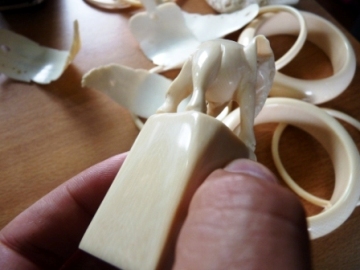 Ivory pieces confiscated by Republic of Congo authorities in Saturday's bust.
Photo by: Naftali Honig (PALF).
by JEREMY HANCE
A Chinese national was caught attempting to smuggle 22 pounds (10 kilos) of ivory out of the Republic of Congo on Saturday, according to the AFP. Officials confiscated five elephant tusks, 80 ivory chopsticks, 3 ivory carvings, and a number of smaller ivory-made items.
The suspect was taken into custody at the Maya-Maya airport in the Republic of Congo's capital, Brazzaville.
"We vowed to help the government of Congo send a zero tolerance message to ivory traffickers, and as you can see this message is in action," Naftali Honig, head of the Project to Apply the Law on Fauna (PALF), told the AFP. A Brazzaville-based NGO, PALF is working to build the capacity of Congolese authorities to enforce wildlife laws, which have long gone ignored in the central African nation.
PALF has been involved in a number of seizures, including catching illegal wildlife traders dealing in leopard skins, ivory, and living chimpanzees and gorillas for the illegal pet trade. The chimpanzee dealer became the first individual sentenced for wildlife trafficking in the Republic of Congo. He was sentenced to a year in prison.
"We work with investigators and local authorities to catch criminals in the act and then follow the legal proceedings to ensure that they don't use a phone call, a bribe, or anything of that nature to illegitimately get themselves off the hook," Honig explained to mongabay.com in an interview last February.
In its first year, PALF conducted 17 investigations resulting in the arrests of 19 alleged traffickers. The program was developed by the Aspinall Foundation and Wildlife Conservation Society.
Monday, January 17, 2011
Puncturing Tool Fail by Goualougo Chimpanzee
For more info and videos from Goualougo go to http://www.congo-apes.org/
and join their facebook page HERE
and here is the keyboard cat version ;)
Monday, November 29, 2010
Conservation Justice
 LAGA now has a counterpart in Gabon, PR-Congo and C.A.R. called Conservation Justice
 (to see the previous LAGA posting go to: KICKING ASS! Ofir Drori and LAGA (the Last Great Ape Organization) )
From the Conservation Justice website:
Conservation Justice suit le modèle développé au Cameroun par l’ONG LAGA (www.LAGA-enforcement.org) depuis 2003 et ayant fait ses preuves en matière de lutte contre le traffic d’espèces et de produits fauniques protégés en Afrique centrale (ivoire, peaux de panthère, grands singes,…).
Conservation Justice a pour vocation de faciliter la réplication de ce modèle en Afrique centrale et prioritairement au Gabon, après l’expérience au Cameroun (LAGA) mais aussi en Républiques du Congo (Projet PALF) et en République centrafricaine (Projet RALF).
Tous ces projets fonctionnent selon une même approche afin de :
1. identifier des trafiquants notoires;
2. faciliter leur arrestation ainsi que leur emprisonnement;
3. aider à leur condamnation;
4. et médiatiser les résultats obtenus comme moyen d’information de grand public.
Le développement d’un volet sensibilsiation/éducation autonome est également à l’étude.
Thanks to Boo M for the link!
0
comments

 Labels:
bushmeat,
cameroon,
central african republic (C.A.R.),
congo,
conservation,
economics,
gabon,
hunting,
ivory,
laga,
poaching,
politics
Labels:
bushmeat,
cameroon,
central african republic (C.A.R.),
congo,
conservation,
economics,
gabon,
hunting,
ivory,
laga,
poaching,
politics
 Labels:
bushmeat,
cameroon,
central african republic (C.A.R.),
congo,
conservation,
economics,
gabon,
hunting,
ivory,
laga,
poaching,
politics
Labels:
bushmeat,
cameroon,
central african republic (C.A.R.),
congo,
conservation,
economics,
gabon,
hunting,
ivory,
laga,
poaching,
politics
Tuesday, November 23, 2010
New MPI Primatology Book: Among African Apes Stories and Photos from the Field
 Among African Apes
Stories and Photos from the Field
Edited by Martha M. Robbins, and Christophe Boesch
Description:
These compelling stories and photographs take us to places like Bwindi Impenetrable National Park in Uganda, Ivindo National Park in Gabon, and the Taï National Park in Côte d’Ivoire for an intimate and revealing look at the lives of African wild apes—and at the lives of the humans who study them. In tales of adventure, research, and conservation, veteran field researchers and conservationists describe exciting discoveries made over the past few decades about chimpanzees, bonobos, and gorillas. The book features vivid descriptions of interactions among these highly intelligent creatures as they hunt, socialize, and play. More difficult themes emerge as well, including the threats apes face from poaching, disease, and deforestation. In stories that are often moving and highly personal, this book takes measure of how special the great apes are and discusses positive conservation efforts, including ecotourism, that can help bring these magnificent animals back from the brink of extinction.
Contents:
1. Discovering Apes - Martha M. Robbins
2. Life and Death in the Forest - Christophe Boesch
3. Encounters with Bili Chimpanzees in the Undisturbed Gangu Forest - Cleve Hicks
4. Is Blood Thicker Than Water? - Gottfried Hohmann and Barbara Fruth
5. Our Cousins in the Forest—or Bushmeat? - Christophe Boesch
6. Discovering Chimpanzee Traditions - Crickette Sanz and David Morgan
7. Keeping it in the Family: Tribal Warfare between Chimpanzee Communities - Josephine Head
8. Winona’s Search for the Right Silverback: Insights into Female Strategies at a Natural Rain Forest Clearing in Northern Congo - Thomas Breuer
9. The Long Road to Habituation: A Window into the Lives of Gorillas - Chloé Cipolletta
10. Among Silverbacks - Martha M. Robbins
11. The Diversity of the Apes: What Is the Future? - Christophe Boesch
"Some of the most devoted primatologists offer a wonderful collection of first-hand accounts and splendid photographs that make us feel like we're beside them watching our relatives in the forest."Click here to go to buy it and find out more-Frans de Waal, author of Our Inner Ape and Chimpanzee Politics
0
comments
Labels:
africa,
bonobos,
central african republic (C.A.R.),
chimpanzees,
congo,
DRC,
gabon,
gorillas,
ivory coast,
lit,
MPI-EVA,
primates,
uganda
Labels:
africa,
bonobos,
central african republic (C.A.R.),
chimpanzees,
congo,
DRC,
gabon,
gorillas,
ivory coast,
lit,
MPI-EVA,
primates,
uganda
Saturday, October 23, 2010
wtf: Croc escapes on board DRC plane, panic spreads, plane crashes.

Original post from Jeune Afrique (in french)
from News.com.au
Crocodile on plane kills 19 passengers
(There is also video of the crash here)
A STOWAWAY crocodile on a flight escaped from its carrier bag and sparked an onboard stampede that caused the flight to crash, killing 19 passengers and crew. The croc had been hidden in a passenger's sports bag - allegedly with plans to sell it - but it tore loose and ran amok, sparking panic. A stampede of terrified passengers caused the small aircraft to lose balance and tip over in mid-air during an internal flight in the Democratic Republic of Congo. The unbalanced load caused the aircraft, on a routine flight from the capital, Kinshasa, to the regional airport at Bandundu, to go into a spin and crash into a house.
A lone survivor from the Let 410 plane told the astonishing tale to investigators.
Ironically the crocodile also survived the crash but was later killed with a machete by rescuers sifting through the wreckage.
British pilot Chris Wilson, 39, from Shurdington, near Cheltenham, Glocs was acting as the plane's first officer alongside Belgian pilot Danny Philemotte, 62, who was owner of the plane's operator Filair. The plane smashed into an empty house just a few hundred metres from its destination.
"According to the inquiry report and the testimony of the only survivor, the crash happened because of a panic sparked by the escape of a crocodile hidden in a sports bag,” news organisation Jeune Afrique reported.
"One of the passengers had hidden the animal, which he planned to sell, in a big sports bag, from which the reptile escaped as the plane began its descent into Bandundu."The terrified air hostess hurried towards the cockpit, followed by the passengers." The plane was then sent off-balance "despite the desperate efforts of the pilot", said the report. "The crocodile survived the crash before being cut up with a machete."
The plane was a Czech-made Let L-410 Turbolet, one of more than 1,100 produced as short-range transport aircraft and used mainly for passenger services.
Saturday, September 11, 2010
Elephant poaching in Semliki Wildlife Reserve, Uganda...

From New Vision Online via the Far Horizons Facebook Page
Elephants killed in Semliki wildlife reserve
BY GERALD TENYWA
Two elephants have been killed in Toro-Semliki wildlife reserve in western Uganda by poachers who crossed over from the Congo.
Sources said one of the poachers was intercepted with elephant ivory and was being held by the Uganda Peoples Defence Forces. The sources added that the elephants were butchered on Wednesday and the carcasses were discovered the following day.
“It is unusual for poachers to cross over from the DR Congo and kill endangered species undetected,” the source said. In a separate interview, John Makombo, the acting head of the Uganda Wildlife Authority (UWA), said the poacher who is being held is a Ugandan from Ntoroko and not a Congolese.
“UWA is working with security operatives to identify the ownership of the gun recovered from the poacher,” he said. “It is possible that he was working for someone from Congo which has a porous border. Many poachers prefer working in Congo and use Uganda as a trafficking route.”
He also said UWA will share information with a watchdog called the Monitoring of the Illegal Killing of Elephants and the Lusaka Task Agreement Force, which polices wildlife crime. Uganda has 5,000 elephants and the number is increasing after the population had slumped in the 1970s due to political and civil unrest.
Poachers killed a lot of wildlife including elephants, which are key tourist attractions. The black and white rhinos were driven into extinction.
Elephants are categorised as endangered species, according to the World Conservation Union, meaning that they are likely to disappear if nothing is done to protect them and their habitats. Locally, a kilo of ivory goes for sh120,000 [~ $50 US dollars]. The value in the Far East is about $600.
Although last week’s incident is the first case of killing elephants in Semliki, elephants in Queen Elizabeth National Park cross over to Congo.
“This is an ecological system and that is why Uganda and the DR Congo collaborate in managing the animals,” said Okello Obongo, the chief park warden.
“Large mammals do not know boundaries and the most important thing is to protect them irrespective of where they are,” said Obongo.
---
The Far Horizons posted the following statement today:
"We condemn the recent poaching of elephants in Semiliki Valley Wildlife Reserve, and support the quick action taken by Uganda's armed forces to apprehend the poachers and recover the ivory. Poaching in East Africa has seen a sharp increase in the last two years and we will be looking to support efforts to counter the l...ooming threat posed by the influx of so called "investors" that are fuelling the trade."
Monday, August 16, 2010
First-Ever Landscape-Wide Study of Elephants and Great Apes
 (sorry I'm a bit late on posting this, but better late than never :) - MA)
from SCIENCE DAILY
The Wildlife Conservation Society announced the results of the first-ever evaluation of a large, "landscape-wide" conservation approach to protect globally important populations of elephants and great apes.
The study looked at wildlife populations in northern Republic of Congo over a mosaic of land-use types, including a national park, a community-managed reserve, and various logging concessions. It found that core protected areas -- coupled with strong anti-poaching efforts -- are critical for maintaining populations of forest elephants, western lowland gorillas, and chimpanzees.
The region, known as the Ndoki-Likouala Conservation Landscape, is considered one of the most important sites in Central Africa for all three species. The Wildlife Conservation Society has been working in the landscape since 1991 and helped establish Nouabalé-Ndoki National Park in 1993.
The study appears in the April 23rd edition of the journal PLoS ONE. Authors include Wildlife Conservation Society researchers Emma Stokes, Samantha Strindberg, Parfait Bakabana, Paul Elkan, Fortuné Iyenguet, Bola Madzoke, Guy Aíme Malanda, Franck Ouakabadio and Hugo Rainey; Brice Mowawa of the Ministre de l'Economie Forestière, Republic of Congo; and Calixte Makoumbou, formerly with WCS Congo Program.
The authors found that protected areas remain a key component of the landscape for all three species. Chimpanzees and elephants are particularly sensitive to human disturbance outside the Nouabalé-Ndoki National Park, and the park plays a major role in their distribution. In fact Nouabalé-Ndoki National Park may be one of the most important sites for chimpanzees in the Congo Basin with some of the highest densities recorded in Central Africa.
The study also found that logging concessions that have wildlife management in place, including protection of key habitats and anti-poaching patrols, can support important populations of elephants and gorillas. However, the authors warn that logging concessions are only of conservation value if there are strict anti-poaching measures in place, and if they are close to protected areas free of human disturbance. As evidence, the study showed the results of surveys in a logging concession without any anti-poaching measures or wildlife management where abundance of all three species was very low.
"Protected areas free of human disturbance, logging, or roads remain key to the protection of great apes and elephants," said WCS researcher Emma Stokes, the study's lead author. "Landscape conservation should focus on protected areas surrounded by other land-use types that also have wildlife management in place."
The forests of the Congo Basin are one of the last remaining tropical wildernesses and a top priority for biodiversity conservation.
Commercial logging is prevalent throughout much of the Congo Basin, with over 30 percent of native forest allocated to logging concessions compared to only 12 percent under protection. More than 50 percent of the current range of western gorillas and chimpanzees is estimated to lie in active logging concessions.
"This study shows that landscape-wide conservation can work in Central Africa -- provided there are the resources and political will to save wildlife over large areas," said James Deutsch, Director of the Wildlife Conservation Society's Africa programs. "Conservation on this scale is difficult and expensive, but absolutely necessary if we hope to save viable populations of elephants and great apes. At the same time, the government's capacity to follow up and take legal action against poachers should be strengthened and is a key to maintaining the protection of the forests and their wildlife."
The authors estimated elephant and great ape density using distance sampling surveys of elephant dung piles and great ape nests.
The surveys presented in this paper were made possible through generous funding from the U.S. Agency for International Development Central Africa Regional Program for the Environment (CARPE) and U.S. Fish and Wildlife Service Great Ape Conservation Fund.
Currently, WCS advocates the speedy passage of HR 4416, the Great Ape Conservation Reauthorization Act, which would continue government support for the Great Ape Conservation Fund, and applauds Rep. George Miller (D-CA) for leading the effort. In January, Dr. Deutsch testified before a Congressional panel on behalf of WCS in support of the legislation.
--
Reference
Stokes EJ, Strindberg S, Bakabana PC, Elkan PW, Iyenguet FC, et al. (2010) Monitoring Great Ape and Elephant Abundance at Large Spatial Scales: Measuring Effectiveness of a Conservation Landscape. PLoS ONE 5(4): e10294. doi:10.1371/journal.pone.0010294
Abstract
Protected areas are fundamental to biodiversity conservation, but there is growing recognition of the need to extend beyond protected areas to meet the ecological requirements of species at larger scales. Landscape-scale conservation requires an evaluation of management impact on biodiversity under different land-use strategies; this is challenging and there exist few empirical studies. In a conservation landscape in northern Republic of Congo we demonstrate the application of a large-scale monitoring program designed to evaluate the impact of conservation interventions on three globally threatened species: western gorillas, chimpanzees and forest elephants, under three land-use types: integral protection, commercial logging, and community-based natural resource management. We applied distance-sampling methods to examine species abundance across different land-use types under varying degrees of management and human disturbance. We found no clear trends in abundance between land-use types. However, units with interventions designed to reduce poaching and protect habitats - irrespective of land-use type - harboured all three species at consistently higher abundance than a neighbouring logging concession undergoing no wildlife management. We applied Generalized-Additive Models to evaluate a priori predictions of species response to different landscape processes. Our results indicate that, given adequate protection from poaching, elephants and gorillas can profit from herbaceous vegetation in recently logged forests and maintain access to ecologically important resources located outside of protected areas. However, proximity to the single integrally protected area in the landscape maintained an overriding positive influence on elephant abundance, and logging roads – even subject to anti-poaching controls - were exploited by elephant poachers and had a major negative influence on elephant distribution. Chimpanzees show a clear preference for unlogged or more mature forests and human disturbance had a negative influence on chimpanzee abundance, in spite of anti-poaching interventions. We caution against the pitfalls of missing and confounded co-variables in model-based estimation approaches and highlight the importance of spatial scale in the response of different species to landscape processes. We stress the importance of a stratified design-based approach to monitoring species status in response to conservation interventions and advocate a holistic framework for landscape-scale monitoring that includes smaller-scale targeted research and punctual assessment of threats.
Tuesday, July 13, 2010
NYTimes interview with Brian Hare and Vanessa Woods

From the NYTimes.com
Why Bonobos Don’t Kill Each Other
By CLAUDIA DREIFUS
Brian Hare, an assistant professor at the Duke Institute for Brain Sciences at Duke University, and Vanessa Woods, a research scientist in the Department of Evolutionary Anthropology at Duke, do comparative studies on the cognitive development of bonobo apes, chimpanzees and humans. Ms. Woods, 33, a former journalist from Australia, has just published a book about their marriage and work, "Bonobo Handshake: A Memoir of Love and Adventure in the Congo." We spoke last month after they had appeared at the World Science Festival in New York City. An edited version of the conversation follows:
Q. VANESSA, YOU’RE NOT A TRAINED PRIMATOLOGIST. HOW DID YOU COME TO WORK WITH BONOBOS?
Vanessa: By a series of happy accidents. For much of my 20s, I didn’t know what I wanted to do with my life. So I went to Africa and did a little of everything. I worked with chimpanzees for a bit and then I did a little bit of filming and I worked a bit on children’s books. When I met Brian in 2004, I was 27 and volunteering at a chimp sanctuary in Uganda. Brian was testing the chimpanzees’ capacity for cooperation and sharing. Then Brian got invited to the Congo to perform the same experiments on bonobos, our other close ape relations. Would I come along as a helpmate? I hated the idea. My mother, the world’s biggest feminist, always said, “Never follow a man — do your own thing.” I knew almost nothing about bonobos. I thought: “Aren’t those the apes that have a lot of sex?”
Brian: That’s what most people know about bonobos: they have a lot of sex. That’s not what’s interesting about them. The No. 1 reason they are interesting is that they don’t kill each other. The question I was in Africa chasing was: why will a chimp get into a severe fight with another — perhaps kill or maim it — while a bonobo, in the same situation, won’t? I’m basically an anthropologist. And in looking at the psychological and social propensities of our close relatives, learning about their differences in behavior, maybe we’ll be able to make some inferences about what happened during human evolution.
Q. WHAT KINDS OF EXPERIMENTS DID YOU DO?
Brian: The type of experiments that developmental psychologists try on human subjects to see how they’d behave in certain situations. With the apes, I designed tests and games where they could obtain treats — apples, bananas — if they engaged in acts of cooperation. The chimps, it turned out, would only cooperate if they were teamed up with others of equal status. If you put them with subordinate or superior status chimps, they became intolerant. When you had equal-status chimps together on a test, they were able to solve conflicts of interest, negotiate successfully and recruit collaborators. But when we changed one simple thing, we’d crush their ability to cooperate. We took separate piles of treats and combined them into one. Immediately, the chimpanzees started competing with each other and all cooperation fell apart. Later, when we were in the Congo, we posed the same question to the bonobos. The piles of food were merged. No problem. Everyone shared.
My doctoral thesis adviser at Harvard, Richard Wrangham, thinks this may be because chimpanzees evolved in a situation of food scarcity while bonobos developed in the giant salad bowl of the Congo basin where there was abundance.
Vanessa: Another thing: bonobos are matriarchal. If it’s usual for female chimps to get pushed around and battered by males, bonobo females run things. Once, while in the Congo, I witnessed Tatango, this young male bonobo, start to do what the chimps in Uganda regularly did: he went up to the alpha female, Mimi, and backhanded her across the face. She gave him the most withering look. Within seconds, five unrelated females chased him into the forest. Poor guy. They almost took his testicles off. After that, he never made another problem. Bonobo females seem to know that if they stick together, the males can’t dominate. Brian’s gender was actually a problem when we first arrived in the Congo. He walked right up to the bonobos, did all these loud displays, which usually fascinates chimpanzees and makes them want to play with you. The male bonobos were terrified of Brian and the female ones would have nothing to do with him. I had to run the experiments because they seemed to accept me more easily. Once that became clear, my role became larger than that of a “helpmate.” With time, the work became mine, too.
Q. WHERE EXACTLY DID YOU PERFORM THESE EXPERIMENTS? I’M UNDER THE IMPRESSION THAT BONOBOS ARE DIFFICULT TO RESEARCH BECAUSE THEIR HABITAT IS IN THE WILDS OF THE CENTRAL AFRICAN RAIN FOREST.
Brian: Well, we went to the semiwild. There’s this amazing conservationist, Claudine Andre, who founded a sanctuary in Kinshasa for bonobos orphaned by the bush meat trade. She’d convinced the Congolese to let her use this 100-acre wood with lily ponds and forests that once had been a bucolic retreat for Mobutu Sese Seko. Working with the orphans in the sanctuary, they were much more like wild animals than the captive bonobos one might study at a zoo. They were obviously much easier to see and interact with than animals in the forest.
Q. HAVE YOU FOUND ANSWERS TO THE SCIENTIFIC QUESTIONS YOU’VE BEEN ASKING?
Brian: Tentative answers. The research is ongoing. Some of the differences between chimps and bonobos have to do with what happens to them during their development. Essentially bonobos and chimps have similar behaviors as youngsters. Like bonobos, juvenile chimps are very tolerant, peaceful. When they go through puberty, they change. So what happens to adolescent bonobos? Nothing! They don’t change. Their levels of play, their levels of sharing and sex, it all keeps going. They are Peter Pans.
Q. HOW ENDANGERED ARE BONOBOS?
Vanessa: Very. There are probably about 10,000 remaining in the wild. Nobody really knows. It’s hard to get in there and count them all. There’s very little agriculture in the Congo. And a lot of hunting. Bush meat is how people get their protein. And unfortunately, bonobos are really prized meat for hunters because they live in communities. If you’ve found one, you’ve found thirty that you can shoot and kill all at the same time. Of course, bonobos aren’t the answer to feeding the Congolese people. There are 68 million Congolese and 10,000 bonobos. The people need aid, some kind of agricultural program so that the farming becomes sustainable, and peace.
Wednesday, June 9, 2010
Be the first! Garamba NP's (DR-Congo) 1st ecotourism lodge opens
Once a rebel haunt, Congo's Garamba opens to tourism
By THOMAS HUBERT
KINSHASA (Reuters) - The Democratic Republic of the Congo's Garamba National Park, once known as a haunt for militias and a vicious Ugandan rebel group, is open for tourism, the park's main Western donor said.
Spain's ambassador to Congo, Felix Costales, told Reuters in a weekend interview that Garamba had opened a tourist camp funded by Spain at the end of May, with 10 lodges, and that armed groups had been cleared from much of the 12,000 square km (4,600 square miles) reserve that is open to tourists. "We are now in a situation in which we can easily save the park," he said, suggesting that tourism would bring in the necessary funds and road access to monitor it.
Nestled in Congo's northeast, on the border with Sudan, Garamba was listed as a UNESCO World Heritage site in Danger in 1996, largely because it houses 30 of the world's last remaining white rhinos. Its vast grasslands, forests and swampy depressions also housing hippos, elephants and giraffes, lost their tourist appeal around that time as Congo descended into chaos, leaving its wildlife prey to rampant poaching.
In 2005 Uganda's Lord's Resistance Army (LRA) crossed into the park and set up camp after losing a Sudanese government-backed haven in neighbour South Sudan. Costales said the rebel group -- infamous for mutilating civilians and abducting children -- no longer posed a threat, as operations by Congolese, Ugandan and U.N. troops in the past 18 months had uprooted them from Garamba.
Spain had spent about 700,000 euros last year making tracks and equipping and training park rangers. French ambassador Pierre Jacquemot visited the park with Costales last month and came back declaring it safe. Officials are hoping revived tourism can help save the park's rare species from extinction at the hands of poachers.
Unlike the sometimes overcrowded game parks of Kenya, remote Garamba is only reachable by plane for most visitors. "There are few places in the world that are still as pristine as Garamba," Costales said. Tour operators were considering trips combining Garamba and Epulu, home to the antelope-like okapi, and Virunga National Park, housing some of the last mountain gorillas.
Thanks to Cleve H for the link!

By THOMAS HUBERT
KINSHASA (Reuters) - The Democratic Republic of the Congo's Garamba National Park, once known as a haunt for militias and a vicious Ugandan rebel group, is open for tourism, the park's main Western donor said.
Spain's ambassador to Congo, Felix Costales, told Reuters in a weekend interview that Garamba had opened a tourist camp funded by Spain at the end of May, with 10 lodges, and that armed groups had been cleared from much of the 12,000 square km (4,600 square miles) reserve that is open to tourists. "We are now in a situation in which we can easily save the park," he said, suggesting that tourism would bring in the necessary funds and road access to monitor it.
Nestled in Congo's northeast, on the border with Sudan, Garamba was listed as a UNESCO World Heritage site in Danger in 1996, largely because it houses 30 of the world's last remaining white rhinos. Its vast grasslands, forests and swampy depressions also housing hippos, elephants and giraffes, lost their tourist appeal around that time as Congo descended into chaos, leaving its wildlife prey to rampant poaching.
In 2005 Uganda's Lord's Resistance Army (LRA) crossed into the park and set up camp after losing a Sudanese government-backed haven in neighbour South Sudan. Costales said the rebel group -- infamous for mutilating civilians and abducting children -- no longer posed a threat, as operations by Congolese, Ugandan and U.N. troops in the past 18 months had uprooted them from Garamba.
Spain had spent about 700,000 euros last year making tracks and equipping and training park rangers. French ambassador Pierre Jacquemot visited the park with Costales last month and came back declaring it safe. Officials are hoping revived tourism can help save the park's rare species from extinction at the hands of poachers.
Unlike the sometimes overcrowded game parks of Kenya, remote Garamba is only reachable by plane for most visitors. "There are few places in the world that are still as pristine as Garamba," Costales said. Tour operators were considering trips combining Garamba and Epulu, home to the antelope-like okapi, and Virunga National Park, housing some of the last mountain gorillas.
Thanks to Cleve H for the link!
Saturday, May 29, 2010
Much success!: INTERPOL's 'Operation Mogatle' seizes 400 kilo of ivory and rhino horn
 Ivory seized during Operation Mogatle
llegal ivory and rhino horn trade target of INTERPOL co-ordinated operation across southern Africa
A transnational operation co-ordinated by INTERPOL targeting wildlife crime across southern Africa has resulted in the location and closure of an illegal ivory factory, the seizure of nearly 400 kilos of ivory and rhino horn with a market value of more than one million dollars, as well as the arrest of 41 people.
The two-day operation (13-14 May), codenamed Mogatle, involved nearly 200 officers from police, national wildlife, customs and national intelligence agencies across six countries – Botswana, Namibia, South Africa, Swaziland, Zambia and Zimbabwe – who carried out inspections and raids on markets and shops.
Checks were also made on suspect vehicles at border crossing points where for the first time in a wildlife crime operation, sniffer dogs provided by South African and Swaziland police were used at check points at the Mozambique/Swaziland border.
“The success of Operation Mogatle is not only in relation to the seizures and arrests which have been made, but is a demonstration of the commitment of national and international law enforcement and other involved agencies to working together to combat wildlife crime,” said Peter Younger, manager of INTERPOL’s OASIS (Operational Assistance, Services and Infrastructure Support) Africa wildlife crime programme.
“Taking these illegal items off the market is just the first step,” added Mr Younger. “Information gathered as part of this operation will also enable law enforcement, both in Africa and abroad, to identify smuggling routes and eventually to further arrests of other individuals involved in these crimes.
“The impact of wildlife crime is wide-ranging. People are threatened with violence, law enforcement officers have been killed while carrying out their duties, and there is the wider economic impact on a country and therefore the livelihoods of ordinary people.”
Supported by INTERPOL’s National Central Bureaus and INTERPOL’s Regional Bureau in Harare, Operation Mogatle was co-ordinated by INTERPOL’s OASIS Africa initiative, which is funded by the German Federal Government. Additional support and funding was also provided for the operation by the Humane Society of Canada and the Born Free Foundation.
INTERPOL’s OASIS programme helps countries in Africa develop a global and integrated approach to fighting 21st century crime by building operational capacities for policing in the region and enhancing the ability of INTERPOL member countries to tackle crime threats nationally, regionally and globally.
Operation Mogatle - named in honour of the late Professor Keitirangi Mogatle, assistant director of the Botswana Department of Wildlife and National Parks and principle motivator behind effective wildlife law enforcement in Botswana – was the third multi-agency wildlife operation co-ordinated by INTERPOL.
The first, Operation Baba (November 2008) resulted in the arrests of nearly 60 people and the seizure of one ton of illegal elephant ivory following co-ordinated actions in Congo, Ghana, Kenya, Uganda and Zambia.
The second, Operation Costa (November 2009) across Burundi, Ethiopia, Kenya, Rwanda, Tanzania and Uganda, led to the arrest of more than100 people and the recovery of 1.5 tons of ivory and hundreds of other illegal wildlife items.
Thanks to Boo M. for the link!
0
comments
Labels:
congo,
elephants,
ghana,
ivory,
kenya,
misc mammals,
southern Africa,
success,
uganda,
zambia
Labels:
congo,
elephants,
ghana,
ivory,
kenya,
misc mammals,
southern Africa,
success,
uganda,
zambia
Wednesday, May 19, 2010
Reintroduced gorilla remembers human caretaker 5 years later...
I know, this goes against a lot of what we (think we) know about conservation: reintroduced animals don't have the skill set to survive in the wild, human-ape contact is dangerous - especially for disease transmission, spending money on reintroduction is the worst use of conservation funds, and so forth... But people thinking out of the box and doing "crazy" things has often been a harbinger of a lot of human progress and innovation...The fact is, they have reintroduced gorillas into the wild, after some false starts, they seem to have figured out how to do safely (and not affect wild ape populations), these gorillas, breed, feed and survive on their own in a nature reserve...it is hard not to be impressed with the John Aspinall Foundation's efforts, perseverance and success! - MA
for more info:
http://www.berggorilla.de/english/gjournal/texte/34lefini.html
http://www.aspinallfoundation.org/aspinall/news/view/197
From youtube:
for more info:
http://www.berggorilla.de/english/gjournal/texte/34lefini.html
http://www.aspinallfoundation.org/aspinall/news/view/197
From youtube:
In the African jungle, conservationist Damian Aspinall searches for Kwibi, a lowland gorilla he hasn't seen for 5 years. Kwibi grew up with Damian at his Howletts Wild Animal Park in England. When he was five, he was released into the forests of Gabon, West Africa as part of conservation programme to re-introduce gorillas back into the wild. Now Kwibi's 10 years old, much bigger and stronger.
Subscribe to:
Posts (Atom)


 Posts
Posts


