translate

Site update

Since I have been really terrible at updating the blog (but pretty good at keeping up with the facebook blog posts) I've added the widget below so that facebook cross posts to the blog.

You shouldn't need to join facebook but can just click on the links in the widget to access the articles. If you have any problems or comments please mail me at arandjel 'AT' eva.mpg.de.
Showing posts with label south america. Show all posts

Thursday, March 10, 2011

blond capuchins use tools to gather termites


Critically endangered capuchins make tools to gather termites
by JEREMY HANCE
from mongabay.com

Less than 200 blond capuchins (Cebus falvius) survive in the highly-fragmented habitat of Brazil's Atlantic Forest. But this tiny group of monkeys, only rediscovered in 2006, is surprising scientists with its adept tool-using abilities. Displaying similar behavior to that which made the chimpanzees of Gombe famous worldwide, the blond capuchins modify sticks to gather termites from trees; however, according to the study published in Biology Letters the blond capuchins use two techniques never witnessed before: twisting the stick when inside the termite nest and tapping the nest before inserting the stick.

"Tapping the walls of the nest and rotating the stick have not been reported previously for chimpanzees or any other non-human primates. They indicate effective problem solving and effective deployment of sensitive manual actions," the study's authors write.

The technique of rotating the stick and tapping the nest add to the monkey's success according to researchers, who tested the monkeys' techniques for themselves.

"It really worked. The way they do it really enhanced their catch," lead author Antonio Souto of the Universidade Federal de Pernambuco, Brazil, told LiveScience. "I think they can do better than we did; they have more experience."

In addition, this is the first time capuchin monkeys have been observed using tools above the ground, since they raid termite nests on tree trunks.

First described by German naturalist George Marcgrave in 1664, the blond capuchin was formally named in 1774. But the blond capuchin disappeared for centuries, only to be re-discovered in 2006. The remaining populations is threatened by habitat loss, as well as hunting for food and as pets. Researchers estimate that 180 survive.

Reference
Souto A, Bione CBC, Bastos M, Bezerra BM, Fragaszy D, Schiel N (2011) Critically endangered blonde capuchins fish for termites and use new techniques to accomplish the task. Biology Letters. doi: 10.1098/rsbl.2011.0034.

Abstract
We report the spontaneous modification and use of sticks to fish for termites, above the ground, in wild blonde capuchins (Cebus flavius). These critically endangered Neotropical primates inhabit remnants of the Atlantic Forest. They used two previously undescribed techniques to enhance their termite capture success: nest tapping and stick rotation. The current ecologically based explanation for tool use in wild capuchins (i.e. terrestrial habits and bipedalism) must be viewed cautiously. Instead, remarkable manual skills linked to a varied diet seem important in promoting tool use in different contexts. The repertoire of tool-using techniques employed by wild capuchins has been expanded, highlighting the behavioural versatility in this genus.

Monday, January 10, 2011

Save the Huemul!


Here is a video from one of my most favorite websites, hyperbole and a half, made for her friends that work in Patagonia. To donate or read more about huemuls, go here:
http://www.patagonianexpeditionrace.com/en/donate.php

Wednesday, November 10, 2010

More Art: Giant drunken monkey made of flip fops

Go to Geekologie.com or Zeutch.com for lots more pics!


From Geekologie:
This is a giant passed-out monkey sculpture made out of flip-flops in São Paulo, Brazil, to celebrate Pixel Show, an international art and design conference. Because if there are two things that go hand in hand in this world, it's drunk monkeys and art.


Monday, October 18, 2010

so cool: whale tracked 6,000 miles through Flickr photos

The image above, taken in 2001, was used to identify a female humpback
whale who traveled more than 6,000 miles from Brazil to Madagascar.
from the NYTimes
By SINDYA N. BHANOO

If you cruise the Web you can find long-lost friends, high school sweethearts and ... far-traveling humpback whales.

With the help of Flickr, a photo-sharing site, Peter Stevick, a biologist at the College of the Atlantic, in Bar Harbor, Me., and colleagues have identified a whale that made an unprecedented journey, an epic 6,000 miles from Brazil to Madagascar, about 10 years ago. The whale’s adventure is described in Biology Letters.

Gale McCullough, a research assistant in Dr. Stevick's lab, often checks Flickr for whale photos because humpbacks can be identified by their tails, which are as individual as fingerprints. An amateur photographer had taken a photo on a film camera in 2001 and only recently posted it. That photo matched one taken by researchers of a whale off the coast of Brazil in 1999.

There is no way to know what the humpback’s exact journey was, but the shortest route it could have taken would have been across the south Atlantic Ocean and around Africa to arrive in Madagascar, in the Indian Ocean, said Dr. Stevick, the study’s lead author.

During the course of a year, humpback whales spend their summers in cooler climates and focus their efforts on getting as much nourishment as possible. In the winter, they travel to warm tropical areas where they mate and give birth to their calves. It is not uncommon for the whales to travel close to 4,000 miles in a single year.

But this female’s journey was unprecedented. “It traveled between two different breeding habitats, which is something that is virtually unseen,” Dr. Stevick said. Just why this particular whale made the unusual journey is unclear. It is possible that it was in search of a better habitat, or that it simply got lost, he said.

--
Reference
Stevick PT, Neves MC, Johansen F, Engel MH, Allen J, Marcondes MCC, Carlson C (2010) A quarter of a world away: female humpback whale moves 10 000 km between breeding areas. Biology Letters doi: 10.1098/rsbl.2010.0717

ABSTRACT
Fidelity of individual animals to breeding sites is a primary determinant of population structure. The degree and scale of philopatry in a population reflect the fitness effects of social facilitation, ecological adaptation and optimal inbreeding. Patterns of breeding-site movement and fidelity are functions of social structure and are frequently sex biased. We report on a female humpback whale (Megaptera novaeangliae) first identified by natural markings off Brazil that subsequently was photographed off Madagascar. The minimum travel distance between these locations is greater than 9800 km, approximately 4000 km longer than any previously reported movement between breeding grounds, more than twice the species' typical seasonal migratory distance and the longest documented movement by a mammal. It is unexpected to find this exceptional long-distance movement between breeding groups by a female, as models of philopatry suggest that male mammals move more frequently or over longer distances in search of mating opportunities. While such movement may be advantageous, especially in changeable or unpredictable circumstances, it is not possible to unambiguously ascribe causality to this rare observation. This finding illustrates the behavioural flexibility in movement patterns that may be demonstrated within a typically philopatric species.

Monday, September 6, 2010

New forest mapping tech shows actual Peruvian amazon forest sequestration

I think this is such a cool study because not only does it show how effective and cheap remote sensing can be for detecting carbon emissions, but it also ground truths how much carbon a given forest can really sequester. It also highlights the secondary effects and carbon release of deforestation and development. We aren't only losing carbon-sequestering plant life, but increasing emissions through road building and access to forested areas. With technology like this, it will be harder and harder for the potential pitfalls (corruption) of REDD to be realized, which means good things for our planet. -MA


Peru's rainforest highway triggers surge in deforestation, according to new 3D forest mapping
From mongabay.com

Scientists using a combination of satellite imagery, airborne-laser technology, and ground-based plot surveys to create three-dimensional high resolution carbon maps of the Amazon rainforest have documented a surge in emissions from deforestation and selective logging following the paving of the Trans-Oceanic Highway in Peru.

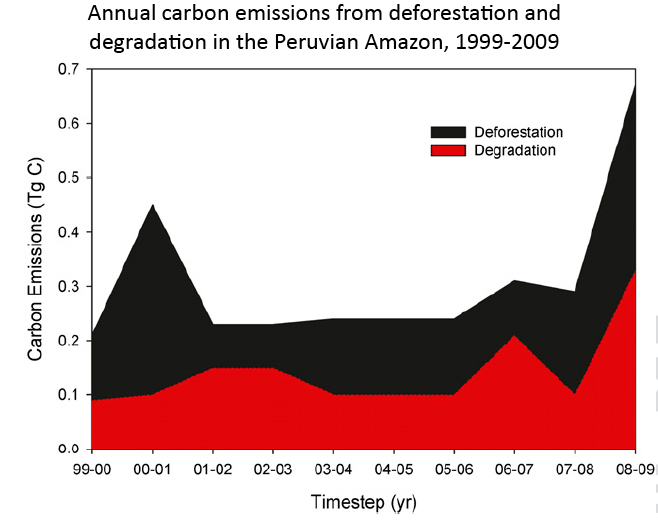
The study, published this week in the early edition of the Proceedings of the National Academy of Sciences, reveals that selective logging and other forms of forest degradation in Peru account for nearly a third of emissions compared to deforestation alone. The findings, which demonstrate the feasibility of using LiDAR and satellite imagery over large areas of tropical forest, have important implications for monitoring, reporting, and verifying emissions reductions under proposed Reduced Emissions from Deforestation and Degradation (REDD) programs, which could compensate developing countries for protecting and sustainability managing their forests.

"We've demonstrated that a cost-effective use of airborne LiDAR and free satellite data can speed up the process of carbon mapping and greatly reduce uncertainties in tracking carbon emissions from land-use change in the humid tropics," lead author Greg Asner, a researcher at the Carnegie Institution's Department of Global Ecology at Stanford University, told mongabay.com. "The role of laborious and expensive field plots can also be reduced to a subset for calibrating the LiDAR to regional biomass conditions."

"Most importantly, the method can be picked up by others, including governments wishing to participate in REDD-type programs. We are working with the Ministries in Peru, Colombia and Ecuador now."

Asner and colleagues used a four-step process to map emissions over over 4.3 million ha of the Peruvian Amazon, an area twice that of all forests in Costa Rica. The vegetation types and disturbance were measured by satellite; the 3-D vegetation structure was mapped using the LiDAR system (light detection and ranging) aboard the Carnegie Airborne Observatory, a small airplane; the data was ground-truthed using field plots on the ground; and the satellite and LiDAR data was integrated to create "high resolution maps of stored and emitted carbon," according to a statement from the Carnegie Institution.

The work shows that some 4.5 million metric tons of aboveground carbon were committed to the atmosphere due to deforestation and forest degradation from 1999 to 2009. Degradation emissions averaged 47% of deforestation emissions over the period, but were offset by forest regrowth, which accounted for 812 million tons of carbon sequestration. Net emissions over the period were thus 3.7 million tons, or roughly the annual emissions of the country of Jamaica.

The research reveals a spike in emissions from deforestation and forest degradation in the Peruvian Amazon in 2009. The increase appears to be associated with the paving of the Trans-Oceanic Highway, which connects the Amazon to Pacific coast ports, facilitating the transport of soy, timber, cattle, and other commodities. The project, which has been partially funded by China, has led to a proliferation in logging, clearing for agriculture, gold mining, and exploration for oil and gas in southeastern Peru. Environmentalists fear the highway will exacerbate forest exploitation in a region where trees lock up massive amounts carbon.

"We found that the total regional forest carbon storage was about 395 million metric tons and emissions reached about 630,000 metric tons per year," Asner said in a statement, adding that the analysis shows current estimates of carbon stored in the vegetation of the Peruvian Amazon are too high by about a third. These estimates are used as a baseline by the Intergovernmental Panel on Climate Change (IPCC) for determining emissions reductions under the proposed REDD mechanism.

The authors also uncovered previously recognized patterns of aboveground biomass distribution, notably that forest growing on geologically younger, more fertile surfaces, stores more carbon that forest growing on ancient soils.

"What really surprised us was how carbon storage differed among forest types and the underlying geology, all in very close proximity to one another," said Asner, who is also using the system to remotely inventory tree biodiversity across the region.

Asner and his team are now expanding their research outside the Amazon. They have benefited from falling technology costs.

"The cost to implement this method of high-resolution carbon stock and emissions monitoring is decreasing. Satellite data costs are decreasing, and the major data sources are now free of charge to end users. The cost for analyzing the satellite data for forest cover, deforestation and degradation is also rapidly diminishing," the authors write, noting that the Carnegie Institution's Landsat Analysis System Lite (CLASlite) for analyzing satellite data is available free to non-profits working in the Amazon region.

Costs of LiDAR are also diminishing.

"For this 4.3 million ha analysis, the Carnegie Airborne Observatory (CAO) operated its LiDAR, processed the data, and provided maps of forest structure at a cost of less than $0.08/ha," the authors write. "More recent work in Madagascar has reduced the cost to approximately $0.06/ha, and there exists a strong economy-of-scale effect whereby larger-area projects prove far more cost effective than small-area analyses. This runs opposite to plot-level work, which increases in cost on a per-area basis."

The authors conclude with a call to map the Peruvian Amazon's entire 60 million hectares.

REFERENCE:
Asner GP. PWell GVN, Mascaro J, Knapp DE, Clark JK, Jacobson J, Kennedy-Bowdoin T, Balaji A, Paez-Acosta G, Victoria E, Secada L, Valqui M, Hughes RF (2010) High-resolution forest carbon stocks and emissions in the Amazon. Proceedings of the National Academy of Sciences

USA FAIL. GDP vs religiousness of nations

From NYTimes
by CHARLES M. BLOW
go to his op-ed piece "Religious Outlier" to read more

Sunday, August 15, 2010

success!: US trades debt for nature with Brazil


from mongabay.com
U.S. signs debt-for-nature swap with Brazil to protect forests

The United States will cut Brazil's debt payments by $21 million under a debt-for-nature that will protect the Latin American country's endangered Atlantic Rainforest (Mata Atlantica), Caatinga and Cerrado ecosystems.

The agreement, announced Thursday, comes under the Tropical Forest Conservation Act (TFCA) of 1998, which to date has generated $239 million to protect tropical forests in Bangladesh, Belize, Botswana, Colombia, Costa Rica, El Salvador, Guatemala, Indonesia, Jamaica, Panama, Paraguay, Peru, and the Philippines. The Brazil deal is the 16th signed under the TFCA.

Funds under the latest debt-for-nature swap will go towards "activities to conserve protected areas, improve natural resource management, and develop sustainable livelihoods for communities that rely on forests," according to the U.S. Treasury Department.

The three ecosystems targeted are under greater threat than the better known Amazon rainforest.

The cerrado, a biologically-rich grassland that once covered an area half the size of Europe, is fast being transformed into croplands to meet rising demand for soybeans, sugarcane, and cattle. It is now disappearing more than twice as the rate as the neighboring Amazon rainforest.

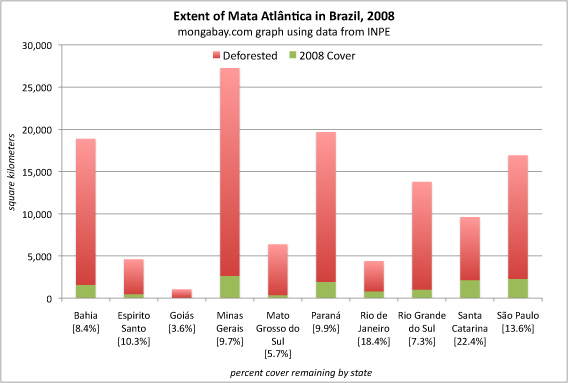
The Mata Atlântica is Brazil's most endangered rainforest, covering less than 8 percent of its original range. Logging and conversion for agriculture and cattle ranches have been the primary drivers of deforestation of the Mata Atlântica, which is found in some of Brazil's richest and most populous states. The ecosystem, which ranks as a global biodiversity hotspot with more than 250 species of mammals, more than 750 species of reptiles and amphibians and nearly 1,000 species of birds, is home to some of Brazil's most famous endangered species like the Golden Lion Tamarin.

The Caatinga is a dry tropical forest characterized by scrubby vegetation in northeastern Brazil, one of the country's poorest regions. Caatinga is under threat from clearing for cattle ranching and agriculture, as well as charcoal production and timber harvesting. The ecosystem is known for its rich bird life, including a number of endemic species like Lear's Macaw (endangered) and Spix's Macaw (now extinct in the wild).

Thursday, July 22, 2010

better REDD than dead?

A REALLY great article on the pros and cons of REDD (Reducing Emissions from Deforestation and forest Degradation) aka Carbon Credits. But by far the best part is this quote from Dan Nepstad:
"We need to approach REDD as a skinny pack donkey upon which we are loading concerns for food security, biodiversity (in savannas and grasslands), land rights, and other issues. The risk is that we will overload the beast and keep it from making any progress or, worse, killing," he said. "REDD must be viewed not as the latest "silver bullet" for protecting tropical forests. Rather, REDD is the first component of a new rural development paradigm that is focused on the maintenance of forests, but that must eventually culminate in even greater biodiversity protection, increased agricultural output, and stronger control over forests and lands by their traditional and indigenous inhabitants."
-MA
from Mongabay.com via Sean Whyte's facebook page
Scientists sound warning on forest carbon payment scheme

Scientists convening in Bali expressed a range of concerns over a proposed mechanism for mitigating climate change through forest conservation, but some remained hopeful the idea could deliver long-term protection to forests, ease the transition to a low-carbon economy, and generate benefits to forest-dependent people.

Presenting at the annual Association for Tropical Biology and Conservation, scientists and policy experts warned that the Reducing Emissions from Deforestation and forest Degradation (REDD) program outlined in international climate talks could fail to achieve the desired outcome of protecting forests, while having detrimental impacts on biodiversity and local livelihoods, if it isn't properly designed or excludes critical safeguards. Some researchers argued that the economics of REDD may fall short of competing with returns from other forms of land use, including logging and plantation development, while others said that a successful REDD program could undermine wildlife-friendly farming approaches, promote conversion of low carbon landscapes for industrial tree-planting projects, and shift conservation priorities toward carbon-dense ecosystems.

"REDD is a potentially excellent mechanism by which to address GHG emissions while incidentally contributing to biodiversity conservation and the maintenance of ecosystem services," said Jaboury Ghazoul, an ecologist at ETH Zurich, who discussed potential unrealized costs of REDD. "There are, however, challenges to overcome, ranging from the administrative and technical implementation of REDD, to the wider knock-on effects on downstream livelihoods and regional development. As scientists keen to see the successful implementation of REDD we must also recognize and grapple with its wider challenges."

Several presenters used the host country of Indonesia, which recently signed a one billion dollar deal with Norway to reduce emissions from deforestation and forest degradation, to provide context of the types of problems that could befall a poorly designed and implemented REDD mechanism.

Financial fraud

Christopher Barr, a former CIFOR researcher, pointed to financial mismanagement and outright fraud in Indonesia's Reforestation Fund as an example. He noted that during former Indonesian President Soeharto's reign the country’s Reforestation Fund suffered losses of more than $5.2 billion – much of it to corruption and fraud. Although the current administration has taken steps to improve financial controls, hHundreds of millions more have been misappropriated or wasted on poorly managed projects in recent years.

According to Barr, “Indonesia’s experience with the Reforestation Fund provides important insights into the government’s capacity to manage and allocate a large stream of funds in the country’s forestry sector. It demonstrates that existing administrative structures are ill-equipped to handle the influx of REDD+ funds and will need to be strengthened. Just as mechanisms are being developed to measure and verify changes in forest carbon emissions, effective systems are urgently needed for financial verification as well.”

Roger James of Conservation International echoed these concerns in a presentation on the REDD readiness of Papua New Guinea, a country that on the international stage has led the push for the payments for forest conservation mechanism, but done little at home to support the scheme at home. James highlighted examples of fraud revolving around the PNG forest carbon sector as well as the rise of a REDD "cargo cult", whereby the expectations for "sky money" have risen so high they can never be met. He mentioned that the fundamentals of REDD were poorly understood in many parts of the country, with some villagers talking of getting carbon money for their forests and then selling the trees to loggers. James said that given the uncertainty around REDD and lack of capacity within PNG, conservationists working in country should focus on making biodiversity conservation effective rather than waiting for carbon finance.

Knock-on effects
Jaboury Ghazoul said that policymakers supporting REDD may be greatly undervaluing the opportunity costs of forgoing logging and conversion of primary forests. Looking at Indonesia, he highlighted potential job losses, shifts in overseas development aid regimes linked to forestry, and impacts on downstream industries as examples. Ghazoul also said that by increasing the opportunity cost of land use, REDD could put pressure on "wildlife-friendly" farming approaches like organic agriculture.

"Two important challenges facing human society is reduction of greenhouse gas emissions and the need to meet food demands for a growing population. REDD is a mechanism that can substantially contribute to the first challenge, but by doing so might constrain our ability to manage the second."

"An expanding population will need more food, which is likely to require more agricultural land at the expense of forests, something that would conflict with REDD. Resolving this conflict requires us to produce more food from less land - in other words the intensification of land use. While this may allow us to reconcile one conflict, it opens us up to another - that of maintaining diverse agricultural landscapes that support biodiversity. So, while promoting REDD to preserve forests we might inadvertently be driving agricultural intensification and the loss of biodiversity in human dominated landscape mosaics. REDD++, which accounts for carbon values of agricultural as well as forest landscapes, offers exciting possibilities to circumvent this second challenge."

Carbon conservation not necessarily aligned with biodiversity conservation

Stuart Pimm, a Duke University scientist, added that biodiversity hotspots not always aligned with the most carbon-dense regions of the world, leading to risk that REDD focus could shift priorities away from species conservation, a sentiment shared by Elizabeth Losos, president of the Organization for Tropical Studies Environmental Sciences & Policy.

Francis "Jack" Putz, an ecologist from the University of Florida, urged caution on what he termed the "arborealization" of conservation agendas. Putz fears that new emphasis on REDD will trigger afforestation of low-carbon ecosystems like savannas, jeopardizing biodiversity.

"We need to be careful not to undervalue low carbon landscapes," he said.

Still hope for REDD
Not all the news was negative however. Greg Asner discussed breakthroughs in remote monitoring of forests, including high resolution, 3-D mapping of forest cover using airplane-based LiDAR sensors and advanced processing of satellite imagery. The image processing technology, which is currently being used in the Amazon to detect both deforestation and small-scale forest disturbance caused by selective logging, will soon be available online for Southeast Asia and Africa. Asner said LiDAR is now allowing researchers to conduct biological inventories of tree species from thousands of feet above the canopy at a rate of more than 10,000 hectares per day.

Dan Nepstad, a researcher at the Woods Hole Research Center, was upbeat about the prospects of carbon finance for protecting rainforests. Nepstad detailed the sharp drop in deforestation in the Brazilian Amazon in recent years and said that REDD could play a key part to consolidating gains in the region, perhaps bringing an end to deforestation within a generation, while helping the world transition to a low carbon economy. He cautioned that REDD could be "messy" from the get-go, but the potential benefits are immense.

"We need to approach REDD as a skinny pack donkey upon which we are loading concerns for food security, biodiversity (in savannas and grasslands), land rights, and other issues. The risk is that we will overload the beast and keep it from making any progress or, worse, killing," he said. "REDD must be viewed not as the latest "silver bullet" for protecting tropical forests. Rather, REDD is the first component of a new rural development paradigm that is focused on the maintenance of forests, but that must eventually culminate in even greater biodiversity protection, increased agricultural output, and stronger control over forests and lands by their traditional and indigenous inhabitants."

Claudia Stickler, also a Woods Hole Research Center scientist, added that carbon finance could be a path to reconcile seemingly conflicting national targets for Brazil: a 30 increase in agricultural production by 2019 and a 70 percent reduction in deforestation by 2020. She said REDD payments could provide a key incentive covert the largest drivers of deforestation in the Amazon — ranchers and farmers — into forest protectors.

“It’s important to understand the true potential of REDD+. If done properly, it could represent a sea-change in the prevailing conservation and economic/social development paradigms, which have largely separated these two agendas and/or relegated their conception and execution to relatively small-scale projects and initiatives," she told mongabay.com.

"Clearly, there are a number of critical issues to deal with—not the least of which is the depth and breadth of social engagement that is necessary to make policies associated with REDD implementation stick—but the opportunity to achieve forest governance on a broad scale should not be jettisoned for fear that these obstacles will prove insurmountable.”

Making logging a part of the solution
Several ATBC presenters emphasized the importance of "sustainable forest management" or low-impact logging and reforestation under the REDD+ mechanism. Bronson Griscom of The Nature Conservancy, said that reduced impact logging would increase returns from carbon conservation, improving its economic performance and reducing the risk that landowners would abandon forest conservation commitments. Griscom argued that careful logging could help mitigate the issue of international leakage, since forests would continue to supply timber to meet global demand. Lex Hovani, also of The Nature Conservancy, added that low-impact logging could generate income for communities and forest managers once REDD payments are phased out sometime after 2030.

"We need to think not only about how REDD is going to start, but how REDD is going to end," he said.

Putz said that reduced impact logging (RIL) techniques can significantly reduce emissions relative to conventional logging. He estimated that RIL could cut global emissions in legal logging concessions alone by 160-360 million tons per year. Several other researchers reported that selectively logged forest retains 80-90 percent of the species found in primary forests, but cautioned that single-species plantations — like acacia, rubber, and oil palm plantations are biological deserts.

"Plantations aren't forests," said Putz.

The ATBC meeting wraps up tomorrow. A declaration on the billion dollar Norway-Indonesia forest partnership is expected at the conclusion of the conference.

Wednesday, July 21, 2010

500 dead starved penguins wash up on Brazilian shore.

From BBC.com via Treehugger
Hundreds of dead penguins washed up in Brazil

Hundreds of penguins have been washed up dead on the beaches of Brazil. Scientists are still investigating what could have caused the death of around 500 animals found on the shores of Sao Paulo state. They say autopsies carried out on some of the carcasses suggest they could have starved to death, as their stomachs were completely empty. They are now trying to establish if strong currents and colder temperatures may be to blame. Thiago do Nascimento of the Peruibe Aquarium says the cooler than usual temperatures off the coast could have driven away the fish and squid the penguins feed on. But he did not rule out that overfishing could have decimated the penguins' food sources.

Mr Nascimento said between 100 and 150 penguins showed up on the beaches every year, but that they were normally alive, with only around 10 washed up dead in an average year. "What worries us this year, is the absurdly high number of penguins that have appeared dead in a short period of time," he told the Associated Press news agency.

Friday, January 8, 2010

"education is often a far better investment than artillery"


from the NYtimes.com, Op-Ed Columnist
The Happiest People
By NICHOLAS D. KRISTOF

Hmmm. You think it’s a coincidence? Costa Rica is one of the very few countries to have abolished its army, and it’s also arguably the happiest nation on earth.

There are several ways of measuring happiness in countries, all inexact, but this pearl of Central America does stunningly well by whatever system is used. For example, the World Database of Happiness, compiled by a Dutch sociologist on the basis of answers to surveys by Gallup and others, lists Costa Rica in the top spot out of 148 nations.

That’s because Costa Ricans, asked to rate their own happiness on a 10-point scale, average 8.5. Denmark is next at 8.3, the United States ranks 20th at 7.4 and Togo and Tanzania bring up the caboose at 2.6.

Scholars also calculate happiness by determining “happy life years.” This figure results from merging average self-reported happiness, as above, with life expectancy. Using this system, Costa Rica again easily tops the list. The United States is 19th, and Zimbabwe comes in last.

A third approach is the “happy planet index,” devised by the New Economics Foundation, a liberal think tank. This combines happiness and longevity but adjusts for environmental impact — such as the carbon that countries spew.

Here again, Costa Rica wins the day, for achieving contentment and longevity in an environmentally sustainable way. The Dominican Republic ranks second, the United States 114th (because of its huge ecological footprint) and Zimbabwe is last.

Maybe Costa Rican contentment has something to do with the chance to explore dazzling beaches on both sides of the country, when one isn’t admiring the sloths in the jungle (sloths truly are slothful, I discovered; they are the tortoises of the trees). Costa Rica has done an unusually good job preserving nature, and it’s surely easier to be happy while basking in sunshine and greenery than while shivering up north and suffering “nature deficit disorder.”

After dragging my 12-year-old daughter through Honduran slums and Nicaraguan villages on this trip, she was delighted to see a Costa Rican beach and stroll through a national park. Among her favorite animals now: iguanas and sloths.

(Note to boss: Maybe we should have a columnist based in Costa Rica?)

What sets Costa Rica apart is its remarkable decision in 1949 to dissolve its armed forces and invest instead in education. Increased schooling created a more stable society, less prone to the conflicts that have raged elsewhere in Central America. Education also boosted the economy, enabling the country to become a major exporter of computer chips and improving English-language skills so as to attract American eco-tourists.

I’m not antimilitary. But the evidence is strong that education is often a far better investment than artillery.

In Costa Rica, rising education levels also fostered impressive gender equality so that it ranks higher than the United States in the World Economic Forum gender gap index. This allows Costa Rica to use its female population more productively than is true in most of the region. Likewise, education nurtured improvements in health care, with life expectancy now about the same as in the United States — a bit longer in some data sets, a bit shorter in others.

Rising education levels also led the country to preserve its lush environment as an economic asset. Costa Rica is an ecological pioneer, introducing a carbon tax in 1997. The Environmental Performance Index, a collaboration of Yale and Columbia Universities, ranks Costa Rica at No. 5 in the world, the best outside Europe.

This emphasis on the environment hasn’t sabotaged Costa Rica’s economy but has bolstered it. Indeed, Costa Rica is one of the few countries that is seeing migration from the United States: Yankees are moving here to enjoy a low-cost retirement. My hunch is that in 25 years, we’ll see large numbers of English-speaking retirement communities along the Costa Rican coast.

Latin countries generally do well in happiness surveys. Mexico and Colombia rank higher than the United States in self-reported contentment. Perhaps one reason is a cultural emphasis on family and friends, on social capital over financial capital — but then again, Mexicans sometimes slip into the United States, presumably in pursuit of both happiness and assets.

Cross-country comparisons of happiness are controversial and uncertain. But what does seem quite clear is that Costa Rica’s national decision to invest in education rather than arms has paid rich dividends. Maybe the lesson for the United States is that we should devote fewer resources to shoring up foreign armies and more to bolstering schools both at home and abroad.

In the meantime, I encourage you to conduct your own research in Costa Rica, exploring those magnificent beaches or admiring those slothful sloths. It’ll surely make you happy.

Thanks to Dieter L for the link