Showing posts with label china. Show all posts
Showing posts with label china. Show all posts
Wednesday, March 14, 2012
Wednesday, October 19, 2011
How Do Giant Pandas Survive on Bamboo?

Panda poop held clues to how bears break down plant fibers, study says.
From National Geographic
by RACHEL KAUFMAN
A new analysis of panda poop has finally answered an age-old question: How do giant pandas survive on a diet that's 99 percent bamboo when they have the guts of carnivores?
Plant-eating animals tend to have longer intestines to aid in digesting fibrous material, a trait the black-and-white bears lack.
What's more, when the giant panda's genome was sequenced in 2009, scientists found that the creature lacks the genes for any known enzymes that would help break down cellulose, the plant fibers found in bamboo and other grasses.
This led researchers to speculate that panda intestines must have cellulose-munching bacteria that play a role in digestion. But previous attempts to find such bacteria in panda guts had failed.
The new study looked at gene sequences in the droppings from seven wild and eight captive giant pandas—a much bigger sample than what was used in previous panda-poop studies, said study leader Fuwen Wei, of the Chinese Academy of Science's Institute of Zoology in Beijing.
Wei and colleagues found that pandas' digestive tracts do in fact contain bacteria similar to those in the intestines of herbivores.
Thirteen of the bacteria species that the team identified are from a family known to break down cellulose, but seven of those species are unique to pandas.
"We think this may be caused by different diet, the unique inner habitat of the gut, or the unique phylogenetic position of their host," since pandas are on a different branch of the tree of life than most herbivores, Wei said.
Humans Drove Pandas to Bamboo?
Even with help from gut bugs, pandas don't derive much nutrition from bamboo—a panda digests just 17 percent of the 20 to 30 pounds (9 to 14 kilograms) of dry food it eats each day. This explains why pandas also evolved a sluggish, energy-conserving lifestyle.
So how and why did pandas became plant-eaters in the first place?
Some scientists theorize that, as the ancient human population increased, pandas were pushed into higher altitudes. The animals then adopted a bamboo diet so they wouldn't compete for prey with other meat-eaters, such as Asiatic black bears, in their new homes, said Nicole MacCorkle, a panda keeper at the Smithsonian's National Zoo in Washington, D.C.
Pandas will eat meat if it's offered to them, MacCorkle added, but they won't actively hunt for it.
Tuesday, June 28, 2011
New DNA-based Panda census to begin!

China to use droppings to count endangered pandas
from Reuters
Thanks to Zoran A for the link!
China will use analysis of panda droppings as it embarks upon a once-in-a-decade census of the endangered animal, state media said on Monday.
Authorities are training some 70 trackers in southwestern China who will begin their work this week and end the survey by late July, Xinhua news agency said.
"The trackers will collect panda droppings for DNA analysis, which will allow zoologists to track individual pandas and accurately estimate the number of pandas living in the wild," it quoted wildlife official Chen Youping as saying.
The census will count not only how many wild pandas there are, but also their living conditions, how old they are and the state of their habitat, Xinhua added.
The last census 10 years ago counted 1,596 wild pandas in China, most of them in Sichuan province, it said.
A 2004 census by the Worldwide Fund for Nature revealed there were 1,600 pandas in the wild.
Considered a national treasure, the panda is seen as having come back from the brink of extinction while remaining under threat from logging, agriculture and China's increasing human population.
Thursday, June 9, 2011
Really bad news for cows: chinese cows genetically modded to produce human breast milk
From Good Food via YumSugar facebook page
"As we told you in March, Chinese scientists have figured out how to genetically modify dairy cows so they can produce human breast milk. Now there's a video explanation, a more definitive marketing plan, and 100 more cows roaming around. These cows were bred by inserting human genes into cloned cow embryos which were then implanted into surrogate cows.
The plan is to have this milk in supermarkets within three years (sped up from the original 10-year prediction), sold as a sweeter, stronger, immune-boosting alternative to cows' milk."
Monday, January 24, 2011
Chinese citizen caught smuggling ivory from the Republic of Congo
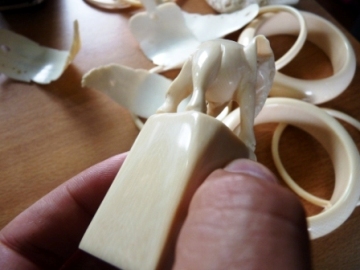 Ivory pieces confiscated by Republic of Congo authorities in Saturday's bust.
Photo by: Naftali Honig (PALF).
by JEREMY HANCE
A Chinese national was caught attempting to smuggle 22 pounds (10 kilos) of ivory out of the Republic of Congo on Saturday, according to the AFP. Officials confiscated five elephant tusks, 80 ivory chopsticks, 3 ivory carvings, and a number of smaller ivory-made items.
The suspect was taken into custody at the Maya-Maya airport in the Republic of Congo's capital, Brazzaville.
"We vowed to help the government of Congo send a zero tolerance message to ivory traffickers, and as you can see this message is in action," Naftali Honig, head of the Project to Apply the Law on Fauna (PALF), told the AFP. A Brazzaville-based NGO, PALF is working to build the capacity of Congolese authorities to enforce wildlife laws, which have long gone ignored in the central African nation.
PALF has been involved in a number of seizures, including catching illegal wildlife traders dealing in leopard skins, ivory, and living chimpanzees and gorillas for the illegal pet trade. The chimpanzee dealer became the first individual sentenced for wildlife trafficking in the Republic of Congo. He was sentenced to a year in prison.
"We work with investigators and local authorities to catch criminals in the act and then follow the legal proceedings to ensure that they don't use a phone call, a bribe, or anything of that nature to illegitimately get themselves off the hook," Honig explained to mongabay.com in an interview last February.
In its first year, PALF conducted 17 investigations resulting in the arrests of 19 alleged traffickers. The program was developed by the Aspinall Foundation and Wildlife Conservation Society.
Thursday, January 13, 2011
Old-growth forest is what giant pandas really need
 Thanks to Carol D for the link!
Zhang Z, Swaisgood RR, Zhang S, Nordstrom LA, Wang H, Gu X, Hu J, Wei F (2011) Old-growth forest is what giant pandas really need. Biology Letters doi: 10.1098/rsbl.2010.1081
Abstract
Giant pandas (Ailuropoda melanoleuca) are an iconic conservation species, but despite significant research effort, do we understand what they really need? Estimating and mapping suitable habitat play a critical role in conservation planning and policy. But if assumptions about ecological needs are wrong, maps with misidentified suitable habitat will misguide conservation action. Here, we use an information-theoretic approach to analyse the largest, landscape-level dataset on panda habitat use to date, and challenge the prevailing wisdom about panda habitat needs. We show that pandas are associated with old-growth forest more than with any ecological variable other than bamboo. Other factors traditionally used in panda habitat models, such as topographic slope, are less important. We suggest that our findings are disparate from previous research in part because our research was conducted over a larger ecological scale than previous research conducted over more circumscribed areas within individual reserves. Thus, extrapolating from habitat studies on small scales to conservation planning on large scales may entail some risk. As the Chinese government is considering the renewal of its logging ban, it should take heed of the panda's dependency on old growth.
Monday, December 6, 2010
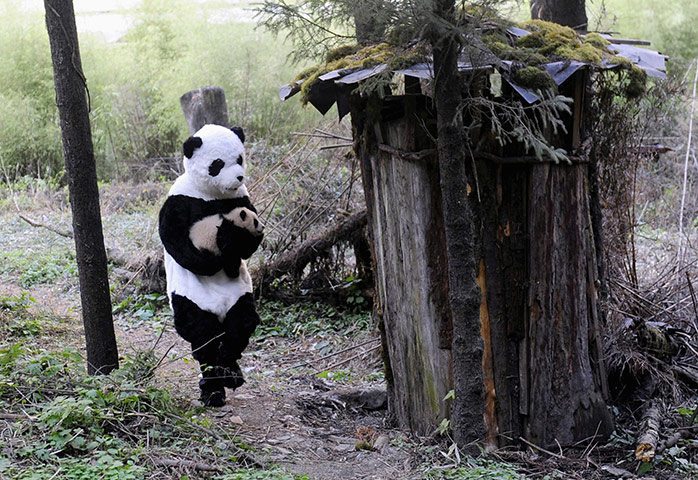
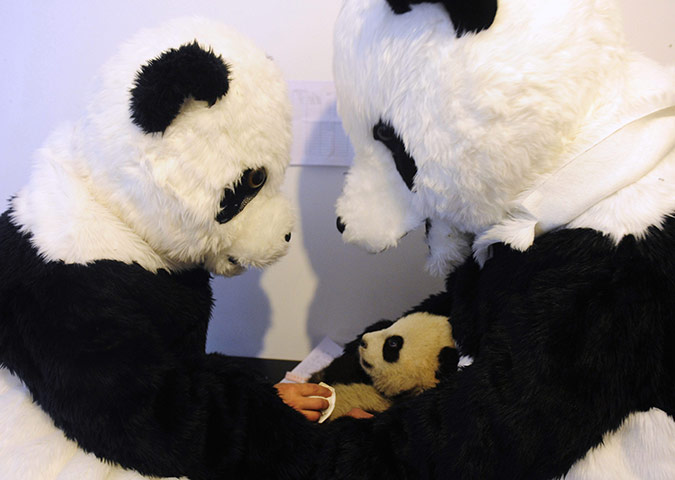
More Panda news: teaching pandas how to be whilst dressed as pandas
When I posted the other panda article this morning: Pandas: possibly the most complex breeding system ever - tricking moms into caring for twins kickstarts reintro program I did not expect Richard M. to post this album of how Chinese conservationists are teaching young pandas to survive in the wild...Who am I to judge, drastic times call for drastic measures and conservation needs thinking outside of the box. At the very least, its great for a Monday smile - MA
For more pictures go to the guardian.co.uk


For more pictures go to the guardian.co.uk
Pandas: possibly the most complex breeding system ever - tricking moms into caring for twins kickstarts reintro program
Click on the BBC link or the to see some good footage from the program "Panda Makers"
From the BBC.co.uk
Giant panda breeding breakthrough in China
By ELLA DAVIES
A critical breakthrough has been made in efforts to save the giant panda, one that could kick-start attempts to reintroduce the animals to the wild.
Conservationists say they have perfected the difficult task of reproducing pandas, having reached their target of successfully raising 300 of the bears in captivity. The breakthrough, mainly by scientists at the Chengdu Panda Breeding Research Centre, China, should lead to the first panda being reintroduced into the wild within 15 years. The revelation comes after documentary makers were given unprecedented access to the research centre to film captive breeding activity over two years.
Just a few thousand wild pandas survive at best, and the species is classified as being Endangered. In a bid to protect the animal, scientists have attempted to breed captive pandas since the first such cub was born in 1963. But many obstacles stood in the way of achieving a stable captive panda population.
The first was the very short window of opportunity provided in the panda's natural reproductive cycle. Female pandas are only on heat for 72 hours a year, and can only actually become pregnant during a 12 to 24 hour window during this time. In order to correctly interpret the bears' breeding potential, caring for captive female pandas required close observation including daily urine samples to monitor hormone levels. Understanding the giant panda's natural patterns of reproduction was only the start of the challenge.
'Turned off'
Despite conservationists' best efforts to encourage mating, pandas were seemingly "turned off" by captivity. In Chengdu, the world's most successful panda breeding centre, researchers attempted to entice male pandas with the scent of suitable females on bamboo poles, mimicking wild scent-marking behaviour. Rare interactions between aroused pairs often ended in disappointment, however.
Male pandas have proportionately short penises meaning pairs must adopt a very exact position in order to mate. During their observations, researchers found that pandas demonstrated poor knowledge of this position. Researchers then employed methods ranging from sex education videos to viagra in order to stimulate natural behaviour. Most techniques failed, and many encounters between pandas turned aggressive and violent.
Scientists therefore had to rely upon artificial insemination, but their efforts were again subject to the pandas' peculiar reproductive cycle. Panda pregnancies can last anything from 11 weeks to 11 months and can remain undetected until shortly before birth. So researchers had to pay close attention to pandas following insemination procedures, ready to perform a crucial intervention whenever cubs were born.
Crucial intervention
The boon in panda numbers at the Chengdu centre has largely been attributed to the innovative "twin swapping" technique. More than half of pandas give birth to two cubs at a time but only care for one. It is assumed that as pandas cannot store fat, they lack the milk or energy to care for more than one cub at a time. Whenever a cub was abandoned after birth, keepers at the Chengdu centre swiftly moved it to an incubator. Panda mothers were tricked into caring for twins as staff stealthily rotated them between their mother and the incubators.
The survival rate of cubs rose to 98% through this combination of maternal care and artificial support. By the end of last year, the Chengdu Panda Breeding Research Centre alone had raised 168 cubs since its inception in 1987.
Hopes of reintroduction
Conservationists now believe captive numbers are strong enough to seriously consider wild reintroduction programmes. Using the profits made from loaning their pandas to zoos worldwide, pioneers have purchased precious panda habitat in the Sichuan mountains, southwestern China. With the goal of 300 captive pandas achieved, construction has started on the country's first dedicated panda reintroduction facility.
Panda Makers is broadcast on BBC TWO at 2000 GMT, Tuesday December 7th.
From the BBC.co.uk
Giant panda breeding breakthrough in China
By ELLA DAVIES
A critical breakthrough has been made in efforts to save the giant panda, one that could kick-start attempts to reintroduce the animals to the wild.
Conservationists say they have perfected the difficult task of reproducing pandas, having reached their target of successfully raising 300 of the bears in captivity. The breakthrough, mainly by scientists at the Chengdu Panda Breeding Research Centre, China, should lead to the first panda being reintroduced into the wild within 15 years. The revelation comes after documentary makers were given unprecedented access to the research centre to film captive breeding activity over two years.
Just a few thousand wild pandas survive at best, and the species is classified as being Endangered. In a bid to protect the animal, scientists have attempted to breed captive pandas since the first such cub was born in 1963. But many obstacles stood in the way of achieving a stable captive panda population.
The first was the very short window of opportunity provided in the panda's natural reproductive cycle. Female pandas are only on heat for 72 hours a year, and can only actually become pregnant during a 12 to 24 hour window during this time. In order to correctly interpret the bears' breeding potential, caring for captive female pandas required close observation including daily urine samples to monitor hormone levels. Understanding the giant panda's natural patterns of reproduction was only the start of the challenge.
'Turned off'
Despite conservationists' best efforts to encourage mating, pandas were seemingly "turned off" by captivity. In Chengdu, the world's most successful panda breeding centre, researchers attempted to entice male pandas with the scent of suitable females on bamboo poles, mimicking wild scent-marking behaviour. Rare interactions between aroused pairs often ended in disappointment, however.
Male pandas have proportionately short penises meaning pairs must adopt a very exact position in order to mate. During their observations, researchers found that pandas demonstrated poor knowledge of this position. Researchers then employed methods ranging from sex education videos to viagra in order to stimulate natural behaviour. Most techniques failed, and many encounters between pandas turned aggressive and violent.
Scientists therefore had to rely upon artificial insemination, but their efforts were again subject to the pandas' peculiar reproductive cycle. Panda pregnancies can last anything from 11 weeks to 11 months and can remain undetected until shortly before birth. So researchers had to pay close attention to pandas following insemination procedures, ready to perform a crucial intervention whenever cubs were born.
Crucial intervention
The boon in panda numbers at the Chengdu centre has largely been attributed to the innovative "twin swapping" technique. More than half of pandas give birth to two cubs at a time but only care for one. It is assumed that as pandas cannot store fat, they lack the milk or energy to care for more than one cub at a time. Whenever a cub was abandoned after birth, keepers at the Chengdu centre swiftly moved it to an incubator. Panda mothers were tricked into caring for twins as staff stealthily rotated them between their mother and the incubators.
The survival rate of cubs rose to 98% through this combination of maternal care and artificial support. By the end of last year, the Chengdu Panda Breeding Research Centre alone had raised 168 cubs since its inception in 1987.
Hopes of reintroduction
Conservationists now believe captive numbers are strong enough to seriously consider wild reintroduction programmes. Using the profits made from loaning their pandas to zoos worldwide, pioneers have purchased precious panda habitat in the Sichuan mountains, southwestern China. With the goal of 300 captive pandas achieved, construction has started on the country's first dedicated panda reintroduction facility.
Panda Makers is broadcast on BBC TWO at 2000 GMT, Tuesday December 7th.
Tuesday, August 24, 2010
China's 45 Billion Disposable Chopsticks Require 100 Acres of Forests Every 24 Hours
I never thought about it, but its so true! If you are going to IPS this year you may want to think about bringing your own chopsticks or buying a pair when you get to Japan as a great souvenir and to help reduce the waste disposable chopsticks cause. SCB gave away free chopsticks to all its participants at the 2008 and 2009 meetings, man do i love that organization, so forward thinking! (although a bit much, i bet if you get a set of these you are less likely to dispose of them at all) - MA

From treehugger.com
by MICHAEL GRAHAM RICHARD
That's a Lot of Chopsticks
Apparently China's Ministry of Commerce has had it with disposable chopsticks. It sent out a warning to chopstick makers in June to warn them that: "Production, circulation and recycling of disposable chopsticks should be more strictly supervised." The reason? With about 45 billion disposable chopstick pairs made every year in the country, or about 130 million a day, a lot of wood is being wasted, and that in a country that is trying to increase its forest coverage (from about 8% in 1949 to 12-13% today, compared to 30% for the USA).
Sadly, change has been slow so far. The Bring Your Own Chopsticks movement has been gaining momentum, but is still far from succeeding in changing people's minds (or even being on most people's radar). But there is some hope on the horizon: As China grows richer, more restaurants will be able to afford the equipment to wash and sterilize reusable chopsticks.

From treehugger.com
by MICHAEL GRAHAM RICHARD
That's a Lot of Chopsticks
Apparently China's Ministry of Commerce has had it with disposable chopsticks. It sent out a warning to chopstick makers in June to warn them that: "Production, circulation and recycling of disposable chopsticks should be more strictly supervised." The reason? With about 45 billion disposable chopstick pairs made every year in the country, or about 130 million a day, a lot of wood is being wasted, and that in a country that is trying to increase its forest coverage (from about 8% in 1949 to 12-13% today, compared to 30% for the USA).
Greenpeace China has estimated that to keep up with this demand, 100 acres of trees need to be felled every 24 hours. Think here of a forest larger than Tiananmen Square -- or 100 American football fields -- being sacrificed every day. That works out to roughly 16 million to 25 million felled trees a year. Deforestation is one of China's gravest environmental problems, leading to soil erosion, famine, flooding, carbon dioxide release, desertification and species extinction. (source)If you compare 100 acres per day to the size of China's forests, it still isn't that much (it's a big country), but chopsticks are far from the only thing pressuring Chinese ecosystems. It's one more thing the country's forests could do without.
Sadly, change has been slow so far. The Bring Your Own Chopsticks movement has been gaining momentum, but is still far from succeeding in changing people's minds (or even being on most people's radar). But there is some hope on the horizon: As China grows richer, more restaurants will be able to afford the equipment to wash and sterilize reusable chopsticks.
Friday, March 12, 2010
Chinese medicine societies reject tiger bones ahead of CITES
 From WWF (panda.org)
WWF and TRAFFIC welcome a World Federation of Chinese Medicine Societies (WFCMS) statement urging its members not to use tiger bone or any other parts from endangered wildlife.
The statement was made at a symposium Friday in Beijing and notes that some of the claimed medicinal benefits of tiger bone have no basis. The use of tiger bones was removed from the traditional Chinese medicine (TCM) pharmacopeia in 1993, when China first introduced a domestic ban on tiger trade.
“Tiger conservation has become a political issue in the world. Therefore, it’s necessary for the traditional Chinese medicine industry to support the conservation of endangered species, including tigers,” said Huang Jianyin, deputy secretary of WFCMS.
Illegal trade in Asian big cat products is a key issue at the Convention on International Trade in Endangered Species of Wild Fauna and Flora (CITES) Conference of Parties meeting at Doha, Qatar. China is among the 175 countries that are signatories to this international treaty governing wildlife trade.
“CITES governments should be encouraged by this statement and use the opportunity they have at this meeting to pass measures, that if properly enforced, can help put an end to tiger trade,” said Dr. Colman O’Criodain, Wildlife trade analyst, WWF International.
The statement also calls on all WFCMS’ members to promote tiger conservation and encourages them to abide by all relevant international and national regulations on wildlife trade.
“The Societies’ public declaration is a clear signal that the traditional Chinese medicinal community is now backing efforts to secure a future for wild tigers,” said Professor Xu Hongfa, head of TRAFFIC’s programme in China.
As an international traditional Chinese academic organization, the WFCMS stated that it had a duty to research the conservation of endangered species, including tigers.
“We will ask our members not to use endangered wildlife in traditional Chinese medicine, and reduce the misunderstanding and bias of the international community,” said the WFCMS’ Huang Jianyin. “The traditional Chinese medicine industry should look for substitutes and research on economical and effective substitutes for tiger products, which will improve the international image and status of traditional Chinese medicine and promote TCM in the world.”
The WFCMS is an international academic organization based in Beijing, with 195 member organizations spanning 57 nations where traditional Chinese medicine is used. It aims to promote the development of traditional Chinese medicine, which is a primary form of healthcare delivery in China, and widely regarded as an important part of China’s rich cultural heritage.
WWF and TRAFFIC are calling for a permanent ban on all trade in tiger parts and products, and for a curtailment of commercial captive breeding operations.
Wild tigers are especially in the spotlight as 2010 marks the celebration of the Year of the Tiger in the Chinese lunar calendar. This year is seen as a unique opportunity to galvanize international action to save this iconic species.
Thursday, February 25, 2010
How Africa is Becoming the New Asia
 Pretoria, South Africa
By Jerry Guo
China and India get all the headlines for their economic prowess, but there's another global growth story that is easily overlooked: Africa. In 2007 and 2008, southern Africa, the Great Lakes region of Kenya, Tanzania, and Uganda, and even the drought-stricken Horn of Africa had GDP growth rates on par with Asia's two powerhouses. Last year, in the depths of global recession, the continent clocked almost 2 percent growth, roughly equal to the rates in the Middle East, and outperforming everywhere else but India and China. This year and in 2011, Africa will grow by 4.8 percent—the highest rate of growth outside Asia, and higher than even the oft-buzzed-about economies of Brazil, Russia, Mexico, and Eastern Europe, according to newly revised IMF estimates. In fact, on a per capita basis, Africans are already richer than Indians, and a dozen African states have higher gross national income per capita than China.
More surprising is that much of this growth is driven not by the sale of raw materials, like oil or diamonds, but by a burgeoning domestic market, the largest outside India and China. In the last four years, the surge in private consumption of goods and services has accounted for two thirds of Africa's GDP growth. The rapidly emerging African middle class could number as many as 300 million, out of a total population of 1 billion, according to development expert Vijay Majahan, author of the 2009 book Africa Rising. While few of them have the kind of disposable income found in Asia and the West, these accountants, teachers, maids, taxi drivers, even roadside street vendors, are driving up demand for goods and services like cell phones, bank accounts, upmarket foodstuffs, and real estate. In fact, in Africa's 10 largest economies, the service sector makes up 40 percent of GDP, not too far from India's 53 percent. "The new Africa story is consumption," says Graham Thomas, head of principal investment at Standard Bank Group, which operates in 17 African countries.
Much of the boom in this new consumer class can be attributed to outside forces: evolving trade patterns, particularly from increased demand coming out of China, and technological innovation abroad that spurs local productivity and growth like the multibillion-dollar fiber-optic lines that are being laid out between Africa and the developed world. Other changes are domestic and deliberate. Despite Africa's well-founded reputation for corruption and poor governance, a substantial chunk of the continent has quietly experienced this economic renaissance by dint of its virtually unprecedented political stability. Spurred by eager investors, governments have steadily deregulated industries and developed infrastructure. As a result, countries such as Kenya and Botswana now boast privately owned world-class hospitals, charter schools, and toll roads that are actually safe to drive on. A study by a World Bank program, the Africa Infrastructure Country Diagnostic, found that improvements in Africa's telecom infrastructure have contributed as much as 1 percent to per capita GDP growth, a bigger role than changes in monetary or fiscal policies. Shares of stocks in recently privatized local airlines, freight companies, and telecoms have skyrocketed.
Entrepreneurship has increased at the same time, powered in part by the influx of returning skilled workers. Just as waves of expats returned to China and India in the 1990s to start businesses that in turn attracted more outside talent and capital, there are now signs that an entrepreneurial African diaspora will help transform the continent. While brain drain is still a chronic problem in countries such as Burundi and Malawi—some of the poorest in the world on a per capita basis—Africa's most robust economies, such as those in Ghana, Botswana, and South Africa, are beginning to see an unprecedented brain gain. According to some reports, roughly 10,000 skilled professionals have returned to Nigeria in the last year, and the number of educated Angolans seeking jobs back home has spiked 10-fold, to 1,000, in the last five years. Bart Nnaji gave up a tenured professorship at the University of Pittsburgh to move back to Nigeria in 2005 and run Geometric Power, the first private power company in sub-Saharan Africa. Its $400 million, 188-megawatt power plant will come online this fall as the sole provider of electricity for Aba, a city of 2 million in southeast Nigeria. Afam Onyema, a 30-year-old graduate of Harvard and Stanford Law, turned down six-figure offers in corporate law to build and run a $50 million state-of-the-art private hospital with a charitable component for the poor in southeast Nigeria.
Many experts believe Africa, with its expansive base of newly minted consumers, may very well be on the verge of becoming the next India, thanks to frenetic urbanization and the sort of big push in services and infrastructure that transformed the Asian subcontinent 15 years ago. Just as India once harnessed its booming population of cheap labor, Africa stands to gain by the rapid growth of its big cities. Already the continent boasts the world's highest rate of urbanization, which jump-starts growth through industrialization and economies of scale. Today only a third of Africa's population lives in cities, but that segment accounts for 80 percent of total GDP, according to the U.N. Centre for Human Settlements. In the next 30 years, half the continent's population will be living in cities.
Nowhere is this relationship between the consumer class and urbanization more apparent than in Lagos, Nigeria, a megalopolis of 18 million that has the anything-goes pace of a Chongqing or Mumbai. On Victoria Island, the city's commercial center, real estate is as expensive as in Manhattan. Everywhere you look, there is construction: luxury condos, office buildings, roads, even a brand-new city nearby being dredged from the sea that will hold half a million people. "Everything is in short supply, so everything's a high-growth area," explains Adedotun Sulaiman, a venture capitalist and chairman of Accenture in Nigeria. "In terms of opportunities, it's just mind-blowing." Aliko Dangote, Africa's richest black entrepreneur, has also cashed in on this consumer culture, with a net worth of $2.5 billion, according to Forbes. His empire, which began in 1978 as a trading business that imported, among other things, baby food, cement, and frozen fish, is focused on Nigeria's burgeoning domestic growth, producing cement for shopping and office complexes; renting luxury condos; making noodles, flour, and sugar; and now expanding into services such as 3G mobile networks and transportation. "There's nowhere you can make money like in Nigeria," says the 53-year-old Dangote. "It's the world's best-kept secret."
Not anymore. A recent study by Oxford economist Paul Collier of all 954 publicly traded African companies operating between 2000 and 2007 found that their annual return on capital was on average 65 percent higher than those of similar firms in China, India, Vietnam, or Indonesia because labor costs are skyrocketing in Asia. Their median profit margin, 11 percent, was also higher than in Asia or South America. African mobile operators, for instance, showed the highest profit margins in the industry worldwide. As a result, foreign multinationals like Unilever, Nestlé, and Swissport International report some of their highest growth in Africa. So even as foreign direct investment fell by 20 percent worldwide in 2008, capital in-flows to Africa actually jumped 16 percent, to $61.9 billion, its highest level ever, according to a report by the Organization for Economic Cooperation and Development. Even Chinese companies are thinking of outsourcing basic manufacturing to Africa. The World Bank is now helping China set up an industrial zone in Ethiopia, the first of perhaps several offshore centers akin to the sprawling free-trade zones that opened up China's economy in the 1980s.
Still, Africa remains at the very frontier of emerging markets. Despite its gains, the difficulty and cost of running a business there are the highest in the world, according to data from the International Monetary Fund. Couple that with pervasive corruption—Transparency International calls the problem "rampant" in 36 of 53 African states—and it's no wonder Africa is often regarded as a toxic place to operate. But World Bank president Robert Zoellick says that in the aftermath of the economic crisis, long-term investors have recognized that "developed markets have big risks too." Like China and India, Africa is exploiting that fact, and perhaps more than any other region it is illustrative of a new world order in which the poorest nations will still find ways to steam ahead.
Tuesday, January 19, 2010
China's Africa footprint: a makeover for Algeria

ALGIERS, Algeria (AP) - While still struggling with the aftermath of a decade-long Islamic insurgency, oil-rich yet impoverished Algeria is getting a makeover: a new airport, its first mall, its largest prison, 60,000 new homes, two luxury hotels and the longest continuous highway in Africa.
The power behind this runaway building spree is China.
Some 50 Chinese firms, largely state-controlled, have been awarded $20 billion in government construction contracts, or 10 percent of the massive investment plan promised by President Abdelaziz Bouteflika for a nation where jobs and housing are scarce and al-Qaida has struck roots.
Algiers, the tense and rundown capital, now has something relatively new to the Arab world: a Chinatown.
The Beijing government has been a supporter of Algeria since the 1960s, after it won independence from France, and today the 35,000 Chinese in the country are the biggest foreign population after the French.
Trade both ways soared to $4.5 billion last year, from just $200 million in 2001, according to Ling Jun, deputy head of the Chinese Embassy in Algiers. China, is now second only to France in exports to Algeria.
Algerian exports to China barely top $300 million because China is a latecomer to the North African nation's biggest asset, the oil and gas under its portion of the Sahara Desert, which is dominated by U.S. firms. "But we're very active for the prospecting of new fields," Ling said.
And meanwhile, they're earning a hefty chunk of Algeria's oil money.
The China State Construction Engineering Corp., is building two-thirds of Algeria's 1,200 kilometer (745 mile) east-west highway at breakneck speed and was on the verge of completing it this month after just three years, Ling says.
The Algerian story mirrors China's inroads elsewhere in Africa, which are helped not just by its bulging coffers but by the fact that unlike some Western countries, China doesn't make human rights and corruption-free procedures a condition for investment.
It has drawn heavy criticism from human rights groups accusing it of bypassing the arms embargo on the embattled Darfur region by trading weapons for oil with the Sudanese government. Elsewhere it is accused of failing to spread the jobs among local workers, and of mistreating those it hires.
Some feel the China's African footprint has gotten too deep.
"Africa shouldn't have eluded one form of neocolonialism to fall headfirst into Chinese neocolonialism," Rene N'Guettia Kouassi, the head of the economic commission at the African Union, was quoted as saying in Jeune Afrique, the leading French-language weekly on the continent.
In Algeria too, that footprint has not been trouble-free.
Last summer Algiers saw its first anti-Chinese riot, apparently touched off when an Algerian got into a scuffle with a Chinese trader in the capital's Chinese market over a parking space, and the confrontation took on Islamic overtones.
Residents and local media say the Chinese beat up at least one man, whereupon an Algerian mob looted Chinese shops and vandalized cars.
The Chinatown in Bab Ezzouar, a suburb of Algiers, is now heavily patrolled by police cars, and the Chinese continue to sell their wares - bed linen, sports shoes, European fashion knockoffs - imported direct from China. "Business is good around here, but it's not as good as it used to be, because there are too many of us now," said Qing Nei, a shopkeeper from Beijing who moved here two years ago and can haggle over prices in rudimentary Arabic and French.
Also last summer, anti-Chinese sentiment rose after Beijing repressed its Muslim minority in western China. Al-Qaida and its Algerian branch, Al-Qaida in the Islamic Maghreb (AQIM) threatened retaliation.
The Chinese Embassy issued warnings to its citizens and heightened security measures, although no specific violence has yet targeted China's interests, Ling said.
In June an AQIM ambush killed at least 19 police officers escorting Chinese workers near the highway construction site. No Chinese were hurt, and Ling says the ambush appears to have been against the state, rather than the Chinese.
The Islamic violence today is scattered, sporadic, and nothing like the 1990s, when regular slaughters by rebels and government forces left up to 200,000 people dead. And despite the lingering al-Qaida threat, most Muslims in Algeria and elsewhere express no hostility to the Chinese as such.
"Islam accepts other religions, and we don't mind that they come to build in our country," said Abdeljabar Saad, an imam with strong ties to Islamists, who lives in area with many Chinese construction projects.
What Saad and others increasingly object to is that there is no trickle-down from China's investment.
Chinese firms import everything from the largest cranes to refills for their water coolers. On construction sites, even the unskilled workers pushing wheelbarrows are usually Chinese, not Algerian.
Ling, at the embassy, said state firms now have the obligation to hire and train two Algerian workers for each employee they bring from China.
But the few Algerian laborers working for Chinese contractors have begun complaining about their conditions. Some of those working on the new highway's construction site went on strike in late September, demanding overtime pay. Two months later, several newspapers reported they stormed and sealed the Chinese workers' camp.
Another image problem is a persistent rumor that some Chinese workers are convicted criminals who got a plea bargain for agreeing to work abroad.
Tang, a chief engineer at a site near Algiers where several hundred homes are being built, denied the rumor as "pure fantasy." Giving only one name because his management had not authorized him to be interviewed, he said every Chinese wishing to work for a state firm must show a clean police record.
He said his site employs 40 Chinese and 10 Algerians.
"Frankly," he said, "the Chinese work better, and longer hours, without complaining."
Thanks to Chrissie E for the link
Wednesday, October 21, 2009
From China: Entrepreneurs, Conservation and the Future of the World

Written by Charles Bedford
Charles Bedford, the state director for The Nature Conservancy in Colorado, is living and working in China for the next year and will be writing about conservation issues there. Read all his posts.
Who’s going to lead the way for conservation in China? Local grass-roots groups? International NGOs? The government?
Here’s another thought: What about Chinese capitalists?
Wang Zhi speaks softly into the microphone and wears the traditional uniform of the Chinese worker — blue collarless jacket with large buttons, matching pants. He introduces the evening with a history of the organization which he chairs — Society-Entrepreneurs-Ecology (SEE). It is hard to discern in his manner, words or style that he is one of the wealthiest men in China. Over the last 20 years he amassed a fortune through savvy real estate dealings. Three years ago, concerned with China’s environmental conditions and the limits that the country’s polluted air and water, degraded soils and dammed rivers will place on its economy, he joined with over 100 other Chinese tycoons to take action on the environment here.
They created SEE, an unprecedented new form of civil society organization in China. Wang and his friends created this organization in a country in which civil society had been virtually subsumed in government for the last 50 years, where “membership” has long been a concept reserved jealously for the Communist Party. In three years, SEE has forged a new power movement, with non-profit/NGO rules and a personality unique to China.
SEE, quite simply, is a club of like-minded entrepreneurs with a commitment to support the government’s environmental agenda by funding local NGO’s that also embrace that agenda and that are committed to principles of “cooperation” and “win-win” solutions. They have raised and spent millions of dollars. They have grant cycles and annually give out over 70 prestigious (and monetary) awards for good works in the field that meet their criteria. SEE acts like a cross between a foundation and a country club — members pony up a certain amount every year and participate in the grant-making and awards decisions in what can only be describe as a very garrulous democracy.
Tonight, I’m in attendance at this year’s awards meeting, along with China Central Television and reporters from all the national papers — who will later describe the event in glowing terms. Deeper into the evening, Wang Zhi is questioning one of the finalists for this year’s awards when an argument erupts about whether the ballots should be anonymous and who should be in charge of the vote tallying. The room explodes in spirited but smiling argument. After 20 minutes and seven voice- and hand-raising votes and recounts, unanimity appears to have broken out that the ballots will not be counted unless they have the judge’s name and phone number — proto-democracy at work in civil society.
Wang resumes his questioning, which becomes a debate between he and the finalist about whether the methods they used can be characterized as “cooperative” or should be thought of as “independent.” The unspoken subtext is — what should be the appropriate level of engagement with the powers-that-be…namely, the government.
Some of the questioning takes on the character of a venture philanthropy audition. The next contestant gets grilled by the sharp finance minds in the room about the cost/benefits of pollution control equipment in a monosodium glutamate (MSG) factory on the Huai River. After asserting that the benefits of this water-quality-monitoring project far exceed the costs, the potential awardee also claims that his project had only a one-year payback, reduced emissions to 10% of the previous year’s levels, and also literally “saved” the MSG industry in the country by driving the technology changes necessary to bring the industry into compliance.
The claim is verified by a SEE entrepreneur who has visited the site and gotten involved intellectually and financially with the local organization. The entrepreneurs erupt in shouts of approval mixed with disbelief. Mr. Wu, whose diversified holdings include provincial vineyards, leads the questioning about the organization’s financial backing and structure. You can almost hear the checkbooks being pulled out.
SEE has evolved over the years from trying to implement its own projects — such as planting trees in the desert — toward acting as a foundation and discussion group for grassroots conservation. Its governance has evolved as well, from a “vote your amount of contribution” model to more stable processes of decision-making. The group also reached out to The Nature Conservancy to bolster its engagement and fundraising systems as well as partnering to create this extraordinary media event, highlighting the power of grassroots organizing on the environment.
Contrast all this with the way that the Chinese government deals and has dealt with issues such as Falun Gong, Uighur or Tibetan separatist groups or the 1989 student movements and the impression you get is of a set of party elders working behind the scenes on the massive hot water boiler that is modern China, making adjustments to this valve or to that pipe, directing pressure towards social goals and away from disharmonious activities. The management of the economic system seems to happen in this way as well, having allowed the wealthy young entrepreneurs in the room to, as Deng Xiaoping said, “get rich is glorious.”
The evening continues to roll along, changing from pep rally to venture capital pitch-meeting and back to discussions of scoring. The prevailing attitudes are hope, optimism and humour, which serves these entrepreneurs well in this incredible Chinese context — a country with the worst pollution on earth, the world’s most-populated country, its wealthiest country, its poorest country, its fastest-developing country, and mega-biodiverse on top of all that.
The view in the room is of the future, the future of the world, which is happening fast. And these are the new leaders of this world, perhaps the only ones that can save the rest of us.
Thursday, July 30, 2009
Alarming Rise in Elephant and Rhino Poaching
 Symbolic ivory burning in 1989
Date: Jul 20 2009 | By: Maina
On Tuesday last week, Kenyan authorities seized a 300kg haul of elephant tusks and rhino horn hidden in coffins at the Jomo Kenyatta International Airport (JKIA). This large haul, valued at approximately $ 1-million, is thought to have either come from Tanzania or South Africa and was headed for Laos. Officials of the Kenya Wildlife Service (KWS) however speculate that the load’s final destination was indeed China, but through Laos, the de-facto ‘gateway to China’.
The KWS has been complaining about increasing ivory poaching since the Convention on International Trade in Endangered Species (CITES) allowed a one-off sale of ivory from southern Africa to China and Japan. The entry of China into the world trade in ivory was in itself a cause for alarm amongst many conservationists on account of what is viewed as China’s laissez-faire attitude towards wildlife - except the giant panda. There have been reports from the KWS and other organizations in Kenya and elsewhere in Africa indicating that there is definitely a rise in poaching for ivory and rhino horn.
According to the KWS, the rise in ivory poaching is partly caused by the CITES declaration to allow minimal trade from southern Africa. They say that this declaration created the illusion that it was OK to trade in ivory. If the number of seizures of ivory being witnessed today is anything to go by, then the KWS are right: the CITES declaration is indeed responsible for this mess.
It’s not just elephant poaching that is a problem. Just the previous week, a report was made public that indicates that rhino poaching has reached a 15 year high. The International Union for the Conservation of Nature, IUCN, and the global conservation organization WWF, and their affiliated wildlife trade monitoring network, TRAFFIC, told a CITES committee in a recent meeting that poachers in Africa and Asia are killing as many as two to three animals a week in some areas to meet a growing demand for the horns. What is more worrying is that this poaching is no longer a subsistence activity but it has now evolved into organized crime similar to cocaine and small arms rackets.
Elephants and rhinos are in a very dire situation as this new wave of wanton decimation of the majestic creatures picks up pace. We are witnessing the inevitable extinction of - in the case of the rhino - an evolutionary relic that generations upon generations of humans have marveled at; and the total loss of - in the case of the elephant - the gentle intelligent giant that has been the centre of almost all mythology.
Sentimental values aside, these are ‘keystone’ species that shape the environment that they occur in. Keeping a balance in the ecology of their habitat, and therefore determining the biological diversity of these habitats. The looming departure of these two could permanently alter ecosystems - in the most part - for the worst.
Poaching can do that, and this is going to happen in our lifetime.
A solution has to be found. We first have to stop lying to ourselves that there can be any sustainable trade in elephant ivory and rhino horn. We have seen this with our own eyes. It’s never going to happen. Having realized that, governments should tighten the noose on illegal traffic routes, cut down the poachers on sight, and increase punishment for poaching offenders. China and it’s Asian friends will need to be re-educated.
Dr Richard Leakey, while he was the head of KWS, led an elephant anti-poaching campaign back in the mid-1980s which brought down a large number of poaching rings. It has been 20 years since the symbolic burning of 12 tonnes of ivory - then worth about $3 million and from approximately 2000 dead elephants - at the height of the campaign. Today, elephant population that had dropped from 167, 000 in 1973 to a paltry 16,000 in 1989, now stand at 32,ooo. These numbers could easily start falling if nothing is done about the recent upsurge in poaching. Current wildlife officials could learn from this and step up the fight against poachers on the local level, while all conservationists push for the total ban on trade in ivory and rhino horn.
Again, China and the Asian world that still believes that rhino horn has medicinal value, and carvings from elephant ivory are ‘cute’, needs re-education.
0
comments

 Labels:
africa,
bushmeat,
china,
conservation,
elephants,
hunting,
ivory,
kenya,
misc mammals,
poaching,
violence
Labels:
africa,
bushmeat,
china,
conservation,
elephants,
hunting,
ivory,
kenya,
misc mammals,
poaching,
violence
 Labels:
africa,
bushmeat,
china,
conservation,
elephants,
hunting,
ivory,
kenya,
misc mammals,
poaching,
violence
Labels:
africa,
bushmeat,
china,
conservation,
elephants,
hunting,
ivory,
kenya,
misc mammals,
poaching,
violence
Sunday, December 9, 2007
National Geographic International Photography Contest Animal Winner

Photo by Li Feng
click here to see full size high res image
Animal Winner - China
Caged monkeys await their fate at a medical laboratory in Hubei Province, China. The judges liked that this image subverts the usual romanticized approach to wildlife photography and more accurately reflects the fate of many of the world’s animals. The sneaker at the top provides scale and injects a human being into the scene; the anonymity of the wearer suggests concealment and complicity. The structure of the cages, the horror of the captivity, the crowded composition, and the claustrophobic tension all add up to a sad and compelling photo.
Subscribe to:
Posts (Atom)


 Posts
Posts


