Thanks to Caro D!
Showing posts with label tool use. Show all posts
Showing posts with label tool use. Show all posts
Friday, January 13, 2012
Tuesday, January 10, 2012
Myth Busting: The Truth About Animals And Tools
from NPR
by JON HAMILTON
A wasp uses a pebble as a hammer. An octopus carries around a coconut shell to hide in. A shrike impales its prey on a sharp thorn.
Those are just a few examples of animal tool use that appear in the new book Animal Tool Behavior by Robert W. Shumaker, Kristina R. Walkup and Benjamin B. Beck. The book updates an edition published in 1980 by Beck. And in the new version, the authors try to dispel a number of persistent myths about animals and tools.
Shumaker tells me about some of those myths during a walk around The Indianapolis Zoo, where he is vice president of life sciences. (He is also a member of the adjunct faculty at the University of Indiana.)
As we approach a female polar bear named Tundra, Shumaker says one myth he hopes to deflate is that tool use is limited to monkeys and apes. Polar bears offer a powerful rebuttal of that idea, he says. In zoos, they often throw objects with great force and accuracy. It's less clear whether this sort of tool use occurs in the wild. But there are anecdotal reports from early Arctic explorers of polar bears using projectiles to hunt.
"One of the stories we have is polar bears getting up on a cliff and hurling great chunks of ice down on something like a walrus to kill it," Shumaker says.
Another common misconception: Tool use requires fingers, or at least hands, Shumaker says. Apparently, no one bothered to tell dolphins. "They have nothing to hold tools with except their mouth," he says, "and yet they are still innovative and creative."
Dolphins play with just about any object they find, Shumaker says. In some cases, the objects are merely toys — but they become tools when used to manipulate another object or creature for a specific purpose. And dolphins do that kind of manipulating a lot, says Jodie Baker, who is in charge of marine mammals at the zoo. As we speak over the din of dolphin splashes and chatter, Baker sees a dolphin named Kimo preparing to manipulate us with a tool — in this case, a buoy.
"If you walk by the pool and there's a dolphin playing with a toy, they'll typically throw it in your direction to get your attention," she says.
That's a form of tool use known as baiting or enticing. But scientists have collected lots of examples of dolphins doing other things with tools, Shumaker says.
"One is a dolphin that found a piece of tile and took it down to the bottom of their pool and used it to scrape algae off the bottom of their pool and then they ate the algae," he says.
And wild dolphins in Australia sometimes flush out their prey with a sponge, he says. "They hold the sponge on their rostrum, and then they use that as they disturb the sandy bottom to get fish like flounder that are down in the sand."
Genetics Or Intelligence?
One of the most widespread myths about tool use is that it is a sign of intelligence. Of course, some really smart animals do use tools. But so do creatures like the bolas spider, which is named after the throwing weapon used by South American gauchos. The spider's version of the bolas is a ball made from the same silk it uses to spin a web, Shumaker says.
"When an insect flies by, they throw it and it attaches to the insect because it's sticky and they reel them in," he says. "It's very complex. Very impressive. Very dramatic. But all available information tells us that it's completely controlled from this animal's genetic history." In other words, it's programmed behavior, not something the spider figured out. Genetic programming is also the reason hermit crabs carry around another creature's shell and ant-lions throw sand at their prey.
When intelligent animals do use tools, though, they often do so in very creative ways, Shumaker says.
At the zoo's spacious elephant enclosure, Tim Littig, a senior animal trainer, points toward a baby elephant named Kalina, who is standing next to her mother, Kubwa. Kalina has been able to nurse without any help, Littig says. But things were trickier with Kubwa's previous baby, he says.
"Her last calf was a little smaller than this one and required a step stool to be able to reach her mammary glands to nurse," Littig explains. "Kubwa would move the stool around so the calf could stand up on the stool to nurse."
Technically, that made her baby the tool user. But it was Kubwa who figured out how to use the tool. And that sort of problem-solving is a sign of intelligence, Shumaker says.
So is figuring out how to make a tool — a skill many scientists once thought of as uniquely human. Shumaker says those scientists must not have spent much time around orangutans. Then he takes me to the orangutan enclosure for a demonstration.
I'm holding a large microphone, which Shumaker reminds me not to point at the orangutans, lest they think it's a weapon. But the animals aren't frightened. Several orangutans reach through the steel mesh and make it clear to Shumaker that they want to have the microphone. Shumaker tells a female named Knobi that she can touch it, which she does several times. When I move it out of reach, though, Knobi walks off and comes back with a small tree branch.
"She's making a reaching tool to try and get your microphone," Shumaker explains as Knobi breaks off one forking branch so the limb will fit through the steel mesh.
But this reaching tool isn't long enough, so Knobi fetches a branch that's 5 or 6 feet long. I stay where I am as Knobi prods at the microphone with the tool.
"She's doing her best to draw the mic in," Shumaker says to me. Then to Knobi he says: "I'm sorry; you cannot have it. Good job with your tool."
As we walk away, we can see Knobi grabbing an even larger branch.
Using Symbols As Tools
Just 10 or 15 years ago, scientists were still debating whether orangutans in the wild also made tools, Shumaker says. Now it's clear they do, and there are several examples in Animal Tool Behavior. The book also offers scientific documentation of other species making tools in the wild. New Caledonian crows make hooks out of twigs to catch prey. Wild chimpanzees make wooden spears for hunting.
Perhaps the most surprising and controversial findings in the new book involve what scientists refer to as symbolic tool use. "These are examples where we see tools being used to represent something else or to provide a change in psychological state," Shumaker says
Symbolic tool use is something people do every time they pay for an item with paper bills or coins. And some monkeys and apes in captivity have learned to use tokens that they trade for various foods.
But Shumaker is more intrigued by the sort of symbolic tools that can affect emotions. There are lots of examples of this in people. Children often have a special stuffed animal or blanket that is much more than a toy. The object represents comfort or security to them, and they use it to feel better.
It's one more behavior that scientists once considered uniquely human. But Shumaker says there is more and more evidence that some animals use symbolic tools in much the same way.
"We would see great apes in times of great stress or sadness, like a female who had an infant that died," Shumaker says. "That female would create something that researchers called a doll and then [she] treated it exactly as she had treated her infant that had recently died."
Shumaker says scientists are still debating the significance of examples like this. But he says the fact that such a debate is even taking place shows how much things have changed since the 1960s, when scientists first realized that humans weren't the only ones using tools.
by JON HAMILTON
A wasp uses a pebble as a hammer. An octopus carries around a coconut shell to hide in. A shrike impales its prey on a sharp thorn.
Those are just a few examples of animal tool use that appear in the new book Animal Tool Behavior by Robert W. Shumaker, Kristina R. Walkup and Benjamin B. Beck. The book updates an edition published in 1980 by Beck. And in the new version, the authors try to dispel a number of persistent myths about animals and tools.
Shumaker tells me about some of those myths during a walk around The Indianapolis Zoo, where he is vice president of life sciences. (He is also a member of the adjunct faculty at the University of Indiana.)
As we approach a female polar bear named Tundra, Shumaker says one myth he hopes to deflate is that tool use is limited to monkeys and apes. Polar bears offer a powerful rebuttal of that idea, he says. In zoos, they often throw objects with great force and accuracy. It's less clear whether this sort of tool use occurs in the wild. But there are anecdotal reports from early Arctic explorers of polar bears using projectiles to hunt.
"One of the stories we have is polar bears getting up on a cliff and hurling great chunks of ice down on something like a walrus to kill it," Shumaker says.
Another common misconception: Tool use requires fingers, or at least hands, Shumaker says. Apparently, no one bothered to tell dolphins. "They have nothing to hold tools with except their mouth," he says, "and yet they are still innovative and creative."
Dolphins play with just about any object they find, Shumaker says. In some cases, the objects are merely toys — but they become tools when used to manipulate another object or creature for a specific purpose. And dolphins do that kind of manipulating a lot, says Jodie Baker, who is in charge of marine mammals at the zoo. As we speak over the din of dolphin splashes and chatter, Baker sees a dolphin named Kimo preparing to manipulate us with a tool — in this case, a buoy.
"If you walk by the pool and there's a dolphin playing with a toy, they'll typically throw it in your direction to get your attention," she says.
That's a form of tool use known as baiting or enticing. But scientists have collected lots of examples of dolphins doing other things with tools, Shumaker says.
"One is a dolphin that found a piece of tile and took it down to the bottom of their pool and used it to scrape algae off the bottom of their pool and then they ate the algae," he says.
And wild dolphins in Australia sometimes flush out their prey with a sponge, he says. "They hold the sponge on their rostrum, and then they use that as they disturb the sandy bottom to get fish like flounder that are down in the sand."
Genetics Or Intelligence?
One of the most widespread myths about tool use is that it is a sign of intelligence. Of course, some really smart animals do use tools. But so do creatures like the bolas spider, which is named after the throwing weapon used by South American gauchos. The spider's version of the bolas is a ball made from the same silk it uses to spin a web, Shumaker says.
"When an insect flies by, they throw it and it attaches to the insect because it's sticky and they reel them in," he says. "It's very complex. Very impressive. Very dramatic. But all available information tells us that it's completely controlled from this animal's genetic history." In other words, it's programmed behavior, not something the spider figured out. Genetic programming is also the reason hermit crabs carry around another creature's shell and ant-lions throw sand at their prey.
When intelligent animals do use tools, though, they often do so in very creative ways, Shumaker says.
At the zoo's spacious elephant enclosure, Tim Littig, a senior animal trainer, points toward a baby elephant named Kalina, who is standing next to her mother, Kubwa. Kalina has been able to nurse without any help, Littig says. But things were trickier with Kubwa's previous baby, he says.
"Her last calf was a little smaller than this one and required a step stool to be able to reach her mammary glands to nurse," Littig explains. "Kubwa would move the stool around so the calf could stand up on the stool to nurse."
Technically, that made her baby the tool user. But it was Kubwa who figured out how to use the tool. And that sort of problem-solving is a sign of intelligence, Shumaker says.
So is figuring out how to make a tool — a skill many scientists once thought of as uniquely human. Shumaker says those scientists must not have spent much time around orangutans. Then he takes me to the orangutan enclosure for a demonstration.
I'm holding a large microphone, which Shumaker reminds me not to point at the orangutans, lest they think it's a weapon. But the animals aren't frightened. Several orangutans reach through the steel mesh and make it clear to Shumaker that they want to have the microphone. Shumaker tells a female named Knobi that she can touch it, which she does several times. When I move it out of reach, though, Knobi walks off and comes back with a small tree branch.
"She's making a reaching tool to try and get your microphone," Shumaker explains as Knobi breaks off one forking branch so the limb will fit through the steel mesh.
But this reaching tool isn't long enough, so Knobi fetches a branch that's 5 or 6 feet long. I stay where I am as Knobi prods at the microphone with the tool.
"She's doing her best to draw the mic in," Shumaker says to me. Then to Knobi he says: "I'm sorry; you cannot have it. Good job with your tool."
As we walk away, we can see Knobi grabbing an even larger branch.
Using Symbols As Tools
Just 10 or 15 years ago, scientists were still debating whether orangutans in the wild also made tools, Shumaker says. Now it's clear they do, and there are several examples in Animal Tool Behavior. The book also offers scientific documentation of other species making tools in the wild. New Caledonian crows make hooks out of twigs to catch prey. Wild chimpanzees make wooden spears for hunting.
Perhaps the most surprising and controversial findings in the new book involve what scientists refer to as symbolic tool use. "These are examples where we see tools being used to represent something else or to provide a change in psychological state," Shumaker says
Symbolic tool use is something people do every time they pay for an item with paper bills or coins. And some monkeys and apes in captivity have learned to use tokens that they trade for various foods.
But Shumaker is more intrigued by the sort of symbolic tools that can affect emotions. There are lots of examples of this in people. Children often have a special stuffed animal or blanket that is much more than a toy. The object represents comfort or security to them, and they use it to feel better.
It's one more behavior that scientists once considered uniquely human. But Shumaker says there is more and more evidence that some animals use symbolic tools in much the same way.
"We would see great apes in times of great stress or sadness, like a female who had an infant that died," Shumaker says. "That female would create something that researchers called a doll and then [she] treated it exactly as she had treated her infant that had recently died."
Shumaker says scientists are still debating the significance of examples like this. But he says the fact that such a debate is even taking place shows how much things have changed since the 1960s, when scientists first realized that humans weren't the only ones using tools.
1 comments

 Labels:
birds,
cognition,
evolution,
misc water dwellers,
misc mammals,
primates,
tool use,
video
Labels:
birds,
cognition,
evolution,
misc water dwellers,
misc mammals,
primates,
tool use,
video
 Labels:
birds,
cognition,
evolution,
misc water dwellers,
misc mammals,
primates,
tool use,
video
Labels:
birds,
cognition,
evolution,
misc water dwellers,
misc mammals,
primates,
tool use,
video
Wednesday, November 23, 2011
Thursday, November 3, 2011
Orangutan Culture Develops Like Human Culture
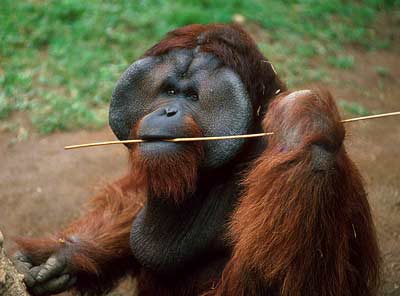
Thanks to Geraldine F and Zoran A for the link
from WIRED.com
By Olivia Solon
A team of anthropologists have shown that orangutans may have the ability to learn socially and pass these lessons down through generations — evidence that culture in humans and great apes has the same evolutionary roots.
In humans, certain behavioral innovations tend to be passed down from generation to generation through social learning. Many consider the existence of culture in humans to be one of the key factors that differentiates us from other animals.
Around a decade ago, biologists observing great apes noticed geographical variations in behavior that suggested that they were passing certain innovations down through generations, just as humans do. To this day, there is much debate about whether geographical variations in behavior is driven culturally or through genetic and environmental factors.
Researchers from the University of Zurich have now studied whether the geographic variation of behavioral patterns in nine orangutan populations in Sumatra and Borneo can be explained by cultural transmission. They have concluded that it can.
The team analyzed more than 100,000 hours of behavioral data and created genetic profiles of more than 150 wild orangutans. They measured the ecological differences between the habitats of the different populations using satellite imagery and remote sensing techniques.
Co-author of the study, published in Current Biology, Carel van Schaik said: “The novelty of our study is that, thanks to the unprecedented size of our dataset, we were the first to gauge the influence genetics and environmental factors have on the different behavioral patterns among the orangutan populations.”
Environmental influences and, to a lesser degree, genetic factors did play an important role in defining differences in social structure and behavioral ecology between the populations. However, these factors did not explain the behavioral patterns.
Michael Krützen, the first author of the study, said: “The cultural interpretation of the behavioral diversity also holds for orangutans — and in exactly the same way as we would expect for human culture. It looks as if the ability to act culturally is dictated by the long life expectancy of apes and the necessity to be able to adapt to changing environmental conditions.”
Classic Clip: Chimpanzee Culture and Medicine Usage
Livia W reminded me of this classic chimp culture clip, featuring Dr. Boesch and the infamous Dr.Wrangham ant-bitten lip scene
Thursday, October 6, 2011
Thursday, September 8, 2011
Very Important Scientist of the Month: Tracy Kivell - Handier than Homo habilis?

From PhysOrg (thanks to gerladine F for the link!)
The versatile hand of Australopithecus sediba makes a better candidate for an early tool-making hominin than the hand of Homo habilis.
Hand bones from a single individual with a clear taxonomic affiliation are scarce in the hominin fossil record, which has hampered understanding of the evolution of manipulative abilities in hominins. An international team of researchers including Tracy Kivell of the Max Planck Institute for Evolutionary Anthropology in Leipzig, Germany has now published a study that describes the earliest, most complete fossil hominin hand post-dating the appearance of stone tools in the archaeological record, the hand of a 1.98-million-year-old Australopithecus sediba from Malapa, South Africa. The researchers found that Au. sediba used its hand for arboreal locomotion but was also capable of human-like precision grips, a prerequisite for tool-making. Furthermore, the Au. sediba hand makes a better candidate for an early tool-making hominin hand than the Homo habilis hand, and may well have been a predecessor from which the later Homo hand evolved.
The extraordinary manipulative skills of the human hand are viewed as a hallmark of humanity. Over the course of human evolution, the hand was freed from the constraints of locomotion and has evolved primarily for manipulation, including tool-use and eventually tool-production. Understanding this functional evolution has been hindered by the rarity of relatively complete hand skeletons that can be reliably assigned to a given taxon based on a clear association with craniodental fossils.
Tracy Kivell of the Max Planck Institute for Evolutionary Anthropology in Leipzig, Germany and colleagues from the University of the Witwatersrand in Johannesburg, South Africa, Duke University in Durham, USA and the University of Zurich in Zurich, Switzerland, now describe the earliest, most complete fossil hominin hand post-dating the appearance of stone tools in the archaeological record around 2.6 million years ago. The fossil remains of an adult female Au. sediba from Malapa, South Africa, include an almost complete right hand in association with the right forelimb bones, in addition to several bones from the left hand. "Almost all other fossil hominin hand bones prior to Neandertals are isolated bones that are not anatomically associated (i.e., do not belong to the same individual) and are not clearly attributed to a specific hominin species", says Kivell: "The Australopithecus sediba hand thus allows us for the first time prior to Neandertals to evaluate the functional morphology of the hand overall, rather than just from isolated bones."
The researchers reconstructed the Au. sediba hand, then compared it with other hominin fossils and investigated the presence of several features that have been associated with human-like precision grip and the ability to make stone tools. They found that Au. sediba has many of these features, including a relatively long thumb compared to the fingers – longer than even that of modern humans – that would facilitate thumb-to-finger precision grips. Importantly, Au. sediba has more features related to tool-making than the 1.75-million-year-old "OH 7 hand" that was used to originally define the "handy man" species, Homo habilis. However, Au. sediba also retains morphology that suggests the hand was still capable of powerful flexion needed for climbing in trees.
"Taken together, we conclude that mosaic morphology of Au. sediba had a hand still used for arboreal locomotion but was also capable of human-like precision grips", says Kivell and adds: "In comparison with the hand of Homo habilis, Au. sediba makes a better candidate for an early tool-making hominin hand and the condition from which the later Homo hand evolved."
More information: Tracy L. Kivell, Job M. Kibii, Steven E. Churchill, Peter Schmid, Lee R. Berger, Australopithecus sediba hand demonstrates mosaic evolution of locomotor and manipulative abilities, Science, 09 September 2011
Friday, August 26, 2011
Monday, July 11, 2011
Diver Snaps First Photo of Fish Using Tools

From Science Now
by REBECCA KESSLER
While exploring Australia's Great Barrier Reef, professional diver Scott Gardner heard an odd cracking sound and swam over to investigate. What he found was a footlong blackspot tuskfish (Choerodon schoenleinii) holding a clam in its mouth and whacking it against a rock. Soon the shell gave way, and the fish gobbled up the bivalve, spat out the shell fragments, and swam off. Fortunately, Gardner had a camera handy and snapped what seem to be the first photographs of a wild fish using a tool.
Tool use, once thought to be the distinctive hallmark of human intelligence, has been identified in a wide variety of animals in recent decades. Although other creatures don't have anything quite like a circular saw or a juice machine, capuchin monkeys select "hammer" rocks of an appropriate material and weight to crack open seeds, fruits, or nuts on larger "anvil" rocks, and New Caledonian crows probe branches with grass, twigs, and leaf strips to extract insects. In addition to primates and birds, many animals, including dolphins, elephants, naked mole rats, and even octopuses, have shown forms of the behavior.
Tool-using fish have been few and far between, however, particularly in the wild. Archerfish target jets of water at terrestrial prey, but whether this constitutes tool use has been contentious. There have also been a handful of reports of fish cracking open hard-shelled prey, such as bivalves and sea urchins, by banging them on rocks or coral, but there's no photo or video evidence to back it up, according to Culum Brown, a behavioral ecologist at Macquarie University in Sydney, Australia, and a co-author of the present paper, to be published in a forthcoming issue of Coral Reefs.
The tuskfish caught on camera was clearly quite skilled at its task, "landing absolutely pinpoint blows" with the shell, Brown says. A scattering of crushed shells around its anvil rock suggests that Gardner didn't just stumble upon the fish during its original eureka moment. In fact, numerous such shell middens are visible around the reef. Blackspot tuskfish, members of the wrasse family, are popular food fish, so it's surprising that its shell-smashing behavior has remained unknown, Brown says. "My feeling is that when we go out and really look for it, it'll turn out to be common."
"I absolutely loved it," says ethologist Michael Kuba of the Hebrew University of Jerusalem of the finding. Last year, Kuba and two colleagues documented stingrays in a laboratory forming jets of water with their bodies to flush food out of a pipe. But solid external objects like rocks are harder to dismiss as tools than water jets, Kuba says, and examples from the wild avoid concerns about whether a behavior elicited in the lab is "natural."
Primatologist Elisabetta Visalberghi of the Institute of Cognitive Sciences and Technologies in Rome is less convinced. Visalberghi, who documented the hammer-wielding monkeys, adheres to a stricter definition of tool use that requires the animal to hold or carry the tool itself, in this case the rock. "The form of tool use described [in tuskfish] is cognitively little demanding and present in a variety of species. Often it has been labeled as proto-tool use because the object used to open the shell is still, fixated to the sea bottom, and not portable as stone tools used to crack open nuts by chimpanzees or capuchin monkeys are," she writes in an e-mail. Seagulls dropping shellfish onto hard surfaces to crack them or lab rats pushing levers to get rewards would join tuskfish in the category of proto-tool—but not true tool—users.
Brown acknowledges that exactly what constitutes tool use is controversial. But he argues that it's not logical to apply the same rules to fish as to primates or birds. For one thing, fish don't have anything but their mouths to manipulate tools with, and for another, water poses different physical limitations than air. "One of the problems with the definition of tool use as it currently stands is it's totally written for primates," he says. "You cannot swing a hammer effectively underwater."
---
Reference
Jones AM, Brown C, Gardner S (2011) Tool use in the tuskfish Choerodon schoenleinii? Coral reefs DOI: 10.1007/s00338-011-0790-y
Thursday, June 9, 2011
chimps problem solve better thean kids in new study
Spitting and urinating chimps 'replay Aesop's fable'
By REBECCA MORELLE
from BBC
(more videos on BBC website)
Chimps have "replayed" an ancient fable, a team says in Plos One journal. In Aesop's 2,000-year-old tale, a crow uses stones to raise the water level in a pitcher to reach the liquid so as to quench its thirst. But when given a similar set up, chimps were able to attain an out-of-reach, floating peanut by spitting water taken from a dispenser into a vertical tube. One hungry chimp went even further by urinating into the vessel to get hold of the prized snack."He was spitting water into the tube, then got frustrated," explained lead researcher Daniel Hanus from the Max Planck Institute for Evolutionary Biology in Leipzig, Germany.
"So he started peeing and then he realised: 'Wait a minute, if I move in that direction, that fills up the tube'."
The chimp's unusual method proved successful, the scientist said. The fact that the peanut was urine-sodden did not deter the animal from eating it, he added.
The study was carried out with gorillas and chimpanzees.
The primates were presented with a vertical glass tube, which was secured to a cage so it could not be moved or broken. At the bottom was a peanut, floating on a small amount of water. They were also given access to a water dispenser.
The idea was that the animals would take water from the dispenser in their mouths, and then spit it into the tube to raise the water level. It would take several visits back and forth between the dispenser and tube to gather enough water to get to the peanut. The team found that none of the five gorillas was able to complete the task. Chimps however were more successful. Out of 43 chimps, based in the Ngamba Island Chimpanzee Sanctuary, in Uganda, and Germany's Leipzig Zoo, 14 worked out that they needed to take the water in their mouths and spit it into the tube, and seven did this enough times to successfully obtain a peanut. Dr Hanus said the study highlighted the chimps' ability to solve problems
He explained: "You cannot explain it by trial-and-error learning. They weren't just spitting water around the room and some fell in by accident. "Instead, they were standing in front of the problem, trying to work out the solution - at first by trying to use their fingers, or trying to break it. "But some, then went to the drinker and got the mouthful of water and came back and spat it directly into the tube, and a few did it enough times to get the peanut." He added: "I think it is quite impressive - I call it insightful behaviour." The urinating chimp, he said, was an interesting case. The animal had initially solved the problem using the standard spitting technique, but when tested again, he was struggling to direct the water into the tube. The urine did the trick, said Dr Hanus. He said: "He seemed like he understood. He was like: 'That's cool, this helps me'."
Child's play
The team also repeated the study with children of varying ages.
Dr Hanus said: "Whenever we talked to people about this task, they'd say: 'Well, this is a demanding task, it is tricky - I don't know if I could solve that'. "So we decided to test four, six and eight-year-olds." This time, the subjects were given a watering can to fill up the tube rather than rely on a water dispenser and a refined spitting technique. The researchers found that the four-year-olds were outperformed by the chimps: only two out 24 younger children could solve the problem. Six-year-olds did better, with 10 out of the 24 managing to work out they needed to use the water. And eight-years-olds did the best, 14 children - 58% - completed the task. Dr Hanus said: "Even the older children found it hard. It was interesting and impressive to see how difficult it was for them." This research follows a similar study carried out with orangutans in 2007. They were very good at solving this problem: five out of the five primates tested could successfully complete the task. The team said the difference between the three primate species was striking - although they plan to test the gorillas again using a slightly different set-up. Birds too have been able to carry out this task. A paper published in 2009 revealed that rooks were highly successful at working out a solution to this problem. With a slightly experiment design, where the birds had to drop stones into the water, and a peanut exchanged for a floating maggot, the team found that all four of the rooks tested could complete the task.
---
Citation: Hanus D, Mendes N, Tennie C, Call J (2011) Comparing the Performances of Apes (Gorilla gorilla, Pan troglodytes, Pongo pygmaeus) and Human Children (Homo sapiens) in the Floating Peanut Task. PLoS ONE 6(6): e19555. doi:10.1371/journal.pone.0019555
Abstract
Recently, Mendes et al. [1] described the use of a liquid tool (water) in captive orangutans. Here, we tested chimpanzees and gorillas for the first time with the same “floating peanut task.” None of the subjects solved the task. In order to better understand the cognitive demands of the task, we further tested other populations of chimpanzees and orangutans with the variation of the peanut initially floating or not. Twenty percent of the chimpanzees but none of the orangutans were successful. Additional controls revealed that successful subjects added water only if it was necessary to obtain the nut. Another experiment was conducted to investigate the reason for the differences in performance between the unsuccessful (Experiment 1) and the successful (Experiment 2) chimpanzee populations. We found suggestive evidence for the view that functional fixedness might have impaired the chimpanzees' strategies in the first experiment. Finally, we tested how human children of different age classes perform in an analogous experimental setting. Within the oldest group (8 years), 58 percent of the children solved the problem, whereas in the youngest group (4 years), only 8 percent were able to find the solution.
By REBECCA MORELLE
from BBC
(more videos on BBC website)
Chimps have "replayed" an ancient fable, a team says in Plos One journal. In Aesop's 2,000-year-old tale, a crow uses stones to raise the water level in a pitcher to reach the liquid so as to quench its thirst. But when given a similar set up, chimps were able to attain an out-of-reach, floating peanut by spitting water taken from a dispenser into a vertical tube. One hungry chimp went even further by urinating into the vessel to get hold of the prized snack."He was spitting water into the tube, then got frustrated," explained lead researcher Daniel Hanus from the Max Planck Institute for Evolutionary Biology in Leipzig, Germany.
"So he started peeing and then he realised: 'Wait a minute, if I move in that direction, that fills up the tube'."
The chimp's unusual method proved successful, the scientist said. The fact that the peanut was urine-sodden did not deter the animal from eating it, he added.
The study was carried out with gorillas and chimpanzees.
The primates were presented with a vertical glass tube, which was secured to a cage so it could not be moved or broken. At the bottom was a peanut, floating on a small amount of water. They were also given access to a water dispenser.
The idea was that the animals would take water from the dispenser in their mouths, and then spit it into the tube to raise the water level. It would take several visits back and forth between the dispenser and tube to gather enough water to get to the peanut. The team found that none of the five gorillas was able to complete the task. Chimps however were more successful. Out of 43 chimps, based in the Ngamba Island Chimpanzee Sanctuary, in Uganda, and Germany's Leipzig Zoo, 14 worked out that they needed to take the water in their mouths and spit it into the tube, and seven did this enough times to successfully obtain a peanut. Dr Hanus said the study highlighted the chimps' ability to solve problems
He explained: "You cannot explain it by trial-and-error learning. They weren't just spitting water around the room and some fell in by accident. "Instead, they were standing in front of the problem, trying to work out the solution - at first by trying to use their fingers, or trying to break it. "But some, then went to the drinker and got the mouthful of water and came back and spat it directly into the tube, and a few did it enough times to get the peanut." He added: "I think it is quite impressive - I call it insightful behaviour." The urinating chimp, he said, was an interesting case. The animal had initially solved the problem using the standard spitting technique, but when tested again, he was struggling to direct the water into the tube. The urine did the trick, said Dr Hanus. He said: "He seemed like he understood. He was like: 'That's cool, this helps me'."
Child's play
The team also repeated the study with children of varying ages.
Dr Hanus said: "Whenever we talked to people about this task, they'd say: 'Well, this is a demanding task, it is tricky - I don't know if I could solve that'. "So we decided to test four, six and eight-year-olds." This time, the subjects were given a watering can to fill up the tube rather than rely on a water dispenser and a refined spitting technique. The researchers found that the four-year-olds were outperformed by the chimps: only two out 24 younger children could solve the problem. Six-year-olds did better, with 10 out of the 24 managing to work out they needed to use the water. And eight-years-olds did the best, 14 children - 58% - completed the task. Dr Hanus said: "Even the older children found it hard. It was interesting and impressive to see how difficult it was for them." This research follows a similar study carried out with orangutans in 2007. They were very good at solving this problem: five out of the five primates tested could successfully complete the task. The team said the difference between the three primate species was striking - although they plan to test the gorillas again using a slightly different set-up. Birds too have been able to carry out this task. A paper published in 2009 revealed that rooks were highly successful at working out a solution to this problem. With a slightly experiment design, where the birds had to drop stones into the water, and a peanut exchanged for a floating maggot, the team found that all four of the rooks tested could complete the task.
---
Citation: Hanus D, Mendes N, Tennie C, Call J (2011) Comparing the Performances of Apes (Gorilla gorilla, Pan troglodytes, Pongo pygmaeus) and Human Children (Homo sapiens) in the Floating Peanut Task. PLoS ONE 6(6): e19555. doi:10.1371/journal.pone.0019555
Abstract
Recently, Mendes et al. [1] described the use of a liquid tool (water) in captive orangutans. Here, we tested chimpanzees and gorillas for the first time with the same “floating peanut task.” None of the subjects solved the task. In order to better understand the cognitive demands of the task, we further tested other populations of chimpanzees and orangutans with the variation of the peanut initially floating or not. Twenty percent of the chimpanzees but none of the orangutans were successful. Additional controls revealed that successful subjects added water only if it was necessary to obtain the nut. Another experiment was conducted to investigate the reason for the differences in performance between the unsuccessful (Experiment 1) and the successful (Experiment 2) chimpanzee populations. We found suggestive evidence for the view that functional fixedness might have impaired the chimpanzees' strategies in the first experiment. Finally, we tested how human children of different age classes perform in an analogous experimental setting. Within the oldest group (8 years), 58 percent of the children solved the problem, whereas in the youngest group (4 years), only 8 percent were able to find the solution.
0
comments
Labels:
birds,
brain,
chimpanzees,
cognition,
gorillas,
homo,
MPI-EVA,
orangutans,
tool use,
very important scientist
Labels:
birds,
brain,
chimpanzees,
cognition,
gorillas,
homo,
MPI-EVA,
orangutans,
tool use,
very important scientist
0
comments
Labels:
birds,
brain,
chimpanzees,
cognition,
gorillas,
homo,
MPI-EVA,
orangutans,
tool use
Labels:
birds,
brain,
chimpanzees,
cognition,
gorillas,
homo,
MPI-EVA,
orangutans,
tool use
Thursday, April 7, 2011
Variation in the termite fishing of wild chimpanzees
 Older chimpanzees more likely to use tools
from TheHindu.com
Age appears to affect the degree to which chimpanzees are prepared to try out new things, at least when it comes to catching termites. Elderly chimpanzees use a greater number of tools, according to an article published in the scientific journal Biology Letters by a group of US researchers.
They discovered that older chimpanzees experimented with tools and used them for tasks apart from catching termites. Younger animals, on the other hand, not only used a smaller range of tools but took more time to get the required result.
Crickette Sanz from Washington University in Saint Louis and David Morgan from the Wildlife Conservation Society in Chicago examined 130 video recordings of chimpanzees. The videos were recorded between 2003 and 2007 in Nouabale Ndoki National Park in the Republic of Congo. Many of the animals were recorded hunting for termites several times.
The region’s chimpanzees are known for their ability to catch termites with several different tools. They are also known to adapt these tools and to show a preference for certain materials. Termites in overground nests are caught by boring a thin branch into one of the nest’s tunnels. A second tool with a brush—like top is then used to fish the termites out. A different method is used for underground nests: the chimpanzees dig a tunnel into the earth through which they then use the brush tool to catch termites.
The researchers discovered that older and younger animals went about employing these two methods in very different ways. Younger chimpanzees used a limited range of tools compared to older animals who also employed different methods of fishing termites from their nest.
If a tunnel became blocked, some of the older chimpanzees would turn the brush tool around and use its other end to remove the blockage. The researchers believe this is an example of how the animals use their knowledge to use certain tools for several functions.
Some chimpanzees also transported tools to termite nests, showing a degree of planning. The researchers say a better understanding of how chimpanzees use tools helps us understand how our human ancestors utilised technology.
--
Reference
Sanz C, and Morgan D (2011) Elemental variation in the termite fishing of wild chimpanzees (Pan troglodytes) Biology Letters doi: 10.1098/rsbl.2011.0088
Abstract
Chimpanzee tool behaviours vary dramatically in their complexity and extent of geographical distribution. The use of tool sets with specific design features to gather termites extends across a large portion of central Africa. Detailed examination of the composition and uniformity of such complex tool tasks has the potential to advance our understanding of the cognitive capabilities of tool users and processes underlying the maintenance of technological skills. In this study, we examined variation in chimpanzee tool use in termite gathering from video-recorded sequences that were scored to the level of functionally distinct behavioural elements. Overall, we found a high degree of similarity in tool-using techniques exhibited by individuals in this population. The number of elements in each individual's repertoire often exceeded that necessary to accomplish the task, with consistent differences in repertoire sizes between age classes. Adults and subadults had the largest repertoires and more consistently exhibited element strings than younger individuals. Larger repertoires were typically associated with incorporation of rare variants, some of which indicate flexibility and intelligence. These tool using apes aid us in understanding the evolution of technology, including that of our human ancestors, which showed a high degree of uniformity over large spatial scales.
Thursday, March 10, 2011
blond capuchins use tools to gather termites

Critically endangered capuchins make tools to gather termites
by JEREMY HANCE
from mongabay.com
Less than 200 blond capuchins (Cebus falvius) survive in the highly-fragmented habitat of Brazil's Atlantic Forest. But this tiny group of monkeys, only rediscovered in 2006, is surprising scientists with its adept tool-using abilities. Displaying similar behavior to that which made the chimpanzees of Gombe famous worldwide, the blond capuchins modify sticks to gather termites from trees; however, according to the study published in Biology Letters the blond capuchins use two techniques never witnessed before: twisting the stick when inside the termite nest and tapping the nest before inserting the stick.
"Tapping the walls of the nest and rotating the stick have not been reported previously for chimpanzees or any other non-human primates. They indicate effective problem solving and effective deployment of sensitive manual actions," the study's authors write.
The technique of rotating the stick and tapping the nest add to the monkey's success according to researchers, who tested the monkeys' techniques for themselves.
"It really worked. The way they do it really enhanced their catch," lead author Antonio Souto of the Universidade Federal de Pernambuco, Brazil, told LiveScience. "I think they can do better than we did; they have more experience."
In addition, this is the first time capuchin monkeys have been observed using tools above the ground, since they raid termite nests on tree trunks.
First described by German naturalist George Marcgrave in 1664, the blond capuchin was formally named in 1774. But the blond capuchin disappeared for centuries, only to be re-discovered in 2006. The remaining populations is threatened by habitat loss, as well as hunting for food and as pets. Researchers estimate that 180 survive.
Reference
Souto A, Bione CBC, Bastos M, Bezerra BM, Fragaszy D, Schiel N (2011) Critically endangered blonde capuchins fish for termites and use new techniques to accomplish the task. Biology Letters. doi: 10.1098/rsbl.2011.0034.
Abstract
We report the spontaneous modification and use of sticks to fish for termites, above the ground, in wild blonde capuchins (Cebus flavius). These critically endangered Neotropical primates inhabit remnants of the Atlantic Forest. They used two previously undescribed techniques to enhance their termite capture success: nest tapping and stick rotation. The current ecologically based explanation for tool use in wild capuchins (i.e. terrestrial habits and bipedalism) must be viewed cautiously. Instead, remarkable manual skills linked to a varied diet seem important in promoting tool use in different contexts. The repertoire of tool-using techniques employed by wild capuchins has been expanded, highlighting the behavioural versatility in this genus.
Sunday, February 20, 2011
FAIL: Vending machine for crows erratum

From the NYtimes
thanks to Claudio T for the link! More info at Info Addict about the scam...
CORRECTION
Vending Machine for Crows
Published: April 12, 2009
An article in the Year in Ideas issue on Dec. 14, 2008, reported on Josh Klein, whose master’s thesis for New York University’s Interactive Telecommunications Program proposed “a vending machine for crows” that would enable the birds to exchange coins for peanuts. The article reported that beginning in June 2008, Klein tested the machine at the Binghamton Zoo, that the crows learned how to use it and that after a month the crows were actually scouring the ground for loose change.
The Times has since learned that Klein was never at the Binghamton Zoo, and there were no crows on display there in June 2008. He performed these experiments with captive crows in a Brooklyn apartment; he told the reporter about the Brooklyn crows but implied that his work with them was preliminary to the work at the zoo. Asked to explain these discrepancies, Klein now says he and the reporter had a misunderstanding about the zoo.
The reporter never called the zoo in Binghamton to confirm. And while the fact-checker did discuss the details with Klein, he did not call the zoo, as required under The Times’s fact-checking standards. In addition, the article said that Klein was working with graduate students at Cornell University and Binghamton University to study how wild crows make use of his machine, which does exist. Klein did get a professor at Binghamton to help him try it out twice in Ithaca, with assistance from a Binghamton graduate student, and it was not a success. Corvid experts who have since been interviewed have said that Klein’s machine is unlikely to work as intended.
These discrepancies were pointed out to The Times by the Binghamton professor several weeks after the article was published; this editors’ note was delayed for additional reporting. These details should have been discovered during the reporting and editing process. Had that happened, the article would not have been published.
---
original article:
Vending Machine for Crows
By CLAIRE TRAGESER
In June, Josh Klein revealed his master’s-thesis project to a flock of crows at the Binghamton Zoo in south-central New York State. The New York University graduate student offered the birds coins and peanuts from a dish attached to a vending machine he’d created, then took the peanuts away. Klein designed the machine so that when the crows searched for the missing peanuts, they pushed the coins out of a dish into a slot, causing more peanuts to be released into the dish. The Binghamton crows quickly learned that dropping nickels and dimes into the slot produced peanuts, and the most resourceful members of the flock began looking for more coins. Within a month, Klein had a flock of crows scouring the ground for loose change.
Now Klein is working with graduate students at Cornell University and Binghamton University to study how wild crows make use of his machine. Although his invention might conjure Hitchcock-worthy visions of crows stealing the loose change from pedestrians’ pockets and hands, Klein’s conception is more benign. To Klein, the machine demonstrates the value of cooperating with “synanthropes” — animals that have adapted seamlessly to human environments. “Rather than just killing off a species, why not see if they can do something useful for us, so we can all live in close proximity?” he said. To pursue his research, he founded the Synanthropy Foundation this year. Someday, he hopes, similar techniques may allow us to train rats to sort our garbage for us.
Monday, September 20, 2010
Filming chimpanzees in the wild is tough

Discovery has a nice little video about filming chimpanzees for the miniseries "Life". They mention Tatyana Humle and Guinea, so I think the footage is from Bossou. It shows how hard it is to film and study wild chimpanzees and I also like that it shows how field sites are now making face masks mandatory to reduce zoonotic disease transmission. It makes the work harder but so much safer for the apes. -MA
video at: http://dsc.discovery.com/videos/life-filming-chimpanzees.html
Monday, July 12, 2010
Tuesday, June 15, 2010
Clever critters: Bonobos that share, brainy bugs and social dogs
 Dr. Brian Hare and Tassie doing some serious science
By FERRIS JABR
When it comes to brain power, we humans like to think we're the animal kingdom's undisputed champions. But in the past few decades we've had to make a lot of room on our mantle place for shared trophies. Problem-solving? Sorry, but crows and octopuses do that too. Tool use? Primates, birds and even fish have learned that trick. It turns out our human cognitive abilities are just not as unique as we once thought.
The collapsing divisions between animal and human minds is exactly what a group of scientists gathered to discuss on Saturday, June 5, at a World Science Festival panel, "All Creatures Great and Smart." WNYC radio host Jad Abumrad mediated the talk.
The first topic of conversation was a behavior known as altruism: selflessly helping a stranger. Brian Hare, who studies ape psychology at Duke University, described a recent experiment on this kind of cooperation in bonobos—primates that are in the same genus as chimpanzees.
"We wanted to challenge that notion that humans are unique and test whether one of our closest relatives is capable of voluntarily sharing," Hare said. In the study, published earlier this year in Current Biology, researchers showed a bonobo into a room with some food inside. Instead of hogging all the grub, the bonobo consistently chose to unlock the door of an adjacent room and share the food with an unfamiliar bonobo.
The exact intentions behind this altruistic behavior remain unclear. Bonobos could expect a stranger to return the favor in the future, or "they could just be saying, 'You know what? I just want to go on a blind date,'" said Hare.
But "the smartest thing about bonobos is that they live in a society with very little violence," said Vanessa Woods, a science communicator and researcher at Duke, who is married to Hare. Woods explained how close-knit groups of females work together to keep the peace in bonobo societies, recounting an incident in which five unrelated female bonobos chased down a male bonobo who slapped another female for no reason. "One male can be stronger than one female, but no male is stronger than five females," Woods said.
"I try to stay good friends with all her girlfriends," Hare said of his wife, in a joking aside.
Altruism, sharing and cooperation aren't the only sophisticated behaviors animals demonstrate, the panelists explained. Klaus Zuberbühler, who studies the cognitive abilities of non-human primates, has found the rudiments of language in certain monkeys. Vervet and Diana monkeys, for example, have different alarm calls for different predators, reacting in the most appropriate way to signs of a leopard, eagle or snake. What recently astonished researchers is that monkeys aren't the only ones eavesdropping on each other—birds listen for the distinct calls as well.
Yellow-casqued hornbills—tropical birds that sport dusty orange mohawks—always perk up when Diana monkeys sound the eagle alarm, since eagles are a common enemy. But hornbills don't react to the Diana’s leopard alarm calls, because leopards usually can't catch the high-flying birds.
After so much talk about clever monkeys and apes, the panel switched their focus to a group of critters most people don't associate with intelligence: bugs.
"Insects can accomplish some very sophisticated things without big brains," said Jeremy Niven, an insect neuroscientist at the University of Cambridge. "It kind of makes you wonder why you need an extra billion neurons to be able to do something that a human does."
A slow-motion video of locusts traversing a horizontal ladder made of cocktail sticks played behind the panel. Niven explained how his recent studies show that locusts, despite their tiny brains, use their vision to control their swift leg movements with incredible precision, never missing a rung of the ladder even when the gaps between rungs are inconsistent between trial runs.
For a laugh, Niven also highlighted footage from an experiment designed to shed light on whether bees have aesthetic sensibilities. In the end, all the study showed is that bees prefer Van Gogh's Sunflowers to more classical flower portraits and to other colorful but flowerless paintings. "It's not really science," Niven said, chuckling, "but it's interesting nonetheless."
The panel discussion concluded with a dog show—a mini-parade of canine intelligence.
To set up the show, Hare explained that although many animals can think and make decisions, questions remain about whether animals can interpret the thoughts of others—an ability called "theory of mind" that humans develop by age three or four. One way to test this is to ask whether animals understand the same kinds of social cues human infants learn to recognize—like voice, gesture and gaze.
Sammy, a small white dog reminiscent of Toto from The Wizard of Oz, trotted on stage with his helper. Hare hid a piece of cheese in one of two tall bowls and pointed to the bowl containing the tempting morsel. Sammy immediately followed his direction.
"Are we sure Sammy isn't smelling the food?" Abumrad asked.
Hare tried the experiment again, but didn't point at any bowl this time. Sammy tried the wrong bowl and then wandered the stage. "When he doesn't have a social cue, he goes to the wrong place," Hare said. "We've found that dogs are incredibly good at this. They don't use olfactory cues—they would much prefer that you help them."
It's especially interesting that dogs are so good at taking social direction because chimpanzees, in contrast, rarely understand the same cues in the same kind of test. The chimps just don't get it.
In some ways, neither do we. As the panel demonstrated, animal minds are wrapped in many mysterious layers that we're only beginning to unravel.
0
comments
Labels:
altruism,
birds,
bonobos,
cognition,
dogs,
misc water dwellers,
primates,
tool use
Labels:
altruism,
birds,
bonobos,
cognition,
dogs,
misc water dwellers,
primates,
tool use
Sunday, June 13, 2010
Cultural complexity correlated to population size
 I found this interesting since I think it goes along well with what we see in wild chimpanzee populations. Recent work from the Goualougo Triangle and Loango National Park have been identifying the most complex tool kits found to date, and both of these sites occur in the rather broad, unfragmented range of the central subspecies (Pan troglodytes troglodytes). -MA
Population size predicts technological complexity in Oceania
By Bayes from the Gene Expression (gnxp.com) blog
Here is a far-reaching and crucially relevant question for those of us seeking to understand the evolution of culture: Is there any relationship between population size and tool kit diversity or complexity? This question is important because, if met with an affirmative answer, then the emergence of modern human culture may be explained by changes in population size, rather than a species-wide cognitive explosion. Some attempts at an answer have led to models which make certain predictions about what we expect to see when populations vary. For instance, Shennan (2001) argues that in smaller populations, the number of people adopting a particular cultural variant is more likely to be affected by sampling variation. So in larger populations, learners potentially have access to a greater number of experts, which means adaptive variants are less likely to be lost by chance (Henrich, 2004).
Models aside, and existing empirical evidence is limited with the results being mixed. I previously mentioned the gradual loss of complexity in Tasmanian tool kits after the population was isolated from mainland Australia. Elsewhere, Golden (2006) highlighted the case of isolated Polar Inuit, who lost kayaks, the bow and arrow and other technologies when their knowledgeable experts were wiped out during a plague.Yet two systematic studies (Collard et al., 2005; Read, 2008) of the Inuit case found no evidence for population size being a predictor of technological complexity.
To read more go to: http://www.gnxp.com/wp/human-evolution/population-size-predicts-technological-complexity-in-oceania
Chimpanzee Tool technology in the Ndoki Forest:
Saturday, June 5, 2010
Dr. Ramachandran TED talk. The evolution of empathy & social learning via mirror neurons
NB: Apes are tool users and show empathy so not sure about the broad strokes implications suggested herein, nevertheless, fascinating - MA
Thanks to Jojo B for the link!
Sunday, January 24, 2010
Feet hold the key to human hand evolution
 from BBC.co.uk
By Victoria Gill
Scientists may have solved the mystery of how human hands became nimble enough to make and manipulate stone tools.
The team reports in the journal Evolution that changes in our hands and fingers were a side-effect of changes in the shape of our feet. This, they say, shows that the capacity to stand and walk on two feet is intrinsically linked to the emergence of stone tool technology. The scientists used a mathematical model to simulate the changes. Other researchers, though, have questioned this approach. Campbell Rolian, a scientist from the University of Calgary in Canada who led the study, said: "This goes back to Darwin's The Descent of Man. "[Charles Darwin] was among the first to consider the relationship between stone tool technology and bipedalism. "His idea was that they were separate events and they happened sequentially - that bipedalism freed the hand to evolve for other purposes. "What we showed was that the changes in the hand and foot are similar developments... and changes in one would have side-effects manifesting in the other."
To study this, Dr Rolian and his colleagues took measurements from the hands and feet of humans and of chimpanzees. Their aim was to find out how the hands and feet of our more chimp-like ancestors would have evolved. The researchers' measurements showed a strong correlation between similar parts of the hand and foot. "So, if you have a long big toe, you tend have a long thumb," Dr Rolian explained."One reason fingers and toes may be so strongly correlated is that they share a similar genetic and developmental 'blueprint', and small changes to this blueprint can affect the hand and foot in parallel," he said. With this anatomical data, the researchers were able to create their mathematical simulation of evolutionary change. "We used the mathematical model to simulate the evolutionary pressures on the hands and feet," Dr Rolian explained. This model essentially adjusted the shape of the hands or the feet, recreating single, small evolutionary changes to see what effect they had. By simulating this evolutionary shape-shifting, the team found that changes in the feet caused parallel changes in the hands, especially in the relative proportions of the fingers and toes. These parallel changes or side-effects, said Dr Rolian, may have been an important evolutionary stem that allowed human ancestors, including Neanderthals, to develop the dexterity for stone tool technology.
Robin Crompton, professor of anatomy at the UK's Liverpool University, said the study was very interesting but also raised some questions. "I am not personally convinced that the foot and hand of chimpanzees are a good model [of human ancestors' hands and feet] - the foot of the lowland gorilla may be more interesting in this respect," he told BBC News. He pointed out that there was a lot more to the functional shape and biomechanics of the human foot than just its proportions. Paul O'Higgins, professor of anatomy at the Hull York Medical School, UK, said: "The results are quite exciting and will doubtless spur further testing and additional work."
Citation:
http://www3.interscience.wiley.com/journal/123228521/abstract?CRETRY=1&SRETRY=0
Rolian C
ABSTRACT
Human hands and feet have longer, more robust first digits, and shorter lateral digits compared to African apes. These similarities are often assumed to be independently-evolved adaptations for manipulative activities and bipedalism, respectively. However, hands and feet are serially homologous structures that share virtually identical developmental blueprints, raising the possibility that digital proportions co-evolved in human hands and feet because of underlying developmental linkages that increase phenotypic covariation between them. Here we show that phenotypic covariation between serially homologous fingers and toes in Homo and Pan is not only higher than expected, it also causes these digits to evolve along highly parallel trajectories under episodes of simulated directional selection, even when selection pressures push their means in divergent directions. Further, our estimates of the selection pressures required to produce human-like fingers and toes from an African ape-like ancestor indicate that selection on the toes was substantially stronger, and likely led to parallel phenotypic changes in the hands. Our data support the hypothesis that human hands and feet coevolved, and suggest that the evolution of long robust big toes and short lateral toes for bipedalism led to changes in hominin fingers that may have facilitated the emergence of stone tool technology.
Subscribe to:
Posts (Atom)


 Posts
Posts


