Showing posts with label violence. Show all posts
Showing posts with label violence. Show all posts
Tuesday, January 10, 2012
Chimp Murder in Mahale

Thanks to Carol RL for the link!
Go the Greystoke Mahale Blog to see images and read about a recent chimp murder at Mahale.
Monday, December 5, 2011
More Military Dogs Show Signs of Combat Stress

thanks to Zoran A for the link!
From the NYTimes.com
After Duty, Dogs Suffer Like Soldiers
By JAMES DAO
The call came into the behavior specialists here from a doctor in Afghanistan. His patient had just been through a firefight and now was cowering under a cot, refusing to come out.
Apparently even the chew toys hadn’t worked.
Post-traumatic stress disorder, thought Dr. Walter F. Burghardt Jr., chief of behavioral medicine at the Daniel E. Holland Military Working Dog Hospital at Lackland Air Force Base. Specifically, canine PTSD.
If anyone needed evidence of the frontline role played by dogs in war these days, here is the latest: the four-legged, wet-nosed troops used to sniff out mines, track down enemy fighters and clear buildings are struggling with the mental strains of combat nearly as much as their human counterparts.
By some estimates, more than 5 percent of the approximately 650 military dogs deployed by American combat forces are developing canine PTSD. Of those, about half are likely to be retired from service, Dr. Burghardt said.
Though veterinarians have long diagnosed behavioral problems in animals, the concept of canine PTSD is only about 18 months old, and still being debated. But it has gained vogue among military veterinarians, who have been seeing patterns of troubling behavior among dogs exposed to explosions, gunfire and other combat-related violence in Iraq and Afghanistan.
Like humans with the analogous disorder, different dogs show different symptoms. Some become hyper-vigilant. Others avoid buildings or work areas that they had previously been comfortable in. Some undergo sharp changes in temperament, becoming unusually aggressive with their handlers, or clingy and timid. Most crucially, many stop doing the tasks they were trained to perform.
“If the dog is trained to find improvised explosives and it looks like it’s working, but isn’t, it’s not just the dog that’s at risk,” Dr. Burghardt said. “This is a human health issue as well.”
That the military is taking a serious interest in canine PTSD underscores the importance of working dogs in the current wars. Once used primarily as furry sentries, military dogs — most are German shepherds, followed by Belgian Malinois and Labrador retrievers — have branched out into an array of specialized tasks.
They are widely considered the most effective tools for detecting the improvised explosive devices, or I.E.D.’s, frequently used in Afghanistan. Typically made from fertilizer and chemicals, and containing little or no metal, those buried bombs can be nearly impossible to find with standard mine-sweeping instruments. In the past three years, I.E.D.’s have become the major cause of casualties in Afghanistan.
The Marine Corps also has begun using specially trained dogs to track Taliban fighters and bomb-makers. And Special Operations commandos train their own dogs to accompany elite teams on secret missions like the Navy SEAL raid that led to the killing of Osama bin Laden in Pakistan. Across all the forces, more than 50 military dogs have been killed since 2005.
The number of working dogs on active duty has risen to 2,700, from 1,800 in 2001, and the training school headquartered here at Lackland has gotten busy, preparing about 500 dogs a year. So has the Holland hospital, the Pentagon’s canine version of Walter Reed Army Medical Center.
Dr. Burghardt, a lanky 59-year-old who retired last year from the Air Force as a colonel, rarely sees his PTSD patients in the flesh. Consultations with veterinarians in the field are generally done by phone, e-mail or Skype, and often involve video documentation.
In a series of videos that Dr. Burghardt uses to train veterinarians to spot canine PTSD, one shepherd barks wildly at the sound of gunfire that it had once tolerated in silence. Another can be seen confidently inspecting the interior of cars but then refusing to go inside a bus or a building. Another sits listlessly on a barrier wall, then after finally responding to its handler’s summons, runs away from a group of Afghan soldiers.
In each case, Dr. Burghardt theorizes, the dogs were using an object, vehicle or person as a “cue” for some violence they had witnessed. “If you want to put doggy thoughts into their heads,” he said, “the dog is thinking: when I see this kind of individual, things go boom, and I’m distressed.”
Treatment can be tricky. Since the patient cannot explain what is wrong, veterinarians and handlers must make educated guesses about the traumatizing events. Care can be as simple as taking a dog off patrol and giving it lots of exercise, playtime and gentle obedience training.
More serious cases will receive what Dr. Burghardt calls “desensitization counterconditioning,” which entails exposing the dog at a safe distance to a sight or sound that might set off a reaction — a gunshot, a loud bang or a vehicle, for instance. If the dog does not react, it is rewarded, and the trigger — “the spider in a glass box,” Dr. Burghardt calls it — is moved progressively closer.
Gina, a shepherd with PTSD who was the subject of news articles last year, was successfully treated with desensitization and has been cleared to deploy again, said Tech. Sgt. Amanda Callahan, a spokeswoman at Peterson Air Force Base in Colorado.
Some dogs are also treated with the same medications used to fight panic attacks in humans. Dr. Burghardt asserts that medications seem particularly effective when administered soon after traumatizing events. The Labrador retriever that cowered under a cot after a firefight, for instance, was given Xanax, an anti-anxiety drug, and within days was working well again.
Dogs that do not recover quickly are returned to their home bases for longer-term treatment. But if they continue to show symptoms after three months, they are usually retired or transferred to different duties, Dr. Burghardt said.
As with humans, there is much debate about treatment, with little research yet to guide veterinarians. Lee Charles Kelley, a dog trainer who writes a blog for Psychology Today called “My Puppy, My Self,” says medications should be used only as a stopgap. “We don’t even know how they work in people,” he said.
In the civilian dog world, a growing number of animal behaviorists seem to be endorsing the concept of canine PTSD, saying it also affects household pets who experience car accidents and even less traumatic events.
Dr. Nicholas H. Dodman, director of the animal behavior clinic at the Cummings School of Veterinary Medicine at Tufts University, said he had written about and treated dogs with PTSD-like symptoms for years — but did not call it PTSD until recently. Asked if the disorder could be cured, Dr. Dodman said probably not.
“It is more management,” he said. “Dogs never forget.”
Thursday, November 3, 2011
Saturday, October 15, 2011
Free doc - Pleasure and Pain
"Pleasure is vital for our survival – without it we wouldn’t eat or have sex, and would soon die out as a species. But how does pleasure work and what gives us the most pleasure in life?
In an attempt to find out, Michael Mosley learns how the hottest chilli in the world creates euphoria in the brain, why parents have an overwhelming surge of love for their newborn child and what happens if you turn your own wedding into a chemistry experiment.
We all know that where there is pleasure, pain can’t be far behind, and Michael gamely exposes himself to some painful experiments to show why the two are so interlinked. Why is pain so important and how can we measure it?
How much pain are we prepared to put up with if the reward is right and what would happen if we couldn’t feel pain at all? And how far is Michael prepared to go in the name of pleasure?
Will he be able to overcome enormous pain and stress in order to experience one of the biggest pleasure kicks in the world?"
Wednesday, October 12, 2011
culture more then consumption determines reaction to alcohol

Thanks to Geraldine F for the link
from the BBC
by Kate Fox
Viewpoint: Is the alcohol message all wrong?
Many people think heavy drinking causes promiscuity, violence and anti-social behaviour. That's not necessarily true, argues Kate Fox.
I am a social anthropologist, but what I do is not the traditional intrepid sort of anthropology where you go and study strange tribes in places with mud huts and monsoons and malaria.
I really don't see why anthropologists feel they have to travel to unpronounceable corners of the world in order to study strange tribal cultures with bizarre beliefs and mysterious customs, when in fact the weirdest and most puzzling tribe of all is right here on our doorstep. I am of course talking about my own native culture - the British.
And if you want examples of bizarre beliefs and weird customs, you need look no further than our attitude to drinking and our drinking habits. Pick up any newspaper and you will read that we are a nation of loutish binge-drinkers - that we drink too much, too young, too fast - and that it makes us violent, promiscuous, anti-social and generally obnoxious.
Clearly, we Brits do have a bit of a problem with alcohol, but why?
The problem is that we Brits believe that alcohol has magical powers - that it causes us to shed our inhibitions and become aggressive, promiscuous, disorderly and even violent.
But we are wrong.
In high doses, alcohol impairs our reaction times, muscle control, co-ordination, short-term memory, perceptual field, cognitive abilities and ability to speak clearly. But it does not cause us selectively to break specific social rules. It does not cause us to say, "Oi, what you lookin' at?" and start punching each other. Nor does it cause us to say, "Hey babe, fancy a shag?" and start groping each other.
The effects of alcohol on behaviour are determined by cultural rules and norms, not by the chemical actions of ethanol.
There is enormous cross-cultural variation in the way people behave when they drink alcohol. There are some societies (such as the UK, the US, Australia and parts of Scandinavia) that anthropologists call "ambivalent" drinking-cultures, where drinking is associated with disinhibition, aggression, promiscuity, violence and anti-social behaviour.
There are other societies (such as Latin and Mediterranean cultures in particular, but in fact the vast majority of cultures), where drinking is not associated with these undesirable behaviours - cultures where alcohol is just a morally neutral, normal, integral part of ordinary, everyday life - about on a par with, say, coffee or tea. These are known as "integrated" drinking cultures.
This variation cannot be attributed to different levels of consumption - most integrated drinking cultures have significantly higher per-capita alcohol consumption than the ambivalent drinking cultures.
Instead the variation is clearly related to different cultural beliefs about alcohol, different expectations about the effects of alcohol, and different social rules about drunken comportment.
This basic fact has been proved time and again, not just in qualitative cross-cultural research, but also in carefully controlled scientific experiments - double-blind, placebos and all. To put it very simply, the experiments show that when people think they are drinking alcohol, they behave according to their cultural beliefs about the behavioural effects of alcohol.
The British and other ambivalent drinking cultures believe that alcohol is a disinhibitor, and specifically that it makes people amorous or aggressive, so when in these experiments we are given what we think are alcoholic drinks - but are in fact non-alcoholic "placebos" - we shed our inhibitions.
We become more outspoken, more physically demonstrative, more flirtatious, and, given enough provocation, some (young males in particular) become aggressive. Quite specifically, those who most strongly believe that alcohol causes aggression are the most likely to become aggressive when they think that they have consumed alcohol.
Our beliefs about the effects of alcohol act as self-fulfilling prophecies - if you firmly believe and expect that booze will make you aggressive, then it will do exactly that. In fact, you will be able to get roaring drunk on a non-alcoholic placebo.
And our erroneous beliefs provide the perfect excuse for anti-social behaviour. If alcohol "causes" bad behaviour, then you are not responsible for your bad behaviour. You can blame the booze - "it was the drink talking", "I was not myself" and so on.
But it is possible to change our drinking culture. Cultural shifts happen all the time, and there is extensive evidence (again from carefully controlled experiments, conducted in natural settings such as bars and nightclubs) to show that it doesn't take much to effect dramatic changes in how people behave when they drink.
These experiments show that even when people are very drunk, if they are given an incentive (either financial reward or even just social approval) they are perfectly capable of remaining in complete control of their behaviour - of behaving as though they were totally sober.
To achieve these changes, we need a complete and radical re-think of the aims and messages of all alcohol-education campaigns. So far, these efforts have perpetuated or even exacerbated the problem, because almost all of them simply reinforce our beliefs about the magical disinhibiting powers of alcohol.
The drinkaware website, for example, warns young people that a mere three pints of beer (ie a perfectly normal evening out) "can lead to anti-social, aggressive and violent behaviour", that "you might start saying things you don't mean and behaving out of character", that alcohol is implicated in a high percentage of sexual offences and street crimes, and that the morning after "you may wonder what you did the night before".
I would like to see a complete change of focus, with all alcohol-education and awareness campaigns designed specifically to challenge these beliefs - to get across the message that a) alcohol does not cause disinhibition (aggressive, sexual or otherwise) and that b) even when you are drunk, you are in control of and have total responsibility for your actions and behaviour.
Alcohol education will have achieved its ultimate goal not when young people in this country are afraid of alcohol and avoid it because it is toxic and dangerous, but when they are frankly just a little bit bored by it, when they don't need to be told not to binge-drink vodka shots, any more than they now need to be told not to swig down 15 double espressos in quick succession.
Even the silliest teenagers would not dream of doing that. And not because they have been educated about the dangers of a caffeine overdose - although there undoubtedly are such dangers - but because it would just be daft, what would be the point?
What we should be aiming for is a culture where you don't need alcohol-education programmes, any more than we now need coffee or tea education programmes.
If I were given total power, I could very easily engineer a nation in which coffee would become a huge social problem - a nation in which young people would binge-drink coffee every Friday and Saturday night and then rampage around town centres being anti-social, getting into fights and having unprotected sex in random one-night stands.
I would restrict access to coffee, thus immediately giving it highly desirable forbidden-fruit status. Then I would issue lots of dire warnings about the dangerously disinhibiting effects of coffee.
I would make sure everyone knew that even a mere three cups (six "units") of coffee "can lead to anti-social, aggressive and violent behaviour", and sexual promiscuity, thus instantly giving young people a powerful motive to binge-drink double espressos, and a perfect excuse to behave very badly after doing so.
I could legitimately base many of my scary coffee-awareness warnings on the known effects of caffeine, and I could easily make these sound like a recipe for disaster, or at least for disinhibition and public disorder.
It would not take long for my dire warnings to create the beliefs and expectations that would make them self-fulfilling prophecies. This may sound like a science fiction story, but it is precisely what our misguided alcohol-education programmes have done.
Over the past few decades the government, the drinks industry and schools have done exactly the opposite of what they should do to tackle our dysfunctional drinking. I remain perhaps stupidly optimistic that eventually they will find the courage to turn things around and start heading in the right direction.
Viewpoint: Is the alcohol message all wrong?
Many people think heavy drinking causes promiscuity, violence and anti-social behaviour. That's not necessarily true, argues Kate Fox.
I am a social anthropologist, but what I do is not the traditional intrepid sort of anthropology where you go and study strange tribes in places with mud huts and monsoons and malaria.
I really don't see why anthropologists feel they have to travel to unpronounceable corners of the world in order to study strange tribal cultures with bizarre beliefs and mysterious customs, when in fact the weirdest and most puzzling tribe of all is right here on our doorstep. I am of course talking about my own native culture - the British.
And if you want examples of bizarre beliefs and weird customs, you need look no further than our attitude to drinking and our drinking habits. Pick up any newspaper and you will read that we are a nation of loutish binge-drinkers - that we drink too much, too young, too fast - and that it makes us violent, promiscuous, anti-social and generally obnoxious.
Clearly, we Brits do have a bit of a problem with alcohol, but why?
The problem is that we Brits believe that alcohol has magical powers - that it causes us to shed our inhibitions and become aggressive, promiscuous, disorderly and even violent.
But we are wrong.
In high doses, alcohol impairs our reaction times, muscle control, co-ordination, short-term memory, perceptual field, cognitive abilities and ability to speak clearly. But it does not cause us selectively to break specific social rules. It does not cause us to say, "Oi, what you lookin' at?" and start punching each other. Nor does it cause us to say, "Hey babe, fancy a shag?" and start groping each other.
The effects of alcohol on behaviour are determined by cultural rules and norms, not by the chemical actions of ethanol.
There is enormous cross-cultural variation in the way people behave when they drink alcohol. There are some societies (such as the UK, the US, Australia and parts of Scandinavia) that anthropologists call "ambivalent" drinking-cultures, where drinking is associated with disinhibition, aggression, promiscuity, violence and anti-social behaviour.
There are other societies (such as Latin and Mediterranean cultures in particular, but in fact the vast majority of cultures), where drinking is not associated with these undesirable behaviours - cultures where alcohol is just a morally neutral, normal, integral part of ordinary, everyday life - about on a par with, say, coffee or tea. These are known as "integrated" drinking cultures.
This variation cannot be attributed to different levels of consumption - most integrated drinking cultures have significantly higher per-capita alcohol consumption than the ambivalent drinking cultures.
Instead the variation is clearly related to different cultural beliefs about alcohol, different expectations about the effects of alcohol, and different social rules about drunken comportment.
This basic fact has been proved time and again, not just in qualitative cross-cultural research, but also in carefully controlled scientific experiments - double-blind, placebos and all. To put it very simply, the experiments show that when people think they are drinking alcohol, they behave according to their cultural beliefs about the behavioural effects of alcohol.
The British and other ambivalent drinking cultures believe that alcohol is a disinhibitor, and specifically that it makes people amorous or aggressive, so when in these experiments we are given what we think are alcoholic drinks - but are in fact non-alcoholic "placebos" - we shed our inhibitions.
We become more outspoken, more physically demonstrative, more flirtatious, and, given enough provocation, some (young males in particular) become aggressive. Quite specifically, those who most strongly believe that alcohol causes aggression are the most likely to become aggressive when they think that they have consumed alcohol.
Our beliefs about the effects of alcohol act as self-fulfilling prophecies - if you firmly believe and expect that booze will make you aggressive, then it will do exactly that. In fact, you will be able to get roaring drunk on a non-alcoholic placebo.
And our erroneous beliefs provide the perfect excuse for anti-social behaviour. If alcohol "causes" bad behaviour, then you are not responsible for your bad behaviour. You can blame the booze - "it was the drink talking", "I was not myself" and so on.
But it is possible to change our drinking culture. Cultural shifts happen all the time, and there is extensive evidence (again from carefully controlled experiments, conducted in natural settings such as bars and nightclubs) to show that it doesn't take much to effect dramatic changes in how people behave when they drink.
These experiments show that even when people are very drunk, if they are given an incentive (either financial reward or even just social approval) they are perfectly capable of remaining in complete control of their behaviour - of behaving as though they were totally sober.
To achieve these changes, we need a complete and radical re-think of the aims and messages of all alcohol-education campaigns. So far, these efforts have perpetuated or even exacerbated the problem, because almost all of them simply reinforce our beliefs about the magical disinhibiting powers of alcohol.
The drinkaware website, for example, warns young people that a mere three pints of beer (ie a perfectly normal evening out) "can lead to anti-social, aggressive and violent behaviour", that "you might start saying things you don't mean and behaving out of character", that alcohol is implicated in a high percentage of sexual offences and street crimes, and that the morning after "you may wonder what you did the night before".
I would like to see a complete change of focus, with all alcohol-education and awareness campaigns designed specifically to challenge these beliefs - to get across the message that a) alcohol does not cause disinhibition (aggressive, sexual or otherwise) and that b) even when you are drunk, you are in control of and have total responsibility for your actions and behaviour.
Alcohol education will have achieved its ultimate goal not when young people in this country are afraid of alcohol and avoid it because it is toxic and dangerous, but when they are frankly just a little bit bored by it, when they don't need to be told not to binge-drink vodka shots, any more than they now need to be told not to swig down 15 double espressos in quick succession.
Even the silliest teenagers would not dream of doing that. And not because they have been educated about the dangers of a caffeine overdose - although there undoubtedly are such dangers - but because it would just be daft, what would be the point?
What we should be aiming for is a culture where you don't need alcohol-education programmes, any more than we now need coffee or tea education programmes.
If I were given total power, I could very easily engineer a nation in which coffee would become a huge social problem - a nation in which young people would binge-drink coffee every Friday and Saturday night and then rampage around town centres being anti-social, getting into fights and having unprotected sex in random one-night stands.
I would restrict access to coffee, thus immediately giving it highly desirable forbidden-fruit status. Then I would issue lots of dire warnings about the dangerously disinhibiting effects of coffee.
I would make sure everyone knew that even a mere three cups (six "units") of coffee "can lead to anti-social, aggressive and violent behaviour", and sexual promiscuity, thus instantly giving young people a powerful motive to binge-drink double espressos, and a perfect excuse to behave very badly after doing so.
I could legitimately base many of my scary coffee-awareness warnings on the known effects of caffeine, and I could easily make these sound like a recipe for disaster, or at least for disinhibition and public disorder.
It would not take long for my dire warnings to create the beliefs and expectations that would make them self-fulfilling prophecies. This may sound like a science fiction story, but it is precisely what our misguided alcohol-education programmes have done.
Over the past few decades the government, the drinks industry and schools have done exactly the opposite of what they should do to tackle our dysfunctional drinking. I remain perhaps stupidly optimistic that eventually they will find the courage to turn things around and start heading in the right direction.
More pachyderms being targeted by deadly jaw bomb
via TRAFFIC - the wildlife trade monitoring network
From Lakimba News
Patas! More pachyderms being targeted by deadly jaw bomb
By Saliya Kumara Gunasekera
Wildlife and Conservation Department officials in the Wayamba, North and North Central Provinces state that over 300 elephants in total die annually in the above areas.
These officials said that the elephants are being killed by the use of a primitive explosive device known as hakka patas.
Hakka patas are explosives made to resemble loaves of bread and laced with dry fish curry. When an elephant attempts to swallow one, the device explodes, injuring its jaws and sometimes even causing death. Department of Wildlife and Conservation sources told LAKBIMAnEWS that at least ten elephants have been injured by hakka patas in the Wayamba Province alone.
Poachers thriving
Environmentalists claimed that Wildlife Department officials have even dispensed with night patrols due to a lack of vehicular facilities. A Department official told LAKBIMAnEWS, on condition of anonymity, “We do not have the necessary vehicles to transport injured animals, nor to bring back to our office suspected poachers.”
Spike in use
When contacted, Director General of the Department of Wildlife and Conservation H.D. Ratnayake commented: “Hakka patas has come into use only relatively recently and its use has increased this year. Not only is it difficult to treat elephants injured by hakka patas, but it is also difficult to track down those using the devices.” He added that they will also be attempting to enlighten villagers on the dangers of using hakka patas.
From Lakimba News
Patas! More pachyderms being targeted by deadly jaw bomb
By Saliya Kumara Gunasekera
Wildlife and Conservation Department officials in the Wayamba, North and North Central Provinces state that over 300 elephants in total die annually in the above areas.
These officials said that the elephants are being killed by the use of a primitive explosive device known as hakka patas.
Hakka patas are explosives made to resemble loaves of bread and laced with dry fish curry. When an elephant attempts to swallow one, the device explodes, injuring its jaws and sometimes even causing death. Department of Wildlife and Conservation sources told LAKBIMAnEWS that at least ten elephants have been injured by hakka patas in the Wayamba Province alone.
Poachers thriving
According to Wildlife Department officials, poachers use this method to obtain elephant tusks. And with the Department’s raids not having measured up, such ruthless poachers continue to thrive. The officials added elephants have suffered at the hands of these poachers in a wide range of areas including Thuruvila, Rambewa Vavuniya, Padaviya,Kahatagasdigiliya, Galgamuwa and Kala weva.
Environmentalists claimed that Wildlife Department officials have even dispensed with night patrols due to a lack of vehicular facilities. A Department official told LAKBIMAnEWS, on condition of anonymity, “We do not have the necessary vehicles to transport injured animals, nor to bring back to our office suspected poachers.”
Spike in use
When contacted, Director General of the Department of Wildlife and Conservation H.D. Ratnayake commented: “Hakka patas has come into use only relatively recently and its use has increased this year. Not only is it difficult to treat elephants injured by hakka patas, but it is also difficult to track down those using the devices.” He added that they will also be attempting to enlighten villagers on the dangers of using hakka patas.
Monday, October 10, 2011
Miss representation trailer
I want to not like this and say something along the lines of physical attractiveness being highly valued in society is part of our evolutionary history and that sexuality should not be tempered...but...I also think its quite possible, and ridiculous, that things have just gone too far...its worth a watch - MA
Thanks to Kym S for the link (via entertainment videos on facebook)
Thanks to Kym S for the link (via entertainment videos on facebook)
Miss Representation 8 min. Trailer 8/23/11 from Miss Representation on Vimeo.
Thursday, June 9, 2011
Traumatic insemination – male spider pierces female’s underside with needle-sharp penis

by ED YONG
Thanks to Alex C for the link!
The courtship rituals of the spider Harpactea sadistica start innocently enough, with a dance and a hug. The male spider taps the female gently with his front legs and embraces her. But from that point onwards, things for the female go rapidly downhill. The male bites her and she becomes passive, allowing him to manoeuvre her into position. Like all spiders, his genitals are found next to his head, on a pair of appendages called the pedipalps. But unusually, his penis ends in a needle-sharp tip called an embolus.
The embolus sits at the end of a loop called the conductor. The male hooks one of these loops around the opposite embolus to steady it. Then, by rotating the anchored needle, he drives the point straight through the female’s underside and ejaculates directly into her body cavity. On average, he does this six times, moving slowly downwards and alternating between his two penises. The entire cringeworthy sequence lasts about 15 minutes and throughout it, the male spider never penetrates the female’s actual genital opening.
The species was discovered in Israel last year by Milan Rezac from the Crop Rsearch Institute in the Czech Republic. He named it well. H.sadistica practices a style of sex that’s understandably known as “traumatic insemination“. It’s disturbingly common among insects and other invertebrates, and is most famously practiced by bedbugs. But this is the first time that the behaviour’s been seen among the chelicerates – the group of animals that includes spiders, scorpions and mites.
You can see it happening in the videos below. In the first, the male spider bites and incapacitates the female. In the second, he hooks the conductor of one pedipalp around the embolus of another and, with rotating motions, drives it into the female. These videos aren’t pretty – you’ve been warned.
When most spiders mate, the male ejects sperm into the female’s vulva, and she stores it in a special pouch called the spermatheca. These pouches allow females to control when she fertilises her eggs, by voluntarily shunting sperm onto them before she lays. It also means that the last male to mate with her typically sires most of her offspring, because his sperm flushes out those of earlier liaisons.
This system means that there’s a fever-pitched sperm competition between males. Different species have evolved bizarre adaptations to get an edge in these conflicts. Some guard their mates after sex. Others leave behind “mate plugs” – chastity belts that block the female’s genitals. The males of one species take this to an extreme, by spontaneously dying during intercourse and turning their entire bodies into a mating plug.
But H.sadistica‘s brutal sexual practice allows it to bypass the competition altogether because the male’s sperm can travel directly to the female’s ovaries through her bloodstream. By wresting control of fertilisation from females, males ensure that when they mate, their sperm isn’t shunted aside at the risk of later removal. The female’s genitals support that idea, for her spemathecae have atrophied and are extremely small. Since the male doesn’t ejaculate in the usual place, she has no need to keep around storage space for his sperm.

The wounds don’t seem to harm the female, and Rezac never saw blood leaking from the punctures. If the females are put off by their repeated stabbings, they don’t show it. Within days, they are usually ready for a new mate. It might even be positively beneficial for the female to mate with males who practice traumatic insemination. The sons of such a partnership would themselves be better at circumventing the female’s sexual stores and having more offspring of their own.
It’s entirely possible that in the future, the H.sadistica females will evolve a countermeasure to the male’s stabbing genitals. Female bedbugs, for example, have developed a set of secondary sperm containers called ‘spermalege’ at the place where the males make their entries. They have effectively shunted the entire sexual process – from penetration to sperm storage – to a different part of their bodies. The original genital opening is only used to lay eggs. The same adaptations have cropped up in other insects too but H.sadistica doesn’t have them… yet.
Reference:Rezac, M. (2009). The spider Harpactea sadistica: co-evolution of traumatic insemination and complex female genital morphology in spiders Proceedings of the Royal Society B: Biological Sciences DOI: 10.1098/rspb.2009.0104
Abstract
The males of invertebrates from a few phyla, including arthropods, have been reported to practise traumatic insemination (TI; i.e. injecting sperm by using the copulatory organ to penetrate the female's body wall). As all previously reported arthropod examples have been insects, there is considerable interest in whether TI might have evolved independently in other arthropods. The research reported here demonstrates the first case of TI in the arthropod subphylum Chelicerata, in particular how the genital morphology and mating behaviour of Harpactea sadistica (Řezáč 2008), a spider from Israel, has become adapted specifically for reproduction based on TI. Males have needle-like intromittent organs and females have atrophied spermathecae. In other spiders, eggs are fertilized simultaneously with oviposition, but the eggs of H. sadistica are fertilized in the ovaries (internal fertilization) and develop as embryos before being laid. Sperm-storage organs of phylogenetically basal groups to H. sadistica provide males with last male sperm priority and allow removal of sperm by males that mate later, suggesting that TI might have evolved as an adaptive strategy to circumvent an unfavourable structure of the sperm-storage organs, allowing the first male to mate with paternity advantage. Understanding the functional significance of TI gives us insight into factors underlying the evolution of the genital and sperm-storage morphology in spiders.
(and since it reminded me of Isabella Rossellini's Green Porno - here you go):
Thursday, April 7, 2011

Monday, February 14, 2011
the bi-polar ape
 From the guardian
The Bi-Polar Ape: Torn between love and war
In this short film sponsored by the Leakey Foundation, psychologist Steven Pinker and primatologists Frans de Waal and Richard Wrangham grapple with human nature. Are we essentially peace-loving, like bonobos, or doomed to continual violent conflict, like chimpanzees?
Thursday, August 12, 2010
Greatest article ever on the role of women in Africa
I remember reading this article in Newsweek way back when and have been searching for it since, and today while doing my background reading for the previous post, i finally found it. A good companion piece is Nicholas D Kristof's op-ed on why we need to get money into African women's hands. Also Pray the Devil Back to Hell trailer (about how Liberia's women rose up against tyranny) at the bottom. Enjoy! -MA
 From http://www.msnbc.msn.com/id/12014185/site/newsweek/
Newsweek, April 3, 2006 issue
Healing Powers
African women are starting to take charge—making new laws, changing old attitudes, inspiring others to follow their lead. Who will help them mend a broken continent?
by with Alexandra Polier in Kigali
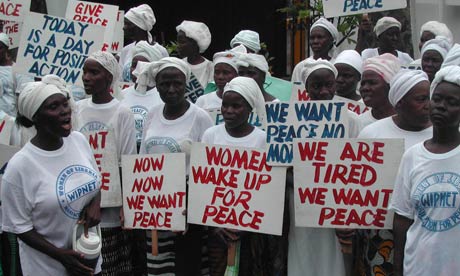 From http://www.msnbc.msn.com/id/12014185/site/newsweek/
Newsweek, April 3, 2006 issue
Healing Powers
African women are starting to take charge—making new laws, changing old attitudes, inspiring others to follow their lead. Who will help them mend a broken continent?
by with Alexandra Polier in Kigali
The national legislature on Monrovia's Capitol Hill is a forlorn wreck of a place, its façade peppered with bullet holes from the country's civil wars, its interior crumbling after two decades of looting and neglect. Legislators wander through darkened hallways that haven't had lights for years; the ceilings are so torn up they look as if they've been hit by mortar rounds. But on a recent Monday, red, white and blue bunting festooned the Joint Chamber and a volunteer band played jauntily on the balcony. Liberian tribal chieftains, Western ambassadors and other dignitaries filed in, buzzing with expectation. Ellen Johnson-Sirleaf, the first elected female leader in Africa's history, was coming to call.
Sweeping in with her entourage at 5 o'clock sharp, Johnson-Sirleaf, who looked both regal and grandmotherly, cast barely a glance over the rogues' gallery that packed the dim hall. There in the front row sat Sen. Adolphus Dolo, formerly known as General Peanut Butter, who stands accused of committing gross abuses as a wartime commander in rural Nimba County. Just behind him, smirking beneath a flaming red cap, was Sen. Prince Johnson, the leader of a breakaway rebel faction that hacked the ears off President Samuel Doe, then killed him, in 1990.
Glowering beside Johnson-Sirleaf on the podium was the new Speaker of the House, Edwin Snowe, accused by opposition leaders and human-rights groups of looting millions of dollars from the Liberian Petroleum Refinery Corporation. (Snowe denies the charge.) Front and center sat Sen. Jewel Howard Taylor, ex-wife of and First Lady to former warlord and president Charles Taylor. Hanging over everything was the specter of Taylor himself, who fled the country in 2003 and has since been accused of stirring up violence from afar.
Yet if Johnson-Sirleaf felt intimidated by the predators who surrounded her, she didn't show it. Instead, she displayed a genteel defiance toward those who wish her harm, and gave hope to those who regard her as a political savior. (A stunning 470,000 voters, or 60 percent, chose her in the November 2005 election.) Standing upright at the podium, she vowed to root out theft from the public coffers and announced a plan to establish a "code of honor" for all civil employees. "Mr. Speaker," she proclaimed, staring directly at Snowe, "we will fight this cancer of corruption."
Nobody doubts her sincerity. But look at what she's up against. For decades, men driven by a lust for power and self-enrichment have ruled the country and stripped it bare. Between 1990 and 2003, ragtag militiamen murdered, raped and plundered with abandon, leaving 150,000 dead and displacing half of the country's 3 million people. Monrovia hasn't had electricity since 1991. Unemployment stands at 80 percent, most schools have been shut down and the infant-mortality rate, at 129 per 1,000 births, is among the worst in the world. Annual per capita income, about $100, is the lowest anywhere.
Can this 67-year-old grandmother, this Harvard-trained economist who has never held a gun and, according to all who know her, never embezzled a dime, really rebuild her ruined country? She has the support of powerful allies—including George W. Bush, whom she met in Washington last week, and U.N. Secretary-General Kofi Annan. But how will she be able to work with the thugs who dominate the legislature? "We believe in redemption," Johnson-Sirleaf told NEWSWEEK. The war criminals in the government, she said, "were elected by the people in a free and fair process, and we accept the decision of the people, who have forgiven them. Unless they revert to their own former practices, we'll give them the benefit of the doubt."
Johnson-Sirleaf's ascendance is the most dramatic development in a quiet revolution transforming Africa. Across the continent, women's empowerment initiatives, disgust with male-dominated politics-as-usual and the inspiring examples of a few female leaders are propelling women to positions of clout in record numbers. Women in at least a dozen African countries are breaking the male stranglehold on national legislatures, cabinets, courts and other government institutions. They're making laws, changing attitudes, inspiring other women to follow them.
The women's revolution has come about partly by necessity. In Rwanda, the genocide led by the Hutu Army and militias nearly wiped out the male Tutsi population. When the killing ended in July 1994, women outnumbered men by seven to three. The government recognized that it faced a crippling shortage of men, and set aside nearly a third of parliamentary seats for female representatives. Now women make up half of Parliament—the largest percentage anywhere in the world.
But Africa's transformation also reflects a growing recognition that the corruption, civil war and decay that have plagued the continent for generations have been largely the work of men. In the past few years, grass-roots women's groups have been sounding a distinctly feminist message, arguing that the qualities displayed by women at the family level—fiscal integrity, maternal nurturing—may be what Africa needs to lift itself off its knees. Give an African woman a loan, they argue, and she'll spend it on her children's school fees and food for the family. Give it to a man, and he'll just as likely fritter it away.
Women certainly have different problems and priorities than men. Across Africa, they're often deprived of education, job opportunities, even the choice of marital partners. Rape is seldom punished. Polygamy is widespread, which has led to spiraling HIV-infection rates. Most African women have no right to own property. Yet the new female politicians are confronting these and other issues that their male counterparts haven't been willing to touch.
Johnson-Sirleaf, who suffered a rape attempt while in jail 20 years ago, worked with a group of female lawyers last year to push Liberia's transitional government to prescribe far tougher sentences for rapists. New laws guaranteeing a woman a sizable share of her late husband's estate just went on the books in Rwanda and Liberia. And microfinancing schemes aimed at freeing women from dependence on men are flourishing. As more women enter legislatures and raise awareness, issues such as inheritance rights, genital mutilation and wife abuse are all coming to the fore. Just as significant, a few African women have proved that they can match or exceed the abilities of men in areas that used to be off bounds—such as law enforcement and security.
Travel now to Lagos, the fetid commercial capital of Nigeria, long regarded as one of the most corrupt, dangerous countries on earth. In the hulking Federal Secretariat building on Lagos Island, Dora Akunyili stands ankle deep in the charred remains of her former office, eying burned air conditioners and dangling wires that still smell of smoke. This is the first time that Akun-yili has been back since March 2004, when arsonists doused four floors of the building with gasoline and set them alight. It was part of an effort by gangs to intimidate her and the law-enforcement agency she runs: the National Agency for Food and Drug Administration and Control, or NAFDAC. "It's depressing being back here," says Akunyili, a 50-year-old mother of three who has become one of the first women to run a police agency in Africa. "But it tells you just how desperate these people are."
Born in southeastern Nigeria to an educated family, Akunyili was a midlevel civil servant with a degree in pharmacology when she inadvertently drew the attention of powerful men in government. While working for the Petroleum Trust Fund, supervising the distribution of oil dividends in villages in southeast Nigeria, she was diagnosed with a potentially fatal pancreatic disorder. Given an $18,000 grant from the PTF, she flew to London for emergency surgery. The diagnosis proved wrong, and Akunyili did the unthinkable: she returned the money. Nigeria had just thrown off years of military rule and established a democracy, and the new president, Olusegun Obasanjo, was looking for a few good men—and women—to clean up the country's tainted agencies. He summoned Akunyili to Abuja, and offered her a job leading the fight against counterfeit drugs.
When Akunyili took over NAFDAC in February 2001, the organization was understaffed and demoralized. Counterfeit drug cartels operated with impunity, protected by corrupt judges, Customs agents and police. In league with manufacturers in India and China, the cartels flooded pharmacies and markets with phony antimalarial pills, antibiotics, blood thinners and dozens of other drugs. According to one study at the time, 80 percent of the pharmaceuticals in Nigeria were fakes. "People were dying in hospitals because of this," says Akunyili, who lost her own sister to an injection of fake insulin. "It was a disgrace."
Weeks after taking over NAFDAC, Akunyili targeted the leader of the most powerful cartel, Marcel Nnakwe, a multimillionaire with an army of bodyguards and protectors high in the government. She pressured wholesalers to reveal Nnakwe's secret warehouses, and acquired product samples for testing. When results proved his drugs were fakes, Akunyili demanded—and got—a confession and a public letter of contrition.
The gesture was meaningless. Fetishes turned up in Akunyili's office as a warning: chicken feathers dipped in blood, a dried tortoise, cowrie shells, beads. Her aides and staff were terrified. Akunyili put a permanent guard at the door, but also stationed agents at ports and seized container loads of phony pharmaceuticals destined for Nnakwe. She raided more warehouses, and NAFDAC destroyed piles of seized drugs in huge bonfires in Lagos.
In December 2003, assassins came for Akunyili. They pulled alongside her Peugeot sedan as she was being driven to work, and opened fire with AK-47s. A bullet grazed her scalp; another killed a bus driver. After the attempt on her life, Akunyili sent her three children—ages 18, 25 and 27—out of the country. But she refused to flee. "If I left after the shooting, I'd look like a coward," she told NEWSWEEK. "I told my family, 'Let me strive to complete my five years'."
Last year Nnakwe and his son were charged in an Abuja court with organizing the attempted hit. But six months into their trial, the judge abruptly announced he had no jurisdiction and freed the defendants. They have gone into hiding. "I suspect it was not just a bribe but a threat [that caused the judge's ruling]," Akunyili says. Despite the setback, Akunyili's crackdown on the cartels has been a huge success. A 2004 study conducted by Britain's Department for International Development said that fake drugs in circulation in Nigeria had declined by 80 percent since she took over. Trust has largely been restored to the pharmaceutical industry. And though Nnakwe remains at large, his drug empire has been broken.
Some countries will be harder to repair than others. In the hallways of Rwanda's National Parliament on the verdant outskirts of Kigali, the chatter and laughter of dozens of women resound through the corridors. It's a dramatic counterpoint to the mortar rounds and machine-gun fire that echoed here a dozen years ago, when Rwandan Patriotic Front guerrillas fought a fierce battle for Parliament with the genocidal Hutu regime. During the war and genocide, hundreds of thousands of Tutsi women and girls were raped, and tens of thousands contracted AIDS. Now, partly in response to that crime, many female legislators have joined forces to rewrite the law—and change the way Rwandan men regard women.
The unprecedented campaign began early last year. Female lawmakers drove through 22 districts, gathering anecdotal evidence from women about their experiences. The progressive sexual-rights bill they drafted establishes a sentence of 15 years for rape, makes spousal abuse a crime, guarantees women an equal split of assets in the event of a divorce, allows them to gain custody of their children and requires that the government set up shelters for victims of wife beating. The bill has received backing from President Paul Kagame, and stands an excellent chance of becoming law this year. "The world is looking to us as role models for gender-based violence," says Rep. Judith Kanakuze, who cosponsored the bill.Few other African nations have been as progressive. Women in Kenya still have no rights to own property, rape is seldom punished and gender violence appears to be on the rise. Even in countries where tough new laws exist on paper, enforcing them will be difficult. Some 90 percent of Liberian women are illiterate, which makes it hard for them to claim their rights under new property and rape laws passed in 2003 and 2005. But they couldn't ask for a better advocate than Ellen Johnson-Sirleaf.
The new president knows the painful contours of their lives. Although a person of privilege—who had ample opportunities to remain in the West and live a comfortable life—she repeatedly returned home in the face of danger. She says she was raised that way. Her indigenous parents—both adopted as children by Americo-Liberians, the descendants of freed slaves who founded Liberia in 1847—were role models. Her father was the first native Liberian to win election to the country's Congress, but his career was cut short by a crippling stroke when he was in his 40s. Martha Johnson, Ellen's mother, was the family breadwinner, an itinerant Methodist minister who cared for her invalid husband and four kids. Mom traveled from church to church by canoe, often taking the children along. "The things we did as kids instilled hard work and honesty," says the president. "We did chores before and after school, we said prayers every morning. We understood the sanctity of 'do not steal'."
Ellen could have been killed on any number of occasions. She was Finance minister in 1980 when soldiers led by Sgt. Samuel Doe murdered President William Tolbert and seized power. Days later the rebels rounded up 13 top officials, tied them to stakes on a Monrovia beach and shot them dead before a cheering crowd. Johnson-Sirleaf was one of a handful of regime insiders who weren't executed. Five years later, after rival officers attempted another coup, Johnson-Sirleaf again was high on Doe's enemies list. Locked inside a Monrovia prison with 15 men, she cowered in terror as soldiers led her cellmates into a courtyard and executed them. Later that night, one of the killers came back to rape her; she was rescued by a sympathetic guard. "Doe had the opportunity to kill me, but whether because of my international contacts, or my positions, he never gave the instructions to do it," Johnson-Sirleaf says. She spent six months in prison, then was acquitted. She fled to the United States shortly after that.
She knows what it means to grab for a thin reed of hope, only to have it break. In the late 1980s, when Charles Taylor was assembling a ragtag rebel force in Côte d'Ivoire, Johnson-Sirleaf gave him aid and encouragement. "So many people supported him in the early days," Johnson-Sirleaf recalls. "But he betrayed everybody. He was hungry for power." Taylor and his rivals fought a vicious civil war for seven years. When it subsided, Johnson-Sirleaf returned to Liberia and challenged Taylor in elections. But the country was volatile, and most feared that if Taylor lost, he'd return to the bush and restart the war. He won with 75 percent of the vote.
Now that she's finally in control, Johnson-Sirleaf needs all the support she can get. Yet expectations are so high, say analysts and diplomats, that Liberians face an inevitable letdown. Already, female activist groups have complained that she didn't appoint enough women to her cabinet, and foes in Congress reprimanded her for making a state visit to Gabon without their permission. She was forced to dial back on a campaign pledge to restore electricity across Liberia in 150 days; she says now that she'll turn some lights on in Monrovia within six months.
Other pressures are growing on Johnson-Sirleaf from outside the country. During an interview with NEWSWEEK at the end of January, she blasted the European Union for threatening to withhold aid until she leans on Nigeria to extradite Charles Taylor to face trial for war crimes. "I just think they're passing the buck on to me," she said, eyes flashing with annoyance. "They should have taken care of this issue before I came to office. It's hanging over my head."
Two weeks ago, she bowed to pressure and publicly called for Taylor's extradition to the war-crimes tribunal in Sierra Leone —risking a backlash by Taylor loyalists. Nigeria later agreed to turn him over to Liberian custody. "I believe that Ellen's personal survival is at risk," says Minister of Gender and Development Varba Gayflor. "I told the U.S. Embassy, 'Guard the life of Ellen Sirleaf, whatever else you do'."
Fifteen thousand U.N. peacekeepers have kept Liberia quiet since 2003. And the U.S. government has committed $1 billion through 2006 to support the peacekeepers, rebuild Liberia's infrastructure and provide demobilized soldiers with education and jobs. Johnson-Sirleaf can't afford to dwell on the dangers. "I've invested my time, my life, my safety in this country, and the Liberians have always defended me," she told NEWSWEEK. "Now I need to stand by them."
She downplays her role as an African pioneer. "I always start from the note that I'm a technocrat who happens to be a woman," she says. "We're not running a women's government." Still, she says she'll keep pushing for women's rights, making sure that rapists get prosecuted, perhaps even setting government hiring quotas. As a result of her success and the achievements of other women on the continent, Johnson-Sirleaf says, "Women know not only that they can compete, but also that they can excel. They can be mothers and also professionals. They know that we don't have to be stuck in the backyard." It's a shining model for Africa, and even the world. But it's far from complete. If Johnson-Sirleaf fails—if her friends and allies allow her to fail—this model will end up like so many others on the continent, a model of despair.
Saturday, July 31, 2010
Canada failing badly at animal protection
“The greatness of a nation and its moral progress can be judged by the way its animals are treated”
-Mahatma Gandhi
I received this action alert from the WSPA today, regarding Canada's failure in making and upholding animal cruelty laws. This is not just about livestock. This is about puppy mills, dog fights, your angry neighbour beating his "pets" and the guy who "doesn't know he has to provide water to his horse". Less that 0.25% of people tried for animal cruelty are convicted; if a law is even in place to try them at all.
I have almost always been proud of the country that welcomed my Italian grandparents and East European father, treated them as equal citizens and allowed them to prosper. I loved that I grew up pretty much colourblind and with a strong sense of equality and human rights. I was always encouraged to speak up when I disagreed with the system and never feared that my voice would be silenced. These are the values that Canadian society instilled in me.
More and more though, Canada is garnering a poor international reputation for its wildlife and environmental policies (I am thinking the seal hunt and our attitude at the recent climate meetings off the top of my head). Since I live in Europe at the moment, i get to know pretty quickly how the world feels about my homeland, and I find myself defending, or feeling ashamed of, Canada more and more. Canada is so good at so many things and is a model for how a society should work. But everytime we take a step backward, in this case with regards to blatant animal cruelty, it becomes harder to highlight all the progress our nation has made and to lead other nations by example in the hopes that fairness prevails across the globe. In this video, you will see that Canada is behind all EU countries (plus Switzerland and Sweden) and even
I also think that unless we get our own national legislation in order regarding treating animals as sentient beings and not property, it will be difficult to convince other nations to take the first steps to do the same. This relates to the wild animal pet trade, the bushmeat crisis and other conservation issues.
One thing I have been thinking a lot about is banning pet stores from selling dogs and cats, yesterday it was revealed that San Francisco is putting forth legislation to do just that (http://www.signonsandiego.com/news/2010/jul/10/san-francisco-hits-nerve-with-pet-sale-ban-idea/). In Germany, it is already illegal to sell cats and dogs in stores, as a consequence there are no puppy mills and their animal shelters are by and far, no kill. Banning the sale of animals in pet stores would not destroy pet stores either. more than 70% of North American homes have a dog or a cat and these people spend more and more on perchadise and pet care every year. A slight switch from pet sales to pet merch sales would not be a big deal for pet stores. Tax payers would also save money since less animals would need to be euthanized, spayed, neutered and housed at pounds too.
You don't have to be an animal lover to see how he way Canada is treating it's animals is wrong. Please watch the video and if you agree that animals should not be treated this way, go to the WSPA website that will generate a letter (which you can personalize) to contact the MP for your riding. Thank You-MA

On Wednesday, Global TV aired an investigative documentary called "Revealed: No Country for Animals" which provides more evidence that Canada falls behind other countries in protecting animals from cruelty and abuse. The documentary was heart-wrenching for me to watch, but I believe it provides us with a great opportunity. If we can get politicians to watch it, they won't be able to turn a blind eye - they will have to do something about the many issues facing Canada's animals.
As someone who is passionate about animal welfare, I'm asking for your help. Contact your MP now: ask them to watch the documentary and encourage them to stand up against animal cruelty. Visit our website http://www.wspa.ca/curbthecruelty to take action now.
Thursday, July 29, 2010
Rhino Miraculously Survives Chainsaw Attack by Poachers in South Africa
From bushwarriors
In a horrifying testament to the brutality of the illegal rhino horn trade, a vicious attack by poachers in a South African reserve has robbed a female rhino of her horns, her sense of smell, her one-month-old calf, and her ability to communicate with other rhinos.
Poachers reportedly used a chainsaw to brutally cut away the rhino’s horns after darting her with a tranquilizer in Tugela Private Game Reserve in KwaZulu-Natal, between Ladysmith and Colenso.
The blades cut so deep into the rhino’s skull that her horns will never grow back, leaving her permanently disfigured and without her sense of smell, which is the rhino’s main method of communicating with one another.
Because she was unable to smell, the rhino could not locate her helpless one-month-old calf, who was later found dead.
Illegal rhino horn destined for China and Vietnam
A recent report by the wildlife trade monitoring network TRAFFIC revealed that most illegal rhino horn leaving southern Africa is destined for consumer markets in China and Vietnam, where traditional Chinese medicine containing rhino horn has been used for thousands of years to treat an assortment of ailments, from fevers to boils – and even devil possession.
However, overwhelming scientific evidence has confirmed that rhino horn actually contains no medicinal properties, as demonstrated by world-renowned rhino horn expert Dr. Raj Amin in the following video:
Wednesday, July 28, 2010
Vigilante Justice: Game manager injecting poison into rhino horns to make rhino horn consumers sick

From mongabay.com
Already illegal, one man tests poisoning rhino horn too
JEREMY HANCE
Given the epidemic of rhino poaching across Africa and Asia, which has placed four out of five species in jeopardy of extinction, one fed-up game manager wants to take the fight beyond the poachers to the consumer. Ed Hern, owner of the Lion and Rhino Park near Johannesburg, told South Africa's The Times that he has begun working with a veterinarian on injecting poison into a rhino's horn to consumers. He told The Times that people who consumed poisoned rhino horn "would get very sick or die".
Unlike the consumer, the rhino likely wouldn't be hurt by the poison, since their was no blood flow from the horn into the rest of the animal. Still Hern was watching his test rhino to make sure it wasn't showing symptoms.
Hern has been warned by unnamed lawyers that he could get "into a lot of trouble" if someone is harmed by ingesting rhino harm that was poisoned.
Banned worldwide by the Convention on International Trade in Endangered Species (CITES) rhino horn is used as a traditional curative in Chinese medicine. While scientific studies have shown that rhino horn has no medicinal properties, it remains in high demand fueling the violent and illegal trade of rhino poaching.
In the last six months, South Africa has lost 124 rhinos to poachers. Ed Hern—on the frontlines of the poaching battle—has taken in five rhino orphans whose mothers were killed. Hern pays private guards to protect his rhinos, but says they are no match against the hi-tech equipment, including helicopters, used by the wildlife trafficking mafia.
Rhino horn consumption recently made news after supermodel and host of Britain's Next Top Model, Elle Macpherson, said in an interview that she consumed powdered rhino horn, because "it works for me". She has since claimed that despite the statement, she had never knowingly taken a substance from an endangered species and her comments were "banter with an interviewer".
Have your say, vote in this poll: "should rhino horns be poisoned?"
success! Catalonia FTW - bull fighting banned!!
Great News from Catalonia today, of course it is still legal in the rest of Spain where it is more popular...but still a great big step forward against animal cruelty. PETA has an online petition against the running of the bulls as they hope to capitalize on the momentum of the Catalonia bull fighting ban, consider signing it here - MA

From the Independant.co.uk
Catalonia votes to ban bullfighting
Bloodthirsty 'sport' is dying a slow death across Spain, as younger audiences turn away
By ALASDAIR FORTHERINHAM
Already faced with a rapidly ageing fanbase at home and widespread incomprehension and rejection abroad, Spanish bullfighting has suffered another major setback after the Catalan parliament voted to outlaw it completely across the region.
The decision was so controversial that some deputies hunched over their desks to hide their fingers from photographers as they punched in their votes. After a narrow initial victory for the abolitionists – 67 in favour and 59 against – the law could become effective as soon as May.
Spain's right-wing press was quick to attribute the result to Catalan separatists' desire to dissociate themselves from an activity often considered as typically Spanish as tapas, siestas and flamenco. Unofficially, though, even before Friday's decision, it seems bullfighting circles in the rest of Spain had given Catalonia up as a lost cause.
Over the past three decades, bullring after bullring has closed in major Catalan towns such as Gerona, Lloret de Mar and Tarragona, and in Barcelona only one of the original three rings remains. As far back as 1909, Barcelona hosted Spain's first anti-bullfighting protest, and by 2004 more than 80 per cent of Catalans were opposed to the practice. "Banning the bulls in Catalonia would be like drawing up a death certificate for a long-dead corpse," said Juan Ilian, a leading Spanish bullfighting correspondent for nearly five decades. "And even if they don't, it'll remain on its deathbed."
Animal rights groups amassed 180,000 signatures for a petition so that the vote could go ahead in Catalonia – more than three times the required minimum – but even the lobby's top activists are not sure how quickly the ban could extend to the rest of Spain. Antonio Moreno, president of Cacma, an animal rights association in the bullfighting heartland of Andalusia, said: "An overwhelming majority of Spaniards, 76 per cent according to Gallup surveys in 2009, are not in favour of bullfighting. However, only half that total want outright prohibition. The government promised six years ago to improve animal welfare laws, but it's been dragging its heels. It's only through legislation like in Catalonia that things are changing."
A lack of enthusiasm for bullfighting among younger generations is most likely to deliver the estocada – the killer blow, in bullfighting terminology. A recent survey showed bullfighting to be most popular among Spaniards in the 45-plus age group. And Spanish state television, TVE, has dropped it permanently from its schedule because, an inside source at TVE said, "it was considered too bloodthirsty for children to watch".
"It's not necessarily that younger Spaniards are more in favour of animal rights, they just don't care so much about bullfighting," Johanna Mayrhofer, an Austrian long-term Spanish resident and animal rights activist, said. "Bullfighting isn't part of their day-to-day culture, as it was for nearly all Spaniards a few decades back."
Long-term observers such as Mr Ilian recognise that while support for bullfighting remains healthy in strongholds such as Andalusia and Madrid, its mid-term prospects are grimmer. "There's a dedicated minority who follow it closely, and some bullfighters have a huge media presence, like rock or film stars, but the vast majority of spectators who go to a bullfight these days have no idea which fighter they're going to see," he said. "Instead, it's just become a show, and interest among the general public is dropping."
"It was banned in the Canary Islands in the mid-1990s, but there was already very little support there," Mr Moreno added. "This is the first big step on mainland Spain."

From the Independant.co.uk
Catalonia votes to ban bullfighting
Bloodthirsty 'sport' is dying a slow death across Spain, as younger audiences turn away
By ALASDAIR FORTHERINHAM
Already faced with a rapidly ageing fanbase at home and widespread incomprehension and rejection abroad, Spanish bullfighting has suffered another major setback after the Catalan parliament voted to outlaw it completely across the region.
The decision was so controversial that some deputies hunched over their desks to hide their fingers from photographers as they punched in their votes. After a narrow initial victory for the abolitionists – 67 in favour and 59 against – the law could become effective as soon as May.
Spain's right-wing press was quick to attribute the result to Catalan separatists' desire to dissociate themselves from an activity often considered as typically Spanish as tapas, siestas and flamenco. Unofficially, though, even before Friday's decision, it seems bullfighting circles in the rest of Spain had given Catalonia up as a lost cause.
Over the past three decades, bullring after bullring has closed in major Catalan towns such as Gerona, Lloret de Mar and Tarragona, and in Barcelona only one of the original three rings remains. As far back as 1909, Barcelona hosted Spain's first anti-bullfighting protest, and by 2004 more than 80 per cent of Catalans were opposed to the practice. "Banning the bulls in Catalonia would be like drawing up a death certificate for a long-dead corpse," said Juan Ilian, a leading Spanish bullfighting correspondent for nearly five decades. "And even if they don't, it'll remain on its deathbed."
Animal rights groups amassed 180,000 signatures for a petition so that the vote could go ahead in Catalonia – more than three times the required minimum – but even the lobby's top activists are not sure how quickly the ban could extend to the rest of Spain. Antonio Moreno, president of Cacma, an animal rights association in the bullfighting heartland of Andalusia, said: "An overwhelming majority of Spaniards, 76 per cent according to Gallup surveys in 2009, are not in favour of bullfighting. However, only half that total want outright prohibition. The government promised six years ago to improve animal welfare laws, but it's been dragging its heels. It's only through legislation like in Catalonia that things are changing."
A lack of enthusiasm for bullfighting among younger generations is most likely to deliver the estocada – the killer blow, in bullfighting terminology. A recent survey showed bullfighting to be most popular among Spaniards in the 45-plus age group. And Spanish state television, TVE, has dropped it permanently from its schedule because, an inside source at TVE said, "it was considered too bloodthirsty for children to watch".
"It's not necessarily that younger Spaniards are more in favour of animal rights, they just don't care so much about bullfighting," Johanna Mayrhofer, an Austrian long-term Spanish resident and animal rights activist, said. "Bullfighting isn't part of their day-to-day culture, as it was for nearly all Spaniards a few decades back."
Long-term observers such as Mr Ilian recognise that while support for bullfighting remains healthy in strongholds such as Andalusia and Madrid, its mid-term prospects are grimmer. "There's a dedicated minority who follow it closely, and some bullfighters have a huge media presence, like rock or film stars, but the vast majority of spectators who go to a bullfight these days have no idea which fighter they're going to see," he said. "Instead, it's just become a show, and interest among the general public is dropping."
"It was banned in the Canary Islands in the mid-1990s, but there was already very little support there," Mr Moreno added. "This is the first big step on mainland Spain."
Monday, July 19, 2010
last white rhino in SAfrican reserve killed: Shot from plane with tranquilizer, horn sawed off, and left to bleed to death
 From TreeHugger.com
Poachers Kill Last Female White Rhino in South African Reserve
by MATTHEW McDERMOTT
One more symbol of the rising global demand for rhino horn and its devastating effect on rhinoceroses in both Africa and Asia: The Guardian reports that the female white rhino in South Africa's Krugersdorp nature reserve has been killed by poachers--who used a tranquilizer gun, fired from a helicopter, to bring down the animal, prior to hacking off its horn, leaving it to bleed to death and orphaning its young calf in the process.
A private airport near the 1500-hectare reserve may have been the launching point for the attack. Japie Mostert, chief game ranger at Krugersdorp:The exercise takes them very little time. They first fly over the park in the late afternoon to locate where the rhino is grazing. Then they return at night and dart the animal from the air. The tranquilizer takes less than seven minutes to act. They saw off the horns with a chainsaw. They do not even need to switch off the rotors of the helicopter. We do not hear anything because our houses are too far away. The animal dies either from an overdoes of tranquilizer or bleeds to deathRhino Horn Worth More Than Gold
Rhino poaching is at a fifteen year high as demand for the horn--still used in Traditional Chinese Medicine despite being officially removed from the pharmacopeia--continues to rise. At the end of last year, rhino horn trades for about $1610 an ounce, more than gold.
The southern white rhino population is listed by the IUCN as near-threatened, and is the most abundant rhino population in the world. By contrast the northern white rhino is considered critically endangered or extinct in the wild, with well under 10 individuals left.
Total African rhino population--including the 3,000 or so black rhinos left in the wild--have been reduced from an estimated 65,000 animals in the 1970s to about 18,000 today.
related: WATCH VIDEO - Discovery News: Poaching Endangers Black Rhinos
0
comments

 Labels:
extinction,
hunting,
ivory,
misc mammals,
poaching,
South Africa,
southern Africa,
violence
Labels:
extinction,
hunting,
ivory,
misc mammals,
poaching,
South Africa,
southern Africa,
violence
 Labels:
extinction,
hunting,
ivory,
misc mammals,
poaching,
South Africa,
southern Africa,
violence
Labels:
extinction,
hunting,
ivory,
misc mammals,
poaching,
South Africa,
southern Africa,
violence
Tuesday, July 13, 2010
***updated with debunking links*** kiss your as goodbye: gulf oil spill may cause end of days
update (July 14th 2010):
original post:
The only good news is: "Most experts in the know, however, agree that if the world-changing event does occur it will happen suddenly and within the next 6 months." So if we make it to new year's 2011 we should be in the clear - if anyone has any more insight into this please post, would love for this to be some crock and unfounded in science [hopeful fear grimace]....The video below is from the Greenpeace Intl facebook page, who posted today " Greenpeace International Professional photographers and film teams are kept away from the shores..metal detectors are being used to make sure no photos are taken with cell phones...animal corpses are secretly taken away in the early morning...sick workers/volunteers need respirators. Riki Ott, Marine Toxicologist reports on the massive cover-ups to hide the Gulf disaster."-MA
Doomsday: How BP Gulf disaster may have triggered a 'world-killing' event
by TERRENCE AYM
from Helium.com
Ominous reports are leaking past the BP Gulf salvage operation news blackout that the disaster unfolding in the Gulf of Mexico may be about to reach biblical proportions. 251 million years ago a mammoth undersea methane bubble caused massive explosions, poisoned the atmosphere and destroyed more than 96 percent of all life on Earth. [1] Experts agree that what is known as the Permian extinction event was the greatest mass extinction event in the history of the world. [2] 55 million years later another methane bubble ruptured causing more mass extinctions during the Late Paleocene Thermal Maximum (LPTM). The LPTM lasted 100,000 years. [3] Those subterranean seas of methane virtually reshaped the planet when they explosively blew from deep beneath the waters of what is today called the Gulf of Mexico.
Now, worried scientists are increasingly concerned the same series of catastrophic events that led to worldwide death back then may be happening again-and no known technology can stop it. The bottom line: BP’s Deepwater Horizon drilling operation may have triggered an irreversible, cascading geological Apocalypse that will culminate with the first mass extinction of life on Earth in many millions of years. The oil giant drilled down miles into a geologically unstable region and may have set the stage for the eventual premature release of a methane mega-bubble.
Ryskin’s methane extinction theory
Northwestern University's Gregory Ryskin, a bio-chemical engineer, has a theory: The oceans periodically produce massive eruptions of explosive methane gas. He has documented the scientific evidence that such an event was directly responsible for the mass extinctions that occurred 55 million years ago. [4]
Many geologists concur: "The consequences of a methane-driven oceanic eruption for marine and terrestrial life are likely to be catastrophic. Figuratively speaking, the erupting region "boils over," ejecting a large amount of methane and other gases (e.g., CO2, H2S) into the atmosphere, and flooding large areas of land. Whereas pure methane is lighter than air, methane loaded with water droplets is much heavier, and thus spreads over the land, mixing with air in the process (and losing water as rain). The air-methane mixture is explosive at methane concentrations between 5% and 15%; as such mixtures form in different locations near the ground and are ignited by lightning, explosions and conflagrations destroy most of the terrestrial life, and also produce great amounts of smoke and of carbon dioxide..." [5]
The warning signs of an impending planetary catastrophe—of such great magnitude that the human mind has difficulty grasping it-would be the appearance of large fissures or rifts splitting open the ocean floor, a rise in the elevation of the seabed, and the massive venting of methane and other gases into the surrounding water. Such occurrences can lead to the rupture of the methane bubble containment—it can then permit the methane to breach the subterranean depths and undergo an explosive decompression as it catapults into the Gulf waters. [6] All three warning signs are documented to be occurring in the Gulf.
Ground zero: The Gulf Coast
The people and property located on the greater expanse of the Gulf Coast are sitting at Ground Zero. They will be the first exposed to poisonous, cancer causing chemical gases. They will be the ones that initially experience the full fury of a methane bubble exploding from the ruptured seabed.
The media has been kept away from the emergency salvage measures being taken to forestall the biggest catastrophe in human history. The federal government has warned them away from the epicenter of operations with the threat of a $40,000 fine for each infraction and the possibility of felony arrests. Why is the press being kept away? Word is that the disaster is escalating.
Cracks and bulges
Methane is now streaming through the porous, rocky seabed at an accelerated rate and gushing from the borehole of the first relief well. The EPA is on record that Rig #1 is releasing methane, benzene, hydrogen sulfide and other toxic gases. Workers there now wear advanced protection including state-of-the-art, military-issued gas masks. Reports, filtering through from oceanologists and salvage workers in the region, state that the upper level strata of the ocean floor is succumbing to greater and greater pressure. That pressure is causing a huge expanse of the seabed-estimated by some as spreading over thousands of square miles surrounding the BP wellhead-to bulge. Some claim the seabed in the region has risen an astounding 30 feet. The fractured BP wellhead, site of the former Deepwater Horizon, has become the epicenter of frenetic attempts to quell the monstrous flow of methane.
The subterranean methane is pressurized at 100,000 pounds psi. According to Matt Simmons, an oil industry expert, the methane pressure at the wellhead has now skyrocketed to a terrifying 40,000 pounds psi. Another well-respected expert, Dr. John Kessler of Texas A&M University has calculated that the ruptured well is spewing 60 percent oil and 40 percent methane. The normal methane amount that escapes from a compromised well is about 5 percent.
More evidence? A huge gash on the ocean floor—like a ragged wound hundreds of feet long—has been reported by the NOAA research ship, Thomas Jefferson. Before the curtain of the government enforced news blackout again descended abruptly, scientists aboard the ship voiced their concerns that the widening rift may go down miles into the earth. That gash too is hemorrhaging oil and methane. It’s 10 miles away from the BP epicenter. Other, new fissures, have been spotted as far as 30 miles distant.
Measurements of the multiple oil plumes now appearing miles from the wellhead indicate that as much as a total of 124,000 barrels of oil are erupting into the Gulf waters daily-that’s about 5,208,000 gallons of oil per day.
Most disturbing of all: Methane levels in the water are now calculated as being almost one million times higher than normal. [7]
Mass death on the water
If the methane bubble—a bubble that could be as big as 20 miles wide—erupts with titanic force from the seabed into the Gulf, every ship, drilling rig and structure within the region of the bubble will immediately sink. All the workers, engineers, Coast Guard personnel and marine biologists participating in the salvage operation will die instantly.
Next, the ocean bottom will collapse, instantaneously displacing up to a trillion cubic feet of water or more and creating a towering supersonic tsunami annihilating everything along the coast and well inland. Like a thermonuclear blast, a high pressure atmospheric wave could precede the tidal wave flattening everything in its path before the water arrives.
When the roaring tsunami does arrive it will scrub away all that is left.
A chemical cocktail of poisons
Some environmentalist experts are calling what’s pouring into the land, sea and air from the seabed breach ’a chemical cocktail of poisons.’ Areas of dead zones devoid of oxygen are driving species of fish into foreign waters, killing plankton and other tiny sea life that are the foundation for the entire food chain, and polluting the air with cancer-causing chemicals and poisonous rainfalls.
A report from one observer in South Carolina documents oily residue left behind after a recent thunderstorm. And before the news blackout fully descended the EPA released data that benzene levels in New Orleans had rocketed to 3,000 parts per billion. Benzene is extremely toxic and even short term exposure can cause agonizing death from cancerous lesions years later. The people of Louisiana have been exposed for more than two months—and the benzene levels may be much higher now. The EPA measurement was taken in early May. [8]
Doomsday
While some say it can’t happen because the bulk of the methane is frozen into crystalline form, others point out that the underground methane sea is gradually melting from the nearby surging oil that’s estimated to be as hot as 500 degrees Fahrenheit.
Most experts in the know, however, agree that if the world-changing event does occur it will happen suddenly and within the next 6 months.
So, if events go against Mankind and the bubble bursts in the coming months, Gregory Ryskin may become one of the most famous people in the world. Of course, he won't have long to enjoy his new found fame because very shortly after the methane eruption civilization will collapse.
Perhaps if humanity is very, very lucky, some may find a way to avoid the mass extinction that follows and carry on the human race.
Perhaps.
…………
Sources
original post:
The only good news is: "Most experts in the know, however, agree that if the world-changing event does occur it will happen suddenly and within the next 6 months." So if we make it to new year's 2011 we should be in the clear - if anyone has any more insight into this please post, would love for this to be some crock and unfounded in science [hopeful fear grimace]....The video below is from the Greenpeace Intl facebook page, who posted today " Greenpeace International Professional photographers and film teams are kept away from the shores..metal detectors are being used to make sure no photos are taken with cell phones...animal corpses are secretly taken away in the early morning...sick workers/volunteers need respirators. Riki Ott, Marine Toxicologist reports on the massive cover-ups to hide the Gulf disaster."-MA
Doomsday: How BP Gulf disaster may have triggered a 'world-killing' event
by TERRENCE AYM
from Helium.com
Ominous reports are leaking past the BP Gulf salvage operation news blackout that the disaster unfolding in the Gulf of Mexico may be about to reach biblical proportions. 251 million years ago a mammoth undersea methane bubble caused massive explosions, poisoned the atmosphere and destroyed more than 96 percent of all life on Earth. [1] Experts agree that what is known as the Permian extinction event was the greatest mass extinction event in the history of the world. [2] 55 million years later another methane bubble ruptured causing more mass extinctions during the Late Paleocene Thermal Maximum (LPTM). The LPTM lasted 100,000 years. [3] Those subterranean seas of methane virtually reshaped the planet when they explosively blew from deep beneath the waters of what is today called the Gulf of Mexico.
Now, worried scientists are increasingly concerned the same series of catastrophic events that led to worldwide death back then may be happening again-and no known technology can stop it. The bottom line: BP’s Deepwater Horizon drilling operation may have triggered an irreversible, cascading geological Apocalypse that will culminate with the first mass extinction of life on Earth in many millions of years. The oil giant drilled down miles into a geologically unstable region and may have set the stage for the eventual premature release of a methane mega-bubble.
Ryskin’s methane extinction theory
Northwestern University's Gregory Ryskin, a bio-chemical engineer, has a theory: The oceans periodically produce massive eruptions of explosive methane gas. He has documented the scientific evidence that such an event was directly responsible for the mass extinctions that occurred 55 million years ago. [4]
Many geologists concur: "The consequences of a methane-driven oceanic eruption for marine and terrestrial life are likely to be catastrophic. Figuratively speaking, the erupting region "boils over," ejecting a large amount of methane and other gases (e.g., CO2, H2S) into the atmosphere, and flooding large areas of land. Whereas pure methane is lighter than air, methane loaded with water droplets is much heavier, and thus spreads over the land, mixing with air in the process (and losing water as rain). The air-methane mixture is explosive at methane concentrations between 5% and 15%; as such mixtures form in different locations near the ground and are ignited by lightning, explosions and conflagrations destroy most of the terrestrial life, and also produce great amounts of smoke and of carbon dioxide..." [5]
The warning signs of an impending planetary catastrophe—of such great magnitude that the human mind has difficulty grasping it-would be the appearance of large fissures or rifts splitting open the ocean floor, a rise in the elevation of the seabed, and the massive venting of methane and other gases into the surrounding water. Such occurrences can lead to the rupture of the methane bubble containment—it can then permit the methane to breach the subterranean depths and undergo an explosive decompression as it catapults into the Gulf waters. [6] All three warning signs are documented to be occurring in the Gulf.
Ground zero: The Gulf Coast
The people and property located on the greater expanse of the Gulf Coast are sitting at Ground Zero. They will be the first exposed to poisonous, cancer causing chemical gases. They will be the ones that initially experience the full fury of a methane bubble exploding from the ruptured seabed.
The media has been kept away from the emergency salvage measures being taken to forestall the biggest catastrophe in human history. The federal government has warned them away from the epicenter of operations with the threat of a $40,000 fine for each infraction and the possibility of felony arrests. Why is the press being kept away? Word is that the disaster is escalating.
Cracks and bulges
Methane is now streaming through the porous, rocky seabed at an accelerated rate and gushing from the borehole of the first relief well. The EPA is on record that Rig #1 is releasing methane, benzene, hydrogen sulfide and other toxic gases. Workers there now wear advanced protection including state-of-the-art, military-issued gas masks. Reports, filtering through from oceanologists and salvage workers in the region, state that the upper level strata of the ocean floor is succumbing to greater and greater pressure. That pressure is causing a huge expanse of the seabed-estimated by some as spreading over thousands of square miles surrounding the BP wellhead-to bulge. Some claim the seabed in the region has risen an astounding 30 feet. The fractured BP wellhead, site of the former Deepwater Horizon, has become the epicenter of frenetic attempts to quell the monstrous flow of methane.
The subterranean methane is pressurized at 100,000 pounds psi. According to Matt Simmons, an oil industry expert, the methane pressure at the wellhead has now skyrocketed to a terrifying 40,000 pounds psi. Another well-respected expert, Dr. John Kessler of Texas A&M University has calculated that the ruptured well is spewing 60 percent oil and 40 percent methane. The normal methane amount that escapes from a compromised well is about 5 percent.
More evidence? A huge gash on the ocean floor—like a ragged wound hundreds of feet long—has been reported by the NOAA research ship, Thomas Jefferson. Before the curtain of the government enforced news blackout again descended abruptly, scientists aboard the ship voiced their concerns that the widening rift may go down miles into the earth. That gash too is hemorrhaging oil and methane. It’s 10 miles away from the BP epicenter. Other, new fissures, have been spotted as far as 30 miles distant.
Measurements of the multiple oil plumes now appearing miles from the wellhead indicate that as much as a total of 124,000 barrels of oil are erupting into the Gulf waters daily-that’s about 5,208,000 gallons of oil per day.
Most disturbing of all: Methane levels in the water are now calculated as being almost one million times higher than normal. [7]
Mass death on the water
If the methane bubble—a bubble that could be as big as 20 miles wide—erupts with titanic force from the seabed into the Gulf, every ship, drilling rig and structure within the region of the bubble will immediately sink. All the workers, engineers, Coast Guard personnel and marine biologists participating in the salvage operation will die instantly.
Next, the ocean bottom will collapse, instantaneously displacing up to a trillion cubic feet of water or more and creating a towering supersonic tsunami annihilating everything along the coast and well inland. Like a thermonuclear blast, a high pressure atmospheric wave could precede the tidal wave flattening everything in its path before the water arrives.
When the roaring tsunami does arrive it will scrub away all that is left.
A chemical cocktail of poisons
Some environmentalist experts are calling what’s pouring into the land, sea and air from the seabed breach ’a chemical cocktail of poisons.’ Areas of dead zones devoid of oxygen are driving species of fish into foreign waters, killing plankton and other tiny sea life that are the foundation for the entire food chain, and polluting the air with cancer-causing chemicals and poisonous rainfalls.
A report from one observer in South Carolina documents oily residue left behind after a recent thunderstorm. And before the news blackout fully descended the EPA released data that benzene levels in New Orleans had rocketed to 3,000 parts per billion. Benzene is extremely toxic and even short term exposure can cause agonizing death from cancerous lesions years later. The people of Louisiana have been exposed for more than two months—and the benzene levels may be much higher now. The EPA measurement was taken in early May. [8]
Doomsday
While some say it can’t happen because the bulk of the methane is frozen into crystalline form, others point out that the underground methane sea is gradually melting from the nearby surging oil that’s estimated to be as hot as 500 degrees Fahrenheit.
Most experts in the know, however, agree that if the world-changing event does occur it will happen suddenly and within the next 6 months.
So, if events go against Mankind and the bubble bursts in the coming months, Gregory Ryskin may become one of the most famous people in the world. Of course, he won't have long to enjoy his new found fame because very shortly after the methane eruption civilization will collapse.
Perhaps if humanity is very, very lucky, some may find a way to avoid the mass extinction that follows and carry on the human race.
Perhaps.
…………
Sources
- [1] The Permian extinction event, when 96% of all marine species became extinct 251 million years ago.
- [2] “The Day The Earth Nearly Died,” BBC Horizon, 2002
- [3] Report about the Late Paleocene Thermal Maximum (LPTM), which occurred around 55 million years ago and lasted about 100,000 years. Large undersea methane caused explosions and mass extinctions.
- [4] Ryskin Theory
- Huge combustible clouds produced by methane gas trapped under the seas and explosively released could have killed off the majority of marine life, land animals, and plants at the end of the Permian era—long before the dinosaurs arrived.
- [5] James P. Kennett, Kevin G. Cannariato, Ingrid L. Hendy, Richard J. Behl (2000), "Carbon Isotopic Evidence for Methane Hydrate Instability During Quaternary Interstadials," Science 288.
- [6] “An awesome mix of fire and water may lie behind mass extinctions”
- [7] “Methane in Gulf 'astonishingly high'-US scientist”
- [8] Report: “Air Quality - Oil Spill” TV 4WWL video
Links
- BP engineer called doomed rig a 'nightmare well’”
- History Channel Mega Disasters - Methane Explosion
- “BP Official Admits to Damage Beneath the Sea Floor"
Monday, July 12, 2010
R.I.P. Ymke Warren 1970-2010
 from www.4apes.org
The conservation world was shaken this week by news of the untimely death of Dr Ymke Warren. Ymke was working in Cameroon for the Wildlife Conservation Society, whose Executive Director, Africa Program, James Deutsch, sent this notice to colleagues on 2nd July:
“It is with immense sadness that I write to inform you of Ymke Warren’s death three days ago. Ymke has worked with WCS in Western Cameroon for the past five years coordinating Cross River Gorilla research and monitoring. She was deeply committed to primate conservation and her work greatly strengthened our program and brightened the future for this critically endangered subspecies. Ymke was the partner of Aaron Nicholas, our Takamanda-Mone Project Director, and all of our thoughts and prayers are with Aaron and with Ymke’s family in the UK. She was killed at home in Limbe, in a senseless act of violence, and we will of course assist the Cameroon authorities in their investigations.”
Ymke was a warm and wonderful, energetic and determined person with a passion for life in general and gorillas in particular. I first met her when she was a student volunteering at the Gorilla Organisation office in London. She set her sights on becoming a primatologist and conservation biologist and succeeded, gaining an MSc for her work on Mountain Gorillas and a PhD for her research into olive baboon ecology in Nigeria and later working on black mongoose in Namibia. For the past five years she has dedicated her career to work on Cross River Gorillas. It seems inconceivable to be writing an obituary for someone so full of life. As Ymke’s family and friends come to terms with their tragic loss, we thought those of you who knew her would like to share your thoughts, memories and photographs by up-loading them here.
Wednesday, June 9, 2010
Be the first! Garamba NP's (DR-Congo) 1st ecotourism lodge opens
Once a rebel haunt, Congo's Garamba opens to tourism
By THOMAS HUBERT
KINSHASA (Reuters) - The Democratic Republic of the Congo's Garamba National Park, once known as a haunt for militias and a vicious Ugandan rebel group, is open for tourism, the park's main Western donor said.
Spain's ambassador to Congo, Felix Costales, told Reuters in a weekend interview that Garamba had opened a tourist camp funded by Spain at the end of May, with 10 lodges, and that armed groups had been cleared from much of the 12,000 square km (4,600 square miles) reserve that is open to tourists. "We are now in a situation in which we can easily save the park," he said, suggesting that tourism would bring in the necessary funds and road access to monitor it.
Nestled in Congo's northeast, on the border with Sudan, Garamba was listed as a UNESCO World Heritage site in Danger in 1996, largely because it houses 30 of the world's last remaining white rhinos. Its vast grasslands, forests and swampy depressions also housing hippos, elephants and giraffes, lost their tourist appeal around that time as Congo descended into chaos, leaving its wildlife prey to rampant poaching.
In 2005 Uganda's Lord's Resistance Army (LRA) crossed into the park and set up camp after losing a Sudanese government-backed haven in neighbour South Sudan. Costales said the rebel group -- infamous for mutilating civilians and abducting children -- no longer posed a threat, as operations by Congolese, Ugandan and U.N. troops in the past 18 months had uprooted them from Garamba.
Spain had spent about 700,000 euros last year making tracks and equipping and training park rangers. French ambassador Pierre Jacquemot visited the park with Costales last month and came back declaring it safe. Officials are hoping revived tourism can help save the park's rare species from extinction at the hands of poachers.
Unlike the sometimes overcrowded game parks of Kenya, remote Garamba is only reachable by plane for most visitors. "There are few places in the world that are still as pristine as Garamba," Costales said. Tour operators were considering trips combining Garamba and Epulu, home to the antelope-like okapi, and Virunga National Park, housing some of the last mountain gorillas.
Thanks to Cleve H for the link!

By THOMAS HUBERT
KINSHASA (Reuters) - The Democratic Republic of the Congo's Garamba National Park, once known as a haunt for militias and a vicious Ugandan rebel group, is open for tourism, the park's main Western donor said.
Spain's ambassador to Congo, Felix Costales, told Reuters in a weekend interview that Garamba had opened a tourist camp funded by Spain at the end of May, with 10 lodges, and that armed groups had been cleared from much of the 12,000 square km (4,600 square miles) reserve that is open to tourists. "We are now in a situation in which we can easily save the park," he said, suggesting that tourism would bring in the necessary funds and road access to monitor it.
Nestled in Congo's northeast, on the border with Sudan, Garamba was listed as a UNESCO World Heritage site in Danger in 1996, largely because it houses 30 of the world's last remaining white rhinos. Its vast grasslands, forests and swampy depressions also housing hippos, elephants and giraffes, lost their tourist appeal around that time as Congo descended into chaos, leaving its wildlife prey to rampant poaching.
In 2005 Uganda's Lord's Resistance Army (LRA) crossed into the park and set up camp after losing a Sudanese government-backed haven in neighbour South Sudan. Costales said the rebel group -- infamous for mutilating civilians and abducting children -- no longer posed a threat, as operations by Congolese, Ugandan and U.N. troops in the past 18 months had uprooted them from Garamba.
Spain had spent about 700,000 euros last year making tracks and equipping and training park rangers. French ambassador Pierre Jacquemot visited the park with Costales last month and came back declaring it safe. Officials are hoping revived tourism can help save the park's rare species from extinction at the hands of poachers.
Unlike the sometimes overcrowded game parks of Kenya, remote Garamba is only reachable by plane for most visitors. "There are few places in the world that are still as pristine as Garamba," Costales said. Tour operators were considering trips combining Garamba and Epulu, home to the antelope-like okapi, and Virunga National Park, housing some of the last mountain gorillas.
Thanks to Cleve H for the link!
Subscribe to:
Posts (Atom)


 Posts
Posts


This 2nd article though sorta reads as a coverup considering the greenpeace report below http://cgi.stanford.edu/gr
Anyway, am happy the world probably won't be ocming to an end, just a pretty big portion of it-MA