Showing posts with label interspecies cuddling. Show all posts
Showing posts with label interspecies cuddling. Show all posts
Friday, March 16, 2012
Friday, January 13, 2012
Wednesday, January 11, 2012
*UPDATED* Gorillas at Bwindi (?) play with photographer
*UPDATE* I really should have made a comment when I originally posted this about how this is really not the greatest situation with humans and wildlife coming into contact, especially apes. Liz W posted this great article outlining the issues with these interactions, its important reading http://www.igcp.org/touched-by-a-wild-mountain-gorilla/ (I've posted it below the video link as well) -MA
![]()
thanks to josh L for the link (best watched with volume off)
http://www.blogger.com/img/blank.gif
Go to the ABC.com site to watch
--
From igcp.org
Katie Frohardt wrote about her impulse to touch a mountain gorilla in her reflection of her time with IGCP in the 1990s, “At one point when the snare had been removed, I found myself quite near to the right foot of the female gorilla. I remember looking at that foot, and being transfixed. Without even really realizing that I was doing it, I had reached out my hand towards her foot, and was just inches away from touching her. At that point, I remember José very gently touching my hand, and shaking his head. Of course, I had no gloves on, and he was preventing my misstep, and protecting the mountain gorilla. I remember him doing this with real kindness, and with a look that made me know that he understood what I had just experienced. That was my first real day with IGCP.”
So, while the video that has gone viral is quite mesmerizing, it raises a lot of fears in the conservation community. It certainly isn’t the first time that mountain gorillas have interacted with people outside of the park, and it won’t be the last. And there is no blame to be placed. The fact is that habituated gorillas leave park boundaries, having overcome their natural fear of humans.
The mountain gorillas of Buhoma, Bwindi Impenetrable National Park, are now quite notorious for it, roaming through the tourist lodges like they themselves are guests. And tourists to Volcanoes National Park in Rwanda are surprised to find that they might be visiting mountain gorillas outside of the park, in a farmer’s field or in a eucalyptus plantation.
A few months ago, gorilla groups monitored for research in Volcanoes National Park even spent the night outside of the park, forcing rangers to camp alongside them to protect and monitor them. And there are gorilla groups as well as a lone silverback that are also occasionally range outside of Virunga National Park, Democratic Republic of Congo, causing neighboring farmers grief and crop loss.
There are several other facts to keep in mind: Tourism is vital to the conservation of mountain gorillas, allowing for regular monitoring of mountain gorilla groups and allowing for veterinary intervention when necessary. Tourism also brings in much-needed revenue to fund park operations and community conservation activities as well as contribute to the national and local economies.
Here are the hard facts: Humans can spread diseases to mountain gorillas and disease outbreaks among mountain gorillas have been recorded in the past, including scabies and respiratory disease. Although it is hard to believe it when seeing the ease at which mountain gorillas can include humans in their social families, mountain gorillas are wild, even those in habituated groups. So now you see the delicate balance that must be struck in tourism as a means for wildlife conservation. Tourist guidelines are in place within the region, a pivotal initiative for IGCP as an advocate for responsible mountain gorilla tourism. We advocate for managing, to the very best of our collective abilities, tourism that carries the smallest risk to people and mountain gorillas.
This is a phenomenon that won’t go away. It will take a constant effort on behalf of conservation organizations like IGCP, park rangers and managers, lodge employees and managers, as well as tourists to take the steps necessary to protect the critically endangered mountain gorillas. Behind the scenes, continued efforts are underway.
thanks to josh L for the link (best watched with volume off)
http://www.blogger.com/img/blank.gif
Go to the ABC.com site to watch
--
From igcp.org
Katie Frohardt wrote about her impulse to touch a mountain gorilla in her reflection of her time with IGCP in the 1990s, “At one point when the snare had been removed, I found myself quite near to the right foot of the female gorilla. I remember looking at that foot, and being transfixed. Without even really realizing that I was doing it, I had reached out my hand towards her foot, and was just inches away from touching her. At that point, I remember José very gently touching my hand, and shaking his head. Of course, I had no gloves on, and he was preventing my misstep, and protecting the mountain gorilla. I remember him doing this with real kindness, and with a look that made me know that he understood what I had just experienced. That was my first real day with IGCP.”
So, while the video that has gone viral is quite mesmerizing, it raises a lot of fears in the conservation community. It certainly isn’t the first time that mountain gorillas have interacted with people outside of the park, and it won’t be the last. And there is no blame to be placed. The fact is that habituated gorillas leave park boundaries, having overcome their natural fear of humans.
The mountain gorillas of Buhoma, Bwindi Impenetrable National Park, are now quite notorious for it, roaming through the tourist lodges like they themselves are guests. And tourists to Volcanoes National Park in Rwanda are surprised to find that they might be visiting mountain gorillas outside of the park, in a farmer’s field or in a eucalyptus plantation.
A few months ago, gorilla groups monitored for research in Volcanoes National Park even spent the night outside of the park, forcing rangers to camp alongside them to protect and monitor them. And there are gorilla groups as well as a lone silverback that are also occasionally range outside of Virunga National Park, Democratic Republic of Congo, causing neighboring farmers grief and crop loss.
There are several other facts to keep in mind: Tourism is vital to the conservation of mountain gorillas, allowing for regular monitoring of mountain gorilla groups and allowing for veterinary intervention when necessary. Tourism also brings in much-needed revenue to fund park operations and community conservation activities as well as contribute to the national and local economies.
Here are the hard facts: Humans can spread diseases to mountain gorillas and disease outbreaks among mountain gorillas have been recorded in the past, including scabies and respiratory disease. Although it is hard to believe it when seeing the ease at which mountain gorillas can include humans in their social families, mountain gorillas are wild, even those in habituated groups. So now you see the delicate balance that must be struck in tourism as a means for wildlife conservation. Tourist guidelines are in place within the region, a pivotal initiative for IGCP as an advocate for responsible mountain gorilla tourism. We advocate for managing, to the very best of our collective abilities, tourism that carries the smallest risk to people and mountain gorillas.
This is a phenomenon that won’t go away. It will take a constant effort on behalf of conservation organizations like IGCP, park rangers and managers, lodge employees and managers, as well as tourists to take the steps necessary to protect the critically endangered mountain gorillas. Behind the scenes, continued efforts are underway.
Wednesday, November 9, 2011
Thursday, August 18, 2011
*updated*: Family Dog Rescues 6-Year-Old Girl from River Drowning
updated august 19th 2011 - read the comment below, i totally fell for this one, my BS detector was on extremely low....

from the Morton Report via 27b/6

from the Morton Report via 27b/6
by Holly Thorne
On August 17, Tom and Marie Morgan of Ridgefield, Washington were walking along the edge of a tributary of the Lewis River with their six year-old daughter Taylor and family dog Maggie. The river was in full flow due to recent heavy rains. As Taylor ran forward to throw a rock into the river, the bank collapsed and, falling into the rushing torrent, Taylor was quickly swept away.
"I couldn't keep up with her," said her father, "the water was too quick." I was running as fast as I could along the edge when Maggie bolted past me for about 30 yards and then leaped into the river. I lost sight of both of them for a second and then I saw Maggie with Taylor's jacket collar in her mouth trying to swim towards the bank. The river took them down about another hundred yards before Maggie was able to reach the bank. Even though they went under a few times she didn't let go once. If it hadn't been for Maggie, we would have lost our daughter."
An eyewitness who was jogging nearby when the incident happened said, "The dog sprinted and jumped about 12 feet out into the river just in front of the child. They both went under and when they came up the dog had her jacket in its mouth and was dragging her to the bank. The dad ran into the water's edge and grabbed the other side of the child's jacket and they both dragged her up onto the grass. I have never seen anything like it."
Sergeant Michael Brodie of the local police department said that in twenty years on the force he had not seen anything like it either.
"I have never heard of a dog jumping into a river to save a child before. The family is very lucky to own a dog with this degree of devotion. When I took the report at the family's home, the dog sat there looking back and forth between me and Taylor and I could sense something extremely unusual between them."
Taylor's father Tom says that it is not the first time Maggie has displayed an unusual degree of devotion towards Taylor.
"Maggie never lets her out of her sight. About two years ago she rushed into the house, breaking the screen, barking as if she had gone crazy. She is usually very gentle and quiet. When my wife and I rushed to see what was happening she ran out into the yard where we found Taylor lying on the grass having trouble breathing. She had been stung on the neck and is highly allergic to bees."
Maggie has been a member of the family since Taylor was just two years old. "We visited an animal shelter and were walking down a row of cages and all the other dogs were either barking or running around but one was just sitting quietly in the middle of its cage as if waiting and Taylor stopped and said, "Hello Maggie, we're taking you home."
The parents don't know where Taylor got the name from but said it just stuck. "We have always known there was an unusual bond between them. When Taylor was younger and first walking, Maggie would move toys out of her path and always sleeps just outside her bedroom door as if on guard."
When asked about her river rescue, Taylor responded "Maggie loves me."
Today, the Morgan family received notice that Maggie has been nominated for a Commendation of Bravery by the police department. Unfortunately, the medal may be given posthumously.
"We found out last month that Maggie has been diagnosed with Hemangiosarcoma cancer and will not be with us in a few months; we haven't told Taylor yet as she will be devastated. It will be the hardest thing we have ever had to do. The two have an inseparable bond that is based on real love. We owe our daughter's life to her.
On August 17, Tom and Marie Morgan of Ridgefield, Washington were walking along the edge of a tributary of the Lewis River with their six year-old daughter Taylor and family dog Maggie. The river was in full flow due to recent heavy rains. As Taylor ran forward to throw a rock into the river, the bank collapsed and, falling into the rushing torrent, Taylor was quickly swept away.
"I couldn't keep up with her," said her father, "the water was too quick." I was running as fast as I could along the edge when Maggie bolted past me for about 30 yards and then leaped into the river. I lost sight of both of them for a second and then I saw Maggie with Taylor's jacket collar in her mouth trying to swim towards the bank. The river took them down about another hundred yards before Maggie was able to reach the bank. Even though they went under a few times she didn't let go once. If it hadn't been for Maggie, we would have lost our daughter."
An eyewitness who was jogging nearby when the incident happened said, "The dog sprinted and jumped about 12 feet out into the river just in front of the child. They both went under and when they came up the dog had her jacket in its mouth and was dragging her to the bank. The dad ran into the water's edge and grabbed the other side of the child's jacket and they both dragged her up onto the grass. I have never seen anything like it."
Sergeant Michael Brodie of the local police department said that in twenty years on the force he had not seen anything like it either.
"I have never heard of a dog jumping into a river to save a child before. The family is very lucky to own a dog with this degree of devotion. When I took the report at the family's home, the dog sat there looking back and forth between me and Taylor and I could sense something extremely unusual between them."
Taylor's father Tom says that it is not the first time Maggie has displayed an unusual degree of devotion towards Taylor.
"Maggie never lets her out of her sight. About two years ago she rushed into the house, breaking the screen, barking as if she had gone crazy. She is usually very gentle and quiet. When my wife and I rushed to see what was happening she ran out into the yard where we found Taylor lying on the grass having trouble breathing. She had been stung on the neck and is highly allergic to bees."
Maggie has been a member of the family since Taylor was just two years old. "We visited an animal shelter and were walking down a row of cages and all the other dogs were either barking or running around but one was just sitting quietly in the middle of its cage as if waiting and Taylor stopped and said, "Hello Maggie, we're taking you home."
The parents don't know where Taylor got the name from but said it just stuck. "We have always known there was an unusual bond between them. When Taylor was younger and first walking, Maggie would move toys out of her path and always sleeps just outside her bedroom door as if on guard."
When asked about her river rescue, Taylor responded "Maggie loves me."
Today, the Morgan family received notice that Maggie has been nominated for a Commendation of Bravery by the police department. Unfortunately, the medal may be given posthumously.
"We found out last month that Maggie has been diagnosed with Hemangiosarcoma cancer and will not be with us in a few months; we haven't told Taylor yet as she will be devastated. It will be the hardest thing we have ever had to do. The two have an inseparable bond that is based on real love. We owe our daughter's life to her.
Sunday, August 14, 2011
baboon adopts bush baby at kenyan sanctuary
I think there are some obvious issues one could take with the story. but the whole thing is rather charming. -MA
Monday, January 3, 2011
Autism and Oxytocin

If you are a long time reader you know I am a bit obsessed with oxytocin, this report came from the NPR today but I am a little confused because excessive oxytocin has also been linked with autism depending on which sideo of the brain the receptors are expressed in, see here: http://www.springerlink.com/content/m87262r738u36385/ -MA
From NPR
Scientists Test 'Trust Hormone' For Autism Fight
by JON HAMILTON
For decades, parents of children with autism have been searching for a drug or diet to treat the disorder. People with autism have impaired feelings of trust and empathy, and early studies show that the hormone oxytocin could help.
Their latest hope is the hormone oxytocin. It's often called the trust hormone or the cuddle hormone. And just to be clear, it has nothing to do with the narcotic oxycontin.
But some children with autism are already being treated with oxytocin, even though it's not approved for this purpose.
The Trust Hormone
It's no wonder parents of children with autism have high hopes for oxytocin. So do a lot of researchers, like Jennifer Bartz at Mount Sinai School of Medicine in New York.
"I think it definitely has promise ... and that's why we're studying it," Bartz says.
The body releases oxytocin to produce contractions during labor and lactation in nursing mothers. Doctors also give it to help with childbirth. A few years ago, researchers realized that oxytocin also affects the brain.
Bartz says a dose given in a nasal spray seems to promote feelings of trust and empathy and bonding in both men and women. Those same feelings are often impaired in people with autism.
"Autism is associated with deficits in social cognition and social functioning," Bartz says. "People have thought, 'Well, perhaps oxytocin might be a good treatment for those deficits in autism.'"
So Bartz and others have been testing this idea. One study in her lab looked at people's ability to recognize emotions in others. She says people with autistic traits usually aren't as good at this as other people.
"But on oxytocin, their performance was indistinguishable," she says. "So we were really excited about this because it really suggests that it might be especially helpful for this population."
Too Early To Tell
But so far there are only a few small studies, and none with young children. Sue Carter, a biologist at the Brain-Body Center at the University of Illinois at Chicago, says that's not much to go on.
"If I had an autistic child, I would not try this because I wouldn't want my child to be one who we later discovered had been harmed in some way," she says.
Oxytocin affects the part of the nervous system that controls functions like heart rate, breathing and digestion. Prescription versions carry warnings about side effects, including bleeding and seizures.
Carter says that's just from short-term treatment with the hormone.
"The big problem here is that there isn't any research to speak of at all on the long-term effects of oxytocin, the effects of repeated treatments, at least in children," she says.
Carter says it's possible that long-term treatment could cause a child's body to produce less oxytocin of its own or become less responsive to the hormone.
New Study In Younger Children
Geraldine Dawson, chief science officer for the advocacy group Autism Speaks and a researcher at the University of North Carolina at Chapel Hill, says there's a pressing need for rigorous scientific studies of the hormone.
"Some physicians are already administering oxytocin to children sometimes as young as 2 years of age," she says. "So it's very important that we good science behind that. Is it really effective? Which children is it most effective for? And importantly, are there any adverse effects?"
So Autism Speaks is funding a new study in which autistic children as young as 3 will receive oxytocin. But results are many months off.
---
NPE side note:
Treating Autism?— by Eliza Barclay
Long before oxytocin became the "cure du jour," parents and doctors began experimenting with a variety of treatments for children with autism. While some behavior and communication approaches have been thoroughly studied and are approved by the American Academy of Pediatrics, many other popular treatments are not.
According to the U.S. Centers for Disease Control and Prevention, up to a third of parents of children with autism have tried complementary or alternative medicine for their kids. And while researchers are beginning to study some of these speculative treatments in controlled trials, many remain controversial and a few are potentially dangerous.
Some of the most popular, but untested autism treatments:
* Vitamin supplements
* Probiotic supplements
* Gluten-free (or wheat free) diet
* Casesin-free (or milk protein free) diet
* Yeast-free diet
* Chelation (a procedure that removes heavy metals like lead from the body)
* Hormones, like secretin, which controls digestion
While the CDC and other health agencies caution against unproven treatments, there are opportunities to participate in medical research trials for treating autism. Parents interested in learning more about clinical trials for experimental treatments can contact the Autism Treatment Network, which connects families with researchers.
0
comments

 Labels:
captive studies,
cognition,
disease,
homo,
hormones,
interspecies cuddling,
oxytocin,
society
Labels:
captive studies,
cognition,
disease,
homo,
hormones,
interspecies cuddling,
oxytocin,
society
 Labels:
captive studies,
cognition,
disease,
homo,
hormones,
interspecies cuddling,
oxytocin,
society
Labels:
captive studies,
cognition,
disease,
homo,
hormones,
interspecies cuddling,
oxytocin,
society
Tuesday, October 26, 2010
Hippo saves infant wildebeast and zebra from drowning
From Africa Geographic
Two miracle rescues by a hippo
We believe this might be the first ever recorded rescue of a baby zebra and wildebeest by the same hippo on the Mara River close to Lemala Mara camp. Both were rescued within space of 10 minutes as they crossed over from the Lamai side. The photos and videos were captured by Michael Yule and other guests as they were watching a major wildebeest crossing at the time.

Two miracle rescues by a hippo
We believe this might be the first ever recorded rescue of a baby zebra and wildebeest by the same hippo on the Mara River close to Lemala Mara camp. Both were rescued within space of 10 minutes as they crossed over from the Lamai side. The photos and videos were captured by Michael Yule and other guests as they were watching a major wildebeest crossing at the time.
The hippo was watching as the wildebeest herd swam past. As soon as the calf jumped in, the hippo swam up to it and pushed it along all the way across until it had reached safety on the other side. It then went back and did the same for a zebra foal just minutes later.
The wildebeest and zebra are now moving down in large numbers from the Masai Mara across the Lamai plains and crossing the Mara River. Guests of Lemala Camp are witnessing crossings every day. Some of the herds have arrived north of Lobo.
From the 15th of November, Lemala Ndutu will be newly appointed with the larger styled tents. As this camp moves to the banks of the Mara River in the Northern Serengeti, the Mara Camp as from 1st of June 2011 will also have the new tents.
We still have space available at Lemala Mara and your guests might just witness the miracle rescues again. It appears the crossings will continue until end of October and possibly longer if there are showers and the wildebeest return to the Lamai and Kogatende areas.
Wednesday, September 1, 2010
monkey adopts kitten in Bali

Unfortunately there is pretty much no text to put these pictures into any context but holy crap are they adorable. Go to the guardian.co.uk to see the rest -MA
Friday, August 6, 2010
Its been a tough week - here is something to smile about :)
and Eles in the snow!
For more info go to the Elephant Sanctuary website and for MANY more videos visit the elephant sanctuary's youtube page
Thanks to Tracy K and Grit S for the link!
Thanks to Tracy K and Grit S for the link!
Monday, July 12, 2010
non-human animals that keep pets (aka interspecies cuddling)
 from Psychology Today
by HAL HERZOG
Are Humans The Only Animals That Keep Pets?
Why don't animals keep pets?
Oh, I can already hear the howls of objections. What about Koko's Kitten, you ask, referring to the well-known case of the American Sign Language-trained gorilla who fell in love with a kitty cat? What about Owen, the 600 pound baby hippo who became fast friends with Mzee, a 160 year old giant tortoise in a Kenyan game preserve? How about Tarra, the Asian elephant, at the Elephant Sanctuary in the hills of Tennessee, whose BFF was a dog named Bella?
You are right. There are scads of examples of long-term attachments between animals of different species. The problem is that virtually all these cases have occurred among captive or semi-captive animals in zoos, wildlife sanctuaries, or research labs. I recently scoured academic journals and consulted a host of animal behaviorists for examples of pet-keeping in other species in the wild. I found none. True, there are a few articles in primatology journals which describe instances in which wild chimpanzees "played" with small animals like hyraxes. But in each case, the relationship soon went south when the chimps killed their new pals and proceeded to toss their corpses around like rag dolls.
In his book Stumbling On Happiness, Harvard's Dan Gilbert claims that every psychologist who puts pen to paper takes a vow to someday write a sentence that begins, "The human being is the only animal that...." I was so convinced that pet-keeping did not occur in other species that I took up Gilbert's challenge by confidently writing in my forthcoming book on human-animal relationships, Some We Love, Some We Hate, Some We Eat: Why It's So Hard To Think Straight About Animals, "The human being is the only animal that keeps members of other species for extended periods of time purely for enjoyment."
The Exception That Proves The Rule?
But then, just days after I sent the last copy-editing changes to my publisher, I received an e-mail from my friend James Serpell, director of the University of Pennsylvania's Center for the Interaction of Animals and Society. James, who knows that I view pet keeping as a uniquely human phenomenon, cryptically wrote, "Hal, I came across this and thought you'd be interested." Attached was an article from the American Journal of Primatology.
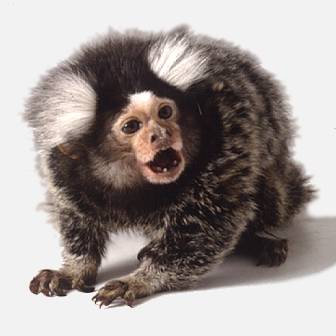
Arggggh. It was bad news for my only-humans-keep-pets theory. I could almost hear James chuckling. The article described a group of a dozen or so bearded capuchin monkeys who were caring for a baby marmoset, another species of monkey. One of the authors of the article was Dorothy Fragaszy, a University of Georgia primatologist who was studying the capuchins at a private nature preserve in Brazil. The article also included a series of stunning photographs by Jeanne Shirley, a California hospital epidemiologist and a serious amateur naturalist who regularly visits the tropics to photograph the wild things. Jeanne came across the group of capuchins by accident and was astounded to see them carrying around and even giving food to the little marmoset.
The researchers found that the capuchins treated the marmoset, who they named Fortunata, just like an infant capuchin. They regularly fed the baby monkey and talked to her in capuchinese. They cradled Fortunata, carried the monkey around and let her ride on their backs during the day. And when they played with their little friend, they carefully adjusted the force of their movements so they wouldn't injure the much smaller marmoset.
Most importantly, the friendship between Fortunata and the capuchins was not just a transient hook-up. The monkeys raised the marmoset from infancy to about the age she would have been an adult. One day, however, she suddenly disappeared, and Dorothy does not know if she left the capuchin group voluntarily or was killed by a predator.
Why I Am Sticking To My Guns...
So, has this case caused me to throw in the towel and abandon the theory that humans are the only species to keep pets? I have to admit that the capuchin-marmoset relationship has caused me moments of doubt. I am not, however, ready to give up the idea for a couple of reasons. First, while the capuchins were not confined, the situation was not completely natural as they were given food every day as part of a program designed to promote ecotourism at the research site. Second, it is unclear whether this is pet-keeping or adoption. In their article, the researchers called it adoption, but in an e-mail Dorothy agreed with me that there is an obvious parallel between with the relationship that the capuchins had with Fortunata and that I have with my cat Tilly, who I also play with, feed, and converse with in baby-talk.
Finally, Fortunata may be the exception that proves the more general rule that non-human animals don't keep pets. Capuchins are among the smartest of monkeys and have been referred to as "the New World Chimpanzee." Like chimps, they live in complex societies, use tools, eat meat, and have large brains in comparison to their body size. But, if capuchins can manage to bring a stranger into their lives and keep it as a pet for well over a year, why don't chimps?
I'll take up this question in my next blog on our relationships with animals. Stay tuned...
Reference
IZAR P, VERDERANE MP, VISALBERGHI E, OTTONI EB, GOMES DE OLIVEIRA M, SHIRLEY J, FRAGASZY D (2006) Cross-Genus Adoption of a Marmoset (Callithrix jacchus)
by Wild Capuchin Monkeys (Cebus libidinosus): Case Report. American Journal of Primatology 68:692–700
Abstract
We report a case of interspecies adoption of an infant marmoset (Callithrix jacchus) by wild capuchin monkeys (Cebus libidinosus). The marmoset was an infant when it was first observed in the capuchin group on 3 March 2004. Since it first appeared it has been observed informally and frequently. In January 2005 systematic observations were made of the marmoset and a capuchin of similar age. Throughout its period of adoption the marmoset appeared to be socially integrated into the group, benefiting from nurturant behaviors exhibited by two successive adoptive ‘‘mothers’’ and pronounced tolerance from all members of the group. This case highlights the flexibility of both Callithrix and Cebus in accommodating variable social behaviors and other characteristics (including size) of social partners.
pdf available here
Thursday, June 24, 2010

Tuesday, June 15, 2010
Interpsecies cuddling or possibly a confused leopard playing with its food...
Thanks to Claudio T for the link
Monday, May 24, 2010
Non-Predator Prey Interspecies Interactions
There is something about interspecies interaction (in a non-predator-prey context) that I find incredible. This is also adorable. -MA
Subscribe to:
Posts (Atom)


 Posts
Posts


