 Biologist Andrei Poyarkov
Follow up to last year's posting "Moscow's stray dogs well adapted to Russian metropolitain life" (originally published in the Wall Street Journal)
- Last year when i blogged about the story an anonymous reader answered with this video: http://smotri.com/video/view/?id=v9388066dbc. I never got any follow up from the reader, but I think its important to keep such things in mind when reading such an overall heart warming story as the one about the Moscow dogs...-MAMoscow’s stray dogs
By Susanne Sternthal From
the Financial TimesRussians can go nutty when it comes to dogs. Consider the incident a few years ago that involved Yulia Romanova, a 22-year-old model. On a winter evening, Romanova was returning with her beloved Staffordshire terrier from a visit to a designer who specialises in kitting out canine Muscovites in the latest fashions. The terrier was sporting a new green camouflage jacket as he walked with his owner through the crowded Mendeleyevskaya metro station. There they encountered Malchik, a black stray who had made the station his home, guarding it against drunks and other dogs. Malchik barked at the pair, defending his territory. But instead of walking away, Romanova reached into her pink rucksack, pulled out a kitchen knife and, in front of rush-hour commuters, stabbed Malchik to death.
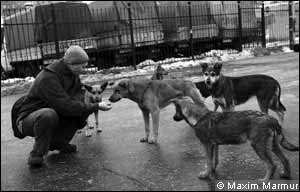
Romanova was arrested, tried and underwent a year of psychiatric treatment. Typically for Russia, this horror story was countered by a wellspring of sympathy for Moscow’s strays. A bronze statue of Malchik, paid for by donations, now stands at the entrance of Mendeleyevskaya station. It has become a symbol for the 35,000 stray dogs that roam Russia’s capital – about 84 dogs per square mile. You see them everywhere. They lie around in the courtyards of apartment complexes, wander near markets and kiosks, and sleep inside metro stations and pedestrian passageways. You can hear them barking and howling at night. And the strays on Moscow’s streets do not look anything like the purebreds preferred by status-conscious Muscovites. They look like a breed apart.
I moved to Moscow with my family last year and was startled to see so many stray dogs. Watching them over time, I realised that, despite some variation in colour – some were black, others yellowish white or russet – they all shared a certain look. They were medium-sized with thick fur, wedge-shaped heads and almond eyes. Their tails were long and their ears erect.
They also acted differently. Every so often, you would see one waiting on a metro platform. When the train pulled up, the dog would step in, scramble up to lie on a seat or sit on the floor if the carriage was crowded, and then exit a few stops later. There is even a website dedicated to the metro stray (www.metrodog.ru) on which passengers post photos and video clips taken with their mobile phones, documenting the savviest of the pack using the public transport system like any other Muscovite.
Where did these animals come from? It’s a question Andrei Poyarkov, 56, a biologist specialising in wolves, has dedicated himself to answering. His research focuses on how different environments affect dogs’ behaviour and social organisation. About 30 years ago, he began studying Moscow’s stray dogs. Poyarkov contends that their appearance and behaviour have changed over the decades as they have continuously adapted to the changing face of Russia’s capital. Virtually all the city’s strays were born that way: dumping a pet dog on the streets of Moscow amounts to a near-certain death sentence. Poyarkov reckons fewer than 3 per cent survive.
Poyarkov works at the A.N. Severtsov Institute of Ecology and Evolution in south-west Moscow. His office is small, but boasts high ceilings and tall windows. Several wire cages sit on a table in the centre of the room. Inside them, four weasels scurry through tunnels and run on a wheel. Poyarkov and I sit near the weasels and sip green tea.
He first thought of observing the behaviour of stray dogs in 1979, and began with the ones that lived near his apartment and those he encountered on his way to work. The area he studied came to comprise some 10 sq km, home to about 100 dogs. Poyarkov started making recordings of the sounds that the strays made, and began to study their social organisation. He photographed and catalogued them, mapping where each dog lived.
He quickly found that the strays were much easier to study than wolves. “To see a wild wolf is a real event,” he says. “You can see them, but not for very long and not at close range. But with stray dogs you can watch them for as long as you want and, for the most part, be quite near them.” According to Poyarkov, there are 30,000 to 35,000 stray dogs in Moscow, while the wolf population for the whole of Russia is about 50,000 to 60,000. Population density, he says, determines how frequently the animals come into contact with each other, which in turn affects their behaviour, psychology, stress levels, physiology and relationship to their environment.
“The second difference between stray dogs and wolves is that the dogs, on average, are much less aggressive and a good deal more tolerant of one another,” says Poyarkov. Wolves stay strictly within their own pack, even if they share a territory with another. A pack of dogs, however, can hold a dominant position over other packs and their leader will often “patrol” the other packs by moving in and out of them. His observations have led Poyarkov to conclude that this leader is not necessarily the strongest or most dominant dog, but the most intelligent – and is acknowledged as such. The pack depends on him for its survival.
Moscow’s strays sit somewhere between house pets and wolves, says Poyarkov, but are in the early stages of the shift from the domesticated back towards the wild. That said, there seems little chance of reversing this process. It is virtually impossible to domesticate a stray: many cannot stand being confined indoors.
“Genetically, wolves and dogs are almost identical,” says Poyarkov. “What has changed significantly [with domestication] is a range of hormonal and behavioural parameters, because of the brutal natural selection that eliminated many aggressive animals.” He recounts the work of Soviet biologist Dmitri Belyaev, exiled from Moscow in 1948 during the Stalin years for a commitment to classical genetics that ran counter to state scientific doctrine of the time.
Under the guise of studying animal physiology, Belyaev set up a Russian silver fox research centre in Novosibirsk, setting out to test his theory that the most important selected characteristic for the domestication of dogs was a lack of aggression. He began to select foxes that showed the least fear of humans and bred them. After 10-15 years, the foxes he bred showed affection to their keepers, even licking them. They barked, had floppy ears and wagged their tails. They also developed spotted coats – a surprising development that was connected with a decrease in their levels of adrenaline, which shares a biochemical pathway with melanin and controls pigment production.
“With stray dogs, we’re witnessing a move backwards,” explains Poyarkov. “That is, to a wilder and less domesticated state, to a more ‘natural’ state.” As if to prove his point, strays do not have spotted coats, they rarely wag their tails and are wary of humans, showing no signs of affection towards them.
The stray dogs of Moscow are mentioned for the first time in the reports of the journalist and writer Vladimir Gilyarovsky in the latter half of the 19th century. But Poyarkov says they have been there as long as the city itself. They remain different from wolves, in particular because they exhibit pronounced “polymorphism” – a range of behavioural traits shaped in part by the “ecological niche” they occupy. And it is this ability to adapt that explains why the population density of strays is so much greater than that of wolves. “With several niches there are more resources and more opportunities.”
The dogs divide into four types, he says, which are determined by their character, how they forage for food, their level of socialisation to people and the ecological niche they inhabit.
Those that remain most comfortable with people Poyarkov calls “guard dogs”. Their territories tend to be garages, warehouses, hospitals and other fenced-in institutions, and they develop ties to the security guards from whom they receive food and whom they regard as masters. I’ve seen them in my neighbourhood near the front gate to the Central Clinical Hospital for Civil Aviation. When I pass on the other side with my dog they cross the street towards us, barking loudly.
“The second stage of becoming wild is where the dog is socialised to people in general, but not personally,” says Poyarkov. “These are the beggars and they are excellent psychologists.” He gives as an example a dog that appears to be dozing as throngs of people walk past, but who rears his head when an easy target comes into view: “The dog will come to a little old lady, start smiling and wagging his tail, and sure enough, he’ll get food.” These dogs not only smell who is carrying something tasty, but sense who will stop and feed them.
The beggars live in relatively small packs and are subordinate to leaders. If a dog is intelligent but occupies a low rank and does not get enough to eat, he will separate from the pack frequently to look for food. If he sees other dogs begging, he will watch and learn.
The third group comprises dogs that are somewhat socialised to people, but whose social interaction is directed almost exclusively towards other strays. Their main strategy for acquiring food is gathering scraps from the streets and the many open rubbish bins. During the Soviet period, the pickings were slim, which limited their population (as did a government policy of catching and killing them). But as Russia began to prosper in the post-Soviet years, official efforts to cull them fell away and, at the same time, many more choice offerings appeared in the bins. The strays flourished.
The last of Poyarkov’s groups are the wild dogs. “There are dogs living in the city that are not socialised to people. They know people, but view them as dangerous. Their range is extremely broad, and they are predators. They catch mice, rats and the occasional cat. They live in the city, but as a rule near industrial complexes, or in wooded parks. They are nocturnal and walk about when there are fewer people on the streets.”
My neighbourhood is in the north-west of Moscow and lies between a large wooded park and one of the canals of the Moscow river. Leaving the windows open once the thaw of spring finally took hold, I found myself pulled out of a deep slumber by a cacophony that sounded as if packs of dogs were tearing each other apart in the grounds of our apartment complex. This went on for weeks. I later learned that spring is when many strays mate – “the dog marriage season”, as Russians poetically call it.
There is one special sub-group of strays that stands apart from the rest: Moscow’s metro dogs. “The metro dog appeared for the simple reason that it was permitted to enter,” says Andrei Neuronov, an author and specialist in animal behaviour and psychology, who has worked with Vladimir Putin’s black female Labrador retriever, Connie (“a very nice pup”). “This began in the late 1980s during perestroika,” he says. “When more food appeared, people began to live better and feed strays.” The dogs started by riding on overground trams and buses, where supervisors were becoming increasingly thin on the ground.
Neuronov says there are some 500 strays that live in the metro stations, especially during the colder months, but only about 20 have learned how to ride the trains. This happened gradually, first as a way to broaden their territory. Later, it became a way of life. “Why should they go by foot if they can move around by public transport?” he asks.
“They orient themselves in a number of ways,” Neuronov adds. “They figure out where they are by smell, by recognising the name of the station from the recorded announcer’s voice and by time intervals. If, for example, you come every Monday and feed a dog, that dog will know when it’s Monday and the hour to expect you, based on their sense of time intervals from their biological clocks.”
The metro dog also has uncannily good instincts about people, happily greeting kindly passers by, but slinking down the furthest escalator to avoid the intolerant older women who oversee the metro’s electronic turnstiles. “Right outside this metro,” says Neuronov, gesturing toward Frunzenskaya station, a short distance from the park where we were speaking, “a black dog sleeps on a mat. He’s called Malish. And this is what I saw one day: a bowl of freshly ground beef set before him, and slowly, and ever so lazily, he scooped it up with his tongue while lying down.”
Stray dogs evoke a strong reaction from Muscovites. While the model Romanova’s stabbing of a stray demonstrated an example of one extreme, the statue erected in his memory depicts the other. The city government has been forced to take action to protect the strays, but with mixed results. In 2002, mayor Yuri Luzhkov enacted legislation forbidding the killing of stray animals and adopted a new strategy of sterilising them and building shelters.
But until Russians themselves adopt the practice of sterilising their pets, this will remain only a half-measure. One Russian, noting that my male Ridgeback is neutered, exclaimed: “Now, why would you want to cripple a dog in that way?” Even though the city budget allocated more than $30m to build 15 animal shelters last year, that is not nearly enough to accommodate the strays. Still, there is pressure from some quarters to return to the practice of catching and culling them. Poyarkov believes this would be dangerous. While the goal, he acknowledges, “is to do away with dogs who carry rabies, tapeworms, toxoplasmosis and other infections, what actually happens is that infected dogs and other animals outside Moscow will come into the city because the biological barrier maintained by the population of strays in Moscow is turned upside down. The environment becomes chaotic and unpredictable and the epidemiological situation worsens.”
Alexey Vereshchagin, 33, a graduate student who works with Poyarkov, says that Moscow probably could find a way of controlling the feared influx. But that doesn’t mean he thinks strays should be removed from the capital. “I grew up with them,” he says. “Personally, I think they make life in the city more interesting.” Like other experts, Vereshchagin questions whether strays could ever be eliminated completely, particularly given the city’s generally chaotic approach to administration.
Poyarkov concedes that sterilisation might control the number of strays, if methodically conducted. But his work suggests that the population is self-regulating anyway. The quantity of food available keeps the total steady at about 35,000 – Moscow strays are at the limit and, as a result, most pups born to strays don’t reach adulthood. “If they do survive, it is only to replace an adult dog that died,” Poyarkov says. Even then, their life expectancy seldom exceeds 10 years. Having spent a career studying the stray dogs of Moscow and tracing their path back towards a wilder state, he is in no hurry to see them swept from the streets.
“I am not at all convinced that Moscow should be left without dogs. Given a correct relationship to dogs, they definitely do clean the city. They keep the population of rats down. Why should the city be a concrete desert? Why should we do away with strays who have always lived next to us?”
Thanks to Cleve H. for the link!




 Posts
Posts


