translate

Site update

Since I have been really terrible at updating the blog (but pretty good at keeping up with the facebook blog posts) I've added the widget below so that facebook cross posts to the blog.

You shouldn't need to join facebook but can just click on the links in the widget to access the articles. If you have any problems or comments please mail me at arandjel 'AT' eva.mpg.de.
Showing posts with label grad life. Show all posts

Friday, January 13, 2012

How fast does the Grim Reaper walk?


By correlating average walking speed and mortality rate over 5 years for men over 70, the authors conclude:
The Grim Reaper’s preferred walking speed is 0.82 m/s (2 miles (about 3 km) per hour) under working conditions. As none of the men in the study with walking speeds of 1.36 m/s (3 miles (about 5 km) per hour) or greater had contact with Death, this seems to be the Grim Reaper’s most likely maximum speed
via neatorama
--

Fiona F Stanaway,Danijela Gnjidic, Fiona M Blyth, David G Le Couteur, Vasi Naganathan, Louise Waite, Markus J Seibel, David J Handelsman, Philip N Sambrook, Robert G Cumming,How fast does the Grim Reaper walk? Receiver operating characteristics curve analysis in healthy men aged 70 and over (2011) BMJ 2011; 343 doi: 10.1136/bmj.d7679

Abstract

Objective:
To determine the speed at which the Grim Reaper (or Death) walks.

Design: Population based prospective study.

Setting: Older community dwelling men living in Sydney, Australia.

Participants: 1705 men aged 70 or more participating in CHAMP (Concord Health and Ageing in Men Project).

Main outcome measures: Walking speed (m/s) and mortality. Receiver operating characteristics curve analysis was used to calculate the area under the curve for walking speed and determine the walking speed of the Grim Reaper. The optimal walking speed was estimated using the Youden index (sensitivity+specificity−1), a common summary measure of the receiver operating characteristics curve, and represents the maximum potential effectiveness of a marker.

Results: The mean walking speed was 0.88 (range 0.15-1.60) m/s. The highest Youden index (0.293) was observed at a walking speed of 0.82 m/s (2 miles (about 3 km) per hour), corresponding to a sensitivity of 63% and a specificity of 70% for mortality. Survival analysis showed that older men who walked faster than 0.82 m/s were 1.23 times less likely to die (95% confidence interval 1.10 to 1.37) than those who walked slower (P=0.0003). A sensitivity of 1.0 was obtained when a walking speed of 1.36 m/s (3 miles (about 5 km) per hour) or greater was used, indicating that no men with walking speeds of 1.36 m/s or greater had contact with Death.

Conclusion: The Grim Reaper’s preferred walking speed is 0.82 m/s (2 miles (about 3 km) per hour) under working conditions. As none of the men in the study with walking speeds of 1.36 m/s (3 miles (about 5 km) per hour) or greater had contact with Death, this seems to be the Grim Reaper’s most likely maximum speed; for those wishing to avoid their allotted fate, this would be the advised walking speed.

Tuesday, January 10, 2012

How to get a faculty job in 20 not-so-easy steps


Thanks to Caro D for sending this to me, mainly because of point #6...which is why I may post-doc forever :D - MA

from the contemplative mammoth

Today’s post is by an anonymous guest blogger, who submitted this in response to a Twitter conversation today that began with a discussion of the recent spate of “Don’t get a PhD!” essays by tenured faculty inspired by the poor job market. I lamented that the process of getting hired isn’t necessarily transparent, for a host of reasons (i.e., how many jobs a person applies for, gets interviewed for, and ultimately offered). Our guest blogger obligingly supplied this hilarious post for your reading pleasure and general edification. I’ll be following up soon with my thoughts on the “Don’t get a PhD!” essays, and in the meantime, feel free to share your application-to-interview-to-hire ratio in the comments. Some of us stubbornly working towards a PhD would love a better sense of what’s typical.

So they’ve called you and scheduled an interview. Congratulations! Get ready for a couple of days of fun with your prospective new faculty. This could be the start of a whole new chapter in your professional career.

1. The Golden Rule of Interviewing: The time to decide if you want the job, is after they offer you the job. The advice below is designed to help you get the job in the first place.

2. When you schedule the interview, tell them how delighted you are and how much you are looking forward to this. They are putting themselves out there by inviting you, and they don’t want to be rejected any more than you do.

3. What to pack? Advice: 1. Better to overdress than underdress; and 2. You want them to remember YOU, not your clothes. Wear something formal but forgettable.

4. Don’t forget to show interest in the local area. It’s effective to wax ebullient about how you view moving to rural Minnesota as a dream-come-true since your personal interests include not being anywhere near a theater, operahouse, symphony or having an escalator in town*.

5. Wear a catheter. Your interview will consist of 1-2 days of 20-minute meetings scheduled back-to-back with absolutely anybody they could cram onto your schedule. There will be no bathroom breaks, no water breaks, and no insulin injections. This is exacerbated by the fact that every single one of the people you meet will want to take the 20-minutes as their coffee break**. In the end, most of the interview will be a blur, except that you will be able to find the coffee cart from any point on campus blindfolded.

6. Point 5 above reminds the author to tell you Not To Wear Heels. Heels make everyone uncomfortable in a scientific setting and I don’t know why. It’s just part of that vast incomprehensible world of feminine frivolity from which we are excluded when we gaze through that first microscope. The author is not sure whether this is good or bad.

7. Never underestimate just how freaking weird these 20-minute meetings can be. Sometimes you will be compulsively talked at as you walk in the door, through the meeting, and you will shut the door on someone still talking as you leave. Sometimes you will share a stony silence with your host for 20 minutes. Many times you will be marched through laboratories, presumably to ogle shiny machines. Ogle them. Ogle them like it is the last glimpse of human civilization you will ever get. The sorry soul who is your tour guide traded her youth and health to become chained to that beeping machine, and is it so much to ask of someone to witness this reality***?

8. People will ask you personal questions. Including questions that are illegal to ask during interviews. Stuff like: “Are you married or are you a lesbian?”, “Do you plan on having children?” and “Would you move here if we offered you the job?” and stuff that’s a lot more crazy than that. The author is telling you now so you won’t be surprised.

9. When people ask you illegal questions, you are not obligated to answer truthfully. Well, that’s the anonymous author’s position anyway. Responses like: “I’m celibate and I’m sterile” and “All my crap is in a moving van on its way here right now” are no harm no foul as far as the author is concerned. I recommend that you don’t get miffy. Nurse your wound and complain about these illegal questions on a blog anonymously many years later after you’ve had the sweet sweet revenge of living well.

10. Play up the young, fresh and cheerful angle. Universities need infusions of optimism more than they need overhead, if you want to know the truth. Academics are such endlessly relentless complainers that you can often distinguish yourself conspicuously just by intimating something (anything) hopeful and positive. Sincerity optional.

11. Here’s the Secret Key to Everything: In every department there’s one dismal job that everyone has been avoiding for years. It could be anything. It could be offering a required course, it could be leading an alumni field trip, it could be writing the annual newsletter — anything. If you can figure out what this job is, and state forcefully that you want to do it, the position is pretty much yours right there. Not only do you not mind teaching “Science 101 for the Declaredly Uninterested”, all the events of your life have been catapulting you towards doing it. You will never feel fulfilled until you can put on your C.V. that you negotiated putting a vending machine in the department’s front office. You get the idea.

12. The Seminar. News flash: none of these people have read any of your papers and maybe two of them have read your application and recommendation letters. Everyone will make their decision based on your seminar. Honestly, at the end of 35 years, the success of your whole career comes down a few one-hour seminars. So make it good. No pressure, though.

13. After your seminar you will be taken to the Interview Dinner. This will take place at a fancy restaurant with a hybridized group of the faculty most interested in your subject area and the faculty most interested in a free meal. A high degree of overlap between the two groups bodes well for your chances of being hired.

14. Order something simple for dinner. The author always goes with scallops because they seem classy, taste good and come in bite-size pieces. It’s hard to pontificate about the future of science while gumming a fistful of baby-back ribs or while standing to gain leverage over a rack of lamb.

15. Don’t drink at the Interview Dinner. Your hosts will. They will drink like men who’ve been stuck in the Sahara Desert for ten years. This is because the fancy dinner will be at the university’s expense. Years of pent up anguish suffered at the cold sinewy hand of the administration can be soothed by about $30 of Sauvingnon with astonishing efficiency. It’s actually a good deal for the alumni.

16. Don’t get into a car with any of your hosts after the Interview Dinner. See point 15 above. Chirp happily about how there’s nothing like a good long walk in the forty-below to ruminate over all the fascinating science to which you’ve been exposed that day.

17. Bring bubble bath. After the dinner, you will get so damn depressed you won’t know what hit you. Everything you worked so hard for and sacrificed so much for — your deep and raw need for acknowledgment – everything just played itself out in a single hour of seminar theater followed by a cold plate of scallops and a weak iced tea. When you get back to your hotel room, the existential emptiness of it all will hit you like an 18-wheeler descending Donner Pass. A long bubble bath and a DVD of old Jackass episodes is the only constructive way to deal with this.

18. If they are going to offer you the job, you’ll know. You’ll just know. It’s like meeting your soulmate for the first time. Except your soulmate won’t ask you to attend weekly meetings for the next 10 years during which your senior colleagues will complain bitterly about things that happened before you were born.

19. The time after the interview is like a break-up. Don’t dwell on it. Don’t stalk the department on FB and try to figure out who else is interviewing. Move on with your life. Do your best to forgive and forget. Then if you ever hear from them again, it will be a pleasant surprise.

20. Repeat as necessary.

Footnotes

*The anonymous author can say this because she grew up in rural Minnesota and she loves it there, even though she was 12 when she first visited a building with more than three floors.

**In the good old days (when the anonymous author was young and innocent) the 20 minutes could be used as a smoke-break. Many a hypothesis was expounded by the author’s shivering frame while Professor Marlboro Man got his fix.

***Maybe the anonymous author runs a lab.

About the author: The author anonymously lives in Hawaii and she’s published a bazillion papers though none of them in Nature anyway. Her dad says, “honey, I love you but you should probably stop trying to be funny and go back to work”. He’s been saying that since she was in second grade.

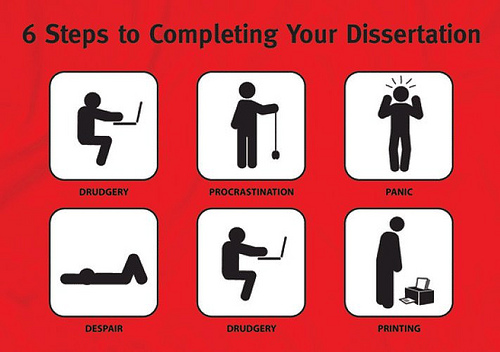
How to Write a Ph.D. Dissertation


from Neatorama

E. Robert Schulman and C. Virginia Cox
Charlottesville, Virginia

Abstract
In this paper we demonstrate that writing a Ph.D. dissertation can have many benefits. Not only do you obtain extensive typesetting experience, but afterwards you can have your frequent-flyer literature addressed to “Dr. Your Name.”

Chapter I: Introduction
Ph.D. dissertations (e.g., Schulman 1995a; Cox 1995) are commonly believed to be comprehensive compendiums of the original research done by a graduate student in partial fulfillment of the requirements for the degree of Doctor of Philosophy.² In reality, the Ph.D. thesis is usually a number of disparate chapters whose most important feature is not the thoroughness of the experimental description but rather the width of the margins. In this paper, the second article in a series on scientific writing that began with Schulman (1996a), we will discuss the phenomenon of the Ph.D. thesis.

Chapter II: Preparing to Write
There comes a time in the life of every graduate student when she or he realizes that another two years of graduate school cannot be endured. Even though a year spent writing your thesis will be filled with frustration and angst, it will end up being worth it in order to escape school forever.

Remember the following phrase: “No one will ever read your thesis.” You’ll hear this phrase a number of times as you finish up, and it’s vitally important that you believe it to be true. The phrase is important because without it you would be tempted to work on your thesis until everything is perfect, and you would never finish.

Say “It’s good enough for the thesis” to yourself several times a day. Tell yourself that you’ll correct all the mistakes when you turn the various chapters into independent scientific papers, even though this won’t happen (see Schulman 1996aand references therein).

Chapter III: Your Thesis Committee

Your thesis committee should consist of between four and nine researchers in and outside of your field. Each committee member has a specific duty.

Your thesis advisor has the most important job: to reassure you that you don’t have to do many of the things you’re positive you should do. She or he will likely say, “It’s good enough for the thesis” fairly often.

You also need one committee member who will insist on more mathematical rigor, one who will demand that the thesis be made more concise by getting rid of all that irrelevant math, and two or three to say that you should do all the things your thesis advisor told you didn’t need to be done.

There should also be at least one committee member who will never read the thesis, and who will therefore ask only general questions at your thesis defense. The other graduate students who attend your defense will often bet on which professors read your thesis. Be prepared to determine the winner (note that it is not considered sporting to participate in this game yourself).

Try to set a defense date early so as to give your committee ample time to schedule conferences, vacations, and/or elective surgery for that day.

Chapter IV: Producing the Thesis
Legend has it that doctoral students in ancient times used to produce their dissertations using a device called a “typewriter.” While there is some archeological evidence for typewriter use in the past, many researchers doubt the plausibility of such claims (e.g. Schulman 1995a).

These days, dissertations are produced using word processing programs such as Word or Word Perfect, or computer typesetting systems such as TeX or LaTeX. The former will give you practice in drawing by hand all the symbols that aren’t supported, while with the latter you have the opportunity to craft new typesetting definitions to satisfy your university’s dissertation policies. For example,

\long\def\printfrontnonchapter{\vfil\eject \rightpage\null\vskip 1in \centerline{{\bf \Uppercase{\frontnonchapterheader}}}\vskip 22pt plus 73pt \relax\bigskip\setwidespacing \frontnonchaptertext\par} (Jerius 1992).

Be sure not to choose the wrong method of producing your thesis.

Chapter V: Writing the Thesis
The Ph.D. thesis usually begins with a pithy quote, after which there will sometimes be a dedication to one’s parents, life partner, and/or pet tapir.

Following this is probably the most important part of the dissertation: the acknowledgments section. This is the only section that everyone who picks up your thesis will read. They will happen upon your dissertation in the library and flip through the first few pages, looking for a juicy acknowledgments section. This is your chance to make obscure references to secret loves, damn various faculty members with faint praise, or be very mysterious by having no acknowledgments section at all so that everyone wonders what you’re hiding.

After the acknowledgments should be the various tables of contents, denoting the page numbers on which the reader may find every section, subsection, subsubsection, figure, table, appendix, footnote, and semicolon in the thesis.

Next comes the first thesis chapter, the introduction, which is judged on the basis of how far back in the past you start. Although the introduction is supposed to enable someone with no knowledge of your field to read and understand your thesis, this is an impossible goal. Instead, simply reference sources such as Rontgen (1896), Galileo (1610), Aristotle (-350), or other similarly ancient researchers. The idea to get across is that your work, being based on the work of great scientists of the past, must be truly worthwhile. Even though these works have little to do with your research, your committee isn’t going to look up the references.

After the introduction come chapters that describe what you did, where you did it, when you did it, why you did it, and how much more work has to be done before you can obtain definitive results. This last point is usually discussed in the concluding chapter.

Chapter VI: The Thesis Defense
Remember those dreams you used to have about going to class and finding out that there was a big test that day for which you hadn’t studied? The thesis defense is worse, because you find out that although you studied very hard, you didn’t study the right things.

Your committee members aren’t going to waste their time asking you about your research, because you know more about that than anyone else in the world. Instead, they will ask questions that are really about their research or–if they are in a particularly punchy mood–about fundamental mathematics.

The fun part is that at most universities the first part of your defense is open to the public, so that your parents will probably want to come and videotape the event.
Chapter VII: Rewriting
Your thesis defense was tough, but you survived. Your committee members have signed a piece of paper saying that they are satisfied with your dissertation as long as your thesis advisor is happy with the revisions you make. Don’t fall into the trap of trying to make everything perfect! Remember the phrase from Chapter II, “No one will ever read your thesis.”

Once your advisor is happy with the revisions, take one unbound, unperforated, paginated copy of your dissertation, two copies of your abstract, one extra copy of your title page, the signed evaluation forms from your committee members in a sealed, notarized envelope, the receipt proving your payment of the Thesis Publication Fee, your diploma application, and proof of your doctoral candidacy enrollment to the Bureaucratic Office of Records, Education, and Dissertations (your requirements may vary; void where prohibited).

The folks at BORED will take a ruler to every page in your thesis, making sure that all the margins are correct and insisting that you go back and redo them if even one page is wrong.

Chapter VIII: Distributing Your Thesis
You’ve passed the format check, and it’s time to make a hundred copies of your thesis and distribute them to departmental libraries all over the world so that everyone in your field can read it. Your advisor should pay for the photocopying and postage (see Schulman & Cox 1997 for a detailed justification).

Try not to think of all the errors lurking in your thesis as you address the envelopes to Professor Famous or Doctor Influential. You want to publicize your dissertation as much as possible so that prospective employers will at least have heard your name.

Some journals will publish brief summaries of your dissertation (e.g. Schulman 1995b; Schulman 1996b), but be warned that these journals may want you to format your summary quite specifically. The requirements for the mini-Annals of Improbable Research are particularly restrictive; it can be difficult to summarize five years of work in five lines of text.

Chapter IX: Conclusion
Congratulations, Doctor! You’ve escaped from graduate school and can now have your frequent-flyer literature addressed to Dr. Your Name, complain when forms only list Mr/Ms/Mrs, and smirk when surgeons whine about all the people with academic doctorates who are making the title meaningless for medical doctors. Go out and make the world a better place.

Bibliography
Aristotle, -350, On The Heavens, Athens, Greece.
Cox, C. V. 1995, Ph.D. thesis, University of Michigan.
Galilei, G. 1610, Sidereus Nuncius, Venice, Italy.
Jerius, D. H. 1992, Ph.D. thesis, University of Michigan.
Kaplan, J. M. 1996, Ph.D. thesis, Stanford University.
Rontgen, W. C. 1896, Nature, 53, 274.
Schulman, E. R. 1995a, Ph.D. thesis, University of Michigan.
Schulman, E. 1995b, mini-Annals of Improbable Research, 1995-08, 4.
Schulman, E. R. 1996a, Annals of Improbable Research, Vol. 2, No. 5, 8.
Schulman, E. 1996b, Publications of the Astronomical Society of the Pacific, 108, 460.
Schulman. E. R. & Cox, C. V. 1997, Annals of Improbable Research, Vol. 3, No. 5, 8.

Notes
1. There is no note 1.
2. One does not actually need to include any philosophy in the thesis unless one is getting a Doctorate of Philosophy in philosophy, and even in that case the philosophical component can be minimized (e.g., Kaplan 1996).

__________________________

This article is republished f the September-October 1997 issue of the Annals of Improbable Research.

Repurpose With Flula!

flula has some great tips for re purposing monkeys and other great recycling ideas

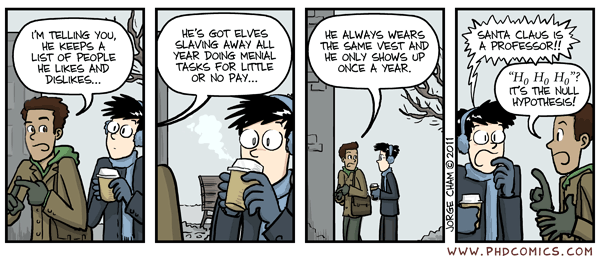
The Clause Hypothesis

Thanks to Chiara B for the link!

from PhDcomics

LOL: talking wildlife

its a repeat but such a good repeat :)
via Neatorama

the Stoned Ape Hypothesis

Thanks to Mark W for the link


Monday, December 5, 2011

attempted murder


from http://chzsomuchpun.files.wordpress.com/2011/09/funny-puns-attempted-murder.jpg

Cigarette smoking: an underused tool in high-performance endurance training


thanks alberto a for the link!

From the Canadian Medical Association Journal
Cigarette smoking: an underused tool in high-performance endurance training
Kenneth A. Myers, BSc

Abstract
The review paper is a staple of medical literature and, when well executed by an expert in the field, can provide a summary of literature that generates useful recommendations and new conceptualizations of a topic. However, if research results are selectively chosen, a review has the potential to create a convincing argument for a faulty hypothesis. Improper correlation or extrapolation of data can result in dangerously flawed conclusions. The following paper seeks to illustrate this point, using existing research to argue the hypothesis that cigarette smoking enhanceshttp://www.blogger.com/img/blank.gif endurance performance and should be incorporated into high-level training programs.

To read it all go HERE

Facebook History of the World

thanks to Jim F for the link!
To see the WHOLE THING go to CollegeHumor.com
by Susanna Wolf

Tuesday, November 22, 2011

The Lord of the Rings: an allegory of the PhD?

Thanks to Alex C for the link!

from http://danny.oz.au/danny/humour/phd_lotr.html
by Dave Pritchard

The story starts with Frodo: a young hobbit, quite bright, a bit dissatisfied with what he's learnt so far and with his mates back home who just seem to want to get jobs and settle down and drink beer. He's also very much in awe of his tutor and mentor, the very senior professor Gandalf, so when Gandalf suggests he take on a short project for him (carrying the Ring to Rivendell), he agrees.

Frodo very quickly encounters the shadowy forces of fear and despair which will haunt the rest of his journey and leave permanent scars on his psyche, but he also makes some useful friends. In particular, he spends an evening down at the pub with Aragorn, who has been wandering the world for many years as Gandalf's postdoc and becomes his adviser when Gandalf isn't around.

After Frodo has completed his first project, Gandalf (along with head of department Elrond) proposes that the work should be extended. He assembles a large research group, including visiting students Gimli and Legolas, the foreign postdoc Boromir, and several of Frodo's own friends from his undergraduate days. Frodo agrees to tackle this larger project, though he has mixed feelings about it. ("'I will take the Ring', he said, 'although I do not know the way.'")

Very rapidly, things go wrong. First, Gandalf disappears and has no more interaction with Frodo until everything is over. (Frodo assumes his supervisor is dead: in fact, he's simply found a more interesting topic and is working on that instead.) At his first international conference in Lorien, Frodo is cross-questioned terrifyingly by Galadriel, and betrayed by Boromir, who is anxious to get the credit for the work himself. Frodo cuts himself off from the rest of his team: from now on, he will only discuss his work with Sam, an old friend who doesn't really understand what it's all about, but in any case is prepared to give Frodo credit for being rather cleverer than he is. Then he sets out towards Mordor.

The last and darkest period of Frodo's journey clearly represents the writing-up stage, as he struggles towards Mount Doom (submission), finding his burden growing heavier and heavier yet more and more a part of himself; more and more terrified of failure; plagued by the figure of Gollum, the student who carried the Ring before him but never wrote up and still hangs around as a burnt-out, jealous shadow; talking less and less even to Sam. When he submits the Ring to the fire, it is in desperate confusion rather than with confidence, and for a while the world seems empty.

Eventually it is over: the Ring is gone, everyone congratulates him, and for a few days he can convince himself that his troubles are over. But there is one more obstacle to overcome: months later, back in the Shire, he must confront the external examiner Saruman, an old enemy of Gandalf, who seeks to humiliate and destroy his rival's protege. With the help of his friends and colleagues, Frodo passes through this ordeal, but discovers at the end that victory has no value left for him. While his friends return to settling down and finding jobs and starting families, Frodo remains in limbo; finally, along with Gandalf, Elrond and many others, he joins the brain drain across the Western ocean to the new land beyond.

Monday, November 21, 2011

Rosa- kick-ass eco-short film - apparently made for $100


ROSA from Jesús Orellana on Vimeo.


via superpunch.blogspot.com

ROSA is an epic sci-fi short film that takes place in a post-apocalyptic world where all natural life has disappeared. From the destruction awakes Rosa, a cyborg deployed from the Kernel project, mankind’s last attempt to restore the earth’s ecosystem. Rosa will soon learn that she is not the only entity that has awakened and must fight for her survival.

The short-film was created entirely by young comic-artist Jesús Orellana with no budget during a single year. Since it's world premiere at the Seattle International Film Festival, ROSA has been an official selection at film festivals around the world such as Screamfest, Toronto After Dark, Anima Mundi or Los Angeles Shorts Film Festival. In October ROSA was screened at the opening night of the Sitges International Film Festival, considered the world's best festival specialized in genre films. Following the succesful festival run, the short film has attracted the attention of the major talent-agencies and Hollywood producers. Currently ROSA is in development to be a live-action motion picture.

For more information regarding ROSA, please visit rosamovie.com

Become a Fan on facebook.com/rosashortfilm