translate

Site update

Since I have been really terrible at updating the blog (but pretty good at keeping up with the facebook blog posts) I've added the widget below so that facebook cross posts to the blog.

You shouldn't need to join facebook but can just click on the links in the widget to access the articles. If you have any problems or comments please mail me at arandjel 'AT' eva.mpg.de.
Showing posts with label radio collars. Show all posts

Thursday, June 23, 2011

Migration tracking reveals a marine Serengeti

Estimates of the daily mean position in the north Pacific of the six marine predator groups studied. Top, left to right: tuna (yellowfin, bluefin, albacore); pinnipeds (northern elephant seals, California sea lions, northern fur seals); sharks (salmon, white, blue, common thresher, mako). Bottom, left to right: seabirds (Laysan and black-footed albatrosses, sooty shearwaters); sea turtles (leatherback, loggerhead); cetaceans (blue, fin, sperm and humpback whales).
From Nature News via RARE
Decade of tagging has mapped predatorial pathways in the north Pacific Ocean.
by ZOE CORBYN

Two vast areas of the north Pacific Ocean, one off the west coast of the United States and the other between Hawaii and Alaska, have been revealed as marine counterparts of East Africa's Serengeti plain. Teeming with life, these oceanic 'hotspots' provide major migration corridors for large marine predators ranging from tuna to whales.

The discovery comes from a huge data set that synthesizes and compares the seasonal migration patterns of 23 species of predators. The findings are published today in Nature.

Between 2000 and 2009, the species were tracked under the Tagging of Pacific Predators (TOPP) programme, part of the Census of Marine Life international collaboration. Electronic tags attached to the animals recorded their movements and the water conditions around them, including temperature, salinity and depth. In total, the programme deployed 4,306 electronic tags, yielding 1,791 individual animal tracks and resulting in 265,386 days' worth of tracking data. The data derived over the course of the project have now been combined for the first time.
(click for a larger image).Block, B. A. et al.

"It is like asking, 'How do lions, zebras and cheetahs use Africa as a whole continent?', only we have done it for a vast ocean," says Barbara Block, a marine scientist at Stanford University in California and lead author of the paper. "We have had single-species papers before on a lot of the migration patterns, but they have never been put together as a whole."
In the zone

The combined data from the tagged species, which carefully removes any bias introduced from where the animals had been tagged, shows two 'hotspot' regions where the predators' migration routes concentrate in the north Pacific. These are the south-flowing California Current off the United States, and the North Pacific transition zone (NPTZ), which runs east–west between Hawaii and Alaska along a boundary between cold sub-Arctic waters and warmer subtropical waters, and which acts like a trans-oceanic migration highway.

"These are the oceanic locations where food is most abundant, and that's driven by high primary productivity at the base of the food chain. These areas are the savannah grasslands of the sea," says Block.

Combining movement and physical data from so many tags can help to explain the behaviour patterns observed. For example, populations of salmon sharks, white sharks and mako sharks can be seen to "split the turf of the central and eastern Pacific", says Block. Records from the tags show that slightly different preferences for water temperature prevent the closely related species from treading on one another's fins.

The work also shows that many species with long migratory paths — including yellowfin tuna, bluefin tuna, white sharks, elephant seals and salmon sharks — return faithfully from their migration to the same region every season. "For me, this homing capacity has been the biggest surprise," says Block. "We didn't really know these creatures had neighbourhoods."
Pinning down predators

The TOPP data suggest that water temperature and the amount of ocean productivity from upwelling (where nutrient-rich water from the depths comes to the surface) could drive the seasonal migration of many species, with the effect particularly evident in the California Current. "Using satellite observations of temperature and chlorophyll concentrations alone, we can now predict when and where individual species are likely to be," said Daniel Costa, an ecologist at the University of California, Santa Cruz, and a co-author of the paper.

Patrick Halpin, a marine geospatial ecologist at Duke University in Durham, North Carolina, who is a member of the Census of Marine Life but not of TOPP, says that the study is groundbreaking, providing not only a comprehensive picture of patterns of marine-predator behaviour in the region, but also a methodological framework for further broad-scale studies. "Future analyses originating from other regions will likely fill in a more comprehensive picture of the entire Pacific basin and identify additional hotspots," he says.

David Sims, a behavioural ecologist at the Marine Biological Association in Plymouth, UK, also praises the study, noting its "unprecedented number" of electronic tags. "They have launched marine animal behaviour as a 'big' science, rivalling in ambition, perhaps, some large projects in astronomy or physics," he says.

Block says that information from the study could aid efforts to protect and conserve the biodiversity of the hotspots. Knowing where and when species overlap is valuable information for efforts to manage and protect critical species and ecosystems, she says.

---
Citation
Block BA, Jonsen ID, Jorgensen SJ, Winship AJ, Shaffer SA, Bograd SJ, Hazen EL, Foley DG, Breed GA, Harrison A-L, Ganon JE, Swithenbank A, Castelton M, Dewar H, Mate BR, Shillinger GL, Schaefer KM, Benson SR, Weise MJ, Henry RW, Costa DP (2011) Tracking apex marine predator movements in a dynamic ocean. Nature doi:10.1038/nature10082

Abstract
Pelagic marine predators face unprecedented challenges and uncertain futures. Overexploitation and climate variability impact the abundance and distribution of top predators in ocean ecosystems. Improved understanding of ecological patterns, evolutionary constraints and ecosystem function is critical for preventing extinctions, loss of biodiversity and disruption of ecosystem services. Recent advances in electronic tagging techniques have provided the capacity to observe the movements and long-distance migrations of animals in relation to ocean processes across a range of ecological scales. Tagging of Pacific Predators, a field programme of the Census of Marine Life, deployed 4,306 tags on 23 species in the North Pacific Ocean, resulting in a tracking data set of unprecedented scale and species diversity that covers 265,386 tracking days from 2000 to 2009. Here we report migration pathways, link ocean features to multispecies hotspots and illustrate niche partitioning within and among congener guilds. Our results indicate that the California Current large marine ecosystem and the North Pacific transition zone attract and retain a diverse assemblage of marine vertebrates. Within the California Current large marine ecosystem, several predator guilds seasonally undertake north–south migrations that may be driven by oceanic processes, species-specific thermal tolerances and shifts in prey distributions. We identify critical habitats across multinational boundaries and show that top predators exploit their environment in predictable ways, providing the foundation for spatial management of large marine ecosystems.

Wednesday, March 16, 2011

shameless self promotion - PLoS ONE: Non-Invasive Genetic Monitoring of Wild Central Chimpanzees


Our new paper came out today in PLosONE (so its open access :)
Arandjelovic M, Head J, Rabanal LI, Schubert G, Mettke E, Boesch C, Robbins M, Vigilant L (2011) Non-Invasive Genetic Monitoring of Wild Central Chimpanzees. PLoS ONE 6(3): e14761. doi:10.1371/journal.pone.0014761

Abstract
Background
An assessment of population size and structure is an important first step in devising conservation and management plans for endangered species. Many threatened animals are elusive, rare and live in habitats that prohibit directly counting individuals. For example, a well-founded estimate of the number of great apes currently living in the wild is lacking. Developing methods to obtain accurate population estimates for these species is a priority for their conservation management. Genotyping non-invasively collected faecal samples is an effective way of evaluating a species' population size without disruption, and can also reveal details concerning population structure.

Methodology/Principal Findings

We opportunistically collected wild chimpanzee faecal samples for genetic capture-recapture analyses over a four-year period in a 132 km2 area of Loango National Park, Gabon. Of the 444 samples, 46% yielded sufficient quantities of DNA for genotyping analysis and the consequent identification of 121 individuals. Using genetic capture-recapture, we estimate that 283 chimpanzees (range: 208–316) inhabited the research area between February 2005 and July 2008. Since chimpanzee males are patrilocal and territorial, we genotyped samples from males using variable Y-chromosome microsatellite markers and could infer that seven chimpanzee groups are present in the area. Genetic information, in combination with field data, also suggested the occurrence of repeated cases of intergroup violence and a probable group extinction.

Conclusions/Significance

The poor amplification success rate resulted in a limited number of recaptures and hence only moderate precision (38%, measured as the entire width of the 95% confidence interval), but this was still similar to the best results obtained using intensive nest count surveys of apes (40% to 63%). Genetic capture-recapture methods applied to apes can provide a considerable amount of novel information on chimpanzee population size and structure with minimal disturbance to the animals and represent a powerful complement to traditional field-based methods.

Sunday, June 20, 2010

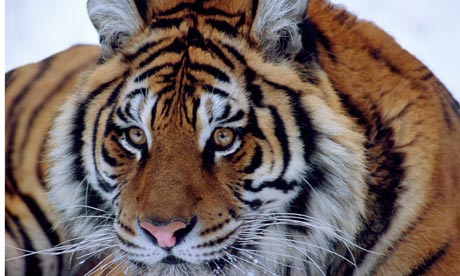
Siberian tiger epidemic blocks their ability to hunt, could decimate entire population.

This is seriously disturbing and then to add salt to the wound is the statement at the end: "The only consolation in this grisly process is that, for once, a serious threat is not originating from human actions, although even that, for now, is open to debate." Please PLEASE don't be due to the radio collars, although I do think they are generally overused, it would be awful if this was a side-effect. In any case, how awful for the species -MA

From The guardian
Siberian tiger threatened by mystery disease
by PATRICK EVANS
Conservationists say an epidemic is destroying the big cats' ability to hunt and turning them into potential man-eaters

A mystery disease is driving the Siberian tiger to the edge of extinction and has led to the last animal tagged by conservationists being shot dead in the far east of Russia because of the danger it posed to people.

The 10-year-old tigress, known to researchers as Galya, is the fourth animal that has had a radio collar attached to it for tracking to die in the past 10 months. All had been in contact with a male tiger suspected of carrying an unidentified disease that impaired the ability to hunt. "We may be witnessing an epidemic in the Amur tiger population," said Dr Dale Miquelle, the Wildlife Conservation Society's (WCS) Russia director.

Galya had recently abandoned a three-week-old litter of cubs and come into the town of Terney looking for an easy meal. Following a series of all-night vigils by researchers, attempts to scare the tigress away failed. She was reported to the Primorsky State Wildlife Department as an official "conflict tiger", and a state wildlife inspector was called in to destroy her earlier this month.

"This tiger had lost its fear of humans – typically Amur tigers will never expose themselves for observation. It was like seeing someone you know turn into a vampire," Miquelle said.

Scientists are attempting to understand what compromised the tigress's ability to capture wild prey, which she had lived upon almost exclusively since birth. Her cubs, which were subsequently found dead at the den, are likely to have had their mother's disease transmitted to them through the placenta. "Initial necropsy results show an empty digestive tract, which is highly unusual. We're still waiting for results of further tests, but the abnormal behaviour suggests disease, possibly neurological," said Miquelle. "We are extremely concerned about the possibility of an epidemic that could be sweeping through this region. Animals we have studied extensively, and known well, have demonstrated radically changed behaviour, which is extremely disconcerting."

Weighing only 91kg at death – down from an estimated 140kg at full health – the tigress's death represents the end of an 11-year lineage of related "study" tigers, and leaves the WCS's Siberian Tiger Project with no radio-collared animals for the first time in 18 years. WCS Russia has tracked more than 60 tigers since inception in 1992.

In March this year, Miquelle raised the prospect of disease as a potential threat to an already endangered Siberian tiger population. WCS Russia reported in October 2009 that there had been a 40% decline in numbers since the last full survey in 2005, from 428 to as little as 252 adult tigers. The tiger's range has been reduced to a small pocket in the corner of the country within the region of Primorsky Krai.

Speaking at a conference in Vladivostok, Miquelle said that anything above a 15% mortality rate in adult females could kill off all Amur tigers. With around 150 adult females in the population, any more than 22 deaths of adult females per year may wipe out the species. Poaching accounts for about 75% of all Amur tiger deaths, with 12 to 16 adult females killed annually. "We're in a new era where disease could seriously affect the Amur tiger."

The Russian draft federal tiger conservation strategy has recently been amended to take account of disease, including a section on vaccination against canine distemper, a viral disease which is common in the Russian far east in domestic dogs and cats.

"The addition of disease-related deaths to existing sources of mortality could push this population over a tipping point," said Miquelle.

The federal strategy, which is being designed by a number of scientific groups including WCS Russia, is being prepared for the first global Tiger Summit due to take place in St Petersburg this September. Along with World Bank president Robert Zoellick, Vladimir Putin is due to preside over the conference.

WCS Russia hopes to recommence the capture of study tigers in September. "We aim to change the focus of why we study tigers, with a new emphasis on disease," said Miquelle. "The only consolation in this grisly process is that, for once, a serious threat is not originating from human actions, although even that, for now, is open to debate."

Thanks to Emma S for the link.