translate

Site update

Since I have been really terrible at updating the blog (but pretty good at keeping up with the facebook blog posts) I've added the widget below so that facebook cross posts to the blog.

You shouldn't need to join facebook but can just click on the links in the widget to access the articles. If you have any problems or comments please mail me at arandjel 'AT' eva.mpg.de.
Showing posts with label japan. Show all posts

Tuesday, December 6, 2011

Scientists a step closer to cloning mammoth


from Japantimes

The thighbone of a mammoth found in August in Siberia contains well-preserved marrow, increasing the chances of cloning one of the extinct beasts, Japanese and Russian scientists confirmed recently.

The teams from the Sakha Republic's mammoth museum in eastern Russia and Kinki University's graduate school in biology-oriented science and technology will launch full-fledged joint research next year to clone the giant mammal, which is believed to have become extinct about 10,000 years ago, they said.

By transplanting nuclei taken from the marrow cells into elephant egg cells whose nuclei have been removed through a cloning technique, embryos with a mammoth gene could be produced and planted into elephant wombs, as the two species are close relatives, they said.

Securing nuclei with an undamaged gene is essential for the nucleus transplantation technique, but doing so from mammoths is extremely difficult and scientists have been trying to reproduce a mammoth since the late 1990s, they said.

In the Sakha Republic, global warming has thawed its almost permanently frozen ground, leading to numerous discoveries of frozen mammoths. But cell nuclei are usually damaged or have not been kept in a frozen state even when they have been found in a good overall condition, a Russian museum official said.

This time, however, there is a high likelihood that biologically active nuclei can be extracted as the frozen marrow found when museum scientists cut open the thighbone Nov. 13 was fresh and in excellent condition, according to the official. The bone was found near Batagay in northern Sakha.

The technique for extracting nuclei, meanwhile, has improved dramatically in the past few years and some undamaged nuclei have been successfully taken from badly preserved mammoth tissue fragments, albeit at low rates, said the Kinki University team based in Osaka Prefecture.

The museum, located in the republic's capital, Yakutsk, soon notified the Japanese side, with which it has had close ties through joint research since 1997, including professor Akira Iritani and associate professor Hiromi Kato.

Iritani confirmed that the outstanding condition of the marrow has increased the chances of cloning a mammoth, and said the Japanese team will try to obtain elephant eggs for the research project, although he added this would not be easy.

Thursday, June 16, 2011

Holy shit...Human poop turned into meat alternative

Are you eating?
No? good.
Yes? Probably wait until you are done to watch/read this. Eventhough I have very little problem with invitro meat or using poop as fuel, this one made me a bit squeemish. A+ for inventiveness! -MA


Thanks to Deb M for the link!


From INhabitat
POOP BURGER: Japanese Researcher Creates Artificial Meat From Human Feces
by LORI ZIMMER

Some hardcore carnivores have a hard time finding meat alternatives such as soy protein or tofu burgers to be palatable. But non-meat eaters may lose their appetite along with their carnivorous friends over this one – a meat alternative made from HUMAN EXCREMENT. Yep, you heard me correctly — Japanese scientist Mitsuyuki Ikeda has developed a “burger” made from soya, steak sauce essence, and protein extracted from human feces.

The meatpacking industry causes 18 percent of our greenhouse gas emissions, mostly due to the release of methane from animals. The livestock industry also consumes huge amounts of feed and water in relation to the amount of meat that it yields, and many find the industry to be inhumane and cruel to animals. These factors alone are reason enough for vegetarians to replace their meat intake with vegetable proteins and legumes. But Ikeda, a scientist at the Environmental Assessment Center in Okayama, sought to further the field of alternative proteins by recycling a form of protein-rich waste : sewage mud.

“Sewage mud” is exactly what you think it is – poop. Ikeda’s process begins by extracting protein and lipids from the “mud.” The lipids are then combined with a reaction enhancer, then whipped into “meat” in an exploder. Ikeda then makes the poop more savory, by adding soya and steak sauce.

Currently, the price of the poop burgers are 10-20 times that of regular meat, due to the cost of research, but he feels they will even out in a few years. He admits that “some people” may have a psychological aversion to eating artificial meat made of their own poop at first, but thinks many would be open to personally completing the food chain. He also notes that the burgers are extremely low in fat.

The artificial meat is low in fat and reduces waste and carbon emissions, however it’s hard to believe that any number of benefits could persuade consumers to take a bite out of a poop sandwich.

Wednesday, June 8, 2011

Rest in peace Dr. Nishida


Dr Frans de Waal posted this nice tribute to Dr. Nishida today on his facebook page
"Very sad news. Yesterday my Japanese friend Toshisada Nishida died at the age of... 70. He was one of the absolute greats of our field, having started his field work on chimpanzees in the mid 60s, and stimulating primatology for many decades. In the last few years he struggled with cancer, in vain. May he rest in peace."

Thursday, February 17, 2011

Promiscuous apes make more sperm

(Camilo the bonobo by Carol Deimel - bonobos are not actually described in this study)

from BBC news (Thanks to Geraldine F for the link!)
Promiscuous apes make more sperm
By ELLA DAVIES

Chimpanzees produce 200 times more sperm than gorillas, the world's largest primates, and 14 times more than orangutans, scientists based in Japan reveal.

Promiscuous ape species have bigger testicles, and the latest discovery finally provides evidence that they also produce more sperm. Scientists previously proposed that chimps have large testicles because several males mate with a single female, and so have to produce more sperm in order to compete. For their research, published in the American Journal of Primatology, scientists studied chimpanzees, orangutans and gorillas from zoos in Japan and Indonesia. Analysing samples of testicular tissues at a microscopic level, researchers found remarkable variation between the apes. They found that the sperm-producing tissue lining gorillas' testes was much thinner than that of orangutans and chimpanzees. Chimpanzees were found to produce 14 times more sperm than orangutans and even more than the world's largest primates.

"Our data indicated that a chimpanzee usually produces about two hundred times more sperm than a gorilla," explained researcher Hideko Fujii-Hanamoto. For these three species of ape, the scientists have now proven that testes size is proportionate to sperm production. The researchers claim that these findings also support theories that sperm production relates directly to reproductive competition and mating behaviour.

Previous studies proposed that testes are smaller in polygynous species such as gorillas where one alpha male monopolises mating with multiple females. In promiscuous species such as chimps however, there is greater competition between males as several copulate with one female.

This competition is thought to be the driving factor for sperm production and larger testes are thought to produce more sperm. However, practical limitations meant sperm production in apes was difficult to accurately measure. "It is generally difficult to get semen from the animals even if they [are] kept in zoological gardens," said Ms Fujii-Hanamoto. "Therefore, the testis weight or the ratio of testis weight [to] body weight was used to estimate the ability of sperm production."

Visual observations confirmed that chimpanzees have larger testes compared to their body size than gorillas but it was not clear whether they actually produced more sperm.

Friday, January 7, 2011

hostile words can cause enduring psychiatric risks for young adults


Thanks to Vaness VanD for the link!

From the Huffington Post
Rudeness Is a Neurotoxin
by Dr. Douglas Fields (Chief of the Nervous System Development and Plasticity Section, National Institute of Child Health and Human Development)

Americans are rude. I say this not to preach, which is neither my right nor my intention, but as a scientist, a developmental neuroscientist. My concern about American rudeness relates to my scientific research and knowledge about the development of the human brain. My conclusion comes from a recent trip to Japan, and from a reminder of times past, the death of actress Barbara Billingsley, who died Oct. 16, 2010.

Billingsley portrayed June Cleaver, the sympathetic and iconic, nurturing mother on the popular 1950s sitcom "Leave It to Beaver." Remember her signature line? "Ward, I'm worried about the Beaver." She confided her concern earnestly to her husband whenever their young son seemed the slightest bit distressed. The latest scientific research backs up with detailed molecular and cellular mechanisms what June Cleaver (and we) always knew intuitively, that through adolescence, the human brain is molded by the social environment in which a child is reared. A disrespectful, stressful social environment is a neurotoxin for the brain and psyche, and the scars are permanent.

One can debate how accurately television entertainment reflects reality, but there is no doubt that it represents the ideals of the time. Commercial art and entertainment always reflect and reinforce a society's values, as the public buy it (literally) because they value it. There is no doubt that American society has changed dramatically with respect to manners and social discourse in a generation. The "Leave It to Beaver" model of American polite society in the 1950s and early 1960s is gone. Those black-and-white sitcoms have been supplanted today by garish reality television programs that showcase domestic and social interactions driven by narcissism, factionalism, competition and selfishness.

The contrast between the brash, comparatively disrespectful behavior of Americans today and the courtesy, formal manners, civil discourse, polite behavior and respect for others regardless of social status that is evident in Japanese society is striking. The contrast hits an American like a splash of cold water upon disembarking the airplane in Japan, because it clashes so starkly with our behavior. For an American, Japanese manners and courtesy must be experienced.

American children today are raised in an environment that is far more hostile than the environment that nurtured today's adults. Children today are exposed to behaviors, profane language, hostilities and stress from which we adults, raised a generation ago, were carefully shielded. When I was a boy, there were no metal detectors at the entrance to my school. The idea was inconceivable, and there was indeed no need for them. Not so today. I wonder: how does this different environment affect brain development?

First it is helpful to consider, from a biological perspective, what "rudeness" is, so that we can consider what is lost when formal polite behaviors are cast away. People (and animals) living together in large numbers must develop strict formalized behaviors governing interactions between all individuals in the group, or there will be strife and chaos. In the natural world, as in the civilized world, it is stressful for individuals (people or animals) to interact with strangers, and also with other members of a working group and family members. As the size of the group increases, so do the number of interactions between individuals, thus raising the level of stress if not controlled by formal, stereotyped behavior, which in human society is called "manners." The formal "Yes, Sir, Yes, Ma'am," is not a showy embellishment in the military; strict respect and formal polite discourse are the hub of the wheel in any effective and cohesive social structure. True, many chafe under a system of behavior that is overly rigid, as do many young Japanese, but my point is that these polite and formalized behaviors reduce stress in a stressful situation that arises from being an individual in a complex society. Stress is a neurotoxin, especially during development of a child's brain.

Studies have shown that children exposed to serious psychological trauma during childhood are at risk of suffering increased psychiatric disorders, including depression, anger, hostility, drug abuse, suicidal ideation, loneliness and even psychosis as adults. Using modern brain imaging, the physical damage to these children's brain development can be seen as clearly as a bone fracture on an X-ray. Early-childhood sexual abuse, physical abuse and witnessing domestic violence undermine the normal wiring of brain circuits, especially those circuits connecting the left and right sides of the brain through a massive bundle of connections called the corpus callosum. Impairment in integrating information between right and left hemispheres is associated with increased risk of craving, drug abuse and dependence, and a weakened ability to make moral judgments. (See my post "Of Two Minds on Morality" for new research on the corpus callosum and the ability to make moral judgments.)

A series of studies by a group of psychiatrists and brain imaging scientists lead by Martin Teicher, of Harvard Medical School, shows that even hostile words in the form of verbal abuse can cause these brain changes and enduring psychiatric risks for young adults. In a study published in 2006, the researchers showed that parental verbal abuse was more strongly associated with these detrimental effects on brain development than was parental physical abuse. In a new study published in the July issue of the American Journal of Psychiatry, they report that exposure to verbal abuse from peers is associated with elevated psychiatric symptoms and corpus callosum abnormalities. The main causes are stress hormones, changes in inhibitory neurotransmitters, and environmental experience affecting the formation of myelin electrical insulation on nerve fibers. The most sensitive period for verbal abuse from peers in impairing brain development was exposure during the middle school years. Why? Because this is the period of life when these connections are developing in the human brain, and wiring of the human brain is greatly influenced by environmental experience.

Unlike the brains of most animals, which are cast at birth, the human brain develops largely after we are born. The brain of a human infant is so feeble that human babies are helpless. Human infants cannot walk, visual perception is rudimentary, and cognitive abilities, likes and dislikes, talents and skills, and the ability to communicate by speech or through reading and writing do not develop fully until the completion of adolescence. Our brains are the product of the environment in which we are nurtured through the first two decades of life. Whether you are Mormon or Muslim or speak Spanish or French depends primarily on where you were born and raised. Our experience during childhood and adolescence determines the wiring of our brain so powerfully that even processing of sensory information is determined by our childhood environment. Whether or not we can hear eight notes in a musical scale or 12, or whether we find symmetry in art beautiful or boring, or whether we can hear the difference in sound of the English letter "R" vs. "L", depends entirely upon whether our brains wired up during childhood in Western culture or Asian culture. The neural circuitry underlying those sensory perceptions is directed by what we experienced in early life, and these circuits cannot be rewired easily in the adult brain.

One can view the effects of environment on brain development with fatalism or with optimism. It is, however, the reason for human success on this planet. The fact that our brains develop after we are born rather than in the womb allows humans to adapt to changing environments. Biologically speaking, this increases the likelihood of success in reproducing in the environment we find ourselves rather than in the cave-man past coded through natural selection in our genes.

There were many other sitcoms of the 1950s and 1960s that portrayed politeness and manners as paramount in social and family interactions: "Ozzie and Harriet," "Father Knows Best," "The Donna Reed Show." These are largely forgotten, but "Leave it to Beaver" thrived. It did so not as a commercial success for the ABC television network during its run from 1957 to 1963, but because of its enormous popularity in syndication, where it ran for decades in the late afternoon, watched with devotion by an audience of school children.

Tuesday, September 28, 2010

The Black Fish cuts nets to free dolphins in Taiji, Japan


thanks to Jen F for the link!
From theblackfish.org
You can follow the black fish on facebook HERE

Divers from the European conservation organisation The Black Fish have last night cut the nets of six holding pens in Taiji, Japan, that were holding dolphins caught during a dolphin drive hunt a few days earlier. During this hunt a number of dolphins were selected for the international dolphinarium trade and transferred to these holding pens. In rough weather conditions the divers swam out and cut the nets of six of these holding pens, allowing a number of dolphins to swim back out to sea. No arrests were made.

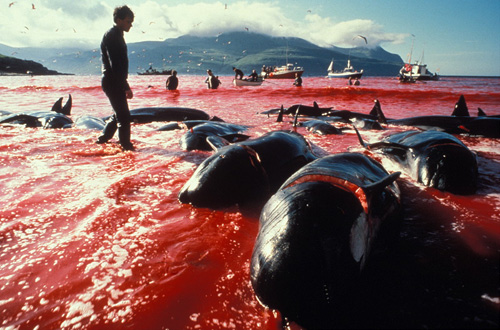
Every year, between September and April, the sea around the fishing village of Taiji on the east coast of Japan turns red as it becomes the scene of one of the biggest mass slaughters of marine wildlife in the world. The dolphin drive hunt, which recently made global headlines through the Oscar winning documentary 'The Cove', is responsible for capturing and killing over 2,000 dolphins of Japan's annual quota of 20,000. Fishermen drive the dolphins from sea into a cove, where some animals are selected for dolphinariums while the others are killed for their meat.

The Black Fish and other marine conservation and animal welfare organisations run ongoing campaigns to push for the closure of the remaining dolphinariums in Europe, where some of the dolphins caught at Taiji inevitably end up. Dolphinariums are already banned in United Kingdom. The Black Fish believes that it is unacceptable to keep dolphins, orca's and other marine wildlife in captivity, given the vast areas which these animals normally inhabit, the miserable and squalid conditions under which they are often kept and the stress that public performances put on them.

Co-founder of The Black Fish, Wietse van der Werf, explains about their decision to intervene: "The connection between the dolphin entertainment industry and this annual drive hunt can no longer be denied. To be successful in our campaigns in Europe we need to get to the root of this illegal trade, which is right at Taiji."

The Black Fish is aware of the sensitivity surrounding the hunt at Taiji this year. With an international media spotlight on the Japanese dolphin hunts, tensions within the country have heated up and Japanese nationalists have seized the opportunity to defend this 'traditional' activity. While we acknowledge that change also needs to come from within Japanese society, we vow to continue to work for the protection of these defenceless dolphins and push to make dolphinariums and the drive hunts which supply them history.

Monday, September 6, 2010

Unjust sentence for Japanese anti-whaling activists

Kumi Naidoo standing with the Tokyo Two
From Greenpeace.org
Junichi Sato and Toru Suzuki, known as the Tokyo Two, exposed widespread corruption in Japan's whaling programme – in return, they have been handed a one year suspended prison sentence. However, despite the harsh punishment the two anti-whaling activists stood in court as heroes today, having successfully put whaling on trial, both in court, and in Japan's national media.

Responding to the verdict Junichi said, "While the court acknowledged that there were questionable practices in the whaling industry, it did not recognise the right to expose these, as is guaranteed under international law. The International Covenant on Civil and Political Rights, on which our defence was based, supersedes domestic criminal law, but the judgment did not properly take this into account."

"This sentence is totally disproportionate and completely undeserved," added Toru. "We set out to reveal the truth about the government's whaling programme, but instead have been punished, while those behind the misuse of public money walk free."

Greenpeace is appealing this totally unjust, politically motivated sentence. Junichi and Toru have taken great personal risks to investigate and expose embezzlement at the heart of Japan's tax-funded whaling industry. They intercepted one of numerous boxes of whale meat embezzled from the whaling programme as evidence. These boxes were taken for private use by the crew of the Nisshin Maru in violation of the whaling programme's regulations, and this amounts to a misuse of public funds.

However, instead of investigating and arresting those behind the whale meat embezzlement scandal, Junichi and Toru were detained arbitrarily, forced to live under onerous bail conditions and put on trial. After more than two-years of political prosecution the court has convicted them of "theft" and "trespass", while the criminals behind the whale meat embezzlement walk free.

You can read key facts heard in the trial here.


"Activists are not criminals, and to treat them as such has a chilling effect in society, undermining the quality of democracy.
The freedom to peacefully expose wrongdoing is not only a crucial part of any democracy, it is a right that must be defended. Greenpeace will continue to make this case a global priority until this unjust conviction is overturned."
--Greenpeace International Executive Director, Dr. Kumi Naidoo
This conviction is a slap in the face for those that expose inconvenient truths and the misuse of public funds. It's bad news for the entire political culture in Japan, not least the role of non-governmental organizations in society; there is little doubt that the ruling signifies a major step backwards for the country’s aim of gaining international reliability. More broadly this conviction is part of a disturbing trend of authorities meeting peaceful and civil dissent with harsh and disproportionately severe punishments. Sentences such as the one that has been given to Junichi and Toru today create a chilling effect in society. They narrow the democratic space and discourage people from speaking out, with impacts for all of us.

Greenpeace activists are always prepared to take responsibility for their actions, and standing up in court for what we believe in is often a result of taking appropriate, peaceful action. However, it is unacceptable for the authorities to ignore human rights and freedom of expression.

Japan has already drawn criticism from the United Nations Working Group on Arbitrary Detention for its treatment of Junichi and Toru, and as Professor Dirk Voorhoof, an international law expert and defence witness in the case, said: "This conviction is very likely to earn Japan more criticism for its failure to respect its obligations under international human rights law."

Junichi and Toru are not alone in facing this verdict. Vigils are being held at Japanese embassies around the world and hundreds of thousands of people have already signed our petition calling for justice. In addition, the Toyo Two's case has already been taken up by Amnesty International, by Nobel Laureates including Archbishop Desmond Tutu, and by celebrities like Bryan Adams and Benicio Del Torro.

Greenpeace activists around the world demanded justice for the whales and the Tokyo Two, as their trial starts in Aomori. Greenpeace is putting whaling on trial.

Over the course of the Tokyo Two trial a lot has also happened to shift public perceptions in Japan. Industry whistleblowers have continued to speak with Japanese media about corruption and wrongdoing in the whaling industry, interest in the story keeps growing, and in the last fortnight alone articles in major newspapers such as Tokyo Shimbun and Kyodo have closely examined the issue. The headlines include "the trial of whale meat theft exposes horrifying realities" and "Scientific Whaling is diverting to illegal channels after all". Japanese journalists are also not just increasingly interested in what's going on in the tax-funded whaling programme, but in what the Tokyo Two trial has to say on the question of freedom of expression and non-governmental organizations' rights in their country.

"Activists are not criminals, and to treat them as such has a chilling effect in society, undermining the quality of democracy," said Greenpeace International Executive Director Dr. Kumi Naidoo, who travelled to Japan to hear the verdict. "The freedom to peacefully expose wrongdoing is not only a crucial part of any democracy, it is a right that must be defended. Greenpeace will continue to make this case a global priority until this unjust conviction is overturned."

We're standing with Junichi and Toru all the way and will make sure as many people as possible hear their story – and the positive impact their brave action is having.

Tuesday, August 24, 2010

China's 45 Billion Disposable Chopsticks Require 100 Acres of Forests Every 24 Hours

I never thought about it, but its so true! If you are going to IPS this year you may want to think about bringing your own chopsticks or buying a pair when you get to Japan as a great souvenir and to help reduce the waste disposable chopsticks cause. SCB gave away free chopsticks to all its participants at the 2008 and 2009 meetings, man do i love that organization, so forward thinking! (although a bit much, i bet if you get a set of these you are less likely to dispose of them at all) - MA


From treehugger.com
by MICHAEL GRAHAM RICHARD

That's a Lot of Chopsticks
Apparently China's Ministry of Commerce has had it with disposable chopsticks. It sent out a warning to chopstick makers in June to warn them that: "Production, circulation and recycling of disposable chopsticks should be more strictly supervised." The reason? With about 45 billion disposable chopstick pairs made every year in the country, or about 130 million a day, a lot of wood is being wasted, and that in a country that is trying to increase its forest coverage (from about 8% in 1949 to 12-13% today, compared to 30% for the USA).
Greenpeace China has estimated that to keep up with this demand, 100 acres of trees need to be felled every 24 hours. Think here of a forest larger than Tiananmen Square -- or 100 American football fields -- being sacrificed every day. That works out to roughly 16 million to 25 million felled trees a year. Deforestation is one of China's gravest environmental problems, leading to soil erosion, famine, flooding, carbon dioxide release, desertification and species extinction. (source)
If you compare 100 acres per day to the size of China's forests, it still isn't that much (it's a big country), but chopsticks are far from the only thing pressuring Chinese ecosystems. It's one more thing the country's forests could do without.

Sadly, change has been slow so far. The Bring Your Own Chopsticks movement has been gaining momentum, but is still far from succeeding in changing people's minds (or even being on most people's radar). But there is some hope on the horizon: As China grows richer, more restaurants will be able to afford the equipment to wash and sterilize reusable chopsticks.

Wednesday, June 23, 2010

success! Whaling Ban Stays! Pro-whalers Fail To Get Commercial Whaling Condoned

From the Whale and Dolphin Conservation Society (WDCS) webpage via the Africa Geographic facebook page

WDCS Press Statement:

Moratorium remains intact: Pro-whaling advocates fail to get commercial whaling condoned

two days of closed-door discussions delegates to the International Whaling Commission (IWC) were unable to reach consensus on a proposal (the 'deal') that would see the legitimization of commercial whaling. The moratorium (ban) still stands and Japan, Iceland and Norway continue to whale outside of the sanction of the IWC. It was clear that, despite many presentations by the pro-whaling advocates, the majority of nations were not convinced by the arguments that any whales being killed under commercial whaling was acceptable. Nations also rejected the view that quotas could be given whilst the moratorium still stood. It became obvious to delegates that the moratorium was fundamental to any allocation of quotas, be they in the thousands or the hundreds, or even tens. The Latin American countries and Australia were clear on their opposition to the proposed deal. After weeks of uncertainty, even the EU took a strong position and rejected the proposed version while continuing to still be willing to negotiate. It appears that the pro-deal advocates decided that it was too risky to push their proposal to a vote, and so risk it being publicly rejected in a devastating vote. WDCS anticipates there will be further discussions in the coming year, but we now call on the nations of the world to realize that the old world view of whaling is over.

"We now call on governments to work together to ensure the moratorium is implemented fully and effectively ending commercial, and so-called scientific whaling, which have no place in the 21st century. WDCS believes that the IWC has a strong future, but not one that legitimizes this cruel, unmanageable and unnecessary industry," says Nicolas Entrup, spokesperson of WDCS in Agadir. The 62nd meeting of the IWC whilst not taking forward the 'deal' will now look at a number of important agenda items. One important item still to be debated is the demand by Demark that Greenland should be allowed to expand its hunt to include 10 humpback whales per year.

Full briefings on the Greenland issue available from WDCS

Sunday, June 13, 2010

Dirty dirty dirty. Japan bribes nations to vote for whaling, UK sting operation catches them in the act!

" the killings have been justified as “scientific research” although whale meat is eaten in dishes such as sashimi" (above)
From the Sunday Times Insight Team
Flights, girls and cash buy Japan whaling votes

The official from the Republic of Guinea barely batted an eyelid when the English lobbyist made a highly irregular offer over coffee in a Barcelona hotel. She wanted to buy Guinea’s vote at the forthcoming International Whaling Commission (IWC) meeting with an aid package.

Rather than protest at this blatant bribery, Ibrahima Sory Sylla, the national director of fisheries for Guinea, got straight on the telephone to his deputy minister. “I spoke to him [the minister] positively about your bargaining,” he reported back over lunch later that day, “time is pressed ... for us to make our decision.”

This was not a guarantee of success. The lobbyist had a formidable rival: the fisheries agency of Japan, which for years has been Guinea’s ally on the IWC.

Sylla had already outlined the extent of Japan’s generosity to Guinea in terms of the cash it paid to his minister. He predicted Japan would make a good counter offer.
Related Links

Such backroom stitch-ups at the IWC have often been rumoured, but they have never before been captured on a video camera. The lobbyist was, in fact, an undercover reporter from the Sunday Times.

Our recordings of the meetings with pro-whaling officials around the world reveal the secrets of a Japanese vote-buying operation that Tokyo has always denied. It also raises serious questions about the credibility of the IWC.

It comes as Japan is attempting to break the 24-year moratorium on commercial whaling with a proposal to introduce fishing quotas at the IWC meeting in Agadir, Morocco, a week tomorrow.

Japan, Norway and Iceland have killed 35,000 whales since the moratorium was introduced. In Japan’s case, the killings have been justified as “scientific research” although whale meat is eaten in dishes such as sashimi.

If the Morocco proposal is successful, the whaling nations will be able to catch a total of 1,800 whales a year including two endangered species, fin and sei. Scientific whaling will be stopped but campaigners fear the new quotas may open the way for a return to the widespread whaling that almost destroyed some species in the 1980s. For Japan it is the culmination of a long campaign to win support for whaling by recruiting small impoverished nations on to the IWC.

Japan is believed to have the backing of at least 38 of the IWC’s 88 members, including three landlocked countries. It needs 75% of the vote but could be helped by disunity in the European Union whose predominantly anti-whaling countries may abstain if they cannot reach a unanimous agreement.

To find out about the secret deals which patch together Japan’s alliance of African, Asian, Pacific and Caribbean states, The Sunday Times approached the key ministers and fisheries officials from those countries in an undercover investigation. Two reporters posed as lobbyists who had been hired by Dr Hans Kruber, a fictional Swiss billionaire philanthropist who had created the European development fund for fisheries.

Our proposal was designed to mirror the alleged tactics of the Japanese. Government officials were told we were putting together a coalition of countries who would vote against whaling. They were each offered £25m in aid over 10 years from Kruber’s fund and all they had to do was vote against the whaling quotas at the Morocco meeting.

Six countries indicated they were willing to consider our offer and went away to discuss it with senior officials and ministers. They were St Kitts and Nevis, the Marshall Islands, Kiribati, Grenada, Ivory Coast and Guinea. Even more revealing were officials’ revelations about their relations with Japan.

Sylla, a veteran of his fisheries department, explained his country had little interest in whales but had been persuaded to become a member of the IWC by Japan 10 years ago.

He said Guinea voted with Japan partly because of fears that whales were consuming fish, a dubious argument that is promoted by Japanese scientists.

An equally important reason for his country’s support was financial. “Japan supports our position commercially,” he said. He was not just referring to the millions in fisheries aid that Japan has given Guinea over the years.

The reporters asked Sylla what other payments they would have to make to match the financial assistance offered by Japan. There were several.

Japan, Sylla revealed, pays Guinea’s £7,900 annual IWC membership fee as well as funding his country’s attendance at the meetings. Travel, hotels and meals were all paid for and each delegate receives up to $300 a day spending money. The average annual wage in Guinea is $1,000.

On the occasions that Guinea’s minister attends as the IWC commissioner, he or she is provided with a car by Japan and spending money. “Minimum, you understand minimum? Maybe one thousand [dollars] a day,” Sylla said.

The cash is handed over by Japanese officials at meetings in envelopes. Sylla said that at some meetings he was given the money for the minister.

Reporter: And then you give it to the minister?

Sylla: Yes. Not straight to the minister.

Reporter: Why not?

Sylla: You know, you know, the minister is a political man.

Reporter: So they don’t want it to seem like they are corrupting the minister.

Sylla: C’est ça. Exactly.

On Friday the Guinea fisheries ministry denied Japan had paid any money to its delegates and claimed Sylla was not involved in IWC matters. Sylla was briefly put on the phone to say he had made everything up.

However, a reporter who telephoned the ministry earlier to check Sylla’s credentials was told he attended IWC meetings and had recently been at preparatory talks for Morocco as a stand-in IWC commissioner.

Japan’s ministry of foreign affairs said: “The government of Japan does not cover any cost of any other IWC member countries related to the IWC.”

However, other countries appear to have deals with Japan. Michael Bootii, deputy director for the ministry of fisheries at Kiribati, a tiny Pacific island that always votes with Japan, was also at the meeting in Barcelona.

He agreed to meet the reporters for coffee after first checking with his minister. Bootii described the reporters’ offer to buy his country’s vote with aid as “attractive”.

He said his ministers would “weigh” the offer against the aid provided by Japan, which is building ice plants to store fish on each of Kiribati’s 33 islands. The decision appeared to have little to do with whaling and was all about money. “I think we will have to see what we get. At the end of the day it’s the benefit, yeah.”

When asked if his ministers would use the reporters’ offer as a bargaining counter with Japan, he replied: “That’s what will happen.”

He, too, confirmed that Japan pays for hotels, business class flights, subsistence and even a “transit allowance” for his country’s delegates at the IWC. They had already offered to pay for Kiribati’s IWC commissioner at Morocco.

Despite Japan’s denials, Bootii confirmed on Friday, after being confronted by The Sunday Times, that it did fund his delegation during IWC trips. “Assistance given to Kiribati by Japan are part of Japanese aid and ongoing support to Kiribati and this includes the cost of the trip to any overseas conference,” he wrote in an email. During the meeting he went further, stating that most of the Pacific islands IWC members were financed by the Japanese. In particular he named Tuvalu and the Marshall Islands.

The reporters had dined with Panapasi Nelsone, Tuvalu’s IWC commissioner, in London a few weeks earlier. Nelsone said his country’s pro-whaling stance had not been linked to the £10m a year it receives in aid fisheries from Japan. But when it came to paying for his IWC trips, he was quite clear: “If Japan wants us to vote on an issue similar to our position, like sustainable use, then why can’t they pay for me? ... If you want us to vote for you, you have to help me to attend that meeting.”

Doreen de Brum, the chief fishing policy adviser to the Marshall Islands, was the next official to meet the reporters. She seemed keen on taking up the reporters’ offer of aid to switch the vote.

Reporter: Do you think ... that would create a problem with Japan and maybe cease their funding?

De Brum: I don’t know, seriously, but I think that’s why we do have the position that we have. It is because of that aid.

Reporter: What, you support whaling because of the aid that Japan gives you?

De Brum: Yeah. We support Japan because of what they give us.

She went on say that the other Pacific islands also supported Japan’s whaling position because of the money they received. “Aid, the aid, that’s it,” she said.

After being told of The Sunday Times undercover investigation on Friday, she returned to the customary public line of the Pacific islands pro-whalers. “The Marshall Islands’ policy on whaling is not decided based on the aid Japan or any other country provides,” she wrote.

Another bloc of pro-whaling countries are the east Caribbean islands of St Kitts and Nevis, Grenada, St Lucia, St Vincent, Antigua, Barbuda and the Grenadines.

St Kitts and Nevis, one of the world’s smallest countries, has a population of 50,000. The former British colony depends heavily on aid as its sugar industry has collapsed.

Timothy Harris, the country’s marine resources minister who is also its IWC commissioner, was only too keen to discuss the undercover reporters’ proposal. The first meeting took place in the cramped government offices in Basseterre, the island’s capital. With a senior civil servant taking notes, Harris explained that Japan provided finance for a number of fish-related infrastructure projects and was paying for a new fish market in Nevis. He promised to raise the reporters’ offer to buy St Kitts’s vote with the cabinet but added there might be concern that Japan could pull the plug on its aid if St Kitts switched sides.

Harris: “Right now we are working on a project for a new complex ... so if you were to do something, we’d want to ensure that is not jeopardised.

Reporter: Not jeopardised. Why?

Harris: It’s being funded by Japan.

Shortly after the meeting, Harris rang the reporters and invited them to lunch. Over conch balls in a restaurant overlooking the beach, he was far more candid. In front of his civil servant earlier he had taken the customary Japanese line that whales were eating “significant proportions” of St Kitts’s fish stocks. Now he admitted this was unlikely: “I’m not sure that we have whales, or at least many.”

The St Kitts interest in the whaling issue was “minimal” but it participated in the IWC because it could have “direct benefits” and also out of solidarity for St Vincent which still allows a small amount of indigenous whaling.

Harris said he had been selected to speak on behalf of his fellow east Caribbeans at a crucial meeting in Grenada last month with Japan’s IWC commissioner and ambassador. He said the islands were angry because they were suffering “reputational damage” by supporting Japan’s pro-whaling stance. Harris was asked to argue that the Japanese should come up with a proposal for compensation ahead of the Morocco vote. The islands wanted Japan to fund wider development projects rather than just fisheries.

Reporter: And were they [the islands] threatening not to support Japan in the IWC vote?

Harris: No, they didn’t put it as that, because I don’t think it might have been diplomatic to say. But if you say to a country or some partner this is matter that is important to me ... and they consistently refuse to help you, then they are leaving you with no choice.

Harris had promised to debate the reporters’ proposal in cabinet and was planning to stop off in London this week to discuss the offer further.

Similarly, Grenada was last week considering the reporters’ offer following a meeting with Michael Lett, fisheries minister and IWC commissioner, and Daniel Lewis, the chief agriculture officer. Later Lewis wrote in an email: “I am glad that your coalition has considered Grenada as a potential recipient of the aid offer.”

In Africa, the Ivory Coast appeared to be interested in the reporters’ offer and was mulling it over last week.

Seydou Coulibaly, Mali’s fisheries minister, was not as keen because he said that whales were threatening his country’s food supplies by eating so many fish. Quite how this could be so is a mystery: Mali is landlocked.

There was little question that Tanzania would change its traditional loyalty to Japan. Over dinner in Barcelona, Geoffrey Nanyaro, its IWC commissioner, explained that five of the seven key people in his fisheries department spoke Japanese because they were educated there. He said Japan paid fisheries officials £22,000 a year in tuition fees and living costs while they studied there. In addition, he said Japan had given his country £80m in fisheries aid in the past two years.

Nanyaro said aid given to Tanzania was not linked to the whaling vote, but he feared the country might lose the funding if it voted against the Japanese. However, he believed other African pro-whaling countries were more directly influenced. Reporter: What do the Japanese do for them [the other African countries] that keeps them in their pockets?

Nanyaro: It is aid.

He said that Japan “secretively” paid the tickets and hotels for the IWC delegates from different countries. They were also, he claimed, taken on all-expenses-paid visits to Japan where “good girls” would be available. He always turned them down.

Reporter: So you think the other countries’ representatives are set up with prostitutes from Japan?

Nanyaro: Yes, you know, yeah ... It starts by saying: do you want massaging? ... It’s going to be free massaging. Are you not lonely? You don’t want any comfort?”

Pro-whaling nations have perpetuated myths to justify their killing:

Whales eat too many fish: Some scientists say whales reduce fish stocks, leaving less for humans. Japan has even suggested that whales consume six times the world’s commercial fish catch.

Other researchers say this is nonsense. The seas were teeming with both fish and whales for millennia — until humans came along. The key change was the arrival of steam power, which allowed trawlers to plunder the oceans.

Whaling is humane: Whalers say they use explosive harpoons to kill the animals “quickly”, but the International Whaling Commission estimates that death takes an average of 14 minutes if harpooned accurately — and potentially hours if not.

Whales that do not die immediately are supposed to be shot with rifles. However, Greenpeace campaigners who have witnessed such incidents say some creatures are dragged backwards until they drown.

Whaling has a cultural heritage: Japan, Norway and Iceland have a long history of small-scale coastal whaling (as did Britain), but this is a far cry from the modern industrialised version. A Greenpeace-commissioned opinion poll in 2006 found that 69% of Japan’s population was against whaling and only 5% ate whale meat.

Friday, May 28, 2010

Double-post: Genetic evidence of illegal whaling linking US, Korea and Japan & Australia takes Japan to court over whaling

Dr. C Scott Baker has many amazing publications on using genetics to identify corruption in the reporting of whales and whale bycatch, his most recent is below but there are many more here (one of my most favorite conservation genetics papers ever), here, here and here -MA

Genetic evidence of illegal trade in protected whales links Japan with the US and South Korea

Baker CS, Steel D, Choi Y, Lee H, Kim KS, Choi SK, Ma Y-U, Hamleton C, Psihoyos L, Brownell RL, Funahashi N (2010) Genetic evidence of illegal trade in protected whales links Japan with the US and South Korea. Biology letters doi: 10.1098/rsbl.2010.0239

Abstract
We report on genetic identification of ‘whale meat’ purchased in sushi restaurants in Los Angeles, CA (USA) in October 2009 and in Seoul, South Korea in June and September 2009. Phylogenetic analyses of mtDNA cytochrome b sequences confirmed that the products included three species of whale currently killed in the controversial scientific whaling programme of Japan, but which are protected from international trade: the fin, sei and Antarctic minke. The DNA profile of the fin whale sold in Seoul established a match to products purchased previously in Japan in September 2007, confirming unauthorized trade between these two countries. Following species identification, these products were handed over to the appropriate national or local authorities for further investigation. The illegal trade of products from protected species of whales, presumably taken under a national permit for scientific research, is a timely reminder of the need for independent, transparent and robust monitoring of any future whaling.

----
From Sign on San Diego
Australia takes Japan to court over whaling
By ROD McGUIRK, Associated Press
(Kristen Gelineau in Sydney and Malcolm J. Foster in Tokyo contributed to this report)

Australia said Friday it will challenge Japan's whale hunting in the Antarctic at the International Court of Justice, a major legal escalation in its campaign to ban the practice despite Tokyo's insistence on the right to so-called scientific whaling.

Japan's Foreign Ministry called the action regrettable at a time when 88 member-nations of the International Whaling Commission were discussing a proposal that could allow some limited whaling for the first time in 25 years.

"We will continue to explain that the scientific whaling that we are conducting is lawful in accordance with Article 8 of the international convention for the regulation of whaling," said Japan's Foreign Ministry Deputy Press Secretary Hidenobu Sobashima. "If it goes to the court, we are prepared to explain that."

Japan, Norway and Iceland, which harpoon around 2,000 whales annually, argue that many species are abundant enough to continue hunting them. They are backed by around half of the whaling commission's members.

Australia has declared the southern seas a whale sanctuary and has long lobbied for an end to whaling there. The government says Japan's hunt is in breach of international obligations, but has declined to release any details of how it will argue its case before the court in The Hague.

The whaling commission has proposed a plan that would allow hunting without specifying whether it is for commercial or other purposes - but under strict quotas that are lower than the current number of hunted whales.

Commission Chairman Cristian Maquieira expressed optimism Thursday in Washington that the issue could be resolved at a meeting next month in Morocco. But senior U.S. official Monica Medina said the current proposal would allow the hunting of too many whales, signaling difficult negotiations ahead.

Australia could argue that Japan is abusing its rights under the whaling commission's 1946 Convention, which allows scientific whaling, said Don Anton, an international law professor at The Australian National University in Canberra. It could claim that the number of whales Japan kills each year is far more than necessary, that nonlethal research alternatives exist and that there is a commercial aspect to the scientific program.

Australia could also argue that Japan has failed to conduct an adequate environmental impact assessment before engaging in whaling, Anton said.

A panel of lawyers and conservationists reported to the Australian and New Zealand governments last year that Japanese whaling in the Antarctic could be stopped if Japan were held accountable for dumping waste and for undertaking hazardous refueling at sea. The Canberra Panel claims that activity violates the 46-member Antarctic Treaty System, to which Japan belongs.

Australia will lodge its claim with the court next week. It is likely then to seek an international injunction to stop any Japanese whaling during the 2010-2011 whaling season, said Don Rothwell, an international law professor at ANU who chaired the Canberra Panel. An injunction ruling could take three to six months, and it could be another four to seven years before the case is settled, he said.

New Zealand Foreign Minister Murray McCully said his government will decide within weeks whether it will also file a case against Japan.

Sobashima and Australian Foreign Minister Stephen Smith said the dispute should not jeopardize the countries' overall good relations, with both governments treating the matter as an independent legal arbitration.

Australia's move also fulfills a 2007 campaign promise by Prime Minister Kevin Rudd's center-left Labor Party.

Friday, April 30, 2010

Dr. Matsuzawa spearheads reforestation project between Bossou and Nimba Mountains (Guinea)

from USAtoday.com
Scientists building Green Corridor to connect fading chimps colony to nearby mountains
By Elizabeth Weise

The chimpanzees in the Bossou, Guinea community described in today's article face dangers other than simple respiratory epidemics -- though the one that killed the two infants described in a paper in this week's edition of the journal Current Biology did wipe out five of them, more than a quarter of the population.

Dora Biro, one of the Oxford University zoologists who does field work watching the group, says their concern is that it is so small that the group will eventually die out. There are only 13 chimpanzees in the community today, she says.

Their numbers are so small because "the core range of this community consists of three hills and everywhere around it is savanna." Chimps don't like to cross open savanna, so they're effectively penned in on their little 'island' of trees.

But just three and a half miles away is "a huge mountain range full of chimpanzees." Chimps naturally move out of their birth group and into others as they mature, so it would be normal for the Bossou group to continually get an influx of new members from other troupes. But the distance, and the danger, is too great.

However, the Japanese team of biologists who originally established the observation site have now begun to plant a corridor of trees across the savanna to try to connect the Bossou 'island' of hills to the nearby Nimba mountain range where the other chimpanzees live.

"The trees still need to grow before they're at all passable for chimps," says Biro. "The idea is if this corridor does work, if the trees survive, it will give chimps access both in and out, and that could save the community."

It's called The Green Corridor Project and it's being spearheaded by Tetsuro Matsuzawa, who helped establish the site.

For more information visit GreenPassage.org

Friday, March 19, 2010

World votes to continue trading in species on verge of extinction

From the Times Online
by Ben Webster and Frank Pope

Their sheer size and strength have made them among the most celebrated of endangered species, yet they have all been betrayed — by vested interests at a UN meeting on wildlife protection.

Proposals to ban trade in bluefin tuna and polar bears were overwhelmingly rejected yesterday at the Convention on International Trade in Endangered Species (Cites), meeting in Doha, Qatar.

A plan for a 20-year ban on ivory sales, to protect African elephants, is also likely to fail in the coming days — partly because Britain and other members of the EU are refusing to support it. Delegates are instead expected to approve a weak compromise, which would encourage poaching by allowing the sale of ivory being stored by several African nations.

Feelings were running high yesterday about the failure of measures to protect endangered tuna. Only 20 of the 120 countries at the meeting voted to ban trade in the bluefin. Intensive lobbying by Japan, which consumes 80 per cent of Atlantic and Mediterranean bluefin, meant that a snap vote was held before any debate on scientific reports that show a catastrophic decline in the largest of the tuna family.

Campaigners reacted with dismay. Oliver Knowles, of Greenpeace, said: “It is an own goal by Japan. By pushing for a few more years of this luxury product it has put the future of bluefin, and the future of its own supply, at serious risk. The abject failure of governments here at Cites to protect Atlantic bluefin tuna spells disaster for its future, and sets the species on a pathway to extinction.”

France, Italy and Spain catch most of the tuna consumed by the global market. In 2009 a quota of 19,950 tonnes of tuna was set by the International Commission for the Conservation of Atlantic Tunas, but many fish are caught live in nets, transferred to farms and fattened before slaughter.

Susan Lieberman, director of international policy for the Pew Environment Group, said: “The market for this fish is just too lucrative and the pressure from fishing interests too great for enough governments to support a truly sustainable future for the fish.”

The Cites process, which requires a two-thirds majority for a proposal to be adopted, is vulnerable to well-funded lobbying by countries and industries that depend on trade in a species. The vested interests exploit uncertainties in the estimates of population numbers, and strike backroom deals to secure the votes of developing countries where endangered species are far down the list of political priorities.

A US proposal to protect polar bears fell victim to arguments put forward by Inuit groups that their livelihoods depended on hunting the animals. The vote on protecting elephants is due on Monday, and is viewed by wildlife groups as the last opportunity to protect many of Africa’s most threatened herds.

The few remaining elephants in Sierra Leone were killed in October by poachers serving the thriving black market in ivory, which fetches up to $1,500 (£980) a kilo in the Far East. In the Zakouma National Park in Chad, poaching has cut the population from 3,885 in 2006 to only 617 last year. The number of elephants lost to poaching in Kenya has quadrupled in the past two years. Kenya is one of seven African nations proposing a 20-year moratorium on sales of stockpiled ivory.

International trade in ivory was banned in 1989, but since then Cites has agreed several “one-off sales” of stockpiled ivory on condition that the proceeds were spent on elephant conservation. Britain supported a one-off sale of 105 tonnes in 2008, arguing that it would reduce poaching by satisfying demand. But Kenya says that the one-off sales have expanded the market in China and Japan for ivory ornaments, and that this in turn has encouraged poaching.

Asian-run crime syndicates are able to pass off illegal ivory as coming from stockpiles sold with Cites approval.

Tanzania and Zambia want to sell 112 tonnes of ivory, and have submitted proposals that would allow the sale to take place by reducing their elephants’ level of protection under Cites trade rules.

Britain will join the rest of the EU in voting against Kenya’s proposal. The Department for Environment, Food and Rural Affairs said it was still considering whether to support a lowering of the Cites protection for Tanzanian and Zambian elephants.

Robbie Marsland, UK Director of the International Fund for Animal Welfare, said: “We are disappointed that the UK Government, and European Union member countries as a whole, have not gone into this meeting with a much stronger message against the ivory trade and in favour of elephant protection.

“This leaves the door open to future trade, which would result in further illegal poaching.”

Nick Herbert, the Shadow Environment Secretary, said the Government should be pressing for the destruction of stockpiles of ivory. “No one proposes stockpiling seized drugs or weapons to sell for profit, and ivory should be treated in just the same way. Instead of flooding the market with more ivory and legitimising the trade these stockpiles should be destroyed. We should be choking demand for ivory, not stoking it.”

A Defra spokesman said: “The UK will not consider other sales of ivory until the effects of last year’s one-off sale of ivory, intended to reduce demand for illegal poached ivory, have been fully analysed. This will take at least a further six years.”

A report last week by an international team of 27 scientists and conservationists concluded that previous one-off sales had contributed to a rise in poaching and failed to deliver the promised conservation benefits, resulting in “only short-term profitability to the few individuals who ran the scheme”.

Thanks to Cleve H for the link

Monday, November 23, 2009

Grandmother monkeys care for baby


a+b) Grandmother GM1 retrieves her granddaughter GD1 then lets her suckle:
c) GMI then grooms her returning daughter who reunites with her own infant

From BBC Earth News
By Matt Walker

Two grandmother monkeys have been seen intervening to raise their own grandchildren, providing essential care including suckling the young.The scientists who witnessed the behaviour say it is the first unambiguous example of such behaviour shown by a non-human primate.The observations were made in a free-ranging group of Japanese macaques living in Katsuyama, Japan. Details of the grandmothers' actions are published in the journal Primates.

The same group of wild, free-ranging Japanese macaques ( Macaca fuscata ) have been studied since 1958, so scientists have kept a record of the birth date and blood relationships of each individual. One scientist, Dr Masayuki Nakamichi at Osaka University in Japan, has been studying the animals' social interactions for 30 years.

However, the behaviour of two macaque grandmothers surprised even him.

"We know that some monkeys... sometimes adopt infants. In most cases, it is females who have lost their own infants," Dr Nakamichi says. "However, in the present cases, the old, probably post-reproductive mothers started to take care of their young granddaughters. "It is very unusual for females who have not had their own young offspring for years to start to take care of other infants."

Dr Nakamichi and colleagues at Osaka University first observed a monkey known to them as GM1, a 24-year-old female macaque, looking after her granddaughter GD1.The infant GD1 was the offspring of GM1's own daughter, known as M1.GM1 started looking after GD1 just 20 days after her birth. And she intervened even more when the infant's mother M1 unexpectedly went missing from the troop. Then the grandmother held, groomed, carried and retrieved the abandoned and now two-month-old infant, even placing her nipples in the infant's mouth. The grandmother looked after her granddaughter in this way for at least six days, before the mother returned and gradually resumed her role.

The second case involved a 23-year-old monkey dubbed GM2, who looked after her 14-month old granddaughter, GD2. In this case, the mother, M2, was busy nursing a second, younger infant. So the grandmother stepped in, allowing her granddaughter to take her nipple on numerous occasions. She was observed still looking after her granddaughter in this way 5 months later.

In both examples, the researchers believe the grandmothers were providing essential care. Without the intervention of GM1, the scientists say her granddaughter would have died within two weeks. Because GM1 had not had offspring for six years, she would not have been able to provide milk for the infant, but her actions would have protected her and kept her warm. The second grandmother, GM2, did likely provide her granddaughter with nutritious milk, as the infant was seen actively suckling. It is likely that the repeated suckling by the granddaughter over a few weeks induced her to begin producing milk again.

The behaviour of the two elder monkeys offers support to an idea called the 'grandmother hypothesis'. "It is an idea that post-reproductive grandmothers can play an important role in the survival of their grandchildren, although they cannot produce their own offspring," explains Dr Nakamichi. By doing so, he says, females can improve the chances that their own genes will be passed on down the generations.
The idea helps explain why mammals such as monkeys can live well beyond reproductive age, as by doing so, they can continue to promote the survival of their relations.

However, definitive evidence for the hypothesis has been difficult to obtain. Numerous studies have shown that monkeys such as vervets, Japanese macaques and langurs will form close relationships with their grandchildren, investing time in them and occasionally helping to protect them. Yet other studies on Japanese macaques, baboons and titi monkeys, for example, do not show that the presence of grandparents improves an infant's survival.

In other social mammals such as elephants, grandmothers may also occasionally help out with grandchildren. But usually the grandmother has more offspring of her own, and does not provide essential, life-saving care.

"To our knowledge, there have been no reported cases in which, instead of a mother, a grandmother without dependant offspring has continuously provided essential care for the survival of her dependant grandchild, which is in accordance with the grandmother hypothesis," Dr Nakamichi and colleagues write in the journal Primates.

Story from BBC NEWS:
http://news.bbc.co.uk/go/pr/fr/-/earth/hi/earth_news/newsid_8370000/8370743.stm

Citation: Nakamichi M, Onishi K, Yamada K (2009) Old grandmothers provide essential care to their young granddaughters in a free-ranging group of Japanese monkeys (Macaca fuscata). Primates DOI 10.1007/s10329-009-0177-7