Thanks to Jim F for the link
go HERE to sign the petition
Target: Division of Policy and Directives - U.S. Fish and Wildlife Services
Sponsored by: Center for Biological Diversity
Please speak up to protect chimpanzees who can't defend themselves. The worldwide population of wild chimpanzees has fallen by nearly 70 percent in the past 30 years -- take action now to save these animals.
Wild chimpanzees have been protected under the Endangered Species Act since 1976, but a special rule exempts captive chimpanzees from protection. This loophole in the Act is preventing the recovery of the species in the wild by encouraging their illegal trade.
Chimpanzees are endangered due to habitat loss, poaching and illegal trafficking -- wild chimpanzees are captured and sold for use as entertainment, as pets and as test subjects.
We have a critical moment right now to help captive and wild chimpanzees: The U.S. Fish and Wildlife Service is considering whether to protect captive chimpanzees under the Endangered Species Act. Send your comments today in support of protecting every chimpanzee as endangered.
Showing posts with label animal rights. Show all posts
Showing posts with label animal rights. Show all posts
Friday, March 16, 2012
Tuesday, January 10, 2012
Decade-long 'Great Chimp Migration' to St. Lucie County complete

Congratulations to Save the Chimps!!! Jen et al. all of your incredible work has paid off, I wish you all the best!!!-MA
from tcpalm.com
by Alexi Howk
If chimps had a history book, Dec. 15 would be an important mark in it, said Save the Chimps Sanctuary Director Jen Feuerstein.
It's a landmark day for some chimps who got to touch grass for the first time and one that also culminated the decade-long "Great Chimpanzee Migration."
The migration came to a close last week as the last 10 of 266 total chimps were relocated from a former biomedical research lab in Alamogordo, N.M., to the Save the Chimps' 150-acre sanctuary in Fort Pierce.
CNN's Miami correspondent, John Zarrella, and camera crew joined Save the Chimps in New Mexico to film the entire migration from start to finish. The event will be featured on the network's "CNN Presents" sometime next year, Feuerstein said.
"There were a lot of tears when we departed the former lab in New Mexico for the last time, a mixture of happy and sad tears," Feuerstein said. "I'd say it was a bit like sending your kids off to college."
The chimps were transported to the Florida sanctuary in a custom-made trailer. As a cross-country tradition, each chimp gets treated to french fries and a window seat.
The two-day journey began Dec. 12. The new residents arrived at the sanctuary on Dec. 14 and were released the next day onto an island and introduced to their new outdoor freedom.
"None of these chimps had ever been outside of a cage before, and they hadn't ever seen grass, never mind touched it," Feuerstein said. "But every single one of them courageously went out the door, even though they had no inkling of what could be waiting for them on the other side. They were pretty quiet for teenage and twenty-something chimps and seemed a bit mystified by it all."
Dubbed by the organization as the largest chimpanzee sanctuary in the world, Save the Chimps provides permanent residence for chimps used by the research, entertainment and pet-trade industries.
The sanctuary, founded in 1997 by the late Dr. Carole Noon, is equipped with 12 man-made islands that connect to hurricane-proof housing units for the animals. Because chimps can't swim, each island is surrounded by moats of water to prevent the primates from escaping.
Many of the chimps at the sanctuary spent their entire lives in small, concrete cages unable to socialize with other primates or experience the outdoors. Many of them still carry the emotional scars of having painful experiments conducted on them.
Most of the chimps come from the Coulston Foundation, a research lab repeatedly cited for abusing and neglecting its primates. The lab closed in 2002 amid financial problems. Save the Chimps later won custody of the chimps and acquired and spruced up the property. The organization has cared for the chimps on site until they could be relocated to Florida.
"The caregivers there are so devoted and will miss the chimps deeply, but they are also overjoyed that the cages there are finally empty," Feuerstein said of the New Mexico facility. "There were also a lot of tears as we thought about Dr. Noon, wishing she was there to close the gate for the last time. This was her dream. But we all felt that she was there in spirit, and we are proud (to) have made her dream come true."
SUCCESS! Panel Finds That Nearly All Invasive Chimp Research is Unnecessary; NIH Agrees
 From Discover magazine
After seven months of deliberation, the US Institute of Medicine has released a report that marks a turning point in the use of chimpanzees, humanity’s closest relative, in medical research. An IOM panel found that chimpanzees were in the vast majority of cases no longer required for disease research and laid out three stringent rules against which all current and future chimp research should be judged. Within two hours, Francis Collins, the head of the National Institutes of Health, announced he had accepted the group’s analysis and would set up a committee to apply the rules to proposed and ongoing research projects funded by the NIH.
The recommendation is a reflection of our growing realization that chimps may be capable of self-awareness, empathy, grief, and happiness, and may possess basic morality as well as a culture; Brandon Keim, who has covered chimp research extensively for Wired, notes that some scientists have begun to think they should qualify as nonhuman people. Subjecting them to disease, pain, and psychological trauma in the service of research thus has grown to seem ethically dubious, especially after it was revealed that the NIH planned to send 209 chimps who had been allowed to retire from medical research back into the lab and that an NIH division had illegally bred captive chimpanzees. At the same time, scientists’ increasing skill with using cells in Petri dishes and cheaper, less ethically daunting lab animals like mice in experiments with potential drugs have meant that there are today relatively few research projects for which chimpanzees are the best option. The only projects that the committee believed might have potential need for chimpanzees are those researching vaccines for hepatitis C and a few current projects looking at certain types of antibodies.
Accordingly, the IOM has recommended that the NIH approve chimps as research subjects only in cases when no other suitable model is available, when the experiment cannot be performed ethically in humans, and when important progress will be significantly delayed or stopped altogether without the use of chimps. Noninvasive behavioral research in which chimps live in near-natural conditions and comparative genomics work, which usually just requires a blood sample, are not prohibited but will need to meet another set of conditions under the committee’s recommendations. All future chimp research projects submitted for funding to the NIH will be assessed according to these criteria, and current publicly funded projects that use chimps, which number roughly 37, will also be reviewed to make sure that they meet the guidelines. Collins told Nature News that he believes about 50% will wash out under the new rules.
--
The official Statement by NIH Director Dr. Francis Collins on the Institute of Medicine report addressing the scientific need for the use of chimpanzees in research:
The use of animals in research has enabled scientists to identify new ways to treat illness, extend life, and improve health and well-being. Chimpanzees are our closest relatives in the animal kingdom, providing exceptional insights into human biology and the need for special consideration and respect. While used very selectively and in limited numbers for medical research, chimpanzees have served an important role in advancing human health in the past. However, new methods and technologies developed by the biomedical community have provided alternatives to the use of chimpanzees in several areas of research.
In December 2010, the National Institutes of Health commissioned a study by the Institute of Medicine to assess whether chimpanzees are or will be necessary for biomedical and behavioral research. The IOM now has issued its findings, with a primary recommendation that the use of chimpanzees in research be guided by a set of principles and criteria. The committee proposed three principles to analyze current and potential future research using chimpanzees.
That the knowledge gained must be necessary to advance the public’s health;
There must be no other research model by which the knowledge could be obtained, and the research cannot be ethically performed on human subjects; and
The animals used in the proposed research must be maintained either in ethologically appropriate physical and social environments (i.e., as would occur in their natural environment) or in natural habitats.
Based on its deliberations, the IOM committee concluded that “while the chimpanzee has been a valuable animal model in past research, most current use of chimpanzees for biomedical research is unnecessary.” The committee also concluded, however, that the following areas may continue to require the use of chimpanzees: some ongoing research on monoclonal antibody therapies, research on comparative genomics, and non-invasive studies of social and behavioral factors that affect the development, prevention, or treatment of disease. The committee was unable to reach consensus on the necessity of the chimpanzee for the development of prophylactic hepatitis C virus vaccine. While the committee encouraged NIH to continue development of non-chimpanzee models and technologies, it acknowledged that new, emerging, or re-emerging diseases may present challenges that may require the use of chimpanzees.
I have considered the report carefully and have decided to accept the IOM committee recommendations. NIH is in the process of developing a complete plan for implementation of the IOM’s guiding principles and criteria. I will be assembling a working group within the NIH Council of Councils to provide advice on the implementation of the recommendations, and to consider the size and placement of the active and inactive populations of NIH-owned or -supported chimpanzees. We will not issue any new awards for research involving chimpanzees until processes for implementing the recommendations are in place.
NIH is committed to conducting and supporting high-quality science in the interest of advancing public health, and to the humane care and use of animals used in NIH research. I am grateful to the IOM for their careful and thoughtful assessment of this important and sensitive topic.
Friday, December 2, 2011
Former Lab Beagles See the Sun for the First Time
Beagle Freedom Project - Second Rescue - June 8, 2011 from João Allex on Vimeo.
By TERRI POUS
from Time
Dog videos never fail to conjure up some sort of emotion. And this one really brings the waterworks. The above footage shows male beagles that were rescued from a California university animal testing lab seeing sunlight and stepping on grass for the first time.
The rescue mission, which happened in June, was recently followed by a much larger one from a lab in Spain. The group that undertook the cause, Animal Rescue Media Education (ARME), rescued a total of 72 dogs in the most recent effort, 32 of them having already been adopted in Europe, according to NBC Los Angeles.
ARME’s Beagle Freedom Project spokesman Gary Smith told the station that the beagles, all between ages 4 and 7, had lived in cages their entire lives.
Unfortunately, beagles’ notoriously obedient dispositions makes them ideal for experimentation. According to the Beagle Freedom Project’s website, they are the breed of choice for lab testing of pharmaceutical, household, and cosmetic products due to their ability to adapt to life in a cage and the fact that they are relatively inexpensive to feed.
When the beagles are no longer needed for research, some labs contact organizations such as ARME, who then work to find good homes for the dogs.
This heartbreaking video was filmed back in June, when the organization brought nine beagles to Los Angeles to get a second chance at life. We dare you not to be moved by that first beagle’s initial tentative steps and soulful eyes.
ARME is a non-profit advocacy group and 501(c)(3) organization funded by tax-deductible contributions. Information on how to make a donation or adopt a beagle is available on the organization’s website.
facebook: https://www.facebook.com/BeagleFreedomProject
homepage: http://www.beaglefreedomproject.org/
Saturday, November 19, 2011
Willie Nelson cold play cover for sustainable agriculture - Back to the start
Thanks to David H for the link (I am even going to steal his comment on his post "Wow, go to love that.....Willie covers Coldplay and on a nice vid from Chipotle about sustainable agriculture.")
Tuesday, October 4, 2011
Did our love of animals propel human social evolution?

Thanks to Geraldine F for the link.
I am not buying this hook, line and sinker but you know I love a just-so story that gets the imagination going. Also its inaccurate to state only humans keep pets, check out:
- non-human animals that keep pets (aka interspecies cuddling)
- Baboons kidnap and raise feral dogs as pets
- monkey adopts kitten in Bali
- baboon adopts bush baby at kenyan sanctuary
---
From the Guardian.com
by ROBIN MCKIE
Love of animals led to language and man's domination of Earth
When our apemen ancestors began to interact with animals they developed empathy and the ability to communicate, claims anthropologist Pat Shipman
Humans became masters of the planet for a startling reason: our love of animals gave us unsurpassed power over nature. This is the claim of a leading American anthropologist who says our prehistoric ancestors' intense relationships with other creatures – including those we hunt, keep as pets and use for food – propelled humanity towards global domination.
Interacting with animals on an intimate basis led humans to develop sophisticated tools and evolve enhanced communication skills, including language itself, Dr Pat Shipman of Pennsylvania State University told the Observer. Animals also taught us that others – even other species – have emotions, needs and thoughts, while they also helped us to evolve the vital skills of empathy, understanding and compromise.
"The longest and enduring trend in human evolution has been a gradual intensification of our involvement with animals," she added. "But now our world is becoming increasingly urbanised and we are having less and less contact with them. The consequences are potentially catastrophic."
Shipman traces humanity's animal connection to the period 2.5 million years ago when our hominid ancestors first made tools. These crafted pieces of stone still litter sites in eastern Africa, including the Olduvai Gorge in Kenya, and bear testimony to the mental transformation in our ancestors' brains.
"These apemen didn't just pick up stones and use them to hammer or pound prey or plants," said Shipman. "They shaped those rocks for specific purposes. They had a mental image of the kind of tools they needed and created them by chipping away at a large piece of stone until they got what they wanted."
And what they wanted were tools for cutting up carcasses. In other words, the sharp stone flakes spread over Olduvai were not used primarily as weapons to kill animals or to hack down plants, but to process dead animals that had already been brought down by other carnivores. Apemen had begun to scavenge for meat from carcasses of prey killed by leopards, cheetahs and other carnivores. Armed with sharp blades, they could cut off chunks of antelope or deer and escape quickly before being eaten themselves by an enraged lion, they discovered.
And that was the crucial point that began our special relationship with the animal kingdom, said Shipman, whose book, The Animal Connection, is published this week. "Until that point, we had been a prey species. Carnivores ate us. Then we began scavenging before going on to hunt on our own behalf. Meat provided our ancestors with a wonderful, rich source of sustenance. However, scavenging for it left us in a very vulnerable position. We were still just as likely to be consumed when confronted by a carnivore as we were to kill in our own right. To survive, we had to learn about the behaviour of a vast number of different species – the ones we wanted to kill and the ones we wanted to avoid.
"For example, we would have learned to spot when lions were preparing to mate – when a male was showing off to a female – so that we could take some its prey while it was otherwise occupied. We would have also built up knowledge about the migration of species such as wildebeest and other animals."
In the end, this expertise would have become crucial to human survival, a point illustrated in the cave paintings in Lascaux and Chauvet in France and the other caves painted by humans 20,000 to 30,000 years ago. They show us that after 2 million years of evolution, humans had become utterly fixated by animals.
"These paintings are stunningly beautiful and superbly crafted," said Shipman. "Sometimes scaffolding was erected in the caves. At the same time, artists went to enormous lengths to get their pigments mixed with the right binding agents and placed in exactly the right spot. And what did they depict when they got things just right? Animals, animals and more animals.
"There are no landscapes and only a handful of poorly executed depictions of humans. By contrast the paintings of lions, stags, horses, bulls and the rest are magnificent. We were besotted with animals because our lives depended on our relationships with them."
Not long after these paintings were created, the first animal – the dog – was domesticated, followed some time later by the horse, sheep, goat and others. The development was crucial. In each case, humans had to learn to put themselves in the minds of these creatures in order to get them to do our bidding. In this way our senses of empathy and understanding, both with animals and with members of own species, were enhanced.
Our special relationship with animals is revealed today through our desire to have pets. "Humans are the only species on Earth to have one-to-one relationships with a member of another species," said Shipman. "No other creature would waste resources on a member of another family, let alone a member of another species. But we do and that is because we have evolved such close ties with specific animals over the millennia and because we are adapted to empathise with other creatures. It is a unique human attribute. We get so much from animals, much more than we appreciate."
Unfortunately, as society becomes increasingly urbanised those ties are being stretched and broken, added Shipman. "Our links to the animal world are precious and shouldn't be taken for granted," she said.
1 comments

 Labels:
animal rights,
cognition,
dogs,
empathy,
homo,
love,
pets,
society,
vegetarianism
Labels:
animal rights,
cognition,
dogs,
empathy,
homo,
love,
pets,
society,
vegetarianism
 Labels:
animal rights,
cognition,
dogs,
empathy,
homo,
love,
pets,
society,
vegetarianism
Labels:
animal rights,
cognition,
dogs,
empathy,
homo,
love,
pets,
society,
vegetarianism
Saturday, September 24, 2011
Great Op-Ed: Apes and Anthropomorphism

from NPR
by BARBARA J KING
Autumn begins tomorrow. Suffused already with a seasonal nostalgia, I'm replaying scenes of summer in my head. Among them is sitting in a dark theatre, watching apes clamber across San Francisco's Golden Gate Bridge.
In the movie Rise of the Planet of the Apes, alpha-male chimpanzee Caesar leads a band of apes against humans in a bid to escape the grip of their tyranny.
Before he is a battle-hardened rebel leader, however, we get to see Caesar as he grows up, transforming from playful primate child in a human household to confused adolescent to powerful adult.
"Careful, human no like smart ape," he's told by the orangutan Maurice. Nevertheless, Caesar learns human speech, and has the temerity to use it.
Two aspects of the film caught my attention. Marvelously, no living primates were forced to work on the set; CGI apes were used instead. What made ROTPOTA work as a film is our collective willingness — at least while watching it — to embrace anthropomorphism.
Defined as the attribution of human qualities or abilities to non-human animals, anthropomorphism is familiar to most anyone who lives with animals. Let's say I'm in a room with two of my cats. One jumps in my lap, and purrs as I stroke and whisper endearments to her. The other glares at me, and acts aloof for the next hour. "He's jealous!" I may think to myself. Or, after a tough day at work, you slump on the couch. Your dog nuzzles your hand and looks into your eyes. "He understands," you may conclude.
But is it valid to label animals' emotions and actions in this way?
It's one thing for Hollywood to dazzle audiences with anthropomorphic screen apes, but when we apply human terms to real-life animals do we wrongly superimpose our experiences onto theirs?
Real, breathing apes offer a good starting place for thinking about anthropomorphism. (Cats, dogs, and other creatures matter too; I'll expand my scope at a later date.) I often recount the following event noted by the biologists Christophe Boesch and Hedwige Boesch-Achermann. It stars the chimpanzee Brutus at Tai National Park in the Cote d'Ivoire, West Africa.
A young female chimpanzee, Tina, was killed by a leopard. Her body lay in the forest. Twelve of Tina's companions sat silently around her body, sometimes touching it gently. Brutus, the community's alpha male, sat with Tina for nearly five hours. When youngsters approached, he shooed them away, with a single exception — Tina's younger brother Tarzan, who came near, pulled on his big sister's hand many times, and gazed at her body.
We know, thanks to decades of field research uncovering aspects of chimpanzees' minds and emotions, that careful anthropomorphism is appropriate here. Working in context, it makes good scientific sense to conclude that Tarzan felt grief for his sister, that Brutus was able to recognize Tarzan's bond of affection with Tina and that Brutus chose to act upon that knowledge by compassionately allowing Tarzan to do what other youngsters could not.
A skeptic would balk. Maybe Tarzan was only curious about why his sister's body lay so still. Perhaps Brutus had noticed some kind of connection between the brother and sister, but had no deep motives for what he did.
Science needs skeptics in order to stay true to its self-correcting nature. I can't emphasize enough, though, the relevant weight of cumulative knowledge about chimpanzees. A new source to consider is Andrew Westoll's The Chimps of Fauna Sanctuary. Westoll tells the stories of 13 chimpanzees, once trapped in biomedical testing facilities and now living in a Canadian sanctuary run by Gloria Grow.
One chimpanzee's tale seared itself into my mind. Westoll writes about Tom:
"For more than thirty years, he was repeatedly infected with increasingly virulent strains of HIV, went through numerous hepatitis-B studies, and survived at least sixty-three liver, bone marrow, and lymph-node biopsies. Tom has gone through more surgeries than anyone else at Fauna — by Gloria's estimate, he was knocked unconscious at least 369 times."Upon arrival at the sanctuary, Tom readily complied with verbal instructions that enabled staff to care properly for his foot injury. When offered a tray of antibiotic cream and other supplies, Tom even treated his own wound. Later, Westoll recounts:
"The chimpanzee Regis sustained a bad bite wound. At first, Grow treated him, but when Regis's strength returned, that option was no longer safe. She then left for Tom all the medical materials on a trolley; Tom cleaned and treated Regis's wound for a week."With the skeptic's help, we might dismiss Tom's behavior toward Regis as a product of curiosity or boredom, or as a conditioned response to human praise. Yet is it so hard to believe that Tom, who himself had suffered badly, might clean Regis's wound because he realized Regis's discomfort and wanted to help?
Wide discussion of Westoll's book could sustain the summer's ape buzz well into autumn. Along the way, we might ask this question: Does a reluctance to assign human depth to chimpanzees' thoughts and feelings make it easier to tolerate what's done inside biomedical labs in this country to chimpanzees like Tom?
Wednesday, September 14, 2011

Monday, September 5, 2011
ex lab chimps see daylight for first time :)
my german is not that good but I think this is a sanctuary in Germany: http://www.gut-aiderbichl.com/page.headline.php?cid=148&redir
0
comments
Labels:
animal rights,
captive studies,
chimpanzees,
europe,
lab,
NOT science,
sanctuary,
video
Labels:
animal rights,
captive studies,
chimpanzees,
europe,
lab,
NOT science,
sanctuary,
video
Thursday, August 4, 2011
Nénette MovieTrailer
Thanks to Richard M for the link!
This looks totally beautiful/tragic.
From Youtube:
Born in the jungles of Borneo, Nenette is a 40-year-old orangutan -- and the oldest (and most beloved) inhabitant at the Menagerie du Jardin des Plantes in Paris. The latest film by legendary French documentarian Nicolas Philibert (TO BE AND TO HAVE), NENETTE is a captivating study of an enigmatic animal and our relationship to her.
Tuesday, July 5, 2011
Magnets destroy tumours in mice without side effects
 Magnetic Nanoparticles Fry Tumors
by TIM WOGAN
From Science NOW
Any parent fretting over a child's fever knows that temperatures just a few degrees above normal can kill. But cancer researchers have now found a way to make high temperatures heal. In a new study, a team found that injecting mice with tiny magnets and cranking up the heat eliminated tumors from the animals' bodies with no apparent side effects.
The idea of killing cancer with heat isn't new. Researchers know that, like normal cells, cancer cells start to die when the mercury rises above 43˚C. The trick is figuring out how to kill the cancer without harming the body's own cells. One promising idea, known as magnetic hyperthermia, involves injecting minuscule "nanoparticles," basically microscopic lumps of iron oxide or other compounds, into tumors to make them magnetic. The patient is put into a magnetic field that reverses direction thousands of times every second. The magnetic nanoparticles are excited by the applied field and begin to get hot, heating and potentially destroying the surrounding cancer tissue. Because healthy tissue is not altered by the magnetic field, it does not heat up and is not damaged.
But the therapy has yet to make its way to the clinic, with only a single reported trial in humans (with modest success). This is largely because conventional nanoparticles interact only weakly with the applied field, so quite a large dose is needed to generate enough heat to damage the tumor. Although nanoparticles aren't particularly toxic, in large quantities they can trigger the body's immune system to attack them, causing allergic reactions.
Nanoscientist Jinwoo Cheon of Yonsei University in Seoul and colleagues set out to create a nanoparticle that would get hotter than traditional nanoparticles so that not as many would need to be injected into the body. They made two-layer nanoparticles, each containing a core of one magnetic mineral inside a shell of another. Because of an esoteric interaction between the two minerals, called exchange coupling, these "core-shell" nanoparticles interacted far more strongly with the magnetic field than do traditional nanoparticles and released up to 10 times as much heat. That means one would need to give only 10% of the original dose to patients to achieve the same degree of hyperthermia as with traditional nanoparticles.
The team tested its technique on three mice whose abdomens had been grafted with cells from human brain cancer. The researchers injected the tumors with core-shell nanoparticles and placed the mice inside a coil of wire (see illustration). They turned on an alternating current in the coil, creating an alternating magnetic field. Although the researchers weren't able to measure the precise temperatures inside the tumors, their estimates are between 43˚ and 48˚C. After 10 minutes, the team removed the mice from the coil and monitored the tumors for the next 4 weeks.
All traces of cancer disappeared from the mice with no apparent side effects, the team reported online 26 June in Nature Nanotechnology. For comparison, another group of mice were treated instead with a single dose of doxorubicin, a traditional anticancer drug. Although it initially shrunk some of the tumors, they grew back to four times their original size by the end of the trial. Heat treatment after an injection of traditional iron oxide nanoparticles had no significant effect on the tumors.
Nanoengineer Naomi Halas of Rice University in Houston, Texas, is impressed. "This group has solved the key impasse that has arrested the development of magnetic nanotherapies, that is, the weak response of the nanoparticle to the applied magnetic field," she says. "I am so happy that more of these types of nanoparticle-based hyperthermal therapies are being developed to increase the arsenal of weapons against cancer."
--
Reference
Lee J-H, Jang J-t, Choi J-s, Moon SH, Noh S-h, Kim J-w, Kim J-G, Kim I-S, PArk KI, Cheon J (2011) Exchange-coupled magnetic nanoparticles for efficient heat induction. Nature Nanotechnology doi:10.1038/nnano.2011.95
The conversion of electromagnetic energy into heat by nanoparticles has the potential to be a powerful, non-invasive technique for biotechnology applications such as drug release, disease treatment and remote control of single cell functions, but poor conversion efficiencies have hindered practical applications so far. In this Letter, we demonstrate a significant increase in the efficiency of magnetic thermal induction by nanoparticles. We take advantage of the exchange coupling between a magnetically hard core and magnetically soft shell to tune the magnetic properties of the nanoparticle and maximize the specific loss power, which is a gauge of the conversion efficiency. The optimized core–shell magnetic nanoparticles have specific loss power values that are an order of magnitude larger than conventional iron-oxide nanoparticles. We also perform an antitumour study in mice, and find that the therapeutic efficacy of these nanoparticles is superior to that of a common anticancer drug.
Thursday, June 9, 2011
Really bad news for cows: chinese cows genetically modded to produce human breast milk
From Good Food via YumSugar facebook page
"As we told you in March, Chinese scientists have figured out how to genetically modify dairy cows so they can produce human breast milk. Now there's a video explanation, a more definitive marketing plan, and 100 more cows roaming around. These cows were bred by inserting human genes into cloned cow embryos which were then implanted into surrogate cows.
The plan is to have this milk in supermarkets within three years (sped up from the original 10-year prediction), sold as a sweeter, stronger, immune-boosting alternative to cows' milk."
Wednesday, June 1, 2011
Burgers From A Lab: The World Of In Vitro Meat
 From npr.org
Imagine picking up a nice juicy burger and taking a bite, only to find out that the meaty burger you're biting into didn't come from an animal — it was grown in a lab.
Sound far-fetched? The reality of test-tube burgers in supermarkets may be close to becoming a reality. Scientists at laboratories around the world are currently working to make meat in labs that will eventually look and taste like the real thing, without any animal parts.
Science writer Michael Specter recently traveled to laboratories in the Netherlands and North Carolina to examine the progress scientists have made in developing in vitro meat. He writes about his trip, and the arguments in favor of lab-made steaks, in the May 23 issue of The New Yorker.
Motivation For Lab Meat
Specter explains that part of the motivation for growing meat in laboratories is animal welfare: billions of cows, chickens and pigs would no longer spend their lives force-fed grain and antibiotics or cooped up in factory farms.
"There is something inherently creepy about [growing meat in labs]," Specter tells Fresh Air's Terry Gross. "But there is something more inherently creepy about the way we deal with the animals that we eat. ... They live a horrible life, and they often die quite cruelly. So the idea of being able to eliminate some of that is extremely exciting for a lot of people."
Another motivation, Specter says, is the positive environmental impact test-tube meat could have on the planet. According to the Food and Agricultural Organization of the United Nations, global livestock is responsible for nearly 20 percent of all greenhouse-gas emissions. And as the population grows, he says, more resources will be needed to sustain the agricultural industry.
"We have 7 billion people on the planet, and there will be 9 billion [people] by 2050," he says. "Those people need food. They need protein — and they tend to eat better as they get wealthier. And better, unfortunately, means eating more like Americans — a lot of meat. And a lot of meat means a lot of water, a lot of grain, a lot of grass. And we don't have that much room for any of it."
How It Works
Currently tissue scientists are taking stem cells from pigs and putting them in nutrient broth-filled petri dishes, where they rapidly grow. The biggest slab of meat grown so far is about the size of a contact lens and contains millions of cells. The next step, Specter says, is trying to take these cells and turn them into muscle tissue, using biodegradable scaffolding platforms.
"The idea is you grow these cells into muscle tissue, and you eventually have the same sort of meat that you would take from the flesh of an animal," he says.
But muscle cells or tissue cannot just be placed on a platform and left alone. Muscles require stimulation and exercise or they will atrophy and die. Scientists currently use electrical impulses to stimulate the muscle cells grown in the laboratory, but haven't yet figured out how to do it on a mass-factory scale.
"If you're growing it in a factory, [there's a mass] quantity of meat," Specter says. "It's difficult to see our way to zapping tons of electricity into muscle cells, because it will just be, if nothing else, extremely costly. So while that works in a lab and it works well, they are looking at other ways of doing it."
In addition to the technical complexities of making test-tube meat, there's also the issue of taste. Specter says scientists assured him that there will be no taste differential between animal meat and test-tube meat.
"I talked to one scientist and I mentioned this as 'synthetic meat,' and she got annoyed," he says. "She said, 'This isn't synthetic. It's organic. It's meat. It's two meat cells growing to become more meat cells.' And depending on what your definition of any sort of life is, this is as fundamental as any animal is."
0
comments
Labels:
animal rights,
animal testing,
economics,
food,
homo,
in vitro meat,
poverty,
society
Labels:
animal rights,
animal testing,
economics,
food,
homo,
in vitro meat,
poverty,
society
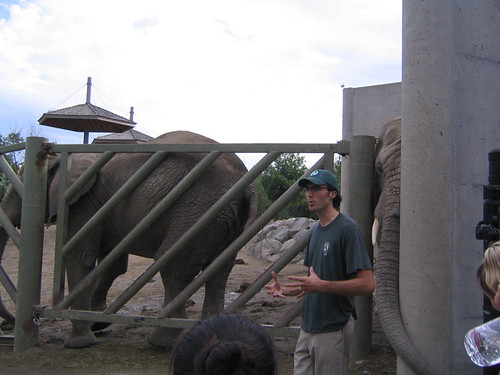
success - Toronto Zoo closes its elephant exhibit!
From PETA.org
Toronto Zoo to Close Elephant Exhibit
by Jennifer O'Connor
I've got some great news and some not-so-great news. The great news is that the Toronto Zoo has heeded the call of animal defenders, including Bob Barker, and decided to close its elephant display, joining more than a dozen other zoos that have done the same thing. What's more, the Toronto Zoo has agreed that it will not send Toka, Iringa and Thika to any facility that uses bullhooks.
The not-so-great news is that instead of sending the elephants to the spacious comfort of a sanctuary, the zoo seems intent on sending them to another zoo.
The Performing Animal Welfare Society (PAWS) sanctuary in California is willing and able to immediately provide these elephants with the many acres of natural habitat that they need to thrive, warmer weather, and the companionship of other elephants. Toka, Iringa, and Thika deserve no less, and we're appealing to the zoo to send them to PAWS.
Another Canadian elephant in desperate need of retirement is Lucy, who spends her days alone in Edmonton's Valley Zoo. Please ask city officials to send Lucy south.
Sunday, May 15, 2011
London Zoo criticised over death of baby gorilla Tiny
I think this is a sad but interesting issue to discuss. I certainly see Dr. Sommer's point but if zoo's are trying to provide the proper social structure for gorillas then what choice did they have? On the other hand, this comes back to the question I have brought up here several times - what is the role of zoos in conservation? I think most zoo apes are far far away from natural conditions, no matter how hard zoos try. In which case, strictly adhering to wild gorilla social structure maybe should not be the priority. They could have had a 2 female and infant group and introduced the other female to the new silverback. Once the infant was older and his mother started cycling again the mother and juvenile could probably be introduced to the silverback without incident. Many zoos have ape groups that are divided so that some are on display and other not at any given time. It is cleearly not a black and white issue and its something that should be discussed. -MA

From the BBC via the Vigilant Primate Genetics Lab facebook page
London Zoo criticised over death of baby gorilla Tiny
Tiny, a baby western lowland gorilla, with his mother Mjukuu Keepers waited months to introduce Tiny and his mother to the new male
A leading evolutionary anthropologist has called London Zoo "incompetent" over the death of its baby gorilla in an attack by a silverback.
Professor Volker Sommer said he was "bewildered" why seven-month-old Tiny was introduced to new male Kesho.
In the wild, when a new male takes over an existing group, there is a danger he will kill any young fathered by other males to ensure his genes survive.
London Zoo said it took expert advice and did all it could to cut the risks.
The young western lowland gorilla, who was fathered by a male that died last year, was injured on Thursday when he and his mother Mjukuu were introduced to Kesho for the second time.
Vets believe Tiny, the first gorilla to be born at the zoo for 22 years, may have suffered internal injuries following a scuffle in which he broke an arm.
The infant underwent a three-hour operation to pin his arm but vets were unable to revive him.
Prof Sommer, an advisor to the International Union for Conservation of Nature on great apes, said introducing Tiny to the silverback "ignored findings accumulated over the last 40 years".
In a letter to the Zoological Society of London (ZSL), he said: "What on Earth did ZSL expect to happen? Any undergraduate student of zoology could have told you what to expect!
"How can it be that ZSL, an organisation known for being guided by scientific knowledge, ignores findings that have been accumulated over the last 40 years?"
He said those responsible should no longer keep apes if the zoo was not up to scratch with what science told us.
The letter added: "Sorry, but the word 'incompetence' comes to mind for those responsible for this blunder.
"As a logical conclusion, London Zoo should not keep apes anymore."
Kesho's arrival last year was recommended by experts to create a cohesive social group, after the death of the zoo's previous male gorilla.
In the wild male gorillas often attack the offspring of their rivals, so staff were cautious about introducing Kesho to the baby, who was the offspring of the former male.
Kesho had been gradually introduced to the two other female gorillas at the zoo but keepers waited many months for an introduction to the youngster and his mother.
London Zoo said it took advice from the European Association of Zoos and Aquaria's European endangered species programme (EEP), and did all it possibly could to lessen the risks.
It said keepers felt it would be unnatural to keep female gorillas without a male leader.
"We always knew the risks and were very open from the beginning about the fact that bringing a new male into a situation where a female was pregnant by another male was very challenging," a ZSL spokeswoman said.
"We held a press conference in August at the science media centre to explain all of this. However, we were advised by the EEP at the time to find a new male for the long-term welfare of the group as a whole.
"It would be unnatural to keep female gorillas without a male leader and would not have met their complex social needs satisfactorily.
"We did all that we possibly could to mitigate the known risks but fundamentally we cannot stop wild animals exhibiting their natural behaviours, and neither should we."

From the BBC via the Vigilant Primate Genetics Lab facebook page
London Zoo criticised over death of baby gorilla Tiny
Tiny, a baby western lowland gorilla, with his mother Mjukuu Keepers waited months to introduce Tiny and his mother to the new male
A leading evolutionary anthropologist has called London Zoo "incompetent" over the death of its baby gorilla in an attack by a silverback.
Professor Volker Sommer said he was "bewildered" why seven-month-old Tiny was introduced to new male Kesho.
In the wild, when a new male takes over an existing group, there is a danger he will kill any young fathered by other males to ensure his genes survive.
London Zoo said it took expert advice and did all it could to cut the risks.
The young western lowland gorilla, who was fathered by a male that died last year, was injured on Thursday when he and his mother Mjukuu were introduced to Kesho for the second time.
Vets believe Tiny, the first gorilla to be born at the zoo for 22 years, may have suffered internal injuries following a scuffle in which he broke an arm.
The infant underwent a three-hour operation to pin his arm but vets were unable to revive him.
Prof Sommer, an advisor to the International Union for Conservation of Nature on great apes, said introducing Tiny to the silverback "ignored findings accumulated over the last 40 years".
In a letter to the Zoological Society of London (ZSL), he said: "What on Earth did ZSL expect to happen? Any undergraduate student of zoology could have told you what to expect!
"How can it be that ZSL, an organisation known for being guided by scientific knowledge, ignores findings that have been accumulated over the last 40 years?"
He said those responsible should no longer keep apes if the zoo was not up to scratch with what science told us.
The letter added: "Sorry, but the word 'incompetence' comes to mind for those responsible for this blunder.
"As a logical conclusion, London Zoo should not keep apes anymore."
Kesho's arrival last year was recommended by experts to create a cohesive social group, after the death of the zoo's previous male gorilla.
In the wild male gorillas often attack the offspring of their rivals, so staff were cautious about introducing Kesho to the baby, who was the offspring of the former male.
Kesho had been gradually introduced to the two other female gorillas at the zoo but keepers waited many months for an introduction to the youngster and his mother.
London Zoo said it took advice from the European Association of Zoos and Aquaria's European endangered species programme (EEP), and did all it possibly could to lessen the risks.
It said keepers felt it would be unnatural to keep female gorillas without a male leader.
"We always knew the risks and were very open from the beginning about the fact that bringing a new male into a situation where a female was pregnant by another male was very challenging," a ZSL spokeswoman said.
"We held a press conference in August at the science media centre to explain all of this. However, we were advised by the EEP at the time to find a new male for the long-term welfare of the group as a whole.
"It would be unnatural to keep female gorillas without a male leader and would not have met their complex social needs satisfactorily.
"We did all that we possibly could to mitigate the known risks but fundamentally we cannot stop wild animals exhibiting their natural behaviours, and neither should we."
0
comments
Labels:
animal rights,
captive studies,
death,
europe,
gorillas,
very important scientist,
zoo
Labels:
animal rights,
captive studies,
death,
europe,
gorillas,
very important scientist,
zoo
Saturday, May 14, 2011
Water for elephants star "trained" by electric shock
Steve Bloom, wildlife photographer, posted this on his facebook page along with the following comment which I totally agree with:
Movie Star Electric Shocked
Video released today by Animal Defenders International shows the elephant that appears alongside Reese Witherspoon and Robert Pattinson in the new film Water for Elephants, being beaten and electric-shocked during training.
Water for Elephants, a romantic drama set in a 1930s animal circus in the USA, starring Reese Witherspoon and Robert Pattinson, is premiering all over the world this month, with the London Premier last Tuesday. But the biggest star of the film is 45-year-old Asian elephant Tai, who plays Rosie, supplied by the performing animal supplier Have Trunk Will Travel, of California.
In the film Rosie, played by Tai, is brutally attacked by the circus owner who beats her with a bull hook. But the producers, stars, and trainers have been at pains to stress that Tai was trained with kindness, marshmallows, and positive reinforcement.
Gary Johnson, a founder of Have Trunk Will Travel claimed: “Tai was never hit in any way at all”.
American Humane observed the animal action during filming and said: “We’re here observing prep on Water for Elephants and so we’re here to make sure that everybody knows that not only the action on set but also the prep is humanely done, all these animals have been treated fairly and humanely throughout the entire course of their training.”
However shocking video, filmed at Have Trunk Will Travel in 2005, has been posted online today by Animal Defenders International (ADI) after the London premier, that tells a different story.
* Elephants including Tai are repeatedly given electric shocks with hand held stun guns
* Tai cries out when being shocked into performing a headstand
* Elephants including Tai are beaten about the body and legs with bull hooks
* A baby elephant is hooked in the lip and cries out
* An elephant is pinned with bull hooks whilst her tusks are sawn down, close to the bone
Jan Creamer, Chief Executive of ADI said: “We were uncomfortable with the message of this film, but the more we saw the repeated assertions that this elephant has been treated with love and affection and never been abused, we realized that we had to get the truth out. The public, the stars and the filmmakers have been duped. This poor elephant was trained to do the very tricks you see in the film by being given electric shocks.”
Kari Johnson, another of the founders of Have Trunk Will Travel has previously stated: “Have Trunk Will Travel has never issued a written endorsement, nor does it condone using electrical devices to discipline and control elephants except in situations where elephant or human safety is at risk.”
Gary Johnson and trainer Joanne Smith appear in the video giving the elephants electric shocks.
ADI are sending copies of the DVD to the film’s stars and makers.
Jan said: “I believe that Reese Witherspoon and Robert Pattinson will be horrified to learn what Tai went through.”
ADI has also contacted American Humane, urging them to re-evaluate how they assess the use of animals in films and the statements being made which effectively endorse the use of performing animals.
What You Can Do
* Please contact ADI today and find out how you can speak up for Tai and all animals being abused in the entertainment industry. If you live in the UK, please contact info@ad-international.org, if you live in the U.S. please contact usa@ad-international.org and ask for a Water for Elephants Letter Writing Pack.
* Boycott this film and tell your family and friends to take a stand against animal cruelty by only supporting films without animal actors.
* Leaflet moviegoers at a theater near you to educate them about the abuse of Tai and other performing animals. Contact ADI to order leaflets.
* Contact your local theater with a copy of the DVD we can provide you, and politely ask them to make the right choice and stop showing the film.
* Contact ADI for a letter writing pack with sample letters to Water for Elephants actors and movie makers, and sample letters to the editor to help you raise your voice for Tai and the other animals abused for entertainment.
* Write a letter to your local paper about Tai’s abuse and educate the public that animal suffering is never romantic and it is never entertainment. (Sample letters available in our letter writing pack.)
* Contact the Director and Producer and politely ask that they make Water for Elephants the last film they will use live animal actors. (Contacts and sample letters available in our letter writing pack.)
* Share the link to the video on your Facebook and other social networking sites, to spread the word to family and friends.
"I have not seen Water For Elephants, but came across a video showing cruel training methods. I don't see why any elephant will perform tricks for human entertainment unless coerced to do so by fear and intimidation. We are in an age of greater awareness of animal sentience, and things we would have taken for granted thirty or forty years ago now make us stop, ask questions and take action."From Animal Defenders International
Movie Star Electric Shocked
Video released today by Animal Defenders International shows the elephant that appears alongside Reese Witherspoon and Robert Pattinson in the new film Water for Elephants, being beaten and electric-shocked during training.
Water for Elephants, a romantic drama set in a 1930s animal circus in the USA, starring Reese Witherspoon and Robert Pattinson, is premiering all over the world this month, with the London Premier last Tuesday. But the biggest star of the film is 45-year-old Asian elephant Tai, who plays Rosie, supplied by the performing animal supplier Have Trunk Will Travel, of California.
In the film Rosie, played by Tai, is brutally attacked by the circus owner who beats her with a bull hook. But the producers, stars, and trainers have been at pains to stress that Tai was trained with kindness, marshmallows, and positive reinforcement.
Gary Johnson, a founder of Have Trunk Will Travel claimed: “Tai was never hit in any way at all”.
American Humane observed the animal action during filming and said: “We’re here observing prep on Water for Elephants and so we’re here to make sure that everybody knows that not only the action on set but also the prep is humanely done, all these animals have been treated fairly and humanely throughout the entire course of their training.”
However shocking video, filmed at Have Trunk Will Travel in 2005, has been posted online today by Animal Defenders International (ADI) after the London premier, that tells a different story.
* Elephants including Tai are repeatedly given electric shocks with hand held stun guns
* Tai cries out when being shocked into performing a headstand
* Elephants including Tai are beaten about the body and legs with bull hooks
* A baby elephant is hooked in the lip and cries out
* An elephant is pinned with bull hooks whilst her tusks are sawn down, close to the bone
Jan Creamer, Chief Executive of ADI said: “We were uncomfortable with the message of this film, but the more we saw the repeated assertions that this elephant has been treated with love and affection and never been abused, we realized that we had to get the truth out. The public, the stars and the filmmakers have been duped. This poor elephant was trained to do the very tricks you see in the film by being given electric shocks.”
Kari Johnson, another of the founders of Have Trunk Will Travel has previously stated: “Have Trunk Will Travel has never issued a written endorsement, nor does it condone using electrical devices to discipline and control elephants except in situations where elephant or human safety is at risk.”
Gary Johnson and trainer Joanne Smith appear in the video giving the elephants electric shocks.
ADI are sending copies of the DVD to the film’s stars and makers.
Jan said: “I believe that Reese Witherspoon and Robert Pattinson will be horrified to learn what Tai went through.”
ADI has also contacted American Humane, urging them to re-evaluate how they assess the use of animals in films and the statements being made which effectively endorse the use of performing animals.
What You Can Do
* Please contact ADI today and find out how you can speak up for Tai and all animals being abused in the entertainment industry. If you live in the UK, please contact info@ad-international.org, if you live in the U.S. please contact usa@ad-international.org and ask for a Water for Elephants Letter Writing Pack.
* Boycott this film and tell your family and friends to take a stand against animal cruelty by only supporting films without animal actors.
* Leaflet moviegoers at a theater near you to educate them about the abuse of Tai and other performing animals. Contact ADI to order leaflets.
* Contact your local theater with a copy of the DVD we can provide you, and politely ask them to make the right choice and stop showing the film.
* Contact ADI for a letter writing pack with sample letters to Water for Elephants actors and movie makers, and sample letters to the editor to help you raise your voice for Tai and the other animals abused for entertainment.
* Write a letter to your local paper about Tai’s abuse and educate the public that animal suffering is never romantic and it is never entertainment. (Sample letters available in our letter writing pack.)
* Contact the Director and Producer and politely ask that they make Water for Elephants the last film they will use live animal actors. (Contacts and sample letters available in our letter writing pack.)
* Share the link to the video on your Facebook and other social networking sites, to spread the word to family and friends.
Elephants never forget
Thanks to Tracy K for the link!
0
comments
Labels:
animal rights,
elephants,
love,
memory,
NOT science,
reintroduction,
sanctuary,
video
Labels:
animal rights,
elephants,
love,
memory,
NOT science,
reintroduction,
sanctuary,
video
Sunday, February 20, 2011
Sea Shepherd Activists Prompt Japan To Suspend Whaling

From the Huffington Post
by MARI YAMAGUCHI
Japan has temporarily suspended its annual Antarctic whaling after repeated harassment by a conservationist group, a government official said Wednesday.
Sea Shepherd Conservation Society ships have been chasing the Japanese whaling fleet for weeks in the icy seas off Antarctica, trying to block Japan's annual whale hunt, planned for up to 945 whales.
Japan has halted the hunt since Feb. 10 after persistent "violent" disruptions by the anti-whaling protesters, said fisheries agency official Tatsuya Nakaoku.
So far, the attacks have not caused any injuries or major damage to the vessels, he said, but the protesters are throwing rancid butter in bottles and once the protesters got a rope entangled in the propeller on a harpoon vessel, causing it to slow down.
"We have temporarily suspended our research whaling to ensure safety," he said. The fleet plans to resume hunting when conditions are deemed safe, he added, but declined to say how long the suspension is planned for.
The whale hunts, which Japan says are for scientific purposes, are allowed by the International Whaling Commission as an exception to the 1986 ban, but opponents say they are a cover for commercial whaling because whale meat not used for study is sold for consumption in Japan.
The Sea Shepherd group has been shadowing Japan's whaling fleet for several years, and its campaign has drawn high-profile donor support in the United States and elsewhere and spawned the popular Animal Planet series "Whale Wars."
Official Sea Shephard Press releases can be found here and here
0
comments
Labels:
animal rights,
cetaceans,
conservation,
hunting,
misc water dwellers,
poaching,
success,
whales
Labels:
animal rights,
cetaceans,
conservation,
hunting,
misc water dwellers,
poaching,
success,
whales
Wednesday, February 9, 2011
FTW: Cockfighting bird stabs man to death

From the NYDaily News via Rescue Ink
Cockfighting bird stabs California man, Jose Luis Ochoa, to death: police
Call it murder most fowl. A California man attending a cockfight was stabbed to death by a bird that had a knife attached to its own limb.
Jose Luis Ochoa, 35, of Lamont, died about two hours after he was injured in neighboring Tulare County on Jan. 30, according to the Kern County coroner. "I have never seen this type of incident," Sgt. Martin King, a 24-year vet of the sheriff's department, told the Bakersfield Californian.
Ochoa died of accidental "sharp force injury" to his right calf, according to the autopsy.
Onlookers fled when cops arrived at the scene of the fight, King told the local newspaper. Authorities, acting on an anonymous tip, found five dead roosters and other evidence of cockfighting at the location.
No arrests were made at the fight.
Cockfighting is an illegal sport in the U.S.
Metal spurs are often placed on the specially bred birds' legs and they are encouraged to fight until one is incapacitated or killed.
ashahid@nydailynews.com
Subscribe to:
Posts (Atom)


 Posts
Posts


