translate

Site update

Since I have been really terrible at updating the blog (but pretty good at keeping up with the facebook blog posts) I've added the widget below so that facebook cross posts to the blog.

You shouldn't need to join facebook but can just click on the links in the widget to access the articles. If you have any problems or comments please mail me at arandjel 'AT' eva.mpg.de.
Showing posts with label modeling. Show all posts

Thursday, April 7, 2011

SAFE (Species Ability to Forestall Extinction): a new method to predict how close species are to extinction

From Mongabay.com
New method to measure threat of extinction could help conservationists prioritize
BY JEREMY HANCE

Researchers have developed a new method to predict how close species are to extinction. Dubbed SAFE (Species Ability to Forestall Extinction) the researchers believe the new tool, published in the Frontiers in Ecology and Environment, should help conservationists select which species to focus on saving and which, perhaps controversially, should be let go.

"The idea is fairly simple—it's the distance a population is (in terms of abundance) from its minimum viable population size. While we provide a formula for working this out, it's more than just a formula—we've shown that SAFE is the best predictor yet of the vulnerability of mammal species to extinction," co-author Professor Corey Bradshaw, Director of Ecological Modeling at the University of Adelaide's Environment Institute, says in a press release.

The authors say that the index is not necessarily meant to be a replacement to the International Union for Conservation of Nature (IUCN) Red List of Threatened Species but a tool to use alongside. However, the SAFE index did prove to be a better predictor of extinction threat than another approach of looking at the percentage species' habitat loss.

"The SAFE index provides a more meaningful and fine-grained interpretation of the relative threat of species extinction than do the IUCN threat categories alone," the authors write.

Using rhinos as an example, Bradshaw explains: "our index shows that not all Critically Endangered species are equal […] For example, our studies show that practitioners of conservation triage may want to prioritize resources on the Sumatran rhinoceros instead of the Javan rhinoceros. Both species are Critically Endangered, but the Sumatran rhino is more likely to be brought back from the brink of extinction based on its SAFE index."

The SAFE index team analyzed 95 mammals species and found nearly 60% are close to a 'tipping point' that could push the species to extinction, while 25% are worse off and already close to extinction. Such analyses should allow conservationists a better tool to determine where to spend funds and time.

"Conservationists with limited resources may want to channel their efforts on saving the tiger, a species that is at the 'tipping point' and could have reasonable chance of survival," Bradshaw says.

Reference:
Clements RG, Bradshaw CJA, Brook BW, Laurance WF (2011) The SAFE. index: using a threshold population target to measure relative species threat. Frontiers in Ecology and the Environment doi:10.1890/100177.

Abstract:
The International Union for Conservation of Nature (IUCN) Red List is arguably the most popular measure of relative species threat, but its threat categories can be ambiguous (eg “Endangered” versus “Vulnerable”) and subjective, have weak quantification, and do not convey the threat status of species in relation to a minimum viable population target. We propose a heuristic measure that describes a “species’ ability to forestall extinction”, or the SAFE index. We compared the abilities of the SAFE index with those of another numerically explicit metric – percentage range loss – to predict IUCN threat categories using binary and ordinal logistic regression. Generalized linear models showed that the SAFE index was a better predictor of IUCN threat categories than was percentage range loss. We therefore advocate use of the SAFE index, possibly in conjunction with IUCN threat categories, because the former indicates the “distance from extinction” of a species, while implicitly incorporating population viability as a variable.

Friday, March 25, 2011

Religion may become extinct in nine nations, study says

from the BBC
by JASON PALMER

A study using census data from nine countries shows that religion there is set for extinction, say researchers.

The study found a steady rise in those claiming no religious affiliation. The team's mathematical model attempts to account for the interplay between the number of religious respondents and the social motives behind being one. The result, reported at the American Physical Society meeting in Dallas, US, indicates that religion will all but die out altogether in those countries.

The team took census data stretching back as far as a century from countries in which the census queried religious affiliation: Australia, Austria, Canada, the Czech Republic, Finland, Ireland, the Netherlands, New Zealand and Switzerland. Their means of analysing the data invokes what is known as nonlinear dynamics - a mathematical approach that has been used to explain a wide range of physical phenomena in which a number of factors play a part.

One of the team, Daniel Abrams of Northwestern University, put forth a similar model in 2003 to put a numerical basis behind the decline of lesser-spoken world languages. At its heart is the competition between speakers of different languages, and the "utility" of speaking one instead of another. "The idea is pretty simple," said Richard Wiener of the Research Corporation for Science Advancement, and the University of Arizona. "It posits that social groups that have more members are going to be more attractive to join, and it posits that social groups have a social status or utility.

"For example in languages, there can be greater utility or status in speaking Spanish instead of [the dying language] Quechuan in Peru, and similarly there's some kind of status or utility in being a member of a religion or not."

Dr Wiener continued: "In a large number of modern secular democracies, there's been a trend that folk are identifying themselves as non-affiliated with religion; in the Netherlands the number was 40%, and the highest we saw was in the Czech Republic, where the number was 60%."

The team then applied their nonlinear dynamics model, adjusting parameters for the relative social and utilitarian merits of membership of the "non-religious" category. They found, in a study published online, that those parameters were similar across all the countries studied, suggesting that similar behaviour drives the mathematics in all of them. And in all the countries, the indications were that religion was headed toward extinction.

However, Dr Wiener told the conference that the team was working to update the model with a "network structure" more representative of the one at work in the world. "Obviously we don't really believe this is the network structure of a modern society, where each person is influenced equally by all the other people in society," he said. However, he told BBC News that he thought it was "a suggestive result". "It's interesting that a fairly simple model captures the data, and if those simple ideas are correct, it suggests where this might be going. "Obviously much more complicated things are going on with any one individual, but maybe a lot of that averages out."

Tuesday, October 19, 2010

very cool new resource: protectedplanet.net


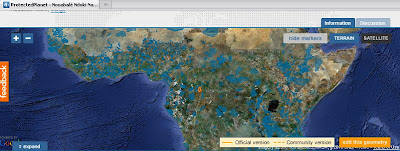
Check out this cool new UNEP/IUCN database, ProtectedPlanet.net on the globe's protected areas, which is wiki based (but with fact checking) so you can update the database with information that you have on some of the more remote areas.

from their website:
Be inspired by the most beautiful places on the planet. Explore the worlds national parks, wilderness areas and world heritage sites. Help us find and improve information on every protected area in the world. Protectedplanet.net lets you discover these incredible places through elegant mapping and intuitive searching. Protectedplanet.net wants you to contribute information about protected areas alongside national agencies and international organisations. Protectedplanet.net helps you understand what and where our natural resources are being conserved. If you are interested in analysing a global dataset on protected areas, you can download the data, today, here at protectedplanet.net.

Tuesday, July 27, 2010

LOL: Predicting the distribution of Sasquatch in western North America: anything goes with ecological niche modelling


I love science that can hammer home an important point in a light hearted way -MA

Lozier JD, Aniello P, Hickerson MJ (2010) Predicting the distribution of Sasquatch in western North America: anything goes with ecological niche modelling. Jounanl of Biogeography 36 (9): 1623 - 1627

ABSTRACT
The availability of user-friendly software and publicly available biodiversity databases has led to a rapid increase in the use of ecological niche modelling to predict species distributions. A potential source of error in publicly available data that may affect the accuracy of ecological niche models (ENMs), and one that is difficult to correct for, is incorrect (or incomplete) taxonomy. Here we remind researchers of the need for careful evaluation of database records prior to use in modelling, especially when the presence of cryptic species is suspected or many records are based on indirect evidence. To draw attention to this potential problem, we construct ENMs for the North American Sasquatch (i.e. Bigfoot). Specifically, we use a large database of georeferenced putative sightings and footprints for Sasquatch in western North America, demonstrating how convincing environmentally predicted distributions of a taxon's potential range can be generated from questionable site-occurrence data. We compare the distribution of Bigfoot with an ENM for the black bear, Ursus americanus, and suggest that many sightings of this cryptozoid may be cases of mistaken identity.