translate

Site update

Since I have been really terrible at updating the blog (but pretty good at keeping up with the facebook blog posts) I've added the widget below so that facebook cross posts to the blog.

You shouldn't need to join facebook but can just click on the links in the widget to access the articles. If you have any problems or comments please mail me at arandjel 'AT' eva.mpg.de.
Showing posts with label lit. Show all posts

Tuesday, January 10, 2012

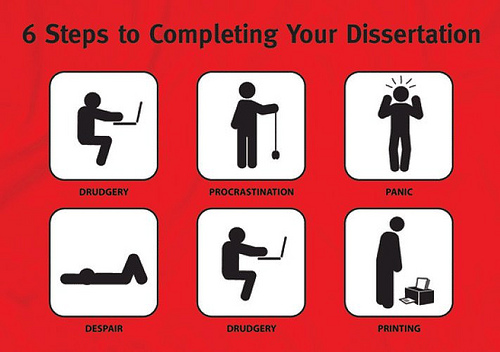
How to Write a Ph.D. Dissertation


from Neatorama

E. Robert Schulman and C. Virginia Cox
Charlottesville, Virginia

Abstract
In this paper we demonstrate that writing a Ph.D. dissertation can have many benefits. Not only do you obtain extensive typesetting experience, but afterwards you can have your frequent-flyer literature addressed to “Dr. Your Name.”

Chapter I: Introduction
Ph.D. dissertations (e.g., Schulman 1995a; Cox 1995) are commonly believed to be comprehensive compendiums of the original research done by a graduate student in partial fulfillment of the requirements for the degree of Doctor of Philosophy.² In reality, the Ph.D. thesis is usually a number of disparate chapters whose most important feature is not the thoroughness of the experimental description but rather the width of the margins. In this paper, the second article in a series on scientific writing that began with Schulman (1996a), we will discuss the phenomenon of the Ph.D. thesis.

Chapter II: Preparing to Write
There comes a time in the life of every graduate student when she or he realizes that another two years of graduate school cannot be endured. Even though a year spent writing your thesis will be filled with frustration and angst, it will end up being worth it in order to escape school forever.

Remember the following phrase: “No one will ever read your thesis.” You’ll hear this phrase a number of times as you finish up, and it’s vitally important that you believe it to be true. The phrase is important because without it you would be tempted to work on your thesis until everything is perfect, and you would never finish.

Say “It’s good enough for the thesis” to yourself several times a day. Tell yourself that you’ll correct all the mistakes when you turn the various chapters into independent scientific papers, even though this won’t happen (see Schulman 1996aand references therein).

Chapter III: Your Thesis Committee

Your thesis committee should consist of between four and nine researchers in and outside of your field. Each committee member has a specific duty.

Your thesis advisor has the most important job: to reassure you that you don’t have to do many of the things you’re positive you should do. She or he will likely say, “It’s good enough for the thesis” fairly often.

You also need one committee member who will insist on more mathematical rigor, one who will demand that the thesis be made more concise by getting rid of all that irrelevant math, and two or three to say that you should do all the things your thesis advisor told you didn’t need to be done.

There should also be at least one committee member who will never read the thesis, and who will therefore ask only general questions at your thesis defense. The other graduate students who attend your defense will often bet on which professors read your thesis. Be prepared to determine the winner (note that it is not considered sporting to participate in this game yourself).

Try to set a defense date early so as to give your committee ample time to schedule conferences, vacations, and/or elective surgery for that day.

Chapter IV: Producing the Thesis
Legend has it that doctoral students in ancient times used to produce their dissertations using a device called a “typewriter.” While there is some archeological evidence for typewriter use in the past, many researchers doubt the plausibility of such claims (e.g. Schulman 1995a).

These days, dissertations are produced using word processing programs such as Word or Word Perfect, or computer typesetting systems such as TeX or LaTeX. The former will give you practice in drawing by hand all the symbols that aren’t supported, while with the latter you have the opportunity to craft new typesetting definitions to satisfy your university’s dissertation policies. For example,

\long\def\printfrontnonchapter{\vfil\eject \rightpage\null\vskip 1in \centerline{{\bf \Uppercase{\frontnonchapterheader}}}\vskip 22pt plus 73pt \relax\bigskip\setwidespacing \frontnonchaptertext\par} (Jerius 1992).

Be sure not to choose the wrong method of producing your thesis.

Chapter V: Writing the Thesis
The Ph.D. thesis usually begins with a pithy quote, after which there will sometimes be a dedication to one’s parents, life partner, and/or pet tapir.

Following this is probably the most important part of the dissertation: the acknowledgments section. This is the only section that everyone who picks up your thesis will read. They will happen upon your dissertation in the library and flip through the first few pages, looking for a juicy acknowledgments section. This is your chance to make obscure references to secret loves, damn various faculty members with faint praise, or be very mysterious by having no acknowledgments section at all so that everyone wonders what you’re hiding.

After the acknowledgments should be the various tables of contents, denoting the page numbers on which the reader may find every section, subsection, subsubsection, figure, table, appendix, footnote, and semicolon in the thesis.

Next comes the first thesis chapter, the introduction, which is judged on the basis of how far back in the past you start. Although the introduction is supposed to enable someone with no knowledge of your field to read and understand your thesis, this is an impossible goal. Instead, simply reference sources such as Rontgen (1896), Galileo (1610), Aristotle (-350), or other similarly ancient researchers. The idea to get across is that your work, being based on the work of great scientists of the past, must be truly worthwhile. Even though these works have little to do with your research, your committee isn’t going to look up the references.

After the introduction come chapters that describe what you did, where you did it, when you did it, why you did it, and how much more work has to be done before you can obtain definitive results. This last point is usually discussed in the concluding chapter.

Chapter VI: The Thesis Defense
Remember those dreams you used to have about going to class and finding out that there was a big test that day for which you hadn’t studied? The thesis defense is worse, because you find out that although you studied very hard, you didn’t study the right things.

Your committee members aren’t going to waste their time asking you about your research, because you know more about that than anyone else in the world. Instead, they will ask questions that are really about their research or–if they are in a particularly punchy mood–about fundamental mathematics.

The fun part is that at most universities the first part of your defense is open to the public, so that your parents will probably want to come and videotape the event.
Chapter VII: Rewriting
Your thesis defense was tough, but you survived. Your committee members have signed a piece of paper saying that they are satisfied with your dissertation as long as your thesis advisor is happy with the revisions you make. Don’t fall into the trap of trying to make everything perfect! Remember the phrase from Chapter II, “No one will ever read your thesis.”

Once your advisor is happy with the revisions, take one unbound, unperforated, paginated copy of your dissertation, two copies of your abstract, one extra copy of your title page, the signed evaluation forms from your committee members in a sealed, notarized envelope, the receipt proving your payment of the Thesis Publication Fee, your diploma application, and proof of your doctoral candidacy enrollment to the Bureaucratic Office of Records, Education, and Dissertations (your requirements may vary; void where prohibited).

The folks at BORED will take a ruler to every page in your thesis, making sure that all the margins are correct and insisting that you go back and redo them if even one page is wrong.

Chapter VIII: Distributing Your Thesis
You’ve passed the format check, and it’s time to make a hundred copies of your thesis and distribute them to departmental libraries all over the world so that everyone in your field can read it. Your advisor should pay for the photocopying and postage (see Schulman & Cox 1997 for a detailed justification).

Try not to think of all the errors lurking in your thesis as you address the envelopes to Professor Famous or Doctor Influential. You want to publicize your dissertation as much as possible so that prospective employers will at least have heard your name.

Some journals will publish brief summaries of your dissertation (e.g. Schulman 1995b; Schulman 1996b), but be warned that these journals may want you to format your summary quite specifically. The requirements for the mini-Annals of Improbable Research are particularly restrictive; it can be difficult to summarize five years of work in five lines of text.

Chapter IX: Conclusion
Congratulations, Doctor! You’ve escaped from graduate school and can now have your frequent-flyer literature addressed to Dr. Your Name, complain when forms only list Mr/Ms/Mrs, and smirk when surgeons whine about all the people with academic doctorates who are making the title meaningless for medical doctors. Go out and make the world a better place.

Bibliography
Aristotle, -350, On The Heavens, Athens, Greece.
Cox, C. V. 1995, Ph.D. thesis, University of Michigan.
Galilei, G. 1610, Sidereus Nuncius, Venice, Italy.
Jerius, D. H. 1992, Ph.D. thesis, University of Michigan.
Kaplan, J. M. 1996, Ph.D. thesis, Stanford University.
Rontgen, W. C. 1896, Nature, 53, 274.
Schulman, E. R. 1995a, Ph.D. thesis, University of Michigan.
Schulman, E. 1995b, mini-Annals of Improbable Research, 1995-08, 4.
Schulman, E. R. 1996a, Annals of Improbable Research, Vol. 2, No. 5, 8.
Schulman, E. 1996b, Publications of the Astronomical Society of the Pacific, 108, 460.
Schulman. E. R. & Cox, C. V. 1997, Annals of Improbable Research, Vol. 3, No. 5, 8.

Notes
1. There is no note 1.
2. One does not actually need to include any philosophy in the thesis unless one is getting a Doctorate of Philosophy in philosophy, and even in that case the philosophical component can be minimized (e.g., Kaplan 1996).

__________________________

This article is republished f the September-October 1997 issue of the Annals of Improbable Research.

Monday, December 5, 2011

Cigarette smoking: an underused tool in high-performance endurance training


thanks alberto a for the link!

From the Canadian Medical Association Journal
Cigarette smoking: an underused tool in high-performance endurance training
Kenneth A. Myers, BSc

Abstract
The review paper is a staple of medical literature and, when well executed by an expert in the field, can provide a summary of literature that generates useful recommendations and new conceptualizations of a topic. However, if research results are selectively chosen, a review has the potential to create a convincing argument for a faulty hypothesis. Improper correlation or extrapolation of data can result in dangerously flawed conclusions. The following paper seeks to illustrate this point, using existing research to argue the hypothesis that cigarette smoking enhanceshttp://www.blogger.com/img/blank.gif endurance performance and should be incorporated into high-level training programs.

To read it all go HERE

Tuesday, June 14, 2011

New book: The science of evil

from the New York Times
From Hitler to Mother Teresa: 6 Degrees of Empathy
By KATHERINE BOUTON

“The Science of Evil,” by Simon Baron-Cohen, seems likely to antagonize the victims of evil, the parents of children with autism spectrum disorder, at least a few of the dozens of researchers whose work he cites — not to mention critics of his views on evolutionary psychology or of his claims about the neurobiology of the sexes. “The Science of Evil” proposes a simple but persuasive hypothesis for a new way to think about evil.

“My main goal is to understand human cruelty, replacing the unscientific term ‘evil’ with the scientific term ‘empathy,’ ” he writes at the beginning of the book, which might be seen as expanding on the views on empathy expressed in his 1997 book, “Mindblindness: An Essay on Autism and Theory of Mind” (Bradford). Evil, he notes, has heretofore been defined in religious terms (with the concept differing in the major world religions), as a psychiatric condition (psychopathology) or, as he puts it, in “frustratingly circular” terms: “He did x because he is truly evil”).

Dr. Baron-Cohen, a professor of developmental psychology at the University of Cambridge and director of the university’s Autism Research Center, proposes that evil is more scientifically defined as an absence of empathy, exacerbated by negative environmental factors (usually parental, sometimes societal) and a genetic component. When these three exist in tandem they result in what he calls a Zero-Negative personality. Zero-Negative takes at least three forms (and possibly more), borrowing from terms used in psychiatry: Zero Type P (psychopathology), Zero Type B (borderline disorder) and Zero Type N (narcissism).

Whereas psychiatry groups these three loosely under the term “personality disorders,” Dr. Baron-Cohen proposes that they all share the characteristic of zero degrees of empathy. (His “empathy quotient” scale is available in the book or online, with an instant numerical score that is translated into degrees of empathy from zero to six, or super empathy.)

Viewing these disorders in terms of empathy “has very different treatment implications,” he maintains. Psychopaths aside, people with low degrees of empathy can be taught empathy, as is done in schools concerned about bullying, and treated with standard psychiatric approaches.

I am not a psychiatrist, psychologist or neurobiologist, but to a lay reader there seem to be limitations in describing pathological behavior in terms of zero degrees of empathy. He cites the example of a Nazi guard who forced a boy to put a noose around his friend’s neck as “cruelty for its own sake.” But rather than zero degrees of empathy, it seems instead that the guard possessed six degrees of anti-empathy: The guard acted in the cruelest way he could think of, fully understanding how devastating the act would be to both boys.

“What leads an individual’s ‘Empathizing Mechanism’ to be set at different levels?’ ”Dr. Baron-Cohen asks. “The most immediate answer is that it depends on the functioning of a special circuit in the brain, the empathy circuit,” which he maps in great detail. (This question — and many sentences in the book — could have used an editor. Does he really mean that an individual’s empathy mechanism goes up and down? I don’t think so. I think what he’s trying to say — and in fact does say at a later point — is “What determines where an individual falls on the spectrum?”)

Further, what causes the same neurological circuitry to produce behaviors as different as Zero N, Zero P and Zero B? The dual answer is environment (extreme emotional deprivation or social pressure, as in Nazi Germany) and genes. The discussion of empathy genes is crammed with caveats and warnings: “I hope this book will not be misunderstood as arguing that empathy is wholly genetic”; “I have put quotation marks around genes for empathy”; “we examine evidence that some genes are associated with...” (italics his). The editors dispense with all this hedging and call the chapter “The Empathy Gene.” (The American publishers did the same with his caveats about the word “evil,” using it in the title. The British edition was called “Zero Degrees of Empathy.”)

In his final chapter, “Reflections on Human Cruelty,” Dr. Baron-Cohen addresses perhaps the most central question: If zero degrees of empathy is a “form of neurological disability, to what extent can such an individual who commits a crime be held responsible for what they have done?”

Does this hypothesis mean that there is no such thing as individual responsibility, free will? Possibly. But sensibly, Dr. Baron-Cohen finds that prison is necessary for the most serious crimes, for three reasons: to protect society, to signal disapproval and to restore some sense of justice to the victim or the victim’s family. (He does not believe in capital punishment.) For lesser crimes, though, imprisonment may not be the answer.

Finally, zero empathy is not necessarily negative. In what he acknowledges is a controversial idea, he maintains “there is at least one way in which zero degrees can be positive.” Preparing for the howl of dissent, he adds: “It seems unthinkable, but bear with me.” People with Asperger’s syndrome also fall on the zero end of the scale, but they are Zero Positive. Zero Positive is almost always accompanied by high scores on the systemizing scale (and can lead to genius). In addition, the way “their brain processes information paradoxically leads them to be supermoral rather than immoral.”

My guess is that even suggesting these two conditions are related in some way will be inflammatory, though in the context of the book the discussion seems reasonable, and in no way does Dr. Baron-Cohen equate the two — except that they have in common zero degrees of empathy.

At the core of this deceptively simple book is the question of the nature of cruelty. In the last and most philosophical chapter Dr. Baron-Cohen discusses situations in which an individual who is not otherwise lacking in empathy may behave cruelly. Citing the philosopher Hannah Arendt’s term “the banality of evil,” and discussing the work of Stanley Milgram and Philip Zimbardo in which ordinary people exhibited cruel behavior, he acknowledges that in most of us empathy may be suspended temporarily, under certain circumstances.

This is a frightening thought, but one borne out not only by research but by history. Dr. Baron-Cohen’s hypothesis that cruelty is merely the zero end of a continuum on which we all fall makes that possibility more comprehensible.

Wednesday, June 1, 2011

short story by David Sedaris - 'I'm actually more of a barfly'

This story took me back to when I used to study Drosophila, its exactly the type of thing we would have found hysterical. Warning: if you are weak-stomached this one is probably not for you. - MA

from the telegraph via the david sedaris fb page

The fly was at the bus station when he saw a man in a sailor suit clutch his stomach. Then he leant forward in his plastic seat and vomited onto the scuffed linoleum floor. “Son of a bitch,” the man muttered, and he wiped his mouth with the back of his hand. “I just paid $6 for that!”

There was a bathroom next to the snack bar, and as the man rose unsteadily to his feet and stumbled in its direction, the people flanking him abandoned their seats, leaving a wide berth for what looked to be an excellent meal. The fly liked a hot lunch and was just tucking in when a second fly, this one a female, flew down from the ceiling and landed on a narrow peninsula beside him. “What have we got here?” she asked.

“Chinese,” the male said.

The female picked half-heartedly at a snow pea. “Ten will get you 20 it’s from the Shanghai Garden,” she told him. “I had their pork lo mein once and was in the rest room for two days.”

“Well, I don’t mind it,” the male said, and he moved from a beef chunk to a sliver of ginger. “If you don’t like ethnic, there are some potato chips in here too. And a grilled cheese sandwich.”

“What kind of cheese?” the female asked. “If it’s American, you can have it.”

“Suit yourself,” the male said.

“By law, they shouldn’t even be calling it cheese, that’s how tasteless and full of chemicals it is.” The female glanced into a slick of digestive juices and saw her face multiplied a hundredfold, scowling back at her. “Anyway, when it comes to regurgitated food, you really need to consider the source — the class of person or dog or whatever. Take the lieutenant governor and his family, for example, whom I happen to know quite intimately.”

“Do you?” the male said. He had no idea what a lieutenant governor was, but out of politeness he made himself sound interested, the way he did when someone spoke about computers or yoga.

“Oh yes,” said the female. “Why, I was practically raised at Old Stoney, which is what they call their summer home on the lake. The lieutenant governor’s wife – Khaki, to her friends — is two months pregnant, though that’s strictly on the QT, at least until the formal announcement is made.

“She suffers from the most terrible morning sickness, and her vomit is outstanding, better than normal spoiled food, in my opinion!”

“You don’t say,” said the fly.

“Her faeces were good as well, at least what I could get of them,” the female continued. “Like most people of good breeding, Khaki uses a toilet, but then some horrible journalist wrote that she’d had a cocaine problem in college, so she defecated into a shoebox. The plan was to mail it to him at the newspaper, and while she pieced together a note I swooped in for a quick taste.”

“And?”

“Excellent,” the female said. “The best faeces I’ve ever had. Almost like dessert.”

The fly pointed in the direction of the departure board. “If it’s sweet you’re after, there’s a bit of jam smeared on that handrail over near the front door. I also saw a peach pit on the ground next to the trash can.”

“I meant inherently sweet, spiritually sweet,” the female said. “It’s a quality the lieutenant governor’s wife has in spades. As has Monica Van Landingham.”

The fly looked at her blankly.

“The actress? Monica Van Landingham? Winner of two Spotlight Awards?”

“Sorry,” confessed the fly.

“Well, she’s a very important person,” the female told him. “Extremely important. We met when she was an overnight guest at Old Stoney — not more than five days ago, it was. There was a fund-raising ball for the upcoming election. Miss Van Landingham’s shoes were too tight, so of course she developed a blood blister and of course it popped on the brand-new ottoman the moment she returned to her room to put her poor swollen feet up. I tried to clean it off before she noticed, but she’s quick, Miss Van Landingham. Observant too, so I got no more than five or six mouthfuls before she dabbed at it with soap and water. That did nothing to get the blood out, so in the end she blamed it on the lieutenant governor’s dog, Chocolate Chip, which may seem dishonest but isn’t, really, seeing as he may as well have done it. It’s such a common breed, the Jack Russell.” She picked at a bit of onion. “I can’t believe you don’t know who Monica Van Landingham is.”

“I’m actually more of a barfly,” the male told her. “Certain sports figures I could maybe recognise, but otherwise I don’t have a clue.” He wanted to add that he didn’t care either. Life was short — with luck, you had maybe 30 days — so what did it matter whose crap you were eating? The same was true for vomit and blood blisters: just eat and shut up about it, for God’s sake.

“Perhaps you’ve seen Miss Van Landingham on TV, then,” the female said. “Not on a commercial — she’d never stoop so low — but on the news. You might think that’s odd for an actress, but she has opinions — important ones. Just last week, to give you an example, she came out against breast cancer — told the world, 'Hey, I think it’s a bad idea!’”

“Well, that’s great,” the fly said.

“Call me crazy, but I’m against it too,” the female announced. “I’m against breast cancer and drunk driving and the one where kids in other countries get their feet blown off. And it’s not just my association with Khaki and Miss Van Landingham — I’d be against these things anyway.”

On the other side of the room, a door opened, and from it stepped a janitor with a mop in a rolling bucket. “Just my luck,” muttered the fly, and he quickened his pace while monitoring the man’s progress.

“Tonight there’s a benefit for people who can’t count,” the female told him. “It’s black tie, and everyone will be there. Everyone important anyway. I’m just waiting until it begins.” She paused. “That’s not an invitation, mind you. I just figured you were wondering what someone like me was doing at the bus station.”

“That, I was,” said the fly, and he watched over her head as the janitor lifted his mop. “Especially someone like you, with American cheese stuck to her chin.”

“Oh my God,” said the female. “How long has it been there?” She dipped her front legs into a puddle of grease, and just as she’d begun to wash her face, the mop came down, and the fly took off for the other side of the room, where a woman in a straw hat had placed an uncovered Tupperware dish upon her suitcase. He parked himself on the NO SMOKING sign above her head, and watched while the janitor ruined a perfectly good meal.

As for the female, he wasn’t going to waste any time feeling guilty. Constant vigilance — that was a fly’s motto, and woe be to anyone who let her attention waver, no matter how good-looking she was. He had to give the female that, at least. She had been pretty. If she’d known how to keep her trap shut, he might have upped her to beautiful, but wasn’t that always the way with the ladies? For every good quality they possessed, there were two bad ones just waiting to be discovered.

The male waited another few seconds, and when the woman below shut her eyes for a nap, he moved a bit closer and saw that what she’d set atop her suitcase was pie. Blueberry, and almost an entire slice. A fellow could spend the rest of his life eating a thing like this. He might not finish it — might not even come close — but neither would he grow tired of it, the way he might of vomit or rot or even fresh faeces. Such succulent bounty, and all of it for him! The fly was rubbing his hands together, just preparing to tuck in, when he heard a familiar voice and looked up to see the female. “Talk about a close call!” she said, and she shook a bead of mop water off her wing. “Now, where was I?”

As the fly bit glumly into his favourite filling, she positioned herself in a sunbeam and resumed her monologue from the vantage point of the upper crust.

* This story, 'Vomit-Eating Flies’, will be published in the paperback edition of Squirrel Seeks Chipmunk (Abacus) next year. Read an interview with David Sedaris in http://www.telegraph.co.uk/culture/books/ He will be appearing at the Telegraph Hay Festival on Monday at 4pm

Monday, January 24, 2011

The Journal of Universal Rejection

About the Journal

The founding principle of the Journal of Universal Rejection (JofUR) is rejection. Universal rejection. That is to say, all submissions, regardless of quality, will be rejected. Despite that apparent drawback, here are a number of reasons you may choose to submit to the JofUR:

  • You can send your manuscript here without suffering waves of anxiety regarding the eventual fate of your submission. You know with 100% certainty that it will not be accepted for publication.
  • There are no page-fees.
  • You may claim to have submitted to the most prestigious journal (judged by acceptance rate).
  • The JofUR is one-of-a-kind. Merely submitting work to it may be considered a badge of honor.
  • You retain complete rights to your work, and are free to resubmit to other journals even before our review process is complete.
  • Decisions are often (though not always) rendered within hours of submission.
  • Read more at the journal's website

    Thanks to Damien C for the link!

    Wednesday, December 29, 2010

    Blackawton bees paper reminds me why I became a scientist


    Deep thanks to Tracy K who posted this on facebook and gave me the perfect introduction to my thesis and reminded me why it is I do science. -MA

    P. S. Blackawton PS, Airzee S, Allen A, Baker S, Berrow A, Blair C, Churchill M, Coles J, Cummin RF-J, Fraquelli L, Hackford C, Hinton Mellor A, Hutchcroft M, Ireland B, Jewsbury D, Littlejohns A, Littlejohns GM, Lotto M, McKeown J, O'Toole A, Richards H, Robbins-Davey L, Roblyn S, Rodwell-Lynn H, Schenck D, Springer J, Wishy A, Rodwell-Lynn T, Strudwick D, Lotto RB (2010) Blackawton bees. Biology Letters doi: 10.1098/rsbl.2010.1056

    Abstract
    Background

    Real science has the potential to not only amaze, but also transform the way one thinks of the world and oneself. This is because the process of science is little different from the deeply resonant, natural processes of play. Play enables humans (and other mammals) to discover (and create) relationships and patterns. When one adds rules to play, a game is created. This is science: the process of playing with rules that enables one to reveal previously unseen patterns of relationships that extend our collective understanding of nature and human nature. When thought of in this way, science education becomes a more enlightened and intuitive process of asking questions and devising games to address those questions. But, because the outcome of all game-playing is unpredictable, supporting this ‘messyness’, which is the engine of science, is critical to good science education (and indeed creative education generally). Indeed, we have learned that doing ‘real’ science in public spaces can stimulate tremendous interest in children and adults in understanding the processes by which we make sense of the world. The present study (on the vision of bumble-bees) goes even further, since it was not only performed outside my laboratory (in a Norman church in the southwest of England), but the ‘games’ were themselves devised in collaboration with 25 8- to 10-year-old children. They asked the questions, hypothesized the answers, designed the games (in other words, the experiments) to test these hypotheses and analysed the data. They also drew the figures (in coloured pencil) and wrote the paper. Their headteacher (Dave Strudwick) and I devised the educational programme (we call ‘i,scientist’), and I trained the bees and transcribed the childrens' words into text (which was done with smaller groups of children at the school's local village pub). So what follows is a novel study (scientifically and conceptually) in ‘kids speak’ without references to past literature, which is a challenge. Although the historical context of any study is of course important, including references in this instance would be disingenuous for two reasons. First, given the way scientific data are naturally reported, the relevant information is simply inaccessible to the literate ability of 8- to 10-year-old children, and second, the true motivation for any scientific study (at least one of integrity) is one's own curiousity, which for the children was not inspired by the scientific literature, but their own observations of the world. This lack of historical, scientific context does not diminish the resulting data, scientific methodology or merit of the discovery for the scientific and ‘non-scientific’ audience. On the contrary, it reveals science in its truest (most naive) form, and in this way makes explicit the commonality between science, art and indeed all creative activities.

    Principal finding
    ‘We discovered that bumble-bees can use a combination of colour and spatial relationships in deciding which colour of flower to forage from. We also discovered that science is cool and fun because you get to do stuff that no one has ever done before. (Children from Blackawton)’.

    Some of the nuggets from the actual paper:
    From the intro:
    "People think that humans are the smartest of animals, and most people do not think about other animals as being smart, or at least think that they are not as smart as humans. Knowing that other animals are as smart as us means we can appreciate them more, which could also help us to help them. "
    From the methods:
    "The bees had black and yellow stripes with white bottoms."
    For so much more check out the Lotto Lab website

    Tuesday, November 23, 2010

    New MPI Primatology Book: Among African Apes Stories and Photos from the Field

    Among African Apes
    Stories and Photos from the Field
    Edited by Martha M. Robbins, and Christophe Boesch

    Description:
    These compelling stories and photographs take us to places like Bwindi Impenetrable National Park in Uganda, Ivindo National Park in Gabon, and the Taï National Park in Côte d’Ivoire for an intimate and revealing look at the lives of African wild apes—and at the lives of the humans who study them. In tales of adventure, research, and conservation, veteran field researchers and conservationists describe exciting discoveries made over the past few decades about chimpanzees, bonobos, and gorillas. The book features vivid descriptions of interactions among these highly intelligent creatures as they hunt, socialize, and play. More difficult themes emerge as well, including the threats apes face from poaching, disease, and deforestation. In stories that are often moving and highly personal, this book takes measure of how special the great apes are and discusses positive conservation efforts, including ecotourism, that can help bring these magnificent animals back from the brink of extinction.

    Contents:

    1. Discovering Apes - Martha M. Robbins
    2. Life and Death in the Forest - Christophe Boesch
    3. Encounters with Bili Chimpanzees in the Undisturbed Gangu Forest - Cleve Hicks
    4. Is Blood Thicker Than Water? - Gottfried Hohmann and Barbara Fruth
    5. Our Cousins in the Forest—or Bushmeat? - Christophe Boesch
    6. Discovering Chimpanzee Traditions - Crickette Sanz and David Morgan
    7. Keeping it in the Family: Tribal Warfare between Chimpanzee Communities - Josephine Head
    8. Winona’s Search for the Right Silverback: Insights into Female Strategies at a Natural Rain Forest Clearing in Northern Congo - Thomas Breuer
    9. The Long Road to Habituation: A Window into the Lives of Gorillas - Chloé Cipolletta
    10. Among Silverbacks - Martha M. Robbins
    11. The Diversity of the Apes: What Is the Future? - Christophe Boesch
    "Some of the most devoted primatologists offer a wonderful collection of first-hand accounts and splendid photographs that make us feel like we're beside them watching our relatives in the forest."
    -Frans de Waal, author of Our Inner Ape and Chimpanzee Politics
    Click here to go to buy it and find out more