translate

Site update

Since I have been really terrible at updating the blog (but pretty good at keeping up with the facebook blog posts) I've added the widget below so that facebook cross posts to the blog.

You shouldn't need to join facebook but can just click on the links in the widget to access the articles. If you have any problems or comments please mail me at arandjel 'AT' eva.mpg.de.
Showing posts with label gabon. Show all posts

Monday, April 23, 2012

"Chimpanzee" Movie


Disney's Chimpanzee has come out in theaters! The movie was primarily filmed in Ivory Coast with the habituated chimps from the Tai Chimpanzee Project and partially with the chimpanzees from the Ngogo Chimpanzee Project and the story is about the orphan adoption by an unrelated male in Tai's East Group :)


I am so proud of so many of my colleagues from the MPI (Tai Chimpanzee and Ngogo Chimpanzee Projects) that helped make the movie 'Chimpanzee' possible. (& thanks to Carly O for the screen snap from the movie :) )


Also, I LOVE Jane Goodall and here is an interview she did about the movie 'Chimpanzee' on the Daily Show. It was a little disappointing she didn't promote the chimpanzees actually featured in the movie (the chimpanzees of the Tai (Ivory Coast) and Kibale (Uganda) forests) or the NGOs that represent them, but if you want to help wild chimpanzee conservation please consider donating to the WILD CHIMPANZEE FOUNDATION or the NGOGO CHIMPANZEE PROJECTs.


Wednesday, March 16, 2011

shameless self promotion - PLoS ONE: Non-Invasive Genetic Monitoring of Wild Central Chimpanzees


Our new paper came out today in PLosONE (so its open access :)
Arandjelovic M, Head J, Rabanal LI, Schubert G, Mettke E, Boesch C, Robbins M, Vigilant L (2011) Non-Invasive Genetic Monitoring of Wild Central Chimpanzees. PLoS ONE 6(3): e14761. doi:10.1371/journal.pone.0014761

Abstract
Background
An assessment of population size and structure is an important first step in devising conservation and management plans for endangered species. Many threatened animals are elusive, rare and live in habitats that prohibit directly counting individuals. For example, a well-founded estimate of the number of great apes currently living in the wild is lacking. Developing methods to obtain accurate population estimates for these species is a priority for their conservation management. Genotyping non-invasively collected faecal samples is an effective way of evaluating a species' population size without disruption, and can also reveal details concerning population structure.

Methodology/Principal Findings

We opportunistically collected wild chimpanzee faecal samples for genetic capture-recapture analyses over a four-year period in a 132 km2 area of Loango National Park, Gabon. Of the 444 samples, 46% yielded sufficient quantities of DNA for genotyping analysis and the consequent identification of 121 individuals. Using genetic capture-recapture, we estimate that 283 chimpanzees (range: 208–316) inhabited the research area between February 2005 and July 2008. Since chimpanzee males are patrilocal and territorial, we genotyped samples from males using variable Y-chromosome microsatellite markers and could infer that seven chimpanzee groups are present in the area. Genetic information, in combination with field data, also suggested the occurrence of repeated cases of intergroup violence and a probable group extinction.

Conclusions/Significance

The poor amplification success rate resulted in a limited number of recaptures and hence only moderate precision (38%, measured as the entire width of the 95% confidence interval), but this was still similar to the best results obtained using intensive nest count surveys of apes (40% to 63%). Genetic capture-recapture methods applied to apes can provide a considerable amount of novel information on chimpanzee population size and structure with minimal disturbance to the animals and represent a powerful complement to traditional field-based methods.

Sunday, February 13, 2011

Ebola vaccine testing in chimpanzees

From Science
Entering a Wild Frontier: Testing Vaccines in Apes for Apes
by JON COHEN

Tomorrow, chimpanzees will take part in a vaccine experiment that, for the first time, aims to help chimpanzees. Researchers at the New Iberia Research Center, a branch of the University of Louisiana, Lafayette, plan to inoculate six chimpanzees with a vaccine against Ebola, which is decimating wild ape populations. The experiment will not test whether the vaccine works, which would require injecting the animals with a "challenge" dose of the deadly Ebola virus. Rather, it will simply assess the safety of the vaccine and its ability to trigger an immune response.

Primatologist Peter Walsh, the driving force behind the experiment, ultimately wants to vaccinate wild chimpanzees and gorillas against Ebola, and he hopes this test will help him clear a few remaining hurdles. "The objective is to show the conservation community that the vaccine won't kill chimpanzees or gorillas," says Walsh, an ecologist who worked until recently at the Max Planck Institute for Evolutionary Anthropology in Leipzig, Germany. A study led by Walsh and published in the 8 December 2006 issue of Science documented that Ebola had killed about 5000 gorillas in the area his group studied in Gabon and the Republic of Congo. "Ebola has killed one-third of the gorillas in the world," estimates Walsh.

Walsh has pushed for vaccinating wild apes for several years and says he has met some steep resistance. "Vaccination is scary both in international conservation circles and to many people in Africa," says Walsh. But Max Planck primatologist and great ape conservationist Christophe Boesch, who has worked with Walsh in the past, supports his efforts. "Vaccination of wild apes is certainly a new and somehow contentious notion," says Boesch. "However, pristine nature is becoming rarer and rarer in Africa, and if we want apes to survive in Ebola-infected areas, vaccination is one of the few realistic solutions. Peter has the stamina to bring this very challenging project to completion, and I am happy to see the concrete steps starting soon."

The vaccine the chimpanzees will receive presents little risk. Developed by Integrated BioTherapeutics Inc. in Gaithersburg, Maryland, which hopes to develop a product to protect humans against biowarfare, the vaccine contains Ebola virus proteins in what's known as a viruslike particle that cannot copy itself or cause disease. In a monkey experiment published in the 15 November 2007 Journal of Infectious Diseases, investigators from the company and the U.S. Army showed that the vaccine completely protected five monkeys against a lethal challenge dose of Ebola virus. But monkeys are not great apes, and captive chimpanzees were the next logical rung in the testing process, especially given Walsh's desire to conduct vaccination of their relatives in the wild.

New Iberia plans to immunize the chimpanzees tomorrow and then 28 days later. The researchers will collect blood samples from the animals, which will require anesthetizing them. "There's a minimal risk there," acknowledges Thomas Rowell, who heads the New Iberia facility. But he stresses that the potential benefit to chimpanzees and other great apes offsets the risks. The tests will also look for Ebola antibodies triggered by the vaccine in chimp stools, which will mirror what Walsh hopes to do in the wild.

Walsh, who has consulted many experts about how best to immunize wild apes, for safety reasons does not want to anesthetize wild apes. Instead, he plans to use darts that contain the vaccine; similar darting has been used to treat wild gorillas with antibiotics. Collection of subsequent fecal samples should allow Walsh and his team to hunt for vaccine antibodies and to pluck out DNA to identify individuals.

The New Iberia experiment is taking place against a backdrop of increasing opposition to the use of chimpanzees in biomedical research. Researchers for many decades have turned to our closest relatives to test vaccines against a wide range of diseases, including polio, hepatitis B and C, respiratory syncytial virus, and AIDS. But this "animal model" largely has fallen out of favor, primarily because the ethical landscape has changed and costs have escalated. Several countries have banned all invasive biomedical research experiments with this endangered species, and the United States and Gabon remain the only two that house captive chimps for research and allow it.

The debate about chimpanzees in research went to a full boil in the United States last year. First, Congress began considering a bill, the Great Ape Protection Act, that would altogether ban this type of biomedical research. Proponents of the bill—including the Humane Society of the United States and primatologist Jane Goodall—teamed with then-New Mexico Governor Bill Richardson and launched a high-powered campaign over the fate of a colony of 186 "research" chimpanzees that live in Alamogordo, New Mexico, and are owned by the U.S. National Institutes of Health (NIH). Scientists have not conducted studies with these chimpanzees for several years, and when NIH announced that it intended to move them to a facility in Texas that again may use them in research, a furor broke out. At the behest of three U.S. senators, the National Academy of Sciences agreed in December to analyze the current and future need for chimpanzees in biomedical research, and NIH put plans for the Alamogordo chimps on hold. New Iberia's Rowell says the analysis will likely look at the impact such a ban would have on chimpanzee health by slowing development of products like an Ebola vaccine that could help both humans and apes.

If all goes well, Walsh expects to begin tests of the Ebola vaccine in Gabon later this year.

Monday, November 29, 2010

Impact of seismic oil exploration on chimps, gorillas, elephants and other primates (Loango, Gabon)


The previous post on the oil exploration in the Virungas made me realize I never posted about Luisa Rabanal's (and colleagues) amazing paper on the impact of oil exploration in Loango National Park -MA

The impact of seismic oil exploration on rainforest wildlife
From Conservation Maven.com
by ROB GOLDSTEIN

A new study looks at the impact of seismic oil exploration on wildlife in Gabon's Loango National Park. Luisa Rabanal and fellow researchers found evidence that the loud noises generated by oil exploration activities can cause elephants to move large distances to escape the disturbance. The study findings also indicate that seismic activities can cause smaller scale disturbances for gorillas.

In threatened species like African forest elephants that have few offspring and mature slowly, disturbances that cause large scale shifts in spatial distribution may negatively affect the health of populations. According to the authors, this is the first study they know of to quantitatively assess the impact of noise from seismic activities on rainforest mammals.

Oil development activities in rainforests have raised a number of deep concerns about social and ecological impacts. During seismic oil exploration, dynamiting and other human activities can generate extremely loud noises - up to 210 decibels next to the explosion site or 10,000 times louder than a jet aircraft flying by at 300 m altitude.

The researchers surveyed elephants, gorillas, chimpanzees, duikers, and monkeys in Loango National Park over a 6-week period of dynamiting in 2007. They used modeling to detect impacts to wildlife distribution at large, intermediate, and small scales.

The researchers hypothesized that large wildlife like elephants, gorillas, and chimpanzees with expansive home ranges would experience large-scale disturbance. They also hypothesized that smaller wildlife like monkeys with limited ability to disperse large distances would experience small scale disturbance - i.e. dynamiting would just cause them to move short distances during the period of the activity.

While the study found large-scale impacts in elephants, they only found medium and small-scale effects in gorillas. The weaker than expected impacts on species distribution may have been due to the fact that the oil exploration activities were actually much less invasive then they could have been.

Environmental organizations commissioned by the Gabon government audited the activities to enforce certain agreed upon best practices to minimize disturbance to wildlife - for example, no chainsaws were permitted and dynamite had to be placed at least 6 meters deep. So seismic activities in other cases without rigorous environmental standards might cause much worse impacts.

The researchers also warn that seismic activity may cause other negative impacts to species unrelated to habitat use. They write,

"Our results may also suggest that the apes were even more disturbed by the explosions if they were unable to move larger distances and hence we stress the need for other methods of examining the seismic impact such as hormone and physiological measures. This also applies to certain species whose movements are restricted by their ranging patterns (e.g. duikers) where stronger responses may be exhibited through physiological mechanisms such as increased stress levels and/or reduced reproductive output"
---
Reference:
Rabanal L, Kuehl H, Mundry R, Robbins M, Boesch C (2010) Oil prospecting and its impact on large rainforest mammals in Loango National Park, Gabon Biological Conservation 143(4): 1017-1024 DOI: 10.1016/j.biocon.2010.01.017

Abstract
Resource extraction is increasingly affecting protected areas worldwide. However, aside from studies on logging, limited information is available about the effect this has on wildlife, which may be of great consequence, especially when endangered species could be affected. Specifically, the effect of intense human-induced noise during oil exploration on wildlife is poorly understood. We explore the effect of seismic oil exploration on large mammal distribution in an 80 km2 area of Loango National Park, Gabon. Following the ecological theory of habitat disturbance, we predicted that changes in habitat use in response to noise disturbance would scale with the body/home range size of each species examined. Our study was conducted over six months before, during and after low-impact seismic operations. We recorded counts along transects of indirect signs of elephants (Loxondota africana cyclotis), chimpanzees (Pan troglodytes troglodytes), gorillas (Gorilla gorilla gorilla), duikers (Cephalophus spp.), and the vocalizations of five monkey species (Cercocebus torquatus, Cercopithecus cephus, C. nictitans, C. pogonias and Lophocebus albigena) and modeled seismic impact over different spatial scales (small, intermediate and large). We found that elephants avoided seismic activity on all three spatial scales, apes avoided on the intermediate and small scales, and there was no effect for duikers and monkeys. We conclude that low-impact seismic operations can cause considerable temporary habitat loss for species with large ranges and suggest that the impact on those endangered species can be minimized by adequately spacing seismic lines and activity in space and time to enable species to move away from the progressive noise disruption.

Conservation Justice

LAGA now has a counterpart in Gabon, PR-Congo and C.A.R. called Conservation Justice

(to see the previous LAGA posting go to: KICKING ASS! Ofir Drori and LAGA (the Last Great Ape Organization) )

From the Conservation Justice website:
Conservation Justice suit le modèle développé au Cameroun par l’ONG LAGA (www.LAGA-enforcement.org) depuis 2003 et ayant fait ses preuves en matière de lutte contre le traffic d’espèces et de produits fauniques protégés en Afrique centrale (ivoire, peaux de panthère, grands singes,…).

Conservation Justice a pour vocation de faciliter la réplication de ce modèle en Afrique centrale et prioritairement au Gabon, après l’expérience au Cameroun (LAGA) mais aussi en Républiques du Congo (Projet PALF) et en République centrafricaine (Projet RALF).

Tous ces projets fonctionnent selon une même approche afin de :

1. identifier des trafiquants notoires;
2. faciliter leur arrestation ainsi que leur emprisonnement;
3. aider à leur condamnation;
4. et médiatiser les résultats obtenus comme moyen d’information de grand public.

Le développement d’un volet sensibilsiation/éducation autonome est également à l’étude.

Thanks to Boo M for the link!

Tuesday, November 23, 2010

New MPI Primatology Book: Among African Apes Stories and Photos from the Field

Among African Apes
Stories and Photos from the Field
Edited by Martha M. Robbins, and Christophe Boesch

Description:
These compelling stories and photographs take us to places like Bwindi Impenetrable National Park in Uganda, Ivindo National Park in Gabon, and the Taï National Park in Côte d’Ivoire for an intimate and revealing look at the lives of African wild apes—and at the lives of the humans who study them. In tales of adventure, research, and conservation, veteran field researchers and conservationists describe exciting discoveries made over the past few decades about chimpanzees, bonobos, and gorillas. The book features vivid descriptions of interactions among these highly intelligent creatures as they hunt, socialize, and play. More difficult themes emerge as well, including the threats apes face from poaching, disease, and deforestation. In stories that are often moving and highly personal, this book takes measure of how special the great apes are and discusses positive conservation efforts, including ecotourism, that can help bring these magnificent animals back from the brink of extinction.

Contents:

1. Discovering Apes - Martha M. Robbins
2. Life and Death in the Forest - Christophe Boesch
3. Encounters with Bili Chimpanzees in the Undisturbed Gangu Forest - Cleve Hicks
4. Is Blood Thicker Than Water? - Gottfried Hohmann and Barbara Fruth
5. Our Cousins in the Forest—or Bushmeat? - Christophe Boesch
6. Discovering Chimpanzee Traditions - Crickette Sanz and David Morgan
7. Keeping it in the Family: Tribal Warfare between Chimpanzee Communities - Josephine Head
8. Winona’s Search for the Right Silverback: Insights into Female Strategies at a Natural Rain Forest Clearing in Northern Congo - Thomas Breuer
9. The Long Road to Habituation: A Window into the Lives of Gorillas - Chloé Cipolletta
10. Among Silverbacks - Martha M. Robbins
11. The Diversity of the Apes: What Is the Future? - Christophe Boesch
"Some of the most devoted primatologists offer a wonderful collection of first-hand accounts and splendid photographs that make us feel like we're beside them watching our relatives in the forest."
-Frans de Waal, author of Our Inner Ape and Chimpanzee Politics
Click here to go to buy it and find out more

Monday, August 16, 2010

Eco-tourism in Loango National Park still ongoing!


I posted last month on how Africa's Eden had halted eco-tourism activities in Loango National Park which had been reported as if Loango NP was being totally shut down (or at least all ecotourism was). WWF posted this update on their facebook page about ecotourism, conservation and research activities in Loango NP, including a link to Gavillo Lodge that still appears to be up and running. So for anyone who wants to see surfing hippos, it seems that it is still possible.

For more, go to Ecotourism in Gamba: the place for an unfogettable adventure

Tuesday, July 27, 2010

Eco-tourism halted in Loango National Park, Gabon

From Africa's Eden via Africa Geographic
Africa’s Eden SA, the main tourism operator at Loango National Park – the park described as Gabon’s "jewel in the crown" – has announced today that it has been forced to abandon its ecotourism operations at the park as of September 1st 2010.

The decision has been taken despite Africa’s Eden’s shareholder having invested more than 15 million euros over the past nine years in aviation access and tourism infrastructure and nature conservation: building accommodation, eco-camps, training Gabonese staff and eco guides and supporting research and monitoring studies for the conservation of Loango’s exceptional wildlife and biodiversity wealth. It means that Loango Lodge, which since 2001 has welcomed thousands of international tourists to discover Gabon’s wildlife rich forests and unspoiled coastline, is closing its doors indefinitely.

The move is a result of the failure of negotiations following a dispute between the Gabonese civil aviation authorities (ANAC) and Africa’s Eden’s sister company SCD Aviation which ran a regional airline charter company to transport tourists from the capital Libreville to the park. Even active support of key members of Gabonese government could not prevent the severe consequence of a malfunctioning civil aviation authority (ANAC) that failed to create the conditions necessary for regular and safe aviation transportation: SCD Aviation was consistently refused the renewal of its Air Operator’s Certificate (AOC) even though all requirements were met.

Another consequence of this problematic situation is the fact that the European Union blacklisted all Gabonese airlines in 2008 when a large number of deficiencies were reported with regards to the capability of ANAC “to perform their air safety oversight responsibilities”, as states the Commission of the European Commission. “More than 93% of the ICAO standards were not implemented”. This was the lowest percentage of all audited countries, and makes ANAC in Gabon one of the poorest performing civil aviation authorities in the world.

“We have made numerous attempts to resolve this dispute amicably for over a year now,” said Rombout Swanborn, founder of Africa’s Eden and SCD Aviation. “The ongoing events and consequences of not being able to operate our aircraft have financially crippled our organisation, leaving us with no choice but to take this drastic measure.” He added: “We are highly disappointed as a solution would have benefited all parties involved. In the end, the Gabonese people. ”

Legal action against the aviation authorities in Gabon has been initiated to seek compensation for the financial losses SCD Aviation and Africa’s Eden have undergone.

The focus of the international investment group behind Africa’s Eden will now shift towards its investments in sustainable development on the island of Príncipe , a tropical island off the west African coast, and in the Dzanga-Sangha Reserve in the Central African Republic. A separate press release can be expected on August 15th 2010 on the 35 Million Euro sized project that aims to create sustainable economic development for the full island of Principe based an ecotourism. Investments are foreseen in the island logistical, tourism and national park infrastructure.

For much more information go to Africa's Eden website and click here for a recent posting on Africa's Eden and ecotourism

Thursday, May 20, 2010

Shameless Self Promotion: Effective non-invasive genetic monitoring of multiple wild western gorilla groups

Photo by Josephine Head of a Loango gorilla

My collaborators and I have a paper that just came online which shows that by using scat samples, collected over a 100 square kilometer area in Loango National Park, Gabon, we could obtain individual genetic fingerprints (genotypes) from most of the gorillas there. We then used those genotypes to assess the number of gorillas living in the area, as well as the grouping patterns of the individuals, their ranging area and even some dispersal events between groups. Methods and results like these are an important first step in devising proper conservation management policies for great apes. Despite all the amazing work that has been done on chimpanzees and gorillas, we still do not have a good idea of how many are left in the wild, nor where they range and we don't have very good methods with which to obtain these measures. With repeated genetic sampling over years, we will be able to look at changes in ape number as well as track individual animals over whatever area is sampled. -MA

Arandjelovic M, Head J, Kühl H, Boesch C, Robbins MM, Maisels F, Vigilant L (2010) Effective non-invasive genetic monitoring of multiple wild western gorilla groups. Biological Conservation doi:10.1016/j.biocon.2010.04.030

Abstract
Obtaining reliable population size or abundance estimates of endangered species is critical for their conservation and management. Genotyping non-invasively collected samples is an effective way to gain insights into the number and grouping patterns of rare or elusive animals. In this study we used genetic capture–recapture estimators to obtain a precise estimate of the size of a western gorilla population inhabiting an intensely sampled 101 km2 area in Loango National Park, Gabon. Using 394 putative gorilla samples collected opportunistically over a 3 year period, we identified 83 unique genotypes. We used a rarefaction curve, Bayesian estimator and two maximum-likelihood methods to estimate that between 87 and 107 individuals used the study area between February 2005 and September 2007. The confidence interval surrounding the genetic estimate was smaller than that obtained using traditional ape survey methods. In addition, genetic analysis showed that gorilla and chimpanzee faeces were identified with 98% and 95% accuracy in the field, respectively. Patterns of co-occurrence of individual gorillas suggest that at least 11 gorilla social groups and five lone silverback males lived in the study area and that several individuals transferred between groups during the 3-year study period. When properly designed and implemented as part of a long-term biomonitoring program, genetic capture-recapture should prove an invaluable tool for evaluating, even on a large-scale, the population size and dynamics of apes and other elusive species.

For a copy of the pdf, click here

Wednesday, May 19, 2010

Reintroduced gorilla remembers human caretaker 5 years later...

I know, this goes against a lot of what we (think we) know about conservation: reintroduced animals don't have the skill set to survive in the wild, human-ape contact is dangerous - especially for disease transmission, spending money on reintroduction is the worst use of conservation funds, and so forth... But people thinking out of the box and doing "crazy" things has often been a harbinger of a lot of human progress and innovation...The fact is, they have reintroduced gorillas into the wild, after some false starts, they seem to have figured out how to do safely (and not affect wild ape populations), these gorillas, breed, feed and survive on their own in a nature reserve...it is hard not to be impressed with the John Aspinall Foundation's efforts, perseverance and success! - MA


for more info:
http://www.berggorilla.de/english/gjournal/texte/34lefini.html
http://www.aspinallfoundation.org/aspinall/news/view/197

From youtube:
In the African jungle, conservationist Damian Aspinall searches for Kwibi, a lowland gorilla he hasn't seen for 5 years. Kwibi grew up with Damian at his Howletts Wild Animal Park in England. When he was five, he was released into the forests of Gabon, West Africa as part of conservation programme to re-introduce gorillas back into the wild. Now Kwibi's 10 years old, much bigger and stronger.

Sunday, May 16, 2010

Visiting Africa’s Eden By Nicholas D. Kristof


Below is Nicholas D. Kristof's latest op-ed piece while he is visting the Gamba Complex in Gabon (which includes Loango National Park).
“The parks are for foreigners, or for rich Gabonese,” she said. “They’re not for ordinary people like me.”
- village chief, Evelyne Kinga
I wonder more and more if eco-tourism is the answer. I can't see how it would change this attitude (which I also heard echoed in Cote d'Ivoire) and is bringing these wild animals into contact with humans (and human development) across their entire range, in all national parks, what we really want for our last untouched spaces? In this sense, carbon credits make so much more sense to me, especially in light of the fact that
"Gabon set aside the parks partly in hopes of diversifying its economy ...and becoming an African version of Costa Rica, bringing in revenue from tourism. But so far the economic bet isn’t paying off."
Nevertheless, the Gabonese government , along with Mike Fay and Lee White, have my utmost respect for their commitment to protected areas, for setting up the amazing National Park system across Gabon and for protecting our wild spaces even though harvesting them could bring them short term economic gains - MA

From the NYTimes.com
Visiting Africa’s Eden
By NICHOLAS D. KRISTOF
GAMBA, Gabon

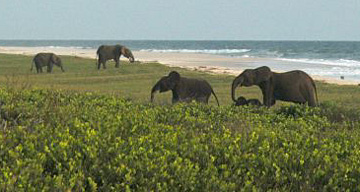
The moment I fell in love with Gabon was when my companions and I walked along the beach at sunset: an endless strip of white sand with no one in sight as far as the eye could see in any direction. Then we spotted movement, and we realized we were sharing the beach after all.

With three elephants.

The elephants had an animated conversation among themselves, presumably about the rare sighting of human beings, then ambled off into the rain forest to tell their friends.

This is my annual win-a-trip journey, in which I take a university student with me on a reporting trip to Africa. The winner this year is Mitch Smith, a University of Nebraska student who had never been outside the United States before. (He is writing about his trip on my blog, nytimes.com/ontheground).

Readers have sometimes complained that my win-a-trip journeys focus on the wretchedness of the developing world — warlords, malnourished children, maternal mortality. Frankly, I’ve always thought these critics had a point. So Mitch and I are starting this trip by covering an African triumph: Gabon’s bold steps to preserve its natural heritage.

Gabon has plenty of problems, including corruption and misspent oil revenues, but it is also covered by dense, uninhabited forest teeming with wildlife. In 2002, the government set aside more than one-tenth of the country for national parks — in one step, making Gabon a leader in wildlife conservation.

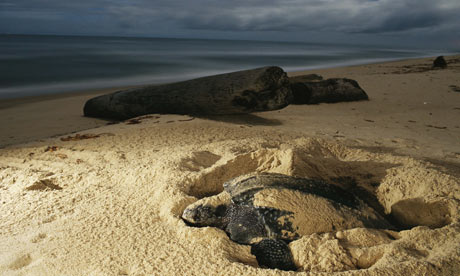
“Gabon is definitely a special place,” said Sebastiaan Verhage, an official here with the World Wildlife Fund, which is helping Gabon preserve its parks. “Where else do you see elephants roaming on the beach, buffalo on the beach, hippos in the surf, humpback whales mating just off the coast, the most important leatherback turtle nesting site in the world, one of the few last refuges for lowland gorillas? Its name of ‘the last Eden,’ ‘the last paradise on earth’ — that’s not too far-fetched.”

The head of the national parks is Lee White, a conservation specialist of Scottish origin. And the technical director is an American, Michael Fay, who famously walked across Gabon in 2000.

President Ali Ben Bongo, who took over last year from his late father, seems enthusiastic about developing a “Green Gabon.” He told me he would like to deepen the environmental protections and build up infrastructure so that Gabon can become an eco-tourism destination.

For now, that’s a problem. Gabon set aside the parks partly in hopes of diversifying its economy (it is dependent on oil, which is slowly running out) and becoming an African version of Costa Rica, bringing in revenue from tourism. But so far the economic bet isn’t paying off.

Very few foreign tourists are coming, because of the distance and the lack of modern hotels. Mitch and I ate lunch at one of the restaurants aiming for tourists, and afterward saw the staff cleaning our plates in the lagoon.

What’s more, thick forest isn’t great terrain to spot wildlife. On one walk along an elephant trail, Mitch and I smelled elephants all around us but never actually spotted them. (Elephants here normally are curious but shy — unless they’ve been nibbling on a root prized among local humans for its hallucinogenic properties, in which case be sure to accord them right of way).

Still, following elephant footprints through an untouched forest is magical. Here in the rain forest, humans seem less the masters of the ecosystem than components of it, along with others. Like gorillas.

I ran into Chloe Cipolletta, a gorilla expert I had met in the Central African Republic in 2006 on my first win-a-trip journey. Ms. Cipolletta was advising on a plan to bring tourists to visit gorillas in Gabon, and she mentioned offhand that some primates self-medicate herbally.

Development experts have been raving in recent years about the health benefits of deworming people in poor countries — but gorillas are way ahead of us. There is a furry forest plant that gorillas occasionally eat, despite evident distaste, making faces and spitting bits of it out. So why do they eat it? Ms. Cipolletta said the plant turns out to be a natural medication that kills intestinal parasites, and the gorillas are deworming themselves.

One sobering truth is that the people who gush about gorillas or elephants usually are Americans and Europeans. For local people, many of them very poor despite the country’s oil wealth, conservation can be an inconvenience. While visiting Loango, we encountered an outspoken young village chief, Evelyne Kinga, who protested that she’d rather elephants were dead than eating her cassava plants.

“The parks are for foreigners, or for rich Gabonese,” she said. “They’re not for ordinary people like me.”

That’s a real tension, and I don’t know whether Gabon can pull this off and monetize its spectacular forest the way it could monetize timber. But for the world’s sake, I’m hoping that it will.

Saturday, May 23, 2009

Op-Ed: Gorillas and Now Leatherbacks


Editorial from the New York Times
Gorillas and Now Leatherbacks
Published: May 21, 2009

Last year, scientists were surprised to discover a large population of western lowland gorillas, a species close to extinction, in northern Congo Republic. Now there is news of another extraordinary find. In a multi-year survey of nesting sites along the coast of Gabon, scientists have found a startling number of leatherback turtles, possibly as many as 40,000, enough perhaps to remove leatherbacks from the list of globally endangered species. This is very good news, especially coupled with the fact that most of the nesting sites were discovered within protected areas.

In both cases, these new populations were located by conducting surveys in regions that had not been thoroughly combed before. Beyond relief, they remind us of what scientists felt in much earlier times, when explorers routinely chronicled the biological largess this world had to offer. Wonder was the predominant note in their chronicles, but there was also a keen eye for economic potential. Behind it all was the feeling of plenitude, that the biological riches of this planet were essentially inexhaustible, no matter what human beings did. That was clearly and tragically wrong.

Which brings us back to sea turtles and gorillas. We've grown accustomed to very different kinds of surveys, like the recent one showing that chimpanzee populations had dropped by 90 percent in Ivory Coast, which was supposed to be a stronghold for the species. In a very real sense, we are still exploring the planet, gradually obtaining a more realistic census of what life looks like in the early 21st century. Now and then there will be good surprises, like the fact that as many as 40,000 leatherbacks are nesting in Gabon. But the question those good surprises ultimately raise is a simple one: for how long?

An original article on the discovery of 40,000 leatherback turtles can be found at the guardian online

Thursday, November 1, 2007

Shameless Self Promotion


Our paper on a Fatal Chimpanzee Attack in Loango National Park, Gabon came out today in the International Journal of primatology
You can CHECK IT OUT HERE

Fatal Chimpanzee Attack in Loango National Park, Gabon
Christophe Boesch, Josephine Head, Nikki Tagg, Mimi Arandjelovic, Linda Vigilant and Martha M. Robbins
International Journal of Primatology
Online first - Saturday, October 27, 2007


Abstract
In some populations, chimpanzees engage in lethal aggression within and between social units. We report a fatal attack on an adult male chimpanzee at a new research site in Loango National Park, Gabon. We found a fresh corpse of an adult male chimpanzee only a few hundred meters from the research camp, after noting numerous vocalizations and chimpanzee movements the previous evening. Previous contacts with chimpanzees and fresh tracks in the area around the corpse suggest that 2 communities of chimpanzees range where the attack occurred and that members of the neighboring community killed the chimpanzee. To support the conclusion, we conducted genetic analysis for 13 Y-chromosome loci and 9 microsatellite loci of fecal samples from the dead individual, 5 possible attackers, and 2 members of the other community Though we cannot exclude the possibility of an intracommunity killing, the combined observational and genetic evidence suggest an intercommunity attack. The case study adds to the growing evidence that intercommunity killings are a rare but widespread phenomenon among chimpanzees and not an artifact of human provisioning or habituation.
Keywords chimpanzees - fatal attack - gabon - intergroup conflict

Wednesday, April 25, 2007

Gabonese Gorillas on 60 minutes

CLICK HERE to watch a few clips from an episode of 60 minutes which featured Mike Fay in Gabon discussing logging, gorillas and re-introduction.