Since I have been really terrible at updating the blog (but pretty good at keeping up with the facebook blog posts) I've added the widget below so that facebook cross posts to the blog.
You shouldn't need to join facebook but can just click on the links in the widget to access the articles. If you have any problems or comments please mail me at arandjel 'AT' eva.mpg.de.
from mongabay.com U.S. signs debt-for-nature swap with Brazil to protect forests
The United States will cut Brazil's debt payments by $21 million under a debt-for-nature that will protect the Latin American country's endangered Atlantic Rainforest (Mata Atlantica), Caatinga and Cerrado ecosystems.
The agreement, announced Thursday, comes under the Tropical Forest Conservation Act (TFCA) of 1998, which to date has generated $239 million to protect tropical forests in Bangladesh, Belize, Botswana, Colombia, Costa Rica, El Salvador, Guatemala, Indonesia, Jamaica, Panama, Paraguay, Peru, and the Philippines. The Brazil deal is the 16th signed under the TFCA.
Funds under the latest debt-for-nature swap will go towards "activities to conserve protected areas, improve natural resource management, and develop sustainable livelihoods for communities that rely on forests," according to the U.S. Treasury Department.
The three ecosystems targeted are under greater threat than the better known Amazon rainforest.
The cerrado, a biologically-rich grassland that once covered an area half the size of Europe, is fast being transformed into croplands to meet rising demand for soybeans, sugarcane, and cattle. It is now disappearing more than twice as the rate as the neighboring Amazon rainforest.
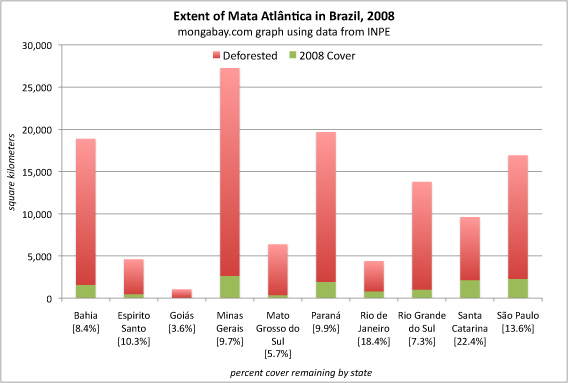
The Mata Atlântica is Brazil's most endangered rainforest, covering less than 8 percent of its original range. Logging and conversion for agriculture and cattle ranches have been the primary drivers of deforestation of the Mata Atlântica, which is found in some of Brazil's richest and most populous states. The ecosystem, which ranks as a global biodiversity hotspot with more than 250 species of mammals, more than 750 species of reptiles and amphibians and nearly 1,000 species of birds, is home to some of Brazil's most famous endangered species like the Golden Lion Tamarin.
The Caatinga is a dry tropical forest characterized by scrubby vegetation in northeastern Brazil, one of the country's poorest regions. Caatinga is under threat from clearing for cattle ranching and agriculture, as well as charcoal production and timber harvesting. The ecosystem is known for its rich bird life, including a number of endemic species like Lear's Macaw (endangered) and Spix's Macaw (now extinct in the wild).
"A Clockwork Origin" is the ninth episode of the sixth season of the animatedsitcom, Futurama. It aired on Comedy Central on August 12, 2010. In the episode, Professor Farnsworth leaves Earth after being frustrated by anti-evolutionists' illogical belief in "Creaturism", a form of Creationism. He and the Planet Express crew arrive at a lifeless planet and the Professor introduces nanobots into the environment. The nanobots rapidly begin evolving into mechanical organisms, allowing the crew to witness a whole new evolutionary history that unfolds before their eyes. The episode was written by Dan Vebber and directed by Dwayne Carey-Hill.
Chinchilla Poop Reveals How Much It Rained From Discovery News By measuring the size of poop pellets from these diminutive mammals, scientists reconstruct rainfall levels from centuries ago. BY JESSICA MARSHALL
THE GIST
Chinchillas deposit their waste in personal scrap piles full of plants and their poop that they glue together with urine.
Scientists find that measuring the size of these pellets can reveal rainfall amounts from previous years.
Reconstructing climate history of Chile's Atacama Desert could help reveal how events like La Nina affect Chile's rainfall.
Chinchilla poop is serving an unlikely purpose in one of the world's driest places, Chile's Atacama Desert. The animals' tiny waste pellets are helping scientists reconstruct the rainfall in the region over the last 14,000 years.
Reconstructing rainfall history of the Atacama can provide important information about how events like La Niña and El Niño affect Chile's rainfall, said Claudio Latorre Hidalgo of the Universidad Catolica de Chile and the Institute of Ecology and Biodiversity in Santiago. Knowing this is important for predicting the future water supply in Chile. About 98 percent of the population gets its water from sources in the Andes adjacent to the high Atacama.
Chinchillas (more formally called chinchilla rats) and other rodents deposit their waste in "middens," their own personal scrap piles full of local plants and their poop that they glue together with urine, which then crystallizes and soaks up moisture to form a seal.
The dry climate in the Atacama (and elsewhere including the southwest United States) preserves rodent middens for thousands of years. "Anything in the Atacama is preserved very well," said Latorre -- even the bodies of people unfortunate enough to be stranded in the desert more than 100 years ago, and mummies thousands of years old. In previous work, Latorre and others have analyzed the contents of various types of rodent middens to determine what plants, pollen, and insects, for example, were available to the rodents at the time the middens were deposited. They used radiocarbon dating to determine the middens' ages. "Each of these is like a little window into an ancient ecosystem," Latorre said. "If you collect enough of them, you can get a record of past variations at a single spot."
Now, Latorre's team has found that measuring the size of the poop pellets sealed inside chinchilla middens can reveal the amount of rain that fell at the time the chinchillas were going about their business. Changes in chinchilla pellet size correlate well with changes in precipitation levels, the team has found, presumably because more rain meant more plants, which in turn meant the animals could grow larger, making bigger pellets, and vice versa, Latorre said. Temperature did not correlate at all with pellet size, according to Latorre, whose team presented their results this week at a meeting of the American Geophysical Union in Foz do Iguacu, Brazil. By measuring pellet size in middens deposited in modern times when rainfall records exist, the team determined the relationship between chinchilla pellet size and amount of rain. They then used this relationship to estimate how much rain fell at points throughout the past 14,000 years, by measuring and radiocarbon dating the animals' poop.
The results show increases in rainfall at 11- to 13.8-thousand years ago, and again about one- to two-thousand years ago. The Atacama is one of the driest places on Earth, with less than 10 percent humidity. Records indicate it has been a hyper-arid desert with less than 30 mm (1.2 inches) of rain per year for about 10 million years. "The Atacama desert is a region with very few paleoclimatic records and the few proxies that exist (e.g. lake sediment) have proven very difficult to accurately date and interpret," said Mathias Vuillle of the University of Albany, in New York. "The midden analysis by Latorre's group is therefore a very important alternative way to learn about how and when climate has varied in this region."
A new paper and forthcoming book by Pat Shipman puts forth the following:
A suite of unique physical and behavioral characteristics distinguishes Homo sapiens from other mammals. Three diagnostic human behaviors played key roles in human evolution: tool making, symbolic behavior and language, and the domestication of plants and animals. I focus here on a previously unrecognized fourth behavior, which I call the animal connection, that characterized the human lineage over the past 2.6 million years. I propose that the animal connection is the underlying link among the other key human behaviors and that it substantially influenced the evolution of humans.
To some extent this challenges the wolf co-domestication hypothesis nicely outlined in the review "Top dogs: wolf domestication and wealth" by Carlos A Driscoll and David W Macdonald:
The initial association of wolves and humans was doubtless instigated by the wolves [9,21]. But, insofar as domestication did not happen overnight, there must have been cultural continuity of wolf tolerance initially and of proto-dog keeping subsequently. A plausible scenario is that proto-domestic wolves were resident scavengers at the rubbish dumps of permanent settlements rather than nomadic camp followers: both wolves and dogs continue in much this role in some places today [22]. Indeed, they perpetuate the general canid dynamic of intraguild competition [23] whereby smaller canids (in this case smaller, domesticated, doggish wolves) can survive the aggression of larger ones (wild wolvish wolves) only with access to a refuge - in this case the umbrella, intended or otherwise, of a companion animal, namely humans. By analogy, and perhaps in a direct parallel, molecular evidence shows that contemporary wild wolf populations - the migratory wolves of the tundra compared with territorial populations of the boreal forest - do not interbreed although they overlap geographically for much of the year [24]. These different lifestyles promote reproductive isolation in ways perhaps reminiscent of the divergence of proto-dogs and wolves.
and why is tool making still considered a hallmark of human evolution, didn't Jane Goodall prove that it wasn't so in the 70s?
A woman ends her marriage of 12 years, begins dating and finds love again — but this time, with another woman.
For many years, researchers assumed so-called "late-life lesbians" were simply repressed by society until they felt comfortable coming out. But that's not entirely the case, says Lisa Diamond, a researcher at the University of Utah who is studying whether sexuality is fluid or fixed. Diamond has been studying a group of 79 women for 15 years to track changes in their sexuality.
"It does appear to be that women's erotic desires are pretty tightly linked to their emotional feelings," she tells NPR's Guy Raz. "So for some of these women, they authentically did not feel attracted to women before they met one particular woman that they completely fell in love with."
Take Macarena Gomez-Barris, an associate professor of sociology and American studies and ethnicity at the University of Southern California. She married her husband in her early 20s, but then, like more than half of married couples in America, they hit a wall. Her husband said she was working too much. She said that she knew she was but that she had to support their family. In 2007, they separated. She was 36.
"Then [I] started dating and soon found this person I was attracted to and began dating her," Gomez-Barris tells Raz.
"The feeling of attraction was strong," she says. "What made sense to me was this feeling of the magnetic pull of this person and realizing [that I had become] open to the possibility of being with another female-bodied person."
The researcher, Diamond, says it's hard to know whether the capacity for women to feel attracted to other women increases as they age.
"A safer conclusion to draw is that as time goes on, women have more opportunities to discover that capacity. They have more diverse relationships. Their life patterns change. Their careers change. They often become more expansive in their thinking, more open-minded," she says. "And I think those sorts of things can create a context in which a woman might have always had that capacity to become attracted to women, but might never have had the opportunity until she reaches a certain stage in her life."
Diamond also points out that a lot of the neurobiological pathways that are involved in sexual desire are similar — and in some cases identical — to the neurobiological underpinnings of romantic love.
Although we normally think about people becoming sexually attracted to someone first and then falling in love with them, she says, it can happen the other way around.
The women Diamond studied who became lesbians later in life were more confused than upset, she says. For a lot of the women, the experience was very satisfying.
"The women would say, 'I don't know what's going on, but I love this woman. I've never felt like this before,'" she says.
Diamond and other researchers are now trying to understand why some individuals have more of a capacity for fluidity than others and why some individuals' experience of their sexual orientation is so different than that of others.
"You can have a whole group of lesbian and gay and bisexual and unlabled individuals in the same room, and they all might be experiencing same-sex attractions for slightly different reasons and in slightly different ways," she says. "Now the puzzle is to figure out why that is and how to explain it developmentally."
I remember reading this article in Newsweek way back when and have been searching for it since, and today while doing my background reading for the previous post, i finally found it. A good companion piece is Nicholas D Kristof's op-ed on why we need to get money into African women's hands. Also Pray the Devil Back to Hell trailer (about how Liberia's women rose up against tyranny) at the bottom. Enjoy! -MA From http://www.msnbc.msn.com/id/12014185/site/newsweek/ Newsweek, April 3, 2006 issue Healing Powers African women are starting to take charge—making new laws, changing old attitudes, inspiring others to follow their lead. Who will help them mend a broken continent? by JOSHUA HAMMER with Alexandra Polier in Kigali
The national legislature on Monrovia's Capitol Hill is a forlorn wreck of a place, its façade peppered with bullet holes from the country's civil wars, its interior crumbling after two decades of looting and neglect. Legislators wander through darkened hallways that haven't had lights for years; the ceilings are so torn up they look as if they've been hit by mortar rounds. But on a recent Monday, red, white and blue bunting festooned the Joint Chamber and a volunteer band played jauntily on the balcony. Liberian tribal chieftains, Western ambassadors and other dignitaries filed in, buzzing with expectation. Ellen Johnson-Sirleaf, the first elected female leader in Africa's history, was coming to call.
Sweeping in with her entourage at 5 o'clock sharp, Johnson-Sirleaf, who looked both regal and grandmotherly, cast barely a glance over the rogues' gallery that packed the dim hall. There in the front row sat Sen. Adolphus Dolo, formerly known as General Peanut Butter, who stands accused of committing gross abuses as a wartime commander in rural Nimba County. Just behind him, smirking beneath a flaming red cap, was Sen. Prince Johnson, the leader of a breakaway rebel faction that hacked the ears off President Samuel Doe, then killed him, in 1990.
Glowering beside Johnson-Sirleaf on the podium was the new Speaker of the House, Edwin Snowe, accused by opposition leaders and human-rights groups of looting millions of dollars from the Liberian Petroleum Refinery Corporation. (Snowe denies the charge.) Front and center sat Sen. Jewel Howard Taylor, ex-wife of and First Lady to former warlord and president Charles Taylor. Hanging over everything was the specter of Taylor himself, who fled the country in 2003 and has since been accused of stirring up violence from afar.
Yet if Johnson-Sirleaf felt intimidated by the predators who surrounded her, she didn't show it. Instead, she displayed a genteel defiance toward those who wish her harm, and gave hope to those who regard her as a political savior. (A stunning 470,000 voters, or 60 percent, chose her in the November 2005 election.) Standing upright at the podium, she vowed to root out theft from the public coffers and announced a plan to establish a "code of honor" for all civil employees. "Mr. Speaker," she proclaimed, staring directly at Snowe, "we will fight this cancer of corruption."
Nobody doubts her sincerity. But look at what she's up against. For decades, men driven by a lust for power and self-enrichment have ruled the country and stripped it bare. Between 1990 and 2003, ragtag militiamen murdered, raped and plundered with abandon, leaving 150,000 dead and displacing half of the country's 3 million people. Monrovia hasn't had electricity since 1991. Unemployment stands at 80 percent, most schools have been shut down and the infant-mortality rate, at 129 per 1,000 births, is among the worst in the world. Annual per capita income, about $100, is the lowest anywhere.
Can this 67-year-old grandmother, this Harvard-trained economist who has never held a gun and, according to all who know her, never embezzled a dime, really rebuild her ruined country? She has the support of powerful allies—including George W. Bush, whom she met in Washington last week, and U.N. Secretary-General Kofi Annan. But how will she be able to work with the thugs who dominate the legislature? "We believe in redemption," Johnson-Sirleaf told NEWSWEEK. The war criminals in the government, she said, "were elected by the people in a free and fair process, and we accept the decision of the people, who have forgiven them. Unless they revert to their own former practices, we'll give them the benefit of the doubt."
Johnson-Sirleaf's ascendance is the most dramatic development in a quiet revolution transforming Africa. Across the continent, women's empowerment initiatives, disgust with male-dominated politics-as-usual and the inspiring examples of a few female leaders are propelling women to positions of clout in record numbers. Women in at least a dozen African countries are breaking the male stranglehold on national legislatures, cabinets, courts and other government institutions. They're making laws, changing attitudes, inspiring other women to follow them.
The women's revolution has come about partly by necessity. In Rwanda, the genocide led by the Hutu Army and militias nearly wiped out the male Tutsi population. When the killing ended in July 1994, women outnumbered men by seven to three. The government recognized that it faced a crippling shortage of men, and set aside nearly a third of parliamentary seats for female representatives. Now women make up half of Parliament—the largest percentage anywhere in the world.
But Africa's transformation also reflects a growing recognition that the corruption, civil war and decay that have plagued the continent for generations have been largely the work of men. In the past few years, grass-roots women's groups have been sounding a distinctly feminist message, arguing that the qualities displayed by women at the family level—fiscal integrity, maternal nurturing—may be what Africa needs to lift itself off its knees. Give an African woman a loan, they argue, and she'll spend it on her children's school fees and food for the family. Give it to a man, and he'll just as likely fritter it away.
Women certainly have different problems and priorities than men. Across Africa, they're often deprived of education, job opportunities, even the choice of marital partners. Rape is seldom punished. Polygamy is widespread, which has led to spiraling HIV-infection rates. Most African women have no right to own property. Yet the new female politicians are confronting these and other issues that their male counterparts haven't been willing to touch.
Johnson-Sirleaf, who suffered a rape attempt while in jail 20 years ago, worked with a group of female lawyers last year to push Liberia's transitional government to prescribe far tougher sentences for rapists. New laws guaranteeing a woman a sizable share of her late husband's estate just went on the books in Rwanda and Liberia. And microfinancing schemes aimed at freeing women from dependence on men are flourishing. As more women enter legislatures and raise awareness, issues such as inheritance rights, genital mutilation and wife abuse are all coming to the fore. Just as significant, a few African women have proved that they can match or exceed the abilities of men in areas that used to be off bounds—such as law enforcement and security.
Travel now to Lagos, the fetid commercial capital of Nigeria, long regarded as one of the most corrupt, dangerous countries on earth. In the hulking Federal Secretariat building on Lagos Island, Dora Akunyili stands ankle deep in the charred remains of her former office, eying burned air conditioners and dangling wires that still smell of smoke. This is the first time that Akun-yili has been back since March 2004, when arsonists doused four floors of the building with gasoline and set them alight. It was part of an effort by gangs to intimidate her and the law-enforcement agency she runs: the National Agency for Food and Drug Administration and Control, or NAFDAC. "It's depressing being back here," says Akunyili, a 50-year-old mother of three who has become one of the first women to run a police agency in Africa. "But it tells you just how desperate these people are."
Born in southeastern Nigeria to an educated family, Akunyili was a midlevel civil servant with a degree in pharmacology when she inadvertently drew the attention of powerful men in government. While working for the Petroleum Trust Fund, supervising the distribution of oil dividends in villages in southeast Nigeria, she was diagnosed with a potentially fatal pancreatic disorder. Given an $18,000 grant from the PTF, she flew to London for emergency surgery. The diagnosis proved wrong, and Akunyili did the unthinkable: she returned the money. Nigeria had just thrown off years of military rule and established a democracy, and the new president, Olusegun Obasanjo, was looking for a few good men—and women—to clean up the country's tainted agencies. He summoned Akunyili to Abuja, and offered her a job leading the fight against counterfeit drugs.
When Akunyili took over NAFDAC in February 2001, the organization was understaffed and demoralized. Counterfeit drug cartels operated with impunity, protected by corrupt judges, Customs agents and police. In league with manufacturers in India and China, the cartels flooded pharmacies and markets with phony antimalarial pills, antibiotics, blood thinners and dozens of other drugs. According to one study at the time, 80 percent of the pharmaceuticals in Nigeria were fakes. "People were dying in hospitals because of this," says Akunyili, who lost her own sister to an injection of fake insulin. "It was a disgrace."
Weeks after taking over NAFDAC, Akunyili targeted the leader of the most powerful cartel, Marcel Nnakwe, a multimillionaire with an army of bodyguards and protectors high in the government. She pressured wholesalers to reveal Nnakwe's secret warehouses, and acquired product samples for testing. When results proved his drugs were fakes, Akunyili demanded—and got—a confession and a public letter of contrition.
The gesture was meaningless. Fetishes turned up in Akunyili's office as a warning: chicken feathers dipped in blood, a dried tortoise, cowrie shells, beads. Her aides and staff were terrified. Akunyili put a permanent guard at the door, but also stationed agents at ports and seized container loads of phony pharmaceuticals destined for Nnakwe. She raided more warehouses, and NAFDAC destroyed piles of seized drugs in huge bonfires in Lagos.
In December 2003, assassins came for Akunyili. They pulled alongside her Peugeot sedan as she was being driven to work, and opened fire with AK-47s. A bullet grazed her scalp; another killed a bus driver. After the attempt on her life, Akunyili sent her three children—ages 18, 25 and 27—out of the country. But she refused to flee. "If I left after the shooting, I'd look like a coward," she told NEWSWEEK. "I told my family, 'Let me strive to complete my five years'."
Last year Nnakwe and his son were charged in an Abuja court with organizing the attempted hit. But six months into their trial, the judge abruptly announced he had no jurisdiction and freed the defendants. They have gone into hiding. "I suspect it was not just a bribe but a threat [that caused the judge's ruling]," Akunyili says. Despite the setback, Akunyili's crackdown on the cartels has been a huge success. A 2004 study conducted by Britain's Department for International Development said that fake drugs in circulation in Nigeria had declined by 80 percent since she took over. Trust has largely been restored to the pharmaceutical industry. And though Nnakwe remains at large, his drug empire has been broken.
Some countries will be harder to repair than others. In the hallways of Rwanda's National Parliament on the verdant outskirts of Kigali, the chatter and laughter of dozens of women resound through the corridors. It's a dramatic counterpoint to the mortar rounds and machine-gun fire that echoed here a dozen years ago, when Rwandan Patriotic Front guerrillas fought a fierce battle for Parliament with the genocidal Hutu regime. During the war and genocide, hundreds of thousands of Tutsi women and girls were raped, and tens of thousands contracted AIDS. Now, partly in response to that crime, many female legislators have joined forces to rewrite the law—and change the way Rwandan men regard women.
The unprecedented campaign began early last year. Female lawmakers drove through 22 districts, gathering anecdotal evidence from women about their experiences. The progressive sexual-rights bill they drafted establishes a sentence of 15 years for rape, makes spousal abuse a crime, guarantees women an equal split of assets in the event of a divorce, allows them to gain custody of their children and requires that the government set up shelters for victims of wife beating. The bill has received backing from President Paul Kagame, and stands an excellent chance of becoming law this year. "The world is looking to us as role models for gender-based violence," says Rep. Judith Kanakuze, who cosponsored the bill.
Few other African nations have been as progressive. Women in Kenya still have no rights to own property, rape is seldom punished and gender violence appears to be on the rise. Even in countries where tough new laws exist on paper, enforcing them will be difficult. Some 90 percent of Liberian women are illiterate, which makes it hard for them to claim their rights under new property and rape laws passed in 2003 and 2005. But they couldn't ask for a better advocate than Ellen Johnson-Sirleaf.
The new president knows the painful contours of their lives. Although a person of privilege—who had ample opportunities to remain in the West and live a comfortable life—she repeatedly returned home in the face of danger. She says she was raised that way. Her indigenous parents—both adopted as children by Americo-Liberians, the descendants of freed slaves who founded Liberia in 1847—were role models. Her father was the first native Liberian to win election to the country's Congress, but his career was cut short by a crippling stroke when he was in his 40s. Martha Johnson, Ellen's mother, was the family breadwinner, an itinerant Methodist minister who cared for her invalid husband and four kids. Mom traveled from church to church by canoe, often taking the children along. "The things we did as kids instilled hard work and honesty," says the president. "We did chores before and after school, we said prayers every morning. We understood the sanctity of 'do not steal'."
Ellen could have been killed on any number of occasions. She was Finance minister in 1980 when soldiers led by Sgt. Samuel Doe murdered President William Tolbert and seized power. Days later the rebels rounded up 13 top officials, tied them to stakes on a Monrovia beach and shot them dead before a cheering crowd. Johnson-Sirleaf was one of a handful of regime insiders who weren't executed. Five years later, after rival officers attempted another coup, Johnson-Sirleaf again was high on Doe's enemies list. Locked inside a Monrovia prison with 15 men, she cowered in terror as soldiers led her cellmates into a courtyard and executed them. Later that night, one of the killers came back to rape her; she was rescued by a sympathetic guard. "Doe had the opportunity to kill me, but whether because of my international contacts, or my positions, he never gave the instructions to do it," Johnson-Sirleaf says. She spent six months in prison, then was acquitted. She fled to the United States shortly after that.
She knows what it means to grab for a thin reed of hope, only to have it break. In the late 1980s, when Charles Taylor was assembling a ragtag rebel force in Côte d'Ivoire, Johnson-Sirleaf gave him aid and encouragement. "So many people supported him in the early days," Johnson-Sirleaf recalls. "But he betrayed everybody. He was hungry for power." Taylor and his rivals fought a vicious civil war for seven years. When it subsided, Johnson-Sirleaf returned to Liberia and challenged Taylor in elections. But the country was volatile, and most feared that if Taylor lost, he'd return to the bush and restart the war. He won with 75 percent of the vote.
Now that she's finally in control, Johnson-Sirleaf needs all the support she can get. Yet expectations are so high, say analysts and diplomats, that Liberians face an inevitable letdown. Already, female activist groups have complained that she didn't appoint enough women to her cabinet, and foes in Congress reprimanded her for making a state visit to Gabon without their permission. She was forced to dial back on a campaign pledge to restore electricity across Liberia in 150 days; she says now that she'll turn some lights on in Monrovia within six months.
Other pressures are growing on Johnson-Sirleaf from outside the country. During an interview with NEWSWEEK at the end of January, she blasted the European Union for threatening to withhold aid until she leans on Nigeria to extradite Charles Taylor to face trial for war crimes. "I just think they're passing the buck on to me," she said, eyes flashing with annoyance. "They should have taken care of this issue before I came to office. It's hanging over my head."
Two weeks ago, she bowed to pressure and publicly called for Taylor's extradition to the war-crimes tribunal in Sierra Leone —risking a backlash by Taylor loyalists. Nigeria later agreed to turn him over to Liberian custody. "I believe that Ellen's personal survival is at risk," says Minister of Gender and Development Varba Gayflor. "I told the U.S. Embassy, 'Guard the life of Ellen Sirleaf, whatever else you do'."
Fifteen thousand U.N. peacekeepers have kept Liberia quiet since 2003. And the U.S. government has committed $1 billion through 2006 to support the peacekeepers, rebuild Liberia's infrastructure and provide demobilized soldiers with education and jobs. Johnson-Sirleaf can't afford to dwell on the dangers. "I've invested my time, my life, my safety in this country, and the Liberians have always defended me," she told NEWSWEEK. "Now I need to stand by them."
She downplays her role as an African pioneer. "I always start from the note that I'm a technocrat who happens to be a woman," she says. "We're not running a women's government." Still, she says she'll keep pushing for women's rights, making sure that rapists get prosecuted, perhaps even setting government hiring quotas. As a result of her success and the achievements of other women on the continent, Johnson-Sirleaf says, "Women know not only that they can compete, but also that they can excel. They can be mothers and also professionals. They know that we don't have to be stuck in the backyard." It's a shining model for Africa, and even the world. But it's far from complete. If Johnson-Sirleaf fails—if her friends and allies allow her to fail—this model will end up like so many others on the continent, a model of despair.







 Posts
Posts


