its my favorite day of the year!!! this post is sorta unrelated, but its funny and I will just file it under "society" -MA
Saturday, October 30, 2010
Thursday, October 28, 2010
The Worst Science Jobs 2010
As a side note - I am a shit-stirrer by trade, and its really not that bad ;P and the last job seems awesome! To see a list from 2009 - check out this old post -MA
From io9.com
by ANNALEE NEWITZ
Fart collecting and testicle mashing: The grossest jobs in science
Fart collecting and testicle mashing: The grossest jobs in science Considering a career in science? You know, all those clean labs and shiny white coats? Well consider this: A lot of science jobs are more disgusting than all the Saw movies put together. We round up seven of the grossest.
Beetle testicle crusher
Do the size of your balls help you find a mate? To answer this burning question, a group of researchers in Japan set out to study whether big-balled beetles scored more with the ladies than small-balled beetles. To do this, I'm afraid, they sacrificed a lot of beetle balls. And to measure their size and volume, they had to grind up their little sacs and measure the volume of each one. The good news is that you don't need big balls to enjoy reproductive success in the beetle world. The bad news is that there are some really sad beetles limping around the lab right now.
Corpse grinder
Sometimes forensic scientists have to analyze corpses after they've been buried. In cases where they are trying to identify the person buried, or do toxicology studies (to see if the person may have been poisoned, for example), they need to get samples of the dead person's DNA. So they exhume the body, take chunks of bone or tissue, grind it up, filter out the DNA, and sequence as much of it as they need to for their research. It's just like that famous cult movie Corpse Grinders, except without the cat food thing.
Whale snot collector
One of this year's IgNobel Prizes for weird science went to three biologists who spent so much time collecting whale snot (to study disease patterns) that they actually invented a special remote-controlled helicopter to scoop up the goo for them. Not only do these brave researchers spend their days sifting through giant whale boogers, but now they have a robot slave to help out. Extra points for evil minionage!
Shit-stirrer
Many studies have been done on the microbes that live in animal guts, from mice to humans. Before scientists get to play around with their fancy DNA sequencers, somebody has to collect what once research team delicately referred to as "freshly voided fecal matter." And then they have to put that steaming poop into a special solution and shake it up. That's right - in labs all over the world, there are genomics and proteomics researchers who are shaking up giant bottles full of poop.
Bacteria chaser
Although bacteria may be the most awesomely adaptable creatures on the planet, they aren't exactly easy on the nose. In fact, scientists who study extremophiles - microbes that live in highly acidic areas, or in regions of intense heat or cold - often have to gather their samples in areas that smell hideous and are intensely hot. It's a stinky job, but somebody has to do it.
Fart statistician
How do you know when you fart too much? Because gastroenterologists have studied human fart production, figured out what the average number of daily farts should be, and determined that levels above that might indicate a medical problem. All hail the fart counters, who are keeping our gastrointestinal tracts healthy. And because I know you want to know: The mean number of farts in humans is "13.6 episodes per day," according to one expert.
Drunken hookup data analyst
Is it true that people look more attractive after you've tossed back a couple of drinks? To find out, a group of long-suffering researchers had to ask drunk people in bars who they would hit. These social scientists endured the real-life version of reading comment threads on YouTube, and discovered - not surprisingly - that people get more attractive the more obnoxiously wasted you get.

From io9.com
by ANNALEE NEWITZ
Fart collecting and testicle mashing: The grossest jobs in science
Fart collecting and testicle mashing: The grossest jobs in science Considering a career in science? You know, all those clean labs and shiny white coats? Well consider this: A lot of science jobs are more disgusting than all the Saw movies put together. We round up seven of the grossest.
Beetle testicle crusher
Do the size of your balls help you find a mate? To answer this burning question, a group of researchers in Japan set out to study whether big-balled beetles scored more with the ladies than small-balled beetles. To do this, I'm afraid, they sacrificed a lot of beetle balls. And to measure their size and volume, they had to grind up their little sacs and measure the volume of each one. The good news is that you don't need big balls to enjoy reproductive success in the beetle world. The bad news is that there are some really sad beetles limping around the lab right now.
Corpse grinder
Sometimes forensic scientists have to analyze corpses after they've been buried. In cases where they are trying to identify the person buried, or do toxicology studies (to see if the person may have been poisoned, for example), they need to get samples of the dead person's DNA. So they exhume the body, take chunks of bone or tissue, grind it up, filter out the DNA, and sequence as much of it as they need to for their research. It's just like that famous cult movie Corpse Grinders, except without the cat food thing.
Whale snot collector
One of this year's IgNobel Prizes for weird science went to three biologists who spent so much time collecting whale snot (to study disease patterns) that they actually invented a special remote-controlled helicopter to scoop up the goo for them. Not only do these brave researchers spend their days sifting through giant whale boogers, but now they have a robot slave to help out. Extra points for evil minionage!
Shit-stirrer
Many studies have been done on the microbes that live in animal guts, from mice to humans. Before scientists get to play around with their fancy DNA sequencers, somebody has to collect what once research team delicately referred to as "freshly voided fecal matter." And then they have to put that steaming poop into a special solution and shake it up. That's right - in labs all over the world, there are genomics and proteomics researchers who are shaking up giant bottles full of poop.
Bacteria chaser
Although bacteria may be the most awesomely adaptable creatures on the planet, they aren't exactly easy on the nose. In fact, scientists who study extremophiles - microbes that live in highly acidic areas, or in regions of intense heat or cold - often have to gather their samples in areas that smell hideous and are intensely hot. It's a stinky job, but somebody has to do it.
Fart statistician
How do you know when you fart too much? Because gastroenterologists have studied human fart production, figured out what the average number of daily farts should be, and determined that levels above that might indicate a medical problem. All hail the fart counters, who are keeping our gastrointestinal tracts healthy. And because I know you want to know: The mean number of farts in humans is "13.6 episodes per day," according to one expert.
Drunken hookup data analyst
Is it true that people look more attractive after you've tossed back a couple of drinks? To find out, a group of long-suffering researchers had to ask drunk people in bars who they would hit. These social scientists endured the real-life version of reading comment threads on YouTube, and discovered - not surprisingly - that people get more attractive the more obnoxiously wasted you get.
1 comments

 Labels:
alcohol,
cetaceans,
death,
forensics,
homo,
insects,
non-invasive,
poop,
pop science,
society,
whales
Labels:
alcohol,
cetaceans,
death,
forensics,
homo,
insects,
non-invasive,
poop,
pop science,
society,
whales
 Labels:
alcohol,
cetaceans,
death,
forensics,
homo,
insects,
non-invasive,
poop,
pop science,
society,
whales
Labels:
alcohol,
cetaceans,
death,
forensics,
homo,
insects,
non-invasive,
poop,
pop science,
society,
whales
Wednesday, October 27, 2010
ZOOLOGY ADMITS DEFEAT OVER COCKS, TITS AND BEAVERS

From the Daily Mash
Thanks to Amanda S for the link!
BEAVERS are to be renamed 'riverdogs' after zoologists finally conceded defeat to the overwhelming forces of sexual innuendo.
The move comes after conservationists admitted that vital research was being hampered by email spam filters which prevent the exchange of information on species such as the dik-dik, the blue tit and the cock-eared fuckmonkey.
Professor Nikki Hollis, a beaver, tit and cock specialist at Reading University, said: "In a world retarded by the proliferation of free internet pornography and the children's magazine Nuts, it is no longer viable for any species to have a name that is transferrable to the male or female genital parts."
She added: "Last week I addressed a conference in Geneva on the threats posed by global warming to the natural habitats of the beaver, the booby and the shag.
"I then faced a series of what I strongly believe were non-zoological questions, such as 'aren't beavers supposed to be wet?' and 'are the hairiest beavers more waterproof?'"
Wildlife bodies have now agreed that tits should be renamed 'skylings', thrushes will become 'horse sparrows' and all varieties of cock bird shall henceforth be known simply as 'Ian'.
But Professor Henry Brubaker, of the Institute for Studies, warned: "In terms of stimulating students' interest in the natural world, we believe it would be beneficial if more animals had names that were not only sexually suggestive, but overtly obscene.
"Would teenagers not be more receptive to the plight of the Asiatic fox if it were called the red spunker? Would the orangutan not have more charitable sponsors if it were called the fannydongball?"
He added: "Professor Hollis may be very worried about her tits, but I think they're stunning."
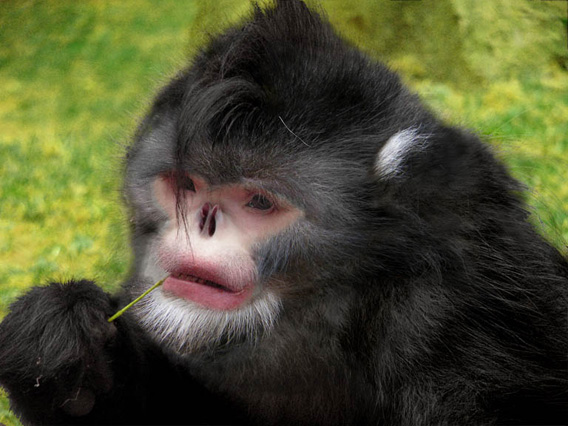
*updated* New monkey with a hairdo discovered in Myanmar

With no photos yet of a living Myanmar snub-nosed monkey, this image was reconstructed using Photoshop, based on a Yunnan snub-nosed monkey and the carcass of the newly discovered species, the Myanmar snub-nosed monkey. Image by: Dr. Thomas Geissmann.
From Mongabay.com
new monkey discovered in Myanmar
by JEREMY HANCE
Described in the American Journal of Primatology, the new monkey, dubbed the Myanmar snub-nosed monkey (Rhinopithecus strykeri), was only discovered after researchers heard reports from hunters of a strange monkey with upturned nostrils and prominent lips. It is known locally as mey nwoah,or 'monkey with an upturned face'.
Locals have an easy time finding the species, since, according to them, it sneezes whenever it rains. Rainwater collects on the monkey's upturned noses causing them to sneeze. To combat this, the monkeys spend their rainy days with heads tucked between legs.
The new primate is especially notable for being the only snub-nosed monkey known in Myanmar. The other four snub-nosed monkey species are found in parts of China and Vietnam.
Frank Momberg, FFI’s Regional Program Development Coordinator in the Asia Pacific and co-author of the paper, told mongabay.com that this new species proves "snub-nosed monkeys must have had a much largest distribution in China and adjacent areas in the past," adding that "[the new species] is most closely related to the Yunnan snub-nosed monkey. However, the two species are morphologically very distinct and are now separated by two major species barriers, the Salween and the Mekong River."
Researchers believe only 260-330 individuals survive of the new species, which would rank it as Critically Endangered according to IUCN Red List standards. Unfortunately, the new species faces a large variety of threats.
"Snub-nosed monkey get frequently trapped in traps laid out for bears. Local hunters also use shotguns. Until 8 years ago hunting was primarily for subsistence use only. Since Chinese logging roads are moving closer, hunting is now increasingly supplying bushmeat for local logging and dam construction camps, as well as feeding into the wildlife trade to China," Momberg says.
But overexploitation of the species isn't the only concern.
"By next year Chinese logging companies will have moved into the Myanmar snub-nosed monkey range, which will cause serious degradation of their habitat and increase hunting pressure," Momberg says.
Saving the Myanmar snub-nosed monkey will require quick work on many different issues, according to Momberg. First, the Chinese government must "crackdown on illegal Chinese logging in the area" and "step-up law enforcement of CITES regulations by Chinese customs officers to reduce trans-border illegal wildlife trade."
A protected area should be established in the Myanmar snub-nosed monkey's range, a recommendation already given by the China Power Investment Corporation, which is building a dam in Myanmar.
In addition, conservationists must work quickly with local people to minimize hunting and trapping, as well as provide income.
Momberg recommends that conservationists "develop a community-based conservation program for the Myanmar snub-nosed monkey range, involving all surrounding villagers in the conservation initiative. Employ local hunters as species guardians and provide alternative livelihoods for forest dependent communities."
The discovery of a new monkey in Myanmar proves just how little we know about the country's wildlife according to Momberg.
"There is plenty of more species to be discovered [in Myanmar], even mammal species. Myanmar is a priority country for biodiversity conservation with currently the second highest deforestation rate in Asia after Indonesia."
REFERENCE: Geissmann. T, Lwin. G, Aung. S, Naing Aung. T, Aung. Z M, Hla. T, Grindley. M, Momberg. F, “A new species of Snub-nosed monkey, Genus Rhinopithecus Milne-Edwards, 1872 (Primates, Colobianae), From Northern Kachin State, Northeastern Myanmar”, American Journal of Primatology, Wiley-Blackwell, October 2010, DOI: 10.1002/ajp.20894
--
*update*
here is an actual picture of the new species moments before it was eaten, from National Geographic

Tuesday, October 26, 2010
Hippo saves infant wildebeast and zebra from drowning
From Africa Geographic
Two miracle rescues by a hippo
We believe this might be the first ever recorded rescue of a baby zebra and wildebeest by the same hippo on the Mara River close to Lemala Mara camp. Both were rescued within space of 10 minutes as they crossed over from the Lamai side. The photos and videos were captured by Michael Yule and other guests as they were watching a major wildebeest crossing at the time.

Two miracle rescues by a hippo
We believe this might be the first ever recorded rescue of a baby zebra and wildebeest by the same hippo on the Mara River close to Lemala Mara camp. Both were rescued within space of 10 minutes as they crossed over from the Lamai side. The photos and videos were captured by Michael Yule and other guests as they were watching a major wildebeest crossing at the time.
The hippo was watching as the wildebeest herd swam past. As soon as the calf jumped in, the hippo swam up to it and pushed it along all the way across until it had reached safety on the other side. It then went back and did the same for a zebra foal just minutes later.
The wildebeest and zebra are now moving down in large numbers from the Masai Mara across the Lamai plains and crossing the Mara River. Guests of Lemala Camp are witnessing crossings every day. Some of the herds have arrived north of Lobo.
From the 15th of November, Lemala Ndutu will be newly appointed with the larger styled tents. As this camp moves to the banks of the Mara River in the Northern Serengeti, the Mara Camp as from 1st of June 2011 will also have the new tents.
We still have space available at Lemala Mara and your guests might just witness the miracle rescues again. It appears the crossings will continue until end of October and possibly longer if there are showers and the wildebeest return to the Lamai and Kogatende areas.
Saturday, October 23, 2010
wtf: Croc escapes on board DRC plane, panic spreads, plane crashes.

Original post from Jeune Afrique (in french)
from News.com.au
Crocodile on plane kills 19 passengers
(There is also video of the crash here)
A STOWAWAY crocodile on a flight escaped from its carrier bag and sparked an onboard stampede that caused the flight to crash, killing 19 passengers and crew. The croc had been hidden in a passenger's sports bag - allegedly with plans to sell it - but it tore loose and ran amok, sparking panic. A stampede of terrified passengers caused the small aircraft to lose balance and tip over in mid-air during an internal flight in the Democratic Republic of Congo. The unbalanced load caused the aircraft, on a routine flight from the capital, Kinshasa, to the regional airport at Bandundu, to go into a spin and crash into a house.
A lone survivor from the Let 410 plane told the astonishing tale to investigators.
Ironically the crocodile also survived the crash but was later killed with a machete by rescuers sifting through the wreckage.
British pilot Chris Wilson, 39, from Shurdington, near Cheltenham, Glocs was acting as the plane's first officer alongside Belgian pilot Danny Philemotte, 62, who was owner of the plane's operator Filair. The plane smashed into an empty house just a few hundred metres from its destination.
"According to the inquiry report and the testimony of the only survivor, the crash happened because of a panic sparked by the escape of a crocodile hidden in a sports bag,” news organisation Jeune Afrique reported.
"One of the passengers had hidden the animal, which he planned to sell, in a big sports bag, from which the reptile escaped as the plane began its descent into Bandundu."The terrified air hostess hurried towards the cockpit, followed by the passengers." The plane was then sent off-balance "despite the desperate efforts of the pilot", said the report. "The crocodile survived the crash before being cut up with a machete."
The plane was a Czech-made Let L-410 Turbolet, one of more than 1,100 produced as short-range transport aircraft and used mainly for passenger services.
Wednesday, October 20, 2010
Subscribe to:
Posts (Atom)


 Posts
Posts