translate

Site update

Since I have been really terrible at updating the blog (but pretty good at keeping up with the facebook blog posts) I've added the widget below so that facebook cross posts to the blog.

You shouldn't need to join facebook but can just click on the links in the widget to access the articles. If you have any problems or comments please mail me at arandjel 'AT' eva.mpg.de.

Friday, January 29, 2010

British scientists deny existence of Gspot - world pities British women...

from The Guardian.co.uk
French hit back after British attack on G-spot touches nerve
by Lizzy Davies
After scientists in London declared the G-spot may be a myth, gynaecologists gather in Paris to launch counterattack

There are a handful of subjects - among them cricket, the weather and the art of downing pints through a funnel - on which the French deign to allow the English a degree of authority. Sex, however, is not one of them.

Today, just three weeks after scientists at King's College London declared that the elusive G-spot may be a myth, a group of gynaecologists gathered in Paris to launch a counter-attack on what they called a "totalitarian" approach to female sexuality.

Denouncing the study carried out last year by British researchers as fundamentally flawed, the French scientists insisted the fabled erogenous zone did exist in many women – around 60% according to Sylvain Mimoun, the organiser of the conference.

But, they said, it had fallen victim to an Anglo-Saxon tendency to reduce the mysteries of sexuality to absolutes. This attempt to set clear parameters on something variable and ambiguous, they said, was characteristic of British scientific attitudes to sex.

"The King's College study ... shows a lack of respect for what women say," said Pierre Foldès, a leading French surgeon. "The conclusions were completely erroneous because they were based solely on genetic observations and it is clear that in female sexuality there is a variability ... It cannot be reduced to a 'yes' or 'no', or an 'on' or an 'off'."

The British study – the largest ever carried out on the body part that bears the initial of its discoverer, German gynaecologist Ernst Gräfenberg – involved 1,800 female twins being asked whether or not they thought they had a G-spot. Researchers concluded earlier this month that there was no proof to suggest it existed.

Odile Buisson, a gynaecologist, said the study was a demonstration of a cultural difference in attitudes to sex, with Gallic acceptance of ambiguity sitting uneasily beside an Anglo-Saxon need to explain everything. "I don't want to stigmatise at all but I think the Protestant, liberal, Anglo-Saxon character means you are very pragmatic. There has to be a cause for everything, a gene for everything," she said, adding: "I think it's totalitarian."

Foldès, who pioneered a globally renowned technique to restore the clitorises to women who have been circumcised, said the questions in the King's College study started from the false premise that all G-spots are alike. In fact, he says, the highly sensitive area bears little resemblance to the famed magic button guaranteed to generate immediate pleasure.

Moreover, said Mimoun, it will only be felt by a woman who knows it is there and takes steps to cultivate it. "In discovering the sensitive parts of her own body, this sensitive zone [the G-spot] will become more and more functional," he said "But if she has never touched it and no one else has ever touched it ... it won't exist for her as a consequence."

Thanks to Andrew F. for the link!
I think Wayne Marshall would have much to say about this outrage:

Thursday, January 28, 2010

Mount Cameroon National Park comes to being

from WWF (panda.org)

A new park created by the Cameroonian government that encompasses the highest mountain in West and Central Africa will help protect some of the rarest ecosystems in the Congo Basin. The government of Cameroon recently signed a decree creating the 58,178 hectare Mount Cameroon National Park, which includes the 4,095-metre high Mount Cameroon – also one of the largest active volcanoes on the African continent.

“A park of such importance will help animal populations to rebuild,” said Atanga Ekobo, Manager of WWF Coastal Forest Project, which covers the region. “It will also encourage the sustainable use of natural resources by introducing and promoting alternative sources of income to the local communities”.

Mount Cameroon is an important refuge and home to many species found nowhere else, including high numbers of plants. A very isolated population of forest elephant also lives there.

For many years, poor land-use planning, land clearance, increasing agriculture, and the bushmeat trade damaged the area’s forest resources and high biological diversity. But if well managed, the new park will both conserve the remaining natural richness of this fragile ecosystem and improve the livelihoods of local people, according to WWF.

About 300,000 people live the area, which provides them with large amounts of non-timber forest products, protects their water supplies and shelters sacred sites for many traditional communities. In addition, Mt. Cameroon has a great potential for eco-tourism, according to WWF. The conservation organization expects the creation of the park will increase this potential.

“Cameroon is once again showing its will to protect and properly manage the environment,” said Natasha K. Quist, Regional Director of WWF in Central Africa. “The park has been created in an area where human activity has been intense over the years and the management plan will be developed with the participation of local villagers to define how they can still use their natural resources.”

Creation of the new Mt Cameroon National Park is the result of intense efforts and collaboration since 2007 between MINFOF (Cameroon’s Ministry of Forestry and Fauna) and WWF, with the financial support of the German Cooperation (KfW). WWF Sweden also provided specific support to track and monitor activities of three forest elephants through radio-collars.

Wednesday, January 27, 2010

Conservation Canines @ U. of Washington

Dieter L drew my attention to this, thanks! Since I work on genetic capture-recapture of elusive species this amazed me, especially the "matching dogs" (See last paragraph)

Conservation Canines
http://conservationbiology.net/conservation-canines/
Our center developed the scat detection dog program in 1997. Having pioneered the development and application of many of the fecal-based hormone and genetic techniques widely used today, we realized the need for a sampling method that would increase sample acquisition over large remote areas, while reducing bias associated with unequal capture probabilities common with other sampling techniques. We collaborated with Sgt. Barbara Davenport, Master Canine Trainer with the Washington State Department of Corrections, modifying narcotics detection dog methods to train dogs to locate scat from endangered species. Our scat detection dogs are now being used to maximize sample collections over large remote landscapes, for use in a wide variety of population-based ecological, genetic and physiological studies. Our training methods are thoroughly described and validated in the following publication: Scat detection dogs in wildlife research and management: application to grizzly and black bears in the Yellowhead Ecosystem, Alberta Canada. Wasser et al. 2004. The ideal detection dog has an excessive, highly focused play drive. They live to play fetch. These dogs happily work all day long, motivated by the expectation of a tennis ball play reward upon sample detection. The obsessive, high-energy personalities of detection dogs also make them difficult to maintain as pets. As a result, they frequently find themselves abandoned to animal shelters, facing euthanasia. We rescue these dogs and offer them a satisfying career in conservation research.

The Research

Since 1997, we have deployed our conservation canines in numerous projects around the world, noninvasively providing vast amounts of information on resource selection, genetics and physiology to address conservation problems around the world. Such information has proved vital for determining the causes and consequences of human disturbances on wildlife as well as the actions needed to mitigate such impacts in species as diverse as killer whales, Pacific fisher, grizzly bear, caribou, moose and wolves, cougar, jaguar, giant anteater and giant armadillo.

We have built a state-of-the-art dog kennel on a 4300 acre forested facility at the UW Pack Forest in Eatonville, WA. Our kennel holds up to 30 detection dogs and is built on land that allows us to simulate a wide variety of real-life field conditions for training.
Pack Forest provides permanent housing for our dog handlers and conference facilities that can accommodate large parties for training and/or capacity building workshops. The kennels also include specialized facilities for conducting canine-based scent matching work to replace expensive DNA analyses used to assign individual identity to wildlife scat. The latter technique greatly enhances the affordability and hence accessibility of our methods to the broader conservation community. Matching

Dogs Can Replace DNA Analyses

We trained dogs to match scat samples collected from the same individual in order to reduce or eliminate the time and financial costs of DNA analyses. Our matching dogs can reliably match samples from individuals whose low genetic diversity may prohibit DNA discrimination at the individual level-a common problem among endangered species. They can also accurately match samples that would otherwise have to be discarded because they are too degraded for DNA analysis. Once samples are grouped by the individual, a single sample from each group can still be selected for DNA amplification to genetically mark the individual, providing more cost-effective means of acquiring the same data from more exhaustive DNA analyses. This approach can save tens of thousands of dollars in DNA analysis costs, greatly enhancing the accessibility of these powerful noninvasive methods to conservation programs whose budgets are limited.

Please visit Conservation Canines for more information & meet them here!


Citation
Wasser SK, Smith H, Madden L, Marks N, Vynne C (2009)Scent-Matching Dogs Determine Number of Unique Individuals From Scat. JOURNAL OF WILDLIFE MANAGEMENT 73(7):1233–1240


ABSTRACT
Noninvasive scat sampling methods can generate large samples sizes, collected over vast landscapes, ideal for addressing wildlife conservation and management questions. However, the cost of genotyping scat samples limits the accessibility of these techniques. We describe detection-dog methods for matching large numbers of scat samples to the individual, reducing or eliminating the need for sample genotyping. Three dogs correctly matched 25 out of 28 samples from 6 captive maned wolves (Chrysocyon brachyurus) of known identity. Sample scent-matching can increase overall accessibility and breadth of applications of noninvasive scat-collection methods to important landscape scale problems in wildlife sciences.

Monday, January 25, 2010

Ivory trading is set to resume

from the Independant
Save the elephant: ivory trading is set to resume

By Michael McCarthy
Britain urged to oppose demands from Tanzania and Zambia to lift ban on tusk sales / Conservationists fear the move would intensify slaughter of elephants

Two African countries are trying to open a new breach in the worldwide ivory trade ban, which conservationists fear could lead to more African elephants being slaughtered by poachers.

Environmental campaigners called on Britain to take a clear lead in opposing the proposals by Tanzania and Zambia to sell their ivory stocks, which will be voted on at the next meeting of the Convention on International Trade in Endangered Species (CITES) in Qatar in March.

Other African countries, led by Kenya and Mali, are strongly opposed to the idea, and are sending representatives to Brussels this week to urge the European Union not to support it. If it went ahead, the sale would be the third "one-off" auction of ivory since the world ban came into force, 20 years ago last week.

The ban was initially successful in halting the huge scale of elephant killing of the 1980s, when Africa's elephant population crashed from 1,300,000 to 625,000 in a mere decade. But following the most recent sale, in November 2008, of 100 tonnes of ivory owned by Botswana, Namibia, Zimbabwe and South Africa - bought by dealers from China and Japan - there has been a notable upsurge in worldwide seizures of illegal ivory, and of elephant poaching. It is thought that the resumption of any trading creates a market into which illegal poached ivory can be laundered, thus boosting demand for it.

In some Central and West African countries this is now pushing elephant populations to extinction. Chad is thought to have only a few hundred elephants and Senegal and Liberia may have fewer than 10; Sierra Leone's last elephants were wiped out by poachers in November.

In Kenya, whose wildlife protection measures are among the strongest in Africa, the number of elephants killed by poachers rose from 47 in 2007, to 98 in 2008, and 214 in 2009. Reports suggest that at least 15 tonnes of African ivory tusks and pieces - the equivalent of up to 1,500 elephants - were seized in, or en route to, Asia in the past year.

Yet the British Government has declined to offer unequivocal opposition to a new one-off sale. "The global ban on international trade in ivory imposed in 1989 remains firmly in place and the UK strongly supports this," said the Wildlife minister, Huw Irranca-Davies. "CITES is assessing the likely effects of another one-off sale, but rigorous enforcement of protection for the planet's endangered species must be paramount, and be the driving force behind CITES' recommendations."

Conservationists say CITES' recommendations regarding the last two sales, in 1997 as well as 2008, were that they should go ahead, and in both cases, Britain, as part of the European Union voting block within the convention, did not oppose them.

"The African elephant population is in crisis, and it's not enough for the British government to take a 'wait and see approach'," Caroline Lucas, the MEP and leader of Britain's Green Party, said last night. "Instead of hiding behind advice from officials, ministers should show leadership by giving a clear guarantee now that they will oppose a further one-off sale."

Allan Thornton, head of the Environmental Investigation Agency, the Washington and London-based pressure group which provided much of the evidence of poaching which led to the original ban, said: "The present level of poaching as a result of the illegal ivory trade is already devastating and wiping out elephant populations across Africa. If this new sale went ahead it would be throwing fuel on the fire. Britain is represented on the standing committee of CITES and should take a lead role in opposing this."

Tanzania and Zambia want to sell their stocks of legally acquired ivory (from culling, or from elephants which have died naturally) which amount to 90 tonnes and 22 tonnes respectively, worth a total of $16m. They also want their elephant populations "downlisted" from CITES' Appendix 1 (which prohibits all trade in the species) to Appendix 2 (which allows trade if it is monitored).

When CITES sanctioned the last ivory auction in 2007, it was agreed that there would be no more such one-off sales for at least nine years, and Tanzania and Zambia are seen as having reneged on this. Their move has aroused resentment and anger among other African states which have elephant populations and wish to protect them. Congo, Ghana, Kenya, Liberia, Mali, Rwanda and Sierra Leone, have tabled a counter-proposal for the March meeting, calling for a 20-year moratorium on any such sales, from the date of the last one.

And delegates from the 23-government African Elephant Coalition (AEC) are in Brussels aiming to persuade the EU Commision, the European Parliament and EU member states, to oppose the new sale, with the Kenyan Forestry and Wildlife Minister, Noah Wekesa, giving a press conference to detail recent poaching.

"This is really the last call for elephants in Africa," said Bourama Niagate, director of parks and natural reserves in Mali. "The devastating poaching of the 1980s first controlled through CITES is now so prevalent that the African elephant is all but extinct in some countries. This is because limited legal sales were allowed in the recent past providing the perfect cover for illegal trade in poached ivory.

"If we do not let elephant populations recover over the next 20 years by stopping the trade entirely, there will be no more African elephants outside a few zoological specimens in reserves in southern parts of Africa. Europe needs to do the right thing and back our stance now because it is nearly too late."

Ivory ban: A sad history

*1989: Member states of CITES agree at their meeting in Lausanne, Switzerland, to place the African elephant on CITES' Appendix One, meaning all all trade in elephant products, ivory, is banned around the world.

1990: The ban comes into force, halting the rapid crash of elephant populations caused by poaching. Poaching levels drop substantially across Africa.

1997: Led by Robert Mugabe of Zimbabwe, inset, four southern African states with substantial elephant populations - Zimbabwe, South Africa, Namibia and Botswana - get CITES to agree to a "one-off" sale of 50 tonnes of ivory. Britain goes along with it. Poaching rises.

2007-08: The same four African states get CITES to agree to another "one-off" sale, this time of 100 tonnes. Britain goes along, despite warnings that it will increase poaching. AndChina is allowed by CITES to become an official ivory buyer, in spite of harbouring the largest amount of illegal ivory. Britain goes along with it, despite warning this too will increase poaching, which soars.

2010: Tanzania and Zambia seek a third "one-off" sale. Will Britain go along with it? Time will tell.

Sunday, January 24, 2010

Betty White rules!


I realize Betty White's SAG lifetime achievement award acceptance speech is a bit off topic for my blog. But Ms. White has been a champion for animal rights and conservation for decades and she is such a strong and sassy woman, I just had to post it.-MA

More of Moscow's stray dogs

Biologist Andrei Poyarkov

Follow up to last year's posting "
Moscow's stray dogs well adapted to Russian metropolitain life" (originally published in the Wall Street Journal) - Last year when i blogged about the story an anonymous reader answered with this video: http://smotri.com/video/view/?id=v9388066dbc. I never got any follow up from the reader, but I think its important to keep such things in mind when reading such an overall heart warming story as the one about the Moscow dogs...-MA

Moscow’s stray dogs
By Susanne Sternthal
From the Financial Times

Russians can go nutty when it comes to dogs. Consider the incident a few years ago that involved Yulia Romanova, a 22-year-old model. On a winter evening, Romanova was returning with her beloved Staffordshire terrier from a visit to a designer who specialises in kitting out canine Muscovites in the latest fashions. The terrier was sporting a new green camouflage jacket as he walked with his owner through the crowded Mendeleyevskaya metro station. There they encountered Malchik, a black stray who had made the station his home, guarding it against drunks and other dogs. Malchik barked at the pair, defending his territory. But instead of walking away, Romanova reached into her pink rucksack, pulled out a kitchen knife and, in front of rush-hour commuters, stabbed Malchik to death.

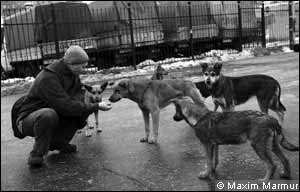
Romanova was arrested, tried and underwent a year of psychiatric treatment. Typically for Russia, this horror story was countered by a wellspring of sympathy for Moscow’s strays. A bronze statue of Malchik, paid for by donations, now stands at the entrance of Mendeleyevskaya station. It has become a symbol for the 35,000 stray dogs that roam Russia’s capital – about 84 dogs per square mile. You see them everywhere. They lie around in the courtyards of apartment complexes, wander near markets and kiosks, and sleep inside metro stations and pedestrian passageways. You can hear them barking and howling at night. And the strays on Moscow’s streets do not look anything like the purebreds preferred by status-conscious Muscovites. They look like a breed apart.

I moved to Moscow with my family last year and was startled to see so many stray dogs. Watching them over time, I realised that, despite some variation in colour – some were black, others yellowish white or russet – they all shared a certain look. They were medium-sized with thick fur, wedge-shaped heads and almond eyes. Their tails were long and their ears erect.

They also acted differently. Every so often, you would see one waiting on a metro platform. When the train pulled up, the dog would step in, scramble up to lie on a seat or sit on the floor if the carriage was crowded, and then exit a few stops later. There is even a website dedicated to the metro stray (www.metrodog.ru) on which passengers post photos and video clips taken with their mobile phones, documenting the ­savviest of the pack using the public transport system like any other Muscovite.

Where did these animals come from? It’s a question Andrei Poyarkov, 56, a biologist specialising in wolves, has dedicated himself to answering. His research focuses on how different environments affect dogs’ behaviour and social organisation. About 30 years ago, he began studying Moscow’s stray dogs. Poyarkov contends that their appearance and behaviour have changed over the decades as they have continuously adapted to the changing face of Russia’s capital. Virtually all the city’s strays were born that way: dumping a pet dog on the streets of Moscow amounts to a near-certain death sentence. Poyarkov reckons fewer than 3 per cent survive.

Poyarkov works at the A.N. Severtsov Institute of Ecology and Evolution in south-west Moscow. His office is small, but boasts high ceilings and tall windows. Several wire cages sit on a table in the centre of the room. Inside them, four weasels scurry through tunnels and run on a wheel. Poyarkov and I sit near the weasels and sip green tea.

He first thought of observing the behaviour of stray dogs in 1979, and began with the ones that lived near his apartment and those he encountered on his way to work. The area he studied came to comprise some 10 sq km, home to about 100 dogs. Poyarkov started making recordings of the sounds that the strays made, and began to study their social organisation. He photographed and catalogued them, mapping where each dog lived.

He quickly found that the strays were much easier to study than wolves. “To see a wild wolf is a real event,” he says. “You can see them, but not for very long and not at close range. But with stray dogs you can watch them for as long as you want and, for the most part, be quite near them.” According to Poyarkov, there are 30,000 to 35,000 stray dogs in Moscow, while the wolf population for the whole of Russia is about 50,000 to 60,000. Population density, he says, determines how frequently the animals come into contact with each other, which in turn affects their behaviour, psychology, stress levels, physiology and relationship to their environment.

“The second difference between stray dogs and wolves is that the dogs, on average, are much less aggressive and a good deal more tolerant of one another,” says Poyarkov. Wolves stay strictly within their own pack, even if they share a territory with another. A pack of dogs, however, can hold a dominant position over other packs and their leader will often “patrol” the other packs by moving in and out of them. His observations have led Poyarkov to conclude that this leader is not necessarily the strongest or most dominant dog, but the most intelligent – and is acknowledged as such. The pack depends on him for its survival.

Moscow’s strays sit somewhere between house pets and wolves, says Poyarkov, but are in the early stages of the shift from the domesticated back towards the wild. That said, there seems little chance of reversing this process. It is virtually impossible to domesticate a stray: many cannot stand being confined indoors.

“Genetically, wolves and dogs are almost identical,” says Poyarkov. “What has changed significantly [with domestication] is a range of hormonal and behavioural parameters, because of the brutal natural selection that eliminated many aggressive animals.” He recounts the work of Soviet biologist Dmitri Belyaev, exiled from Moscow in 1948 during the Stalin years for a commitment to classical genetics that ran counter to state scientific doctrine of the time.

Under the guise of studying animal physiology, Belyaev set up a Russian silver fox research centre in Novosibirsk, setting out to test his theory that the most important selected characteristic for the domestication of dogs was a lack of aggression. He began to select foxes that showed the least fear of humans and bred them. After 10-15 years, the foxes he bred showed affection to their keepers, even licking them. They barked, had floppy ears and wagged their tails. They also developed spotted coats – a surprising development that was connected with a decrease in their levels of adrenaline, which shares a biochemical pathway with melanin and controls ­pigment production.

“With stray dogs, we’re witnessing a move backwards,” explains Poyarkov. “That is, to a wilder and less domesticated state, to a more ‘natural’ state.” As if to prove his point, strays do not have spotted coats, they rarely wag their tails and are wary of humans, showing no signs of ­affection towards them.

The stray dogs of Moscow are mentioned for the first time in the reports of the journalist and writer Vladimir Gilyarovsky in the latter half of the 19th century. But Poyarkov says they have been there as long as the city itself. They remain different from wolves, in particular because they exhibit pronounced “polymorphism” – a range of behavioural traits shaped in part by the “ecological niche” they occupy. And it is this ability to adapt that explains why the population density of strays is so much greater than that of wolves. “With several niches there are more resources and more opportunities.”

The dogs divide into four types, he says, which are determined by their character, how they forage for food, their level of socialisation to people and the ecological niche they inhabit.

Those that remain most comfortable with people Poyarkov calls “guard dogs”. Their territories tend to be garages, warehouses, hospitals and other fenced-in institutions, and they develop ties to the security guards from whom they receive food and whom they regard as masters. I’ve seen them in my neighbourhood near the front gate to the Central Clinical Hospital for Civil Aviation. When I pass on the other side with my dog they cross the street towards us, barking loudly.

“The second stage of becoming wild is where the dog is socialised to people in general, but not personally,” says Poyarkov. “These are the beggars and they are excellent psychologists.” He gives as an example a dog that appears to be dozing as throngs of people walk past, but who rears his head when an easy target comes into view: “The dog will come to a little old lady, start smiling and wagging his tail, and sure enough, he’ll get food.” These dogs not only smell who is carrying something tasty, but sense who will stop and feed them.

The beggars live in relatively small packs and are subordinate to leaders. If a dog is intelligent but occupies a low rank and does not get enough to eat, he will separate from the pack frequently to look for food. If he sees other dogs begging, he will watch and learn.

The third group comprises dogs that are somewhat socialised to people, but whose social interaction is directed almost exclusively towards other strays. Their main strategy for acquiring food is gathering scraps from the streets and the many open rubbish bins. During the Soviet period, the pickings were slim, which limited their population (as did a government policy of catching and killing them). But as Russia began to prosper in the post-Soviet years, official efforts to cull them fell away and, at the same time, many more choice offerings appeared in the bins. The strays flourished.

The last of Poyarkov’s groups are the wild dogs. “There are dogs living in the city that are not socialised to people. They know people, but view them as dangerous. Their range is extremely broad, and they are ­predators. They catch mice, rats and the occasional cat. They live in the city, but as a rule near industrial complexes, or in wooded parks. They are nocturnal and walk about when there are fewer people on the streets.”

My neighbourhood is in the north-west of Moscow and lies between a large wooded park and one of the canals of the Moscow river. Leaving the windows open once the thaw of spring finally took hold, I found myself pulled out of a deep slumber by a cacophony that sounded as if packs of dogs were tearing each other apart in the grounds of our apartment complex. This went on for weeks. I later learned that spring is when many strays mate – “the dog marriage season”, as Russians poetically call it.

There is one special sub-group of strays that stands apart from the rest: Moscow’s metro dogs. “The metro dog appeared for the simple reason that it was permitted to enter,” says Andrei Neuronov, an author and specialist in animal behaviour and psychology, who has worked with Vladimir Putin’s black female Labrador retriever, Connie (“a very nice pup”). “This began in the late 1980s during perestroika,” he says. “When more food appeared, people began to live better and feed strays.” The dogs started by riding on overground trams and buses, where supervisors were becoming increasingly thin on the ground.

Neuronov says there are some 500 strays that live in the metro stations, especially during the colder months, but only about 20 have learned how to ride the trains. This happened gradually, first as a way to broaden their territory. Later, it became a way of life. “Why should they go by foot if they can move around by public transport?” he asks.

“They orient themselves in a number of ways,” Neuronov adds. “They figure out where they are by smell, by recognising the name of the station from the recorded announcer’s voice and by time intervals. If, for example, you come every Monday and feed a dog, that dog will know when it’s Monday and the hour to expect you, based on their sense of time intervals from their ­biological clocks.”

The metro dog also has uncannily good instincts about people, happily greeting kindly passers by, but slinking down the furthest escalator to avoid the intolerant older women who oversee the metro’s electronic turnstiles. “Right outside this metro,” says Neuronov, gesturing toward Frunzenskaya station, a short distance from the park where we were speaking, “a black dog sleeps on a mat. He’s called Malish. And this is what I saw one day: a bowl of freshly ground beef set before him, and slowly, and ever so lazily, he scooped it up with his tongue while lying down.”

Stray dogs evoke a strong reaction from Muscovites. While the model Romanova’s stabbing of a stray demonstrated an example of one extreme, the statue erected in his memory depicts the other. The city government has been forced to take action to protect the strays, but with mixed results. In 2002, mayor Yuri Luzhkov enacted legislation forbidding the killing of stray animals and adopted a new strategy of sterilising them and building shelters.

But until Russians themselves adopt the practice of sterilising their pets, this will remain only a half-measure. One Russian, noting that my male Ridgeback is neutered, exclaimed: “Now, why would you want to cripple a dog in that way?” Even though the city budget allocated more than $30m to build 15 animal shelters last year, that is not nearly enough to accommodate the strays. Still, there is pressure from some quarters to return to the practice of catching and culling them. Poyarkov believes this would be dangerous. While the goal, he acknowledges, “is to do away with dogs who carry rabies, tapeworms, toxoplasmosis and other infections, what actually happens is that infected dogs and other animals outside Moscow will come into the city because the biological barrier maintained by the population of strays in Moscow is turned upside down. The environment becomes chaotic and unpredictable and the epidemiological situation worsens.”

Alexey Vereshchagin, 33, a graduate student who works with Poyarkov, says that Moscow probably could find a way of controlling the feared influx. But that doesn’t mean he thinks strays should be removed from the capital. “I grew up with them,” he says. “Personally, I think they make life in the city more interesting.” Like other experts, Vereshchagin questions whether strays could ever be eliminated completely, particularly given the city’s generally chaotic approach to administration.

Poyarkov concedes that sterilisation might control the number of strays, if methodically conducted. But his work suggests that the population is self-regulating anyway. The quantity of food available keeps the total steady at about 35,000 – Moscow strays are at the limit and, as a result, most pups born to strays don’t reach adulthood. “If they do survive, it is only to replace an adult dog that died,” Poyarkov says. Even then, their life expectancy seldom exceeds 10 years. Having spent a career studying the stray dogs of Moscow and tracing their path back towards a wilder state, he is in no hurry to see them swept from the streets.

“I am not at all convinced that Moscow should be left without dogs. Given a correct relationship to dogs, they definitely do clean the city. They keep the population of rats down. Why should the city be a concrete desert? Why should we do away with strays who have always lived next to us?”

Thanks to Cleve H. for the link!

Feet hold the key to human hand evolution

from BBC.co.uk
By Victoria Gill
Scientists may have solved the mystery of how human hands became nimble enough to make and manipulate stone tools.

The team reports in the journal Evolution that changes in our hands and fingers were a side-effect of changes in the shape of our feet. This, they say, shows that the capacity to stand and walk on two feet is intrinsically linked to the emergence of stone tool technology. The scientists used a mathematical model to simulate the changes. Other researchers, though, have questioned this approach. Campbell Rolian, a scientist from the University of Calgary in Canada who led the study, said: "This goes back to Darwin's The Descent of Man. "[Charles Darwin] was among the first to consider the relationship between stone tool technology and bipedalism. "His idea was that they were separate events and they happened sequentially - that bipedalism freed the hand to evolve for other purposes. "What we showed was that the changes in the hand and foot are similar developments... and changes in one would have side-effects manifesting in the other."

To study this, Dr Rolian and his colleagues took measurements from the hands and feet of humans and of chimpanzees. Their aim was to find out how the hands and feet of our more chimp-like ancestors would have evolved. The researchers' measurements showed a strong correlation between similar parts of the hand and foot. "So, if you have a long big toe, you tend have a long thumb," Dr Rolian explained."One reason fingers and toes may be so strongly correlated is that they share a similar genetic and developmental 'blueprint', and small changes to this blueprint can affect the hand and foot in parallel," he said. With this anatomical data, the researchers were able to create their mathematical simulation of evolutionary change. "We used the mathematical model to simulate the evolutionary pressures on the hands and feet," Dr Rolian explained. This model essentially adjusted the shape of the hands or the feet, recreating single, small evolutionary changes to see what effect they had. By simulating this evolutionary shape-shifting, the team found that changes in the feet caused parallel changes in the hands, especially in the relative proportions of the fingers and toes. These parallel changes or side-effects, said Dr Rolian, may have been an important evolutionary stem that allowed human ancestors, including Neanderthals, to develop the dexterity for stone tool technology.

Robin Crompton, professor of anatomy at the UK's Liverpool University, said the study was very interesting but also raised some questions. "I am not personally convinced that the foot and hand of chimpanzees are a good model [of human ancestors' hands and feet] - the foot of the lowland gorilla may be more interesting in this respect," he told BBC News. He pointed out that there was a lot more to the functional shape and biomechanics of the human foot than just its proportions. Paul O'Higgins, professor of anatomy at the Hull York Medical School, UK, said: "The results are quite exciting and will doubtless spur further testing and additional work."

Citation:
http://www3.interscience.wiley.com/journal/123228521/abstract?CRETRY=1&SRETRY=0
Rolian C, Lieberman DE, Hallgrímsson B (2009) The Co-Evolution of Human Hands and Feet. Evolution (online first)

ABSTRACT

Human hands and feet have longer, more robust first digits, and shorter lateral digits compared to African apes. These similarities are often assumed to be independently-evolved adaptations for manipulative activities and bipedalism, respectively. However, hands and feet are serially homologous structures that share virtually identical developmental blueprints, raising the possibility that digital proportions co-evolved in human hands and feet because of underlying developmental linkages that increase phenotypic covariation between them. Here we show that phenotypic covariation between serially homologous fingers and toes in Homo and Pan is not only higher than expected, it also causes these digits to evolve along highly parallel trajectories under episodes of simulated directional selection, even when selection pressures push their means in divergent directions. Further, our estimates of the selection pressures required to produce human-like fingers and toes from an African ape-like ancestor indicate that selection on the toes was substantially stronger, and likely led to parallel phenotypic changes in the hands. Our data support the hypothesis that human hands and feet coevolved, and suggest that the evolution of long robust big toes and short lateral toes for bipedalism led to changes in hominin fingers that may have facilitated the emergence of stone tool technology.