translate

Site update

Since I have been really terrible at updating the blog (but pretty good at keeping up with the facebook blog posts) I've added the widget below so that facebook cross posts to the blog.

You shouldn't need to join facebook but can just click on the links in the widget to access the articles. If you have any problems or comments please mail me at arandjel 'AT' eva.mpg.de.

Wednesday, July 21, 2010

500 dead starved penguins wash up on Brazilian shore.

From BBC.com via Treehugger
Hundreds of dead penguins washed up in Brazil

Hundreds of penguins have been washed up dead on the beaches of Brazil. Scientists are still investigating what could have caused the death of around 500 animals found on the shores of Sao Paulo state. They say autopsies carried out on some of the carcasses suggest they could have starved to death, as their stomachs were completely empty. They are now trying to establish if strong currents and colder temperatures may be to blame. Thiago do Nascimento of the Peruibe Aquarium says the cooler than usual temperatures off the coast could have driven away the fish and squid the penguins feed on. But he did not rule out that overfishing could have decimated the penguins' food sources.

Mr Nascimento said between 100 and 150 penguins showed up on the beaches every year, but that they were normally alive, with only around 10 washed up dead in an average year. "What worries us this year, is the absurdly high number of penguins that have appeared dead in a short period of time," he told the Associated Press news agency.

Cash payments reduce HIV risk: World Bank studies

From Yahoo. News
by ALEX OGLE

The World Bank released two studies Sunday linking cash payments to Malawian and Tanzanian youths with "significantly lower" rates of HIV and other sexually transmitted infections.

In the first study, a two-year program rewarded young girls in Malawi, rife with poverty and high HIV infection rates, with cash payments for regular school attendance. In Tanzania, the Bank paid young adults in cash to avoid unsafe sex.

The studies "show the potential for using cash payments to prevent people, especially women and girls, from engaging in unsafe sex while also ensuring that they stay in school and get the full benefit of an education," said David Wilson, who heads the Bank's global HIV/AIDS program.

In the education study in Malawi's Zomba district, which has both high HIV rates and school dropout rates among young girls, the World Bank found cash payments for at least 75 percent school attendance each month reduced infection rates by 60 percent, compared to an unpaid control group.

"Girls who received payments not only had less sex, but when they did, they tended to choose younger, safer partners," the World Bank said in a statement on the studies, which were released on the first day of the 18th International AIDS Conference in Vienna.

Cash transfers, the institution said, enabled a significant drop in what is called "transactional sex" among girls and young women who trade intercourse for assistance, gifts or money.

Schoolgirls who received payment appeared to avoid older, wealthier men who are much more likely to be HIV positive than schoolboys, according to the study.

"Programs like these could become an important missing part of effective HIV-prevention strategies," said Berk Ozler, a senior economist with the World Bank's Development Research Group, who conducted the study with researchers from George Washington University and the University of California.

Ozler said the findings suggest that "empowering girls financially can lead to reduced risk -- not just by reducing their sexual activity or practicing safer sex, but also by enabling them to choose partners who are less likely to be infected with HIV in the first place."

In Tanzania, meanwhile, a 12-month cash payment scheme for both young men and women to avoid unsafe sex and prevent a multitude of curable sexually transmitted infections (STIs) found a 25 percent drop compared to a control group.

"Existing prevention strategies have had limited success, so we have to look for creative new approaches to help people change their behavior and finally stop and then reverse the HIV/AIDS epidemic," said senior World Bank economist Damien de Walque, who carried out the study with researchers from the University of California and the Ifakara Health Institute in Tanzania.

To date, the World Bank has provided 4.5 billion dollars for HIV prevention, treatment, care and support programs in developing countries.

Monday, July 19, 2010

last white rhino in SAfrican reserve killed: Shot from plane with tranquilizer, horn sawed off, and left to bleed to death

From TreeHugger.com
Poachers Kill Last Female White Rhino in South African Reserve
by MATTHEW McDERMOTT

One more symbol of the rising global demand for rhino horn and its devastating effect on rhinoceroses in both Africa and Asia: The Guardian reports that the female white rhino in South Africa's Krugersdorp nature reserve has been killed by poachers--who used a tranquilizer gun, fired from a helicopter, to bring down the animal, prior to hacking off its horn, leaving it to bleed to death and orphaning its young calf in the process.

A private airport near the 1500-hectare reserve may have been the launching point for the attack. Japie Mostert, chief game ranger at Krugersdorp:
The exercise takes them very little time. They first fly over the park in the late afternoon to locate where the rhino is grazing. Then they return at night and dart the animal from the air. The tranquilizer takes less than seven minutes to act. They saw off the horns with a chainsaw. They do not even need to switch off the rotors of the helicopter. We do not hear anything because our houses are too far away. The animal dies either from an overdoes of tranquilizer or bleeds to death
Rhino Horn Worth More Than Gold
Rhino poaching is at a fifteen year high as demand for the horn--still used in Traditional Chinese Medicine despite being officially removed from the pharmacopeia--continues to rise. At the end of last year, rhino horn trades for about $1610 an ounce, more than gold.

The southern white rhino population is listed by the IUCN as near-threatened, and is the most abundant rhino population in the world. By contrast the northern white rhino is considered critically endangered or extinct in the wild, with well under 10 individuals left.

Total African rhino population--including the 3,000 or so black rhinos left in the wild--have been reduced from an estimated 65,000 animals in the 1970s to about 18,000 today.

related: WATCH VIDEO - Discovery News: Poaching Endangers Black Rhinos

Saturday, July 17, 2010

Happy Mandela Day!!!


What is Mandela Day?

• Mandela Day is an annual celebration of Nelson Mandela’s life and a global call to action for people to recognize their individual ability to make an imprint and change the world around them.

• Mandela Day has been created to inspire people from every corner of the world to embrace the values that have embodied Nelson Mandela’s life – democracy; equality; reconciliation; diversity; responsibility; respect and freedom – for these are the values of Nelson Mandela and they are his legacy to the world.

• Mandela Day aims to showcase the work of the Nelson Mandela charitable organisations (Nelson Mandela Foundation; Nelson Mandela Children’s Fund; Mandela Rhodes Foundation) and raise monies to support their continuing work.

• By connecting people with ways to act on Nelson Mandela’s values, we aim to empower every individual to make an imprint on the world.

• The Mandela Day campaign message is simple: Nelson Mandela has given 67 years of his life fighting for the rights of humanity. All we are asking is that everyone gives 67 minutes of their time, whether it’s supporting your chosen charity or serving your local community.

• Mandela Day is a global social movement – an umbrella idea – that does not discriminate, it’s open and lets in and embraces every organization that does good, whilst enabling people to serve their community and improve their lives.

• The Mandela Day brand icon represents Mr Mandela’s hand and the passing of the torch to each of us and our individual ability to make an imprint on the world.

• Mandela Day is not a holiday – it is a day for all of us to opt in and show that we can all make an impact.

...and in case you haven't seen it - today might also be a good day to watch Invictus,:) -MA


Wednesday, July 14, 2010

Liberian leader bans exportation of bush meat and wild animals


From Afrique Avenir via the IPPL facebook page

IPPL suggests sending a congratulatory email "to Liberian President Ellen Johnson Sirleaf! She has, by proclamation, banned the exportation of wild animals and bush meat from Liberia! Send a nice note to her (info@emansion.gov.lr), on behalf of all Liberia’s monkeys and chimpanzees, who, like other primates throughout Africa, are threatened with extinction from unregulated trade and other human hazards"

Liberian President Ellen Johnson Sirleaf has by proclamation banned the exportation of wild animals and bush meat from Liberia, APA learns here.

A Foreign Ministry press statement issued here Monday says the ban shall remain in force pending the passage of a proposed legislation to be submitted to the national legislature for enactment.

The statement said President Sirleaf is accordingly warning all those involved in the illegal exportation of bush meat and wild animals to desist with immediate effect or face the consequences. The statement said the ban is aimed at preserving Liberia’s wildlife as it has been observed that certain species of wild life are under threat of extinction. The government’s ban comes in the wake of reports of an increase in cross-border trade in wild animals and bush meat from Liberia.

Successful long term relationships need cuddling and sex

From UW-MAdison news
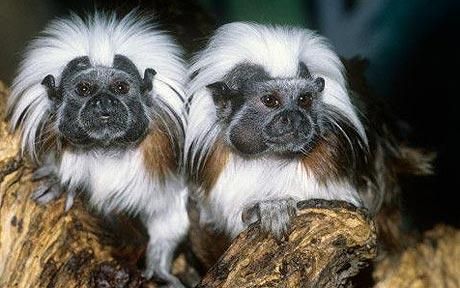
Hormone study finds monkeys in long-term relationship look strangely human
by DAVID TENENBAUM

Monkeys in enduring relationships show a surprising correspondence in their levels of oxytocin, a key behavioral hormone, according to research published online June 28 in the journal Hormones and Behavior.

While measuring oxytocin in the urine of 14 pairs of cotton-top tamarins, Charles Snowdon, a University of Wisconsin-Madison professor of psychology, observed a wide range of hormone levels.

But he also saw a striking correspondence among the couples: When one mate had a high level of oxytocin, so did the other, and vice versa.

Furthermore, partners with a high level of oxytocin performed correspondingly more cuddling, grooming and sex, while those with low levels of oxytocin spent less time on these relationship-building activities.

The hormone oxytocin was originally studied for its role during childbirth, when it helps cement the mother-child emotional attachment. More recently, it has been linked to many other attachments. "Only in the past 20 years have we started to think more broadly about oxytocin's social function in forming and maintaining long-term relationships," says Snowdon.

In monogamous mammal species, he says, "We see that oxytocin in parts of the brain in females leads to pair-bonding." An oxytocin nasal spray makes people more willing to trust strangers. Oxytocin rises after orgasm, massage and petting. "All this together suggests that oxytocin would play some role in creating strong pair bonds in these cotton-top tamarins, who are socially monogamous," says Snowdon, "and that the amount of cuddling, grooming, stroking and sex might be related directly to the oxytocin level."

In the new study, Snowdon, Toni Ziegler, a scientist at the Wisconsin National Primate Research Center, and their collaborators measured urine samples for oxytocin and recorded behavioral activity three times a week for three weeks, and then noticed the surprising correspondence between both members of the pairs.

Predictably, the study showed that high oxytocin among females was associated with more cuddling and stroking, and that among males, the major element was the amount of sex.

Snowdon may have been the first to respond "Isn't that familiar!" to this part of the results: It doesn't take a high-tech lab to notice that women and men have different emotional and physical needs, and the monkeys seem to echo this need.

But he noticed something else: The high-oxytocin monkeys seem to know how to soothe their partners. In previous studies, after monkey pairs were mildly disturbed either by removing one animal for a half hour or by introducing the scent of another female, both partners increased cuddling and sex as though to mend the relationship.

In the current study, the partners seem to know what the other partner needed. "Males in a high-oxytocin relationship were more likely to initiate cuddling, and females were more likely to initiate sex," Snowdon says. "These males were initiating the behavior that the female needed for high oxytocin, and the females with high oxytocin were initiating the behavior that male partner needed for high oxytocin."

Snowdon says this "monkey version of 'kiss and make up' suggests that sex and affiliative behavior may play an important role in maintaining a relationship."

Stroking, sex and cuddling are critical parts of what it means to be a cotton-top tamarin, and to be human, Snowdon says. "Here we have a nonhuman primate model that has to solve the same problems that we do: to stay together and maintain a monogamous relationship, to rear children, and oxytocin may be a mechanism they use to maintain the relationship. Therapeutically, I'd suggest this would have relevance to human couples."

Female chimps build up alpha male's ego by dissing subordinates

From the BBC
Chatting chimps 'socially aware'
By MATT WALKER

Chimpanzees are aware of the social impact of their communications, primatologists have discovered. Chimps communicate using a variety of calls and gestures, including making vocalisations known as pant grunts, which signal subordination. But researchers have found that chimps will change what they "say" depending on who is listening. That reveals a previously unrecognised social awareness that has implications for the origin of human language. Details of the discovery are published in the journal Animal Behaviour.

PhD student Ms Marion Laporte of the University of St Andrews in Fife, UK studied a population of chimps living in the Sonso community of Budongo Forest in Uganda. The Sonso chimpanzees have been followed by researchers without interruption since 1990. Together with Professor Klaus Zuberbuhler of the University of St Andrews, Ms Laporte recorded how often, and in what context, the chimps communicated with one another using the pant grunt vocalisation (go to original article to watch/hear video).

Chimpanzees produce four basic call types: grunts, barks, screams and hoots. "However, there is considerable acoustic variation within these four call types, which makes them difficult to study," says Prof Zuberbuhler. "Our research is beginning to show that much of this variation is closely linked with different external events and therefore very meaningful to others."

Chimps specifically use the pant grunt to signal they are subordinate to another ape. A higher ranking group member will never use it in front of a lower ranking member of the group. "Because of this, they were thought to be rigid expressions of rank relations," says Prof Zuberbuhler. "Our study shows this is not true. Callers exhibit a high degree of social awareness when producing these signals."

Ms Laporte and Prof Zuberbuhler's research, partly funded by the UK's Edinburgh Zoo, documented all the times when subordinate female chimps did, and more important, did not not make a pant grunt vocalisation when meeting a higher ranked chimp. Then then analysed the data to understand when and why the chimps communicate this way. The researchers found that female chimps modify their use of the pant grunt signal depending on which other chimps are listening. If the alpha male was in earshot, the female chimps often refused to greet another male. The presence of the alpha female also inhibited lower ranking chimps from communicating.

The researchers do not yet know exactly why the chimps stop calling in certain social situations. One idea is that they stop deferring to other males in the presence of the alpha male to ensure he does not become aggressive. A more provocative suggestion, say the researchers, is that females may allocate their pant grunts strategically, to help their favourite males climb the social ladder, though this idea remains speculation.

"Pant grunts are very special vocalisations in the chimpanzee repertoire because they are directed at specific individuals," says Ms Laporte. "And still, surrounding individuals seem to be taken into account before producing this vocalisation." Prof Zuberbuhler agrees: "What we found was a surprisingly high awareness of the potential social consequences of calling, something that has not been shown so far in any non-human primate," he told the BBC.

The finding that at least one species of great ape is socially aware in this way may have implications for our understanding of how our own language evolved. "When humans communicate they mainly want to be understood," explains Prof Zuberbuhler. "Monitoring the effects of one's own communication signals on the audience is a key component in this process. "The current study shows that chimpanzees do the same, thus revealing some of the evolutionary roots of a key capacity required for language in our closest living relative. "Our common ancestor which lived some six million years ago must have been able to do the same."